
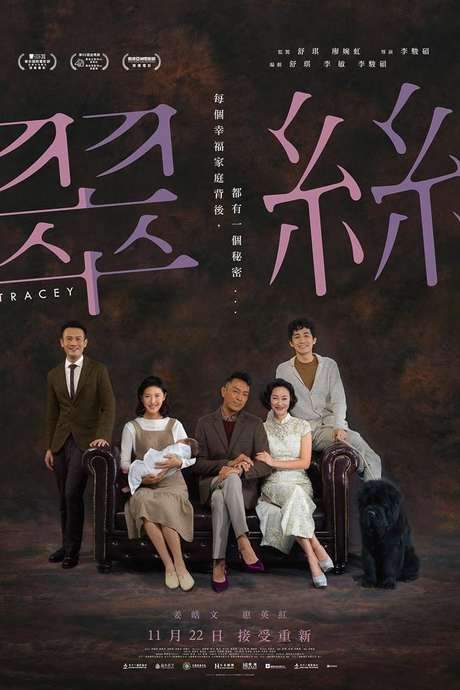
What Is Tracey About?
The premise of Tracey in 274 words, with nothing given away. The full story follows below.
In his early fifties, Tai‑hung leads a steady, seemingly contented life in Hong Kong, sharing a modest home with his wife Anne and their adult children, Vincent and Brigitte. The rhythm of his days—work, family meals, weekend walks with the family dog—feels comfortably ordinary until a quiet phone call announces the death of a former high‑school friend. The news pulls a long‑dormant chapter of his past into sharp focus, hinting at memories that have quietly shaped him for decades.
The film gently unfolds the subtle fractures beneath the family’s surface. Anne is an exacting, disciplined woman whose habits and expectations sometimes clash with the unspoken quirks of her husband. Vincent navigates his own path, while Brigitte wrestles with personal decisions that echo the tensions of the older generation. Amidst these domestic interludes, Tai‑hung carries a private world of concealed habits and an artistic tie‑in to a bygone era of Cantonese opera, where he once crossed paths with the flamboyant performer known as Brother Darling. Their shared history with the colorful theatre community hints at a life lived in the shadows of performance and identity.
As the narrative advances, Tai‑hung is compelled to confront the layers of his concealed self, the expectations of a society that often resists fluidity, and the lingering impact of friendships that never truly faded. Jun Li’s feature debut renders Hong Kong with a tender, slightly melancholy palette, blending moments of quiet humor with a contemplative undercurrent. The film invites viewers to linger on questions of memory, gender, and belonging, offering a richly textured portrait of a man standing at the crossroads of his past and the life he has built.
What Happens in Tracey?
The complete story of Tracey, from the first scene to the last, in 892 words (about 4 minutes). Spoilers throughout. Names in the text link to 8 cast member pages.
Spoilers ahead
Travis Tung Philip Keung Ho-Man’s family unfolds in a mix of warmth and tension: his wife Kara Wai Ying-Hung Anne, their son Ng Siu-Hin Vincent, and daughter Brigitte Jennifer Yu Brigitte, who lives with her husband Aaron Chow Jeffrey. The household is quietly marked by Brigitte’s observation that Vincent’s mother can be both mysophobic and briefly racist toward their housekeeper, a detail that sits alongside the fact that Tung and Anne sleep in separate rooms. Beneath the surface, Tung guards a private truth: he secretly changes into women’s underwear beneath their clothes, a habit that reveals a long-suppressed gender identity and a longing for a life not constrained by traditional expectations.
During a routine walk with their dog Bowie, a momentary sense of reunion with an old friend dissolves into tragedy when Bowie falls ill and dies. The family’s grief is compounded when Brigitte, who is pregnant, chooses to stay the night rather than wake her husband. The plot widens as Tung learns that his childhood friend Ko Ching has died overseas; with the help of their friend Chi Jun Eric Kot Man-Fai, Tung travels to the airport to collect Ching’s ashes, while Bond Tann River Huang speaks frankly about the discrimination surrounding sexuality in Hong Kong, calling the city “a backwards country.”
At a small opera performance that includes Anne, the group reconnects with an old confidant: Brother Darling, also known as Fa Yim-hung Ben Yuen, a Cantonese actor renowned for playing women’s roles in operas. Tung recalls a pivotal childhood moment—an infamous “peeper” incident in the ladies’ room that actually involved Brother Darling—before Brother Darling reveals that, despite being born male, they are, in truth, a woman and cannot pee standing up. This moment deepens Tung’s awareness of gender fluidity and the social risks of living openly.
Back home, the family’s conversations turn to Brigitte’s options as Jeffrey’s fidelity is questioned and Brigitte contemplates abortion or divorce. Anne pushes back on the idea that she would have nothing if Brigitte leaves, while Vincent heads off to be with his girlfriend, a tattoo artist who asserts ownership of her body through her art. The emotional stakes rise as Tung visits Bond in his hotel room and the two women and men in their circle confront shared longing and fear. They cry beside the door, then find a way to confront their past—Tung and Bond recall a mutual, unacted love from youth, a moment that never fully blossomed but has lingered as a quiet ache between them.
The two reconnect by a pond—the place where the trio used to meet—where Tung finally comes out: “I am a woman, not outside, but deep inside.” They acknowledge early signs of difference, initially mistaking their own feelings as mere gay desire, and admit the lifelong habit of hiding who they are, including wearing bras, tucking, and changing into lingerie at work because of a body that felt wrong. Tung’s sense of duty toward family grows heavier after his father is murdered, thrusting him into being the “man” of the house in a world that mistrusts gender nonconformity.
Anne’s suspicions intensify when she finds receipts from a lingerie store that Tung frequents. Tung struggles to explain, even fabricating stories about relatives, until he admits that he isn’t merely gay but that he is a transgender woman in the process of self-acceptance. Tung, Bond, and Chi Jun later travel to sea to spread Ching’s ashes, and Tung comes out to Chi Jun—who accepts them and Ching’s sexuality with quiet grace.
The trio then introduce Brother Darling, and the group embraces a transformation: they go to a club dressed as trans women, with full hair and dress. The experience is exhilarating—Brother Darling proclaims that she “can finally use the ladies’ room”—but joy turns to tragedy when Brother Darling collapses and dies in a hospital. Vincent, who has been largely distant, confronts his own hypocrisy as his girlfriend calls him out: it’s not okay for others to be gay if his own family is.
Back at home, Tung attempts to come out to Anne, but she responds with hostility, insisting that Tung is sick and selfish. In a moment of despair, Tung contemplates self-harm, cutting away at her own body in a futile search for wholeness.
Seven months later, Brigitte has given birth, and Tung has become a grandmother. On Vincent’s advice, Tung attends Anne’s latest performance, hoping for a breakthrough, but Anne stubbornly refuses to sign divorce papers, lamenting to her son, “why force me to accept this?” Another seven months pass, and Tung undergoes gender-affirmation surgery, shedding the name Travis Tung for Tracey. Tracey and Bond reconnect after a gallery visit, and the two become physically intimate again. Tracey also finds time to visit her blind mother, who affirms with quiet, enduring love that gender does not diminish the bond of family: “Male or female, you’re always my child.”
The film culminates in a resonant meditation on identity, acceptance, and the enduring ties that bind a family through upheaval and transformation. Its emotional arc lingers on the courage it takes to live authentically, even when that truth upends expectations and unsettles the people you love most. As Tracey’s journey closes, the story leaves viewers with a poignant reminder that love, in all its forms, can endure beyond labels and time. > “Male or female, you’re always my child.”
Tracey Timeline: Every Key Event in Order
14 key events in the order they happen, from “Family dynamics and secrecy at home” to “Grandmother, mother, and unconditional love”. 14 events name a place, across 12 locations.
- 1
Family dynamics and secrecy at home
Tung's family lives under strict rules: mysophobia and prejudice shape daily life, and sex in the house is prohibited. Tung's parents sleep in separate rooms, and Tung secretly changes into women's underwear beneath their clothes. These hidden practices set the stage for Tung's later gender identity to emerge.
When:Childhood/early life Where:Tung family home
- 2
Dog walk tragedy and Brigitte's pregnancy
While walking their dog Bowie, Tung spots an old friend and chases after them, only to discover that Bowie has died from an unknown illness. The family is shaken by the loss, and Brigitte, who is pregnant, stays the night to avoid waking her husband. The emotional shock binds the family even as tensions simmer beneath the surface.
When:Evening Where:Residential area during dog walk
- 3
Ching's death and Bond's arrival
News arrives that Ko Ching has died overseas. Tung and Chi Chun go to Hong Kong's airport to fetch Ching's husband Bond Tann, who complains about discrimination against sexuality. They decide to seek legal advice from Tung's son-in-law, who is a lawyer.
When:Soon after Ching's death Where:Hong Kong airport
- 4
Opera performance reunion and Brother Darling's revelation
At a small opera performance that includes Anne, Tung reconnects with Brother Darling, a Cantonese actor who used to play women's roles. Brother Darling reveals that although born male, they identify as a woman and cannot pee standing up, sharing a candid look at gender and identity.
When:During performance Where:Opera venue
- 5
Brigitte's dilemma and marital issues
Back at home, Brigitte's options are debated as Jeffrey has been unfaithful. Anne insists she won't have anything if Brigitte leaves, while Vincent leaves to be with his girlfriend. The family grapples with loyalty, love, and the strain of Brigitte's situation.
When:Evening Where:Tung family home
- 6
Tung's visit to Bond and kiss
Tung visits Bond at his hotel, where they cry and reminisce about Ching. They share a kiss, and Bond begins to unbutton Tung's shirt to reveal lingerie, leaving Tung embarrassed and hurrying away.
When:Evening Where:Bond's hotel room
- 7
Pond confession and coming to terms
At a pond where the three friends used to meet, Tung comes out as a woman, telling Bond that 'I am a woman, not outside, but deep inside.' They discuss discovering their gender identity and the barriers of past loves, including how Tung hid their true self for years.
When:After the hotel scene Where:Pond where they used to meet
- 8
Receipt discovery and denial
Anne finds receipts from a women's lingerie store. Tung lies, blaming purchases on others or using evasive excuses, and ultimately admits that they're not gay, signaling the beginning of a difficult confrontation about identity.
When:Following the pond moment Where:Tung family home
- 9
Ashes at sea and acceptance
Tung, Bond, and Chun travel to the sea to scatter Ching's ashes. There, Tung comes out to Chun, who accepts both Ching's homosexuality and Tung's gender identity, marking a fragile moment of understanding among friends.
When:At sea Where:Sea
- 10
Makeovers, club night, and Brother Darling's death
They introduce Brother Darling to the others and have makeovers, heading to a club as trans women. The night is joyful, but Brother Darling collapses in the bathroom and dies, prompting Vincent to question the family's hypocrisy.
When:Club night, then hospitalization Where:Club and hospital
Show the other 4 events of Tracey Hide the last 4 events
- 11
A dangerous impulse and its aftermath
Back home, Tung, still in female attire, attempts to cut off their genitalia but cannot complete the act. The impulsive act underscores the depth of inner turmoil and the desperation to end the confusion.
When:Shortly after Brother Darling's death Where:Home
- 12
Seven months later: Brigitte's child and divorce stalemate
Seven months pass and Brigitte has given birth, making Tung a grandmother. Tung attends Anne's latest performance at Vincent's urging, but Anne stubbornly refuses to sign the divorce papers, keeping the couple in limbo.
When:Seven months later Where:Anne's theater and Tung's home
- 13
Seven months later: surgery and renewed bond
Another seven months pass, and Tung undergoes gender affirmation surgery, becoming Tracey. Tracey and Bond reconnect after a gallery and become physically intimate, signaling a new chapter in their relationship.
When:Another seven months later Where:Gallery and Bond's home
- 14
Grandmother, mother, and unconditional love
Tracey visits her blind mother, who reminds her that 'Male or female, you're always my child.' The final moment affirms the familial bond and acceptance despite the years of struggle.
When:Final scene after reconciliation Where:Anne's home
Who Are the Main Characters in Tracey?
12 characters, among them Tung Tai-hung / Tracey (Philip Keung Ho-Man), Anne Tung (Kara Wai Ying-Hung) and Brigitte Tung (Jennifer Yu): who each one is and the part they play in the story. Every profile links to the actor’s page.
- TT
Tung Tai-hung / Tracey (Philip Keung Ho-Man)
Played by Philip Keung Ho-Man
Born as Travis Tung, they hide a gender discrepancy within a traditional family and secretly wear women's lingerie under their clothes. They navigate a private life that conflicts with social expectations, keeping a fragile balance between husband, father, and self. Over time, Tung moves toward authenticity, adopting the name Tracey after gender-affirming steps. The arc foregrounds love, fear, and resilience in the face of uprooting family dynamics.
- 🏳️⚧️ Identity
- 👪 Family
- 💬 Secrets
- AT
Anne Tung (Kara Wai Ying-Hung)
Played by Kara Wai Ying-Hung
Anne is Tung's wife, deeply protective of family appearances and resistant to changing traditional roles. Her reactions range from suspicion to hostility as Tung's identity becomes more visible, testing the couple's marriage. She embodies the stakes of maintaining status and control within a conventional household. Her stance amplifies the drama surrounding acceptance and rupture within the family.
- 💔 Family
- 🧭 Tradition
- BT
Brigitte Tung (Jennifer Yu)
Played by Jennifer Yu
Brigitte is Tung's daughter, navigating her own life amid parental upheaval. Her pregnancy adds emotional weight and complicates family loyalties, highlighting the clash between personal choices and family expectations. She observes the conflict between truth and appearances from a close vantage point. Brigitte's perspective anchors how the next generation responds to change.
- 👪 Family
- 🧭 Choices
- VT
Vincent Tung (Ng Siu-Hin)
Played by Ng Siu-Hin
Vincent, Tung and Anne's son, shifts between loyalty to family and his own social world. He exposes hypocrisy about acceptance while being drawn into his girlfriend's independent stance. His responses reveal tensions between filial duty and personal authenticity. Vincent's arc mirrors the broader questions of how families adapt when identities evolve.
- 👪 Family
- 🕵️ Secrets
- J(
Jeffrey (Aaron Chow)
Played by Aaron Chow
Jeffrey is Brigitte's husband, whose infidelity strains the marriage and forces Brigitte to reconsider her future. He represents the fractures that can accompany domestic life during upheaval. His actions catalyze conversations about fidelity, responsibility, and the consequences of hidden truths. Jeffrey's role underscores the ripple effects of personal dishonesty in a family system.
- 💔 Infidelity
- 🛡️ Domestic
- BT
Bond Tann (River Huang)
Played by River Huang
Bond is Tung's long-ago love and Ching's husband, who remains supportive as they confront identity and loss. He shares a deep, complicated history with Tung, culminating in a tender moment that redefines their bond. Bond offers emotional anchorage and understands the pain of societal judgment. Their reconciliation and tenderness highlight themes of acceptance and lasting connection.
- 💗 Love
- 👫 Friendship
- FY
Fa Yim-hung / Brother Darling (Ben Yuen)
Played by Ben Yuen
Brother Darling is a Cantonese actor famed for playing women's roles, who embodies a life of performance and revelation. He helps Tung explore gender expression and provides companionship through revelatory moments. His death later in the story marks a poignant turning point that tests the resilience of the group. He embodies courage, humor, and tragedy within the journey of self-discovery.
- 🎭 Art
- 💔 Loss
- CJ
Chi Jun (Eric Kot Man-Fai)
Played by Eric Kot Man-Fai
Chi Jun is a longtime friend whose presence grounds Tung and Bond's past. He participates in pivotal conversations about identity, loyalty, and acceptance. His perspective helps illuminate how friendships withstand the strain of changing identities. He acts as a confidant during the emotional arcs of the story.
- 🧭 Friendship
- 🗝️ Secrets
- YT
Young Tung Tai-hung (Zeno Koo)
Played by Zeno Koo
The younger version of Tung, whose memories hint at early awareness of difference and the roots of later choices. Their experiences foreshadow the personal conflict that unfolds in adulthood. The portrayal emphasizes how early perception shapes later identity. A subtle thread that ties past and present together.
- 🧒 Youth
- 🗝️ Secrets
- YC
Young Ching (Yatho Wong Yat-Ho)
Played by Yatho Wong Yat-Ho
Young Ching represents the early connectivity between Tung and their inner circle, revealing the seeds of affection and companionship that later influence choices. Their presence underscores the theme of unexpressed love and the endurance of friendship across time. This memory anchors the emotional landscape of the story.
- 🧒 Youth
- 🧭 Friendship
- TS
Tai-hung's Sister (Ivy Pang)
Played by Ivy Pang
Tung's sister provides a familial counterpoint, reflecting shared history and support networks. Her interactions help illustrate the widening circle of acceptance and the personal stakes within the family. She acts as a voice of familial memory and potential reconciliation.
- 👭 Family
- 🕊️ Support
- TM
Tai-hung's Mother (Lily Leung Shun-Yin)
Played by Lily Leung Shun-Yin
Tai-hung's mother appears as a matriarch figure whose reactions shape the family dynamics around identity and tradition. Her stance embodies generational perspectives on gender and propriety. Her presence emphasizes the challenge of bridging old and new values within families.
- 👵 Family
- 🧭 Tradition
Where and When Is Tracey Set?
Tracey is set in Hong Kong. Here is why the place matters to the story.
Where
Hong Kong
Tracey unfolds in Hong Kong, a dense, bustling metropolis where skyscrapers meet crowded neighborhoods. The city’s opera venues, clubs, and seaside streets frame intimate revelations about gender and identity against a backdrop of public life. Its urban pace and cultural mix highlight the tension between private truth and social expectation in a society that polices conformity.
- 🏙️ Urban city
- 🌊 Coastal setting
What Are the Themes of Tracey?
4 ideas the story keeps returning to, among them Identity, Family and Performance & Masks.
-
01
Identity
Tung's journey moves from secret masculine presentation to openly embracing a female identity. The character negotiates desire, body image, and social roles within a traditional family structure. The turning point comes with coming out and adopting a new name, signaling a redefinition of self. The transformation culminates in gender-affirming steps that reshape relationships with loved ones and friends.
-
02
Family
Family loyalties collide with personal truth as Tung's transformation unsettles Anne, Brigitte, and Vincent. Anne's defensiveness tests the bonds and triggers confrontations about trust and acceptance. Brigitte's pregnancy adds pressure, forcing decisions about marriage and duty. The story traces how family members negotiate love, hypocrisy, and support as identities shift.
-
03
Performance & Masks
Opera and club scenes frame gender as performance and art, blurring lines between disguise and authenticity. Brother Darling's revelations about gender and the past show how theatrical roles echo real identities. The troupe's makeovers and nightlife culminate in moments of joy and tragedy, illustrating the costs and risks of self-expression. The performances reveal how society enables and constrains personal truth.
-
04
Societal Norms
The film critiques discrimination and pressure surrounding sexuality and gender in a metropolitan setting like Hong Kong. Bond's remark about a 'backwards country' signals the broader social climate that challenges coming-out and acceptance. The characters navigate legal, cultural, and family expectations as they seek dignity and safety. The ending offers cautious hope: acceptance from close friends and chosen family, though not without wounds.
What Kind of Film Is Tracey?
Bittersweet in tone, with steady pacing and a moderate story, going by the plot summary.
- Tone
- Bittersweet
- Pacing
- Steady
- Story
- Moderate
- Intensity
- Medium
- Ending
- Happy
A poignant and intimate drama about confronting a hidden identity and seeking acceptance, marked by personal revelations, familial tension, and moments of profound tenderness.
- reflective
- melancholic
- cathartic
- intimate
- resilient
- tense
- gender identity
- self-discovery
- family conflict
- grief and loss
Content notes: self harm, animal death, emotional abuse.
Quiz
How well do you remember Tracey? Test yourself on the story.
