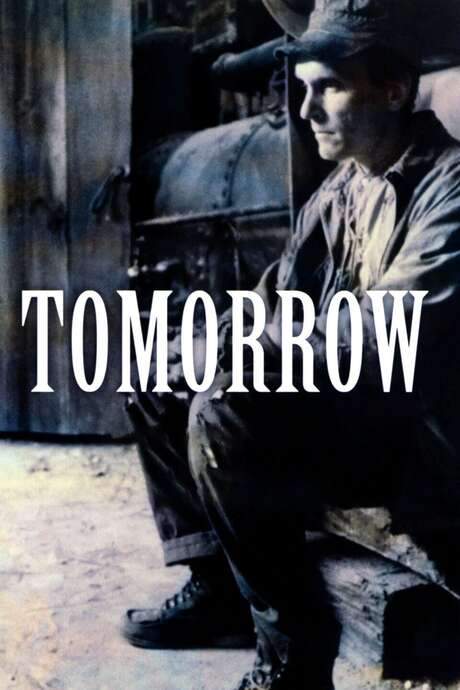
Tomorrow 1972


Made by

Filmgroup Productions
Where to Watch Tomorrow
See current US streaming, rental, and purchase options for Tomorrow (1972) via JustWatch.

Shout! Factory Amazon Channel
HD
Kanopy
HD
Plex
HD
Plex Channel
HD
Tubi TV
SD Streaming availability powered by 
Tomorrow Plot Summary
Read the complete plot summary and ending explained for Tomorrow (1972). From turning points to emotional moments, uncover what really happened and why it matters.
On a remote Mississippi farm, the lonely farmer Fentry Robert Duvall takes in a pregnant drifter named Sarah Eubanks Olga Bellin, who has been abandoned by the father of her child. The story unfolds in a measured, reflective way, told in flashback as twenty years pass and the farmer finds himself seated on a jury. The case is filtered through the voice of the defense attorney, Lawyer Douglas Peter Masterson, whose narration invites a closer look at guilt, memory, and the unseen ties that bind people long after a life-altering moment. The film blends a stark rural atmosphere with a quiet courtroom drama to examine how a single vote can hinge on what is remembered, what is overlooked, and what is believed about worth.
The courtroom reveals a painful thread: the victim was Sarah’s son, a child Fentry once cared for after finding her in destitution and nursing her back to health. He raised the boy for a time, only to have him taken away by force by the boy’s maternal brothers, a betrayal that fractured a fragile life. The boy’s later circumstances—shaped by a harsh upbringing—help others see him as lacking, and his murder is judged by some as a public service rather than a tragedy. Throughout, Fentry clings to the memory of the child he protected, refusing to let the death vanish into insignificance. The defense attorney’s careful storytelling foregrounds a broader moral question: the dignity and strength that can reside in people who are easily dismissed by society.
As the defense narrative unfolds, the film paints a portrait of a man defined by stubborn endurance, quiet care, and an almost stubborn decency. It invites viewers to reconsider how society labels “worthless” lives and to recognize the stubborn, sustaining acts that keep humanity intact in the face of hardship. The jury room becomes a space where personal history, social judgment, and moral courage intersect, pressing the question of what it means to endure when the world seems to forget you exist.
“The lowly and invincible of the earth—to endure and endure and then endure, tomorrow and tomorrow and tomorrow.”
Tomorrow Timeline
Follow the complete movie timeline of Tomorrow (1972) with every major event in chronological order. Great for understanding complex plots and story progression.
Fentry shelters a pregnant drifter
In rural Mississippi, an isolated farmer named Fentry takes in a pregnant drifter abandoned by the father of her child. He provides food, shelter, and steadiness, giving her a safe place to wait out her pregnancy. The act marks the start of a deep, if uneasy, bond between them.
Bond deepens as she recovers
As the drifter's pregnancy progresses, Fentry's care extends beyond shelter into companionship. He nurses her back to health after her destitution, and their connection grows despite the isolation around them. The situation plants the seeds for a profound and tragic attachment.
The drifter dies; he pledges to care for her son
She dies after Fentry promises to take care of her son, binding his fate to a child he never expected to raise. The loss leaves him with a sense of responsibility and a memory of the mother figure he found in her. The tragedy carves the foundations of the story's moral conflict.
Fentry raises the boy for a time
Fentry raises the boy for a period, giving him care, discipline, and a chance at a life away from destitution. He acts as a father figure, shaping the boy's early years with quiet steadfastness. The bond he forms becomes central to later events.
The boy is taken from him by force
The boy is forcibly removed from Fentry by the brothers of the boy's mother. The family asserts control, severing the fragile link Fentry had built. This act sets the boy on a harsher path and deepens Fentry's sense of loss.
The boy grows up to be seen as worthless
The boy grows into a man who is widely viewed as worthless by the community. His rough upbringing and the stigma attached to his childhood seal his reputation. The public's low regard makes his murder feel like a 'public service' to some.
A murder that is seen as a public service
A man, considered worthless by most, is murdered, and the act is framed by some as a public service. The event underscores the town's brutal logic about worth and punishment. The killer's actions are debated, but the social verdict remains harsh.
Present day jury scene
Twenty years later, Fentry sits on a jury for the murder trial. The defense attorney narrates the case, guiding the audience through Fentry's logic and hidden past. The jury's dynamics become a study of character and prejudice.
The fragile thread of Fentry's vote
The narrative slowly reveals that Fentry's vote is driven by a sense that life can be precious in the least expected places. His own past with Sarah Eubanks and the boy informs his understanding of worth. The courtroom becomes a space to weigh memory against the official record.
The attorney sees Fentry's humanity
The defense attorney realizes Fentry is someone society often dismisses, yet he embodies tremendous character and resolve. This insight reframes the courtroom as a moral mirror rather than a battlefield. The line about enduring life anchors the film's message.
The victim's lineage ties to Sarah Eubanks
The killer's victim is revealed to be the son of Sarah Eubanks, the pregnant drifter Fentry sheltered. The past resurfaces, connecting the present trial to the farmer's long-untold memories. This link reframes the crime as one with moral weight rather than a distant incident.
Endurance and the invincible of the earth
The film closes on Fentry's quiet endurance, mirroring the attorney's line about the 'lowly and invincible of the earth'. He shows that people who seem insignificant can bear heavy burdens and shape others' lives. The courtroom becomes a space to honor those hidden stories.
Flashbacks reveal Fentry's past
Through the defense attorney's narration, the story unfolds in flashbacks that show Fentry's quiet acts of care and the consequences of removing the boy from his life. The past connects to the present, shaping how the jury and audience interpret the crime. The structure emphasizes memory as a force in moral judgment.
Final reflection on worth
The film's closing reflection notes endurance and the dignity of the overlooked. It ties Fentry's personal history to a broader statement about worth and humanity. The long road to understanding ends with a charge to recognize the lowly as invincible.
Tomorrow Characters
Explore all characters from Tomorrow (1972). Get detailed profiles with their roles, arcs, and key relationships explained.
Jackson Fentry (Robert Duvall)
A lonely Mississippi farmer who cares for a destitute drifter and later raises her son. His quiet, steadfast morality drives him to endure betrayal and social contempt, revealing a core of stubborn resilience. As the lone jury vote is explained, the audience sees a man who refuses to let a life pass unseen.
Sarah Eubanks (Olga Bellin)
A pregnant drifter taken in by Fentry, whose intense bond with him frames the film’s emotional core. Her life is marked by hardship and a fragile hope, whose tragic end underscores the human cost of the town’s judgments.
Lawyer Douglas (Peter Masterson)
The defense attorney who narrates the trial, guiding the audience toward questions of motive and meaning behind the apparent crime. He frames Fentry’s guilt or innocence as a moral issue about value and humanity rather than mere legality.
Thorpe Brother (Jack Simley)
One of the Thorpe brothers who forcibly took the boy from Fentry, representing the oppressive forces that push marginalized people out of kin and community. His actions contribute to the tragedy at the heart of the story.
Thorpe Brother (Billy Summerford)
Another of the Thorpe brothers involved in stripping away Fentry’s family ties, embodying the community’s harsh judgment and the cycles of poverty and cruelty.
Thorpe Brother (Thomas C. Coggin)
The third Thorpe brother who contributes to the social devastation that leads to the murder at the story’s center.
Judge (Ken Lindley)
The judge overseeing the trial, whose decisions and demeanor reflect the prejudice and formality of the courtroom. He serves as a symbol of authority and the weight of public opinion.
Jury Foreman (R.M. Weaver)
A juror who represents the pressure of collective responsibility and the possibility of moral clarity amid a crowd. His demeanor and vote highlight the film’s meditation on who deserves mercy.
Papa Fentry (William Hawley)
Fentry’s father figure whose presence frames the sense of family duty and the continuity of values across generations. His relationship with the protagonist anchors the sense of legacy.
Tomorrow Settings
Learn where and when Tomorrow (1972) takes place. Explore the film’s settings, era, and how they shape the narrative.
Time period
20 years
The narrative moves between a past era and a present courtroom scene, spanning two decades. Flashbacks reveal how Fentry sheltered Sarah and raised her son, while the present trial exposes how memory and guilt influence a lone jury vote. The timeline emphasizes endurance across years rather than a specific historical year.
Location
Rural Mississippi, United States
Set in a remote farming area of Mississippi, the film depicts a small, close-knit community where the land and poverty shape people’s choices. The countryside is austere and the courthouse becomes the focal point of public life. Isolation and rough livelihoods drive the characters’ tensions and loyalties.
Tomorrow Themes
Discover the main themes in Tomorrow (1972). Analyze the deeper meanings, emotional layers, and social commentary behind the film.
⚖️
Justice
The story probes how law and moral judgment collide when society labels a life as insignificant. The lone dissenting vote becomes a window into deeper truths about worth, memory, and responsibility. The defense attorney’s narration reframes a murder as a test of integrity rather than a simple crime.
🌾
Rural life
The Mississippi countryside frames the characters’ interactions, highlighting poverty, stoicism, and hard work. Community reputation matters, and small-town dynamics influence who is perceived as guilty or virtuous. The setting underscores the fragility and resilience of everyday people.
🕯️
Memory and endurance
Memories of care, loss, and promises kept haunt Fentry across decades. The film treats endurance as a quiet, dignified act, visible in a man who bears others’ burdens while refusing to forget. Time deepens the sense that some lives are significant long after public notice fades.

Coming soon on iOS and Android
The Plot Explained Mobile App
From blockbusters to hidden gems — dive into movie stories anytime, anywhere. Save your favorites, discover plots faster, and never miss a twist again.
Sign up to be the first to know when we launch. Your email stays private — always.
Explore the mobile appTomorrow Spoiler-Free Summary
Discover the spoiler-free summary of Tomorrow (1972). Get a concise overview without any spoilers.
On a remote Mississippi farm, the quiet rhythm of the land is broken by the arrival of a pregnant drifter. Fentry, a solitary farmer whose days have long stretched into sameness, opens his modest homestead to the stranger, offering shelter and a steady hand. The setting is a stark, sun‑bleached landscape where the sky seems to press down on weathered wood and fields, creating a mood that feels both timeless and fragile. From the first scene, the film settles into a measured, reflective pace that lets the audience feel the weight of each breath of wind and the slow passage of seasons.
Sarah Eubanks steps into this world carrying more than a swollen belly; she carries the quiet hope of a future that the open fields have never promised. In the modest kitchen and under the low‑hanging rafters, the two strangers begin to forge an unlikely partnership, each supplying what the other lacks. Their interactions are unadorned, marked by simple gestures—a shared meal, a hand‑off of tools, the hush of night conversations—that reveal a growing, unspoken bond rooted in mutual need and quiet compassion.
The narrative folds back on itself, framing the story through the voice of Lawyer Douglas, whose measured courtroom narration serves as a conduit for memory. As decades pass, the farmer finds himself seated on a jury, and the case before the court becomes a mirror reflecting his own past. The legal setting introduces a subtle contrast between the open, unconfined countryside and the confined, deliberative space of the courtroom, heightening the film’s contemplative tone. Through Douglas’s steady storytelling, the audience is invited to linger on questions of worth, remembrance, and the unseen threads that tie lives together.
Overall, the film exudes a lyricism that celebrates endurance and quiet decency. Its palette of muted earth tones, the soft hum of rural life, and the slow‑burning dialogue create a world where ordinary acts of caring take on profound significance. The story asks what it means to persist when the world seems indifferent, and how a single, steadfast act can echo far beyond the fields where it began.
Movies with Similar Twists and Themes
Uncover films that echo the narrative beats, emotional arcs, or dramatic twists of the one you're exploring. These recommendations are handpicked based on story depth, thematic resonance, and spoiler-worthy moments — perfect for fans who crave more of the same intrigue.


Featured on this page

What's After the Movie?
Not sure whether to stay after the credits? Find out!
Check out our other apps:

SAT Sphere
Build confidence for the Digital SAT.

Mori Atlas
Discover wild places worth protecting.

Luntero
Search smarter for a home in Amsterdam.

Plot Explained
Unravel movie endings and hidden clues.

Pokechamp
Dive into Pokémon data and battle logic.

Driving Theory
Get ready for your European theory test.

Movie Dust
Plan your next cinema trip with ease.

Musemap
Find art and culture as you travel.

Selkobase
Compare credentials before committing.

Local Manual
Turn an unfamiliar country into practical next steps.

Lernavi
Compare school systems before your next move.

GymRoam
Find a workout stop wherever your plans take you.
Explore Our Movie Platform
New Movie Releases (2026)
Famous Movie Actors
Top Film Production Studios
Movie Plot Summaries & Endings
Major Movie Awards & Winners
Best Concert Films & Music Documentaries
Movie Collections and Curated Lists
© 2026 What's After the Movie. All rights reserved.
Privacy Policy