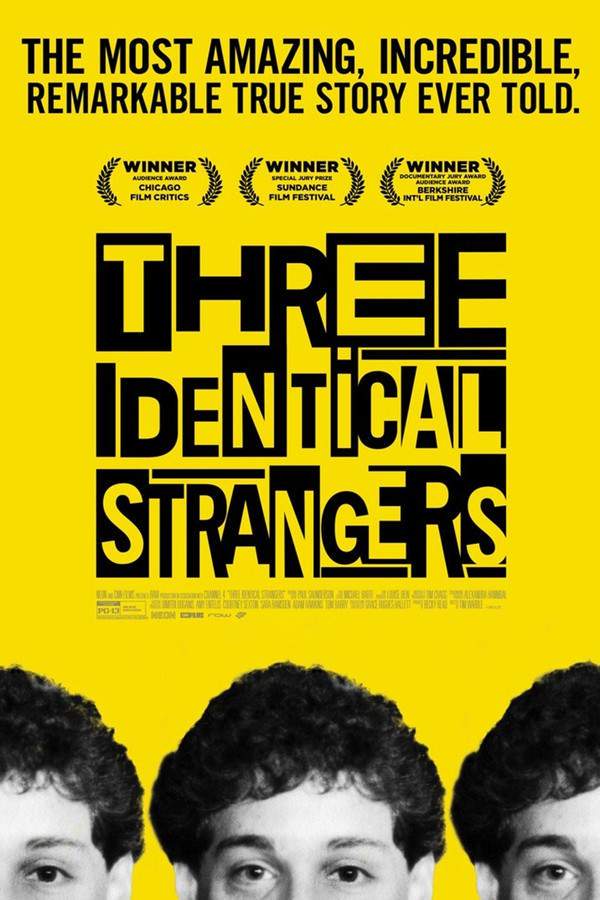
What Is Three Identical Strangers About?
The premise of Three Identical Strangers in 351 words, with nothing given away. The full story follows below.
In the late summer of 1980, a chance encounter on a college campus in upstate New York sets in motion an extraordinary story of identity and belonging. Robert Shafran arrives at school only to find himself repeatedly greeted by strangers who clearly believe they already know him. The confusion leads him to a young man named Eddy Galland — and within hours, the two discover an uncanny connection: they are twins, separated as infants and adopted by different families. The bond they form is immediate, electric, and almost impossible to comprehend.
Their story soon captures the imagination of an even wider circle. A third young man, David Kellman, sees the coverage and recognizes himself in their story. The three meet, and the revelation that ripples outward is staggering — not twins, but triplets, born together and separated without anyone’s knowledge. Their resemblance goes beyond the surface: shared tastes, similar habits, and parallel experiences suggest a connection that time and distance could not sever. The brothers are swept into a whirlwind of media attention, talk show appearances, and a kind of celebrity that turns personal history into public spectacle.
Together, they embrace their newfound brotherhood with infectious joy, moving in together and channeling their bond into a shared venture — a restaurant called Triplets, where their unusual story becomes part of the décor. Yet beneath the warmth and wonder, questions begin to surface. Why were they separated in the first place? What forces arranged their childhoods in such deliberate, parallel ways? The adoptive families seek answers from the adoption agency and the researchers involved, but the explanations offered only deepen the mystery.
The film captures a tone that balances euphoria with unease — the heady rush of reunion shadowed by the unsettling sense that something important remains unspoken. As the brothers navigate fame, family, and the strange architecture of their parallel lives, the story gestures toward a larger, more intricate history that few outside their circle could have imagined, inviting viewers to sit with the wonder and the weight of what it means to discover the truth about where you came from.
What Happens in Three Identical Strangers?
The complete story of Three Identical Strangers, from the first scene to the last, in 550 words (about 2 minutes). Spoilers throughout. Names in the text link to 3 cast member pages.
Spoilers ahead
The story begins in 1980, when Robert Shafran arrived at the campus of Sullivan County Community College in upstate New York. Upon his arrival, he experienced a series of bizarre encounters where students and staff members constantly greeted him with familiarity, though he did not know them. It became clear that people were incorrectly recognizing him as another student named Eddy Galland. The two young men eventually met that very evening, and through their conversation, they discovered a shocking commonality: both had been adopted. They quickly reached the conclusion that they were long-lost twins.
The mystery deepened months later when the publicity surrounding this heartwarming human interest story caught the attention of David Kellman. Given his striking physical resemblance to the pair and the matching circumstances of his own adoption, it was soon revealed that the three of them were actually identical triplets.
As they spent more time together, the brothers were astonished to find that their similarities extended far beyond their physical appearance. They shared the exact same tastes in food, smoked the same brand of cigarettes, and had both wrestled during their high school years. Even their childhoods mirrored one another, as all three had exhibited signs of separation anxiety as young children. This discovery turned them into a minor media sensation, leading to appearances on high-profile programs such as The Phil Donahue Show. In a celebration of their newfound brotherhood, the three decided to move in together and venture into business by opening a restaurant called Triplets, which they operated as a team.
However, a darker narrative emerged regarding their origins. It was discovered that each boy had been a subject in a childhood study conducted by psychiatrists Peter B. Neubauer and Viola W. Bernard, operating under the Jewish Board of Guardians. This study involved periodic home visits and evaluations, yet the true intent of these visits was never disclosed to the adoptive parents. When the parents eventually sought answers from the Louise Wise adoption agency, they were told that the boys had been separated simply because it was difficult to place triplets in a single household.
Further investigation revealed a much more sinister truth: the infants had been intentionally separated and placed into families with vastly different economic backgrounds and parenting styles—specifically, one blue-collar, one middle-class, and one affluent household—as part of a calculated experiment on human subjects. During the film, the siblings question whether they and other twins in the study were selected because their biological parents had histories of mental illness. When confronted, one researcher interviewed flatly denies this, insisting the research was strictly focused on parenting.
As the years passed, the initial euphoria of their reunion faded. Differences in personality became more apparent, and the strain of managing their restaurant caused their relationships to become tense. All three brothers had struggled with mental health issues during their youth. Tragically, Eddy Galland, who had been diagnosed with manic depressive disorder, died by suicide in 1995.
The scientific results of this controversial experiment were never published, and the official records are scheduled to remain sealed until the year 2066. The film concludes with onscreen text revealing that David Kellman and Robert Shafran were eventually granted access to some of the files; however, the documents were heavily redacted and provided no formal conclusions regarding the experiment.
Three Identical Strangers Timeline: Every Key Event in Order
15 key events in the order they happen, from “The triplets are separated at birth” to “Sealed records and partial answers”. 3 events name a place, across 2 locations.
- 1
The triplets are separated at birth
As infants, the three identical brothers were separated and adopted out to different families without anyone knowing they had siblings. The adoption was handled through the Louise Wise adoption agency under the auspices of the Jewish Board of Guardians. Each boy was placed with a family of a different economic level: one blue-collar, one middle-class, and one affluent.
When:During their infancy Where:New York
- 2
A secret childhood study
Each boy was involved as a child in a study conducted by psychiatrists Peter B. Neubauer and Viola W. Bernard. The study involved periodic home visits and evaluations of the children. The true intent of these visits was never explained to the adoptive parents.
Where:New York
- 3
A case of mistaken identity at college
In 1980, Robert Shafran arrived on the campus of Sullivan County Community College in upstate New York. He was constantly greeted by students and staff who incorrectly recognized him as Eddy Galland. Puzzled by the misplaced recognition, Shafran looked into the matter and discovered the existence of his twin brother.
When:1980 Where:Sullivan County Community College, upstate New York
- 4
Bobby and Eddy meet for the first time
That same evening, Robert Shafran and Eddy Galland met face to face. The two young men compared their life stories and found striking parallels between them. Both had been adopted, and they quickly concluded that they were identical twin brothers.
- 5
David Kellman completes the trio
Months later, the publicity surrounding the twins' reunion reached David Kellman. He noticed his own resemblance to the pair and learned that his adoption circumstances matched theirs exactly. His arrival confirmed that the two brothers were in fact three identical triplets.
When:Months after the reunion
- 6
Uncanny similarities emerge
As the brothers spent time together, they discovered they were alike in many ways beyond their appearance. They had the same taste in food, smoked the same brand of cigarettes, and had all wrestled in high school. They also found they had shown similar signs of separation anxiety as children.
- 7
An instant media sensation
The story of three identical brothers who found each other by chance quickly captured public attention. The triplets became a minor media sensation and appeared on popular talk shows such as The Phil Donahue Show. They celebrated their newfound brotherhood in the spotlight.
- 8
Moving in together and opening a restaurant
Riding the wave of their fame, the three brothers moved in together to embrace their new life as a family. They went into business as a trio and opened a restaurant called Triplets, which they operated together. The venture became a symbol of their celebrated reunion.
- 9
Parents demand answers from the agency
Following the discovery that the boys were triplets, the adoptive parents sought more information from the Louise Wise adoption agency. The agency claimed that it had separated the infants because of the difficulty of placing triplets in one household. This explanation, however, would soon be contradicted by further investigation.
- 10
The truth about the experiment
Upon further investigation, it was revealed that the infants had been intentionally separated and placed with families with different parenting styles and economic levels. The placement was part of an experiment on human subjects, not a practical adoption decision. The brothers and their families learned that their lives had unknowingly been part of a secret study from the very beginning.
Show the other 5 events of Three Identical Strangers Hide the last 5 events
- 11
Why were they chosen?
During the film, the siblings questioned whether they and other sets of twins involved in the study had been selected because their parents reported signs of mental illness before having children. One researcher interviewed in the documentary flatly denied this suggestion. According to the researcher, the research was simply about parenting.
- 12
Cracks in the brotherhood
Over time, differences among the triplets became increasingly apparent despite their identical genes. Their relationships became strained, especially due to the stress of running their restaurant together. The fairy-tale reunion began to reveal the real tensions beneath it.
- 13
Battling mental health problems
All three brothers struggled with mental health problems in their youth. Eddy Galland was diagnosed with manic depressive disorder and fought to cope with his condition. His struggles weighed heavily on him and on the family the triplets had built together.
- 14
The death of Eddy Galland
In 1995, Eddy Galland died by suicide after years of struggling with his mental health. His death devastated his brothers and cast a shadow over the joyful reunion that had made them famous. It also underscored the human cost of the secret experiment that had shaped their lives.
When:1995
- 15
Sealed records and partial answers
The results of the experiment were never published, and the records were ordered to remain sealed until 2066. At the end of the film, onscreen text explained that Kellman and Shafran were granted access to the files. However, the documents they received were heavily redacted and contained no formal conclusions.
Who Are the Main Characters in Three Identical Strangers?
3 characters, among them Robert Shafran, Eddy Galland and David Kellman: who each one is and the part they play in the story. Every profile links to the actor’s page.
- RS
Robert Shafran
Played by Robert Shafran
Robert Shafran is one of the triplets who initially discovers their unique connection with Eddy Galland. He embodies curiosity and a desire to understand his past, which drives the narrative of the film. His interactions with his brothers reveal the joy of brotherhood as well as the pain of familial separation.
- 👦 Triplet
- 👨👦 Family
- EG
Eddy Galland
Played by Eddy Galland
Eddy Galland is one of the identical triplets whose joyful reunion with Robert sets off a media frenzy. He represents the emotional complexities of childhood separation, grappling with deep-seated mental health struggles. His tragic end serves as a stark reminder of the impact of unresolved trauma.
- 👦 Triplet
- 😢 Tragedy
- DK
David Kellman
Played by David Kellman
David Kellman is the third triplet who joins Robert and Eddy in discovering their shared identities. His character navigates the excitement of reunion and the ensuing emotional turmoil. David's quest for answers and understanding of his origins is a central aspect of the narrative.
- 👦 Triplet
- 🤝 Reunion
Where and When Is Three Identical Strangers Set?
Three Identical Strangers is set in Sullivan County and New York (1980s). Here is why the time and place matter to the story.
When
1980s
The 1980s was a decade characterized by cultural shifts, rising media influence, and various social movements. It was during this vibrant era that the three brothers discovered their shared identity and complex origins. This time period also saw advancements in psychology that intersected with the themes explored in their unique story.
Where
Sullivan County, New York
Sullivan County is located in upstate New York and is known for its beautiful landscapes and community colleges. In 1980, it served as the backdrop for an extraordinary reunion of three identical triplets. The region's educational institutions provided the setting where their paths crossed, igniting a media sensation.
- 🗽 New York
- 🏫 College
What Are the Themes of Three Identical Strangers?
3 ideas the story keeps returning to, among them Identity, Psychological Experimentation and Mental Health.
-
01
Identity
The theme of identity runs deeply throughout the film as the triplets grapple with their shared physical resemblance and the psychological impacts of their separation. Their journey reflects the struggle to understand one’s self in light of familial ties, and the disconnect caused by their upbringing in different environments. As they explore their identities together, they raise profound questions about nature versus nurture.
-
02
Psychological Experimentation
The film delves into the ethical implications of psychological experimentation on humans, particularly regarding the long-term effects of intentional separation on the triplets. It highlights the responsibility of researchers to disclose intentions and the potential harm caused by their experiments. The triplets' discovery of their manipulated beginnings brings into question the morality of such studies.
-
03
Mental Health
The struggles with mental health faced by the brothers serve as a poignant theme in the movie. Their experiences highlight the lingering effects of childhood trauma and the complexities of mental well-being. Eddy's battle with manic depressive disorder tragically underscores the urgent need for openness and support surrounding mental health issues.
What Kind of Film Is Three Identical Strangers?
Bittersweet in tone, with steady pacing and a moderate story, going by the plot summary.
- Tone
- Bittersweet
- Pacing
- Steady
- Story
- Moderate
- Intensity
- High
- Ending
- Bittersweet
A compelling documentary that opens as a heartwarming reunion tale before unraveling into a chilling exposé of secret psychological experimentation, leaving viewers shaken by human cruelty and lingering unanswered questions.
- bittersweet
- unsettling
- investigative
- nostalgic
- contemplative
- shocking
- separated at birth
- twin reunion
- unethical medical experiment
- adoption
Content notes: suicide, mental illness, unethical medical experimentation, child exploitation, adoption trauma, family separation.
Quiz
How well do you remember Three Identical Strangers? Test yourself on the story.