
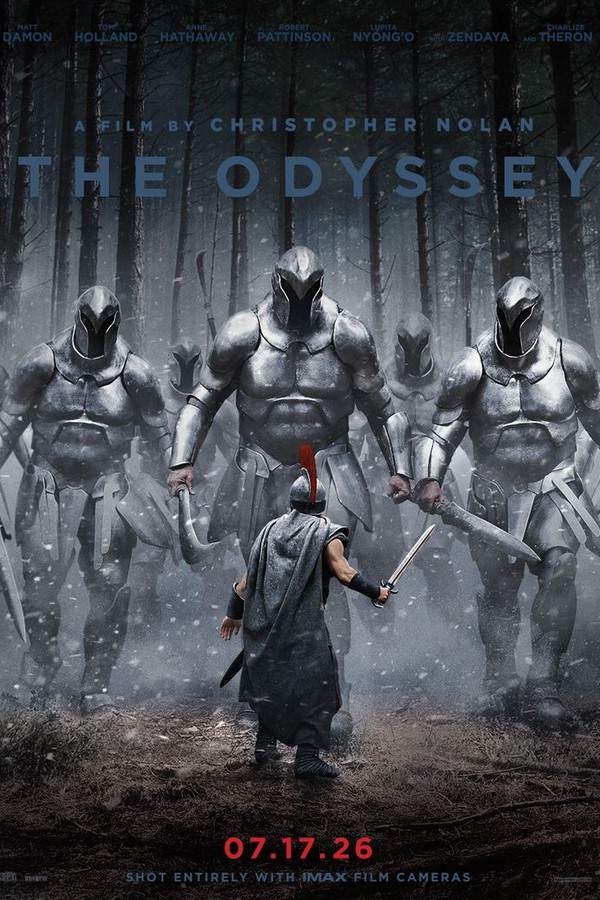
What Is The Odyssey About?
The premise of The Odyssey in 323 words, with nothing given away. The full story and the ending follow below.
In the wake of a kingdom’s long absence, Odysseus—legendary king of Ithaca—sets sail across a mythic Mediterranean where gods, monsters, and mortal cunning collide. Where Troy’s fall has become legend, his name still echoes with the scent of trickery and triumph, and his voyage home stretches into something far longer and stranger than any hero bargained for. The world around him hums with divine caprice: towering cyclopes, shifting seas that answer to wounded gods, and creatures drawn from nightmare and prophecy alike. It is a realm where heroism is not simply tested by sword or strategy, but by the slow erosion of memory, loyalty, and self.
The tale hums with the tone of an ancient epic brought to thundering life—vast horizons, brutal weather, and encounters that blur the line between sacrifice and survival. Every trial demands a different piece of Odysseus: his wit, his restraint, his willingness to wade through the unknown. Yet beneath the pageantry of supernatural danger lies a quieter ache—the longing for a hearth that may have changed as much as he has. The journey home becomes a measure of what kind of man walks back through the door, if he ever does.
Odysseus moves with the cadence of legend and the intimacy of a personal reckoning. His companions, his gods, and the ever-shifting sea each become mirrors of his own endurance, forcing him to weigh cunning against conscience at every turn. The film builds its drama not from simple victories, but from the slow, haunting question of whether a hero can survive his own myth.
At its heart, this is a story about return, identity, and the cost of being remembered. Odysseus’s homecoming is wrapped in uncertainty, his throne unsettled, his legend already larger than life. The stage is set for a confrontation between the man he has become and the king he is expected to be—one that will demand nothing less than everything he has left to give.
What Happens in The Odyssey?
The complete story of The Odyssey, from the first scene to the last, in 1,079 words (about 5 minutes). Spoilers throughout. Names in the text link to 14 cast member pages.
Spoilers ahead
For two long decades, the kingdom of Ithaca has remained without a ruler, left in a state of instability since Odysseus, played by Matt Damon, failed to return from the brutal Trojan War. In his absence, the palace has been overrun by aggressive suitors who seek to claim the throne. Among them is the ambitious nobleman Antinous, portrayed by Robert Pattinson, who relentlessly courts Odysseus’s wife, Penelope, played by Anne Hathaway, in an attempt to seize power from her and their son, Telemachus, played by Tom Holland. Despite the overwhelming pressure, only Penelope, Telemachus, and the loyal, half-blind servant Eumaeus, played by John Leguizamo, maintain the unwavering belief that the king will one day return home. Amidst this tension, Penelope expresses her deep fear to her son regarding the “Sea Peoples”—murderous invaders who violate the sacred laws of Zeus, specifically the ancient customs of hospitality and respect between guests and hosts.
Driven by a need for answers, Telemachus sets out on a journey accompanied by his father’s trusted friend Mentor, played by Ryan Hurst. Their destination is Sparta, where they seek audience with King Menelaus, played by Jon Bernthal, to discover any information regarding his father’s fate. However, Antinous discovers this plan and begins conspiring to ambush and murder Telemachus upon his return to Ithaca, hoping to plunder the city without opposition. While in Sparta, Menelaus and his wife, Helen, portrayed by Lupita Nyong’o, recount the horrors of the war to the young prince, though they admit they are uncertain if Odysseus is still alive.
Far away on the island of Ogygia, the goddess Athena, played by Zendaya, appears to Odysseus. He has been held captive by the nymph Calypso, played by Charlize Theron, who is deeply infatuated with him. While Calypso is reluctant to let him go, Athena commands that he be allowed to return home, prompting Calypso to encourage Odysseus to reflect upon his tumultuous past.
Years prior, the Greek forces—led by Agamemnon, played by Benny Safdie—had finally conquered Troy through a legendary stratagem. Odysseus had devised the Trojan Horse, a massive wooden decoy that hid Greek soldiers inside. To ensure the ruse worked, a soldier named Sinon, played by Elliot Page, was sacrificed as a decoy. While Agamemnon and Menelaus returned to their respective lands, Odysseus and his crew, including his second-in-command Eurylochus, played by Himesh Patel, were diverted. While searching an island for essential supplies, they were trapped in a cave by the cyclops Polyphemus. After the creature devoured several of his men, Odysseus managed to blind the beast to facilitate their escape. However, as they fled, they heard Polyphemus crying out to his father, the sea god Poseidon, sparking a divine grudge that would plague the crew with horrific sea conditions.
The journey grew increasingly perilous. Upon landing at Telepylus, they were attacked by the Laestrygonians—man-eating giants who destroyed two of the three Greek ships and slaughtered most of the crew. The remaining survivors, driven by desperation and rebellion, eventually sought refuge on the island of Aeaea. There, they encountered the witch Circe, played by Samantha Morton, who used her magic to transform the men into pigs. After Odysseus successfully persuaded Circe to reverse the spell, she provided him with critical advice: to reach Ithaca, he would first have to cross the river Oceanus and enter the depths of Hades.
In the underworld, Odysseus encountered the shades of his fallen comrades. He was confronted by the ghost of Sinon, who reproached him for the deception and revealed that Antinous had manipulated him into joining the army. He also spoke with the spirit of Agamemnon, who revealed the grim reality that his wife Clytemnestra, also played by Lupita Nyong’o, had murdered him upon his homecoming as retribution for the sacrifice of their daughter, Iphigenia. Finally, the prophet Tiresias delivered a chilling prediction: by divine will, Odysseus would be the only member of his crew to ever return home.
After being chased from the underworld by the ghosts of his own army, Odysseus navigated the treacherous waters, surviving the lethal songs of the Sirens and the terrors of the sea monsters Scylla and Charybdis. Upon reaching Thrinacia, Odysseus strictly warned his men not to touch the cattle of Apollo, as Tiresias had foretold that doing so would result in their deaths. However, driven by starvation, the crew disobeyed. In retaliation, Zeus unleashed a catastrophic storm that sank the ship and killed everyone except Odysseus. He washed ashore on Ogygia unconscious, where Calypso’s lotus flowers stripped him of his memories.
After seven years of amnesia, Odysseus regained his recollections and built a raft to brave the storm once more. He eventually washed ashore in his homeland of Ithaca, though he remained in disguise, using the alias “Sinon.” He reunited with Eumaeus, who informed him that the suitors had hired bandits to assassinate Telemachus and Mentor. In a violent clash, the bandits killed Mentor, but Odysseus managed to save his son and slay the attackers. In a poignant moment, Odysseus’s elderly dog, Argos, recognized his master and died peacefully. Telemachus soon deduced his father’s true identity. During a subsequent feast, Odysseus confronted Antinous regarding the betrayal of Sinon, leading to a physical altercation where Antinous thrashed the disguised king before Telemachus stepped in.
Still hiding his identity, Odysseus had a private confession with Penelope. He admitted his deep guilt for violating the laws of Zeus during the fall of Troy, specifically for desecrating the statue of Athena after killing her priestess. He revealed a shocking truth: the dreaded “sea people” were actually the Greeks themselves, and he begged Penelope for her forgiveness. In response, Penelope announced she was finally ready to remarry, instructing the suitors to return the following dawn.
She declared a challenge: she would marry whoever could string Odysseus’s legendary bow and shoot an arrow through a row of axe heads. One by one, the suitors failed miserably. When Odysseus took the bow, he succeeded effortlessly, revealing his true identity to the room. A bloody battle erupted in the hall; Telemachus fought alongside his father to eliminate the suitors, including the death of Antinous. Once the remaining suitors surrendered, Odysseus made the surprising decision to cede his throne to Telemachus. Seeking a life of peace and exile, he and Penelope sailed west to honor the memory of his fallen soldiers. As they traveled, they hoped for a renewal of civilization, musing that with the passage of time, the world would eventually forget the mistakes of Odysseus.
The Odyssey Timeline: Every Key Event in Order
15 key events in the order they happen, from “Twenty Years Without a King” to “The Reckoning and the Farewell”. 15 events name a place, across 10 locations.
- 1
Twenty Years Without a King
For twenty years, Ithaca has been kingless since Odysseus never returned from the Trojan War. Suitors led by the nobleman Antinous aggressively court his wife Penelope in a bid to claim the throne from her son, Telemachus. Only Penelope, Telemachus, and Odysseus's half-blind servant Eumaeus still believe the king will one day return.
When:Twenty years after the Trojan War Where:Ithaca
- 2
Telemachus Seeks Answers in Sparta
Penelope fears raids by the murderous 'Sea Peoples', who violate Zeus's law of respect between guests and hosts. Seeking news of his father, Telemachus travels to Sparta with Odysseus's old friend Mentor to question King Menelaus. Menelaus and his wife Helen recount the war, but they can offer no certainty about Odysseus's fate. Meanwhile, Antinous learns of the journey and conspires to kill Telemachus upon his return and plunder Ithaca.
Where:Sparta
- 3
Athena Commands the Return
On the distant island of Ogygia, the goddess Athena appears before Odysseus and commands him to return home at last. The nymph Calypso, who is infatuated with him, resents the order yet urges Odysseus to remember his past. His memories pull him back to the terrible story of his long, doomed voyage from Troy.
Where:Ogygia
- 4
Flashback: The Fall of Troy
Years earlier, the Greek army under Agamemnon conquered Troy using Odysseus's cunning stratagem, the Trojan Horse. Greek soldiers hid inside the wooden structure while the soldier Sinon was sacrificed as a decoy. With Menelaus and Agamemnon safely home, Odysseus and his crew set sail, beginning their ill-fated journey back to Ithaca.
When:Years earlier, at the end of the Trojan War Where:Troy
- 5
Flashback: The Curse of Polyphemus
Stopping at an island for supplies, Odysseus and his men are trapped in a cave by the cyclops Polyphemus, who hungrily devours several soldiers. The survivors blind the monster and make their escape. From the water they hear Polyphemus crying out to his father, the sea god Poseidon, whose wrath soon unleashes brutal sea conditions on the crew.
Where:A cave on an island
- 6
Flashback: The Laestrygonian Massacre
The battered fleet lands at Telepylus, where the Laestrygonians, man-eating giants, attack without warning. Most of the remaining crew are slaughtered, and two of the fleet's three ships are sunk. The disaster shatters what is left of the men's trust in their leader.
Where:Telepylus
- 7
Flashback: Circe's Island
The surviving crew rebels against Odysseus and seeks refuge on the island of Aeaea, where the witch Circe turns them into pigs. Odysseus persuades her to restore his men, including his second-in-command Eurylochus. Circe then reveals that to reach Ithaca, he must first cross the river Oceanus into the land of the dead.
Where:Aeaea
- 8
Flashback: Into the Underworld
Crossing the river Oceanus, Odysseus enters Hades, where he meets the shades of his fallen soldiers. Sinon's shade reproaches him for his deception and reveals that Antinous manipulated him into taking Sinon's place in the Greek army. Agamemnon's shade tells of his murder at the hands of his wife Clytemnestra, and the prophet Tiresias foretells that only Odysseus will ever survive the journey home.
Where:Hades (the Underworld)
- 9
Flashback: The Sirens and the Sea Monsters
Chased from the underworld by the shades of his fallen army, Odysseus follows Tiresias's guidance for the trials ahead. He survives the deadly allure of the Sirens as well as the twin sea monsters Charybdis and Scylla. Yet each ordeal thins his crew further and deepens the men's desperation.
Where:The open sea
- 10
Flashback: The Cattle of Apollo
Landing on Thrinacia, Odysseus warns his starving men not to touch the cattle of Apollo, since Tiresias foretold they would die if they did. Weak with hunger, the men disobey and slaughter the sacred herd. Zeus answers with a violent storm that sinks their ship, killing everyone except Odysseus, who washes ashore unconscious on Ogygia.
Where:Thrinacia
Show the other 5 events of The Odyssey Hide the last 5 events
- 11
Seven Years of Oblivion on Ogygia
On Ogygia, Calypso's lotus flowers strip Odysseus of his memories, and he remains with her for seven years. When he finally regains himself, he builds a raft and surrenders his fate to the storm and the sea. His return home, however, comes with the suitors' plot against Telemachus already in motion.
When:Seven years after the shipwreck Where:Ogygia
- 12
The Homecoming in Disguise
Odysseus comes ashore in disguise, taking the alias 'Sinon'. From Eumaeus he learns that the suitors sent bandits to assassinate Telemachus and Mentor; the bandits kill Mentor, but Odysseus rescues Telemachus and slays the attackers. His loyal old dog Argos dies as it joyfully recognizes its master, and Telemachus quietly deduces the stranger's true identity.
Where:Ithaca
- 13
Feast, Confrontation, and Confession
During a feast, the disguised Odysseus confronts Antinous about betraying Sinon, and the furious suitor thrashes him before Telemachus intervenes. After the meal, Odysseus confesses to Penelope his guilt for violating Zeus's law during the sacking of Troy and desecrating Athena's statue after killing her priestess. He reveals that the dreaded 'Sea Peoples' were the Greeks themselves, whose brutality helped ignite the Late Bronze Age collapse, and begs Penelope's forgiveness.
Where:Ithaca
- 14
The Trial of the Bow
Penelope instructs the suitors to return at dawn and declares she will remarry whoever can string Odysseus's great bow and shoot an arrow through a row of axe heads. Every suitor fails at the impossible task. When Odysseus takes the bow and succeeds effortlessly, his true identity is revealed before the entire hall.
When:At dawn Where:Ithaca
- 15
The Reckoning and the Farewell
The hall erupts in battle, and with Telemachus fighting at his side, Odysseus cuts down the challenging suitors, including the treacherous Antinous. Once the remaining suitors surrender, Odysseus cedes the throne of Ithaca to his son. He then departs with Penelope to seek peace in exile, sailing west to honor his fallen soldiers, with the couple musing that time will forget Odysseus's mistakes.
Where:Ithaca
Who Are the Main Characters in The Odyssey?
5 characters, among them Odysseus (Matt Damon), Penelope (Anne Hathaway) and Telemachus (Tom Holland): who each one is and the part they play in the story. Every profile links to the actor’s page.
-

Odysseus (Matt Damon)
Played by Matt Damon
Odysseus is portrayed as a heroic yet flawed leader, deeply determined to return home after the Trojan War. His cunning and resourcefulness are tested through trials that challenge his morality and resolve. Despite the weight of his decisions and guilt over past actions, Odysseus embodies the relentless pursuit of home and identity.
- 🗡️ Hero
- 🌊 Adventurer
- 🤔 Complex
-

Penelope (Anne Hathaway)
Played by Anne Hathaway
Penelope is depicted as a resilient and intelligent woman who remains loyal to Odysseus during his 20-year absence. She skillfully navigates the pressures from suitors while holding onto hope for her husband's return. Her character reflects strength and adaptability in a chaotic environment, embodying the theme of unwavering love.
- ❤️ Loyal
- 👑 Queen
- 🧠 Intelligent
-

Telemachus (Tom Holland)
Played by Tom Holland
Telemachus, Odysseus's son, undergoes a transformation from a boy to a man burdened by the absence of his father. His bravery in seeking knowledge about Odysseus reflects his desire for identity and independence. Throughout the story, Telemachus embodies the hope for new beginnings and a stronger future for Ithaca.
- 🧑🦱 Brave
- 👶 Son
- 🔍 Seekers of Truth
-

Calypso (Charlize Theron)
Played by Charlize Theron
Calypso is a complex character torn between her love for Odysseus and the constraints of her divine role as a nymph. Her infatuation with Odysseus showcases themes of desire and captivity, as she embodies both the danger and allure of longing. Calypso's character raises questions about freedom and the cost of love.
- 🌊 Nymph
- 💘 Obsessed
- ⚖️ Torn
-

Antinous (Robert Pattinson)
Played by Robert Pattinson
Antinous is a primary antagonist, embodying betrayal and ambition as he vies for Penelope's hand. His ruthless tactics and manipulative nature reveal the darker side of desire for power. Antinous represents the challenges faced by Odysseus upon his return, emphasizing the theme of loyalty and the consequences of treachery.
- 👑 Suitor
- 🔪 Devious
- 💔 Betrayer
Where and When Is The Odyssey Set?
The Odyssey is set in Ithaca, Ogygia, Sparta, Hades and Thrinacia (Ancient Greece, during the Trojan War and its aftermath). Here is why the time and place matter to the story.
When
Ancient Greece, during the Trojan War and its aftermath
The story is set in Ancient Greece, primarily during the aftermath of the Trojan War, a significant conflict that involved legendary heroes and gods. This era is marked by epic tales of heroism, moral dilemmas, and divine intervention. The events, spanning over two decades, illustrate the complexities of loyalty, love, and destiny in a world shaped by war and mythology.
Where
Ithaca, Ogygia, Sparta, Hades, Thrinacia
Ithaca is the home of Odysseus, known for its strategic significance and rich mythology. Ogygia, an island where Calypso keeps Odysseus captive, represents a place of beauty and longing. Sparta, ruled by Menelaus, is recognized as a powerful city-state during ancient Greek times. Hades is depicted as the underworld, where Odysseus encounters spirits of the deceased. Thrinacia, home to the cattle of Apollo, serves as a critical turning point in Odysseus's journey.
- 🏝️ Island
- 🏛️ Ancient Greece
- 👻 Underworld
What Are the Themes of The Odyssey?
3 ideas the story keeps returning to, among them Heroism, Divine Intervention and Loyalty and Betrayal.
-
01
Heroism
The theme of heroism runs deep throughout 'The Odyssey', showcasing Odysseus as a multifaceted hero who faces numerous trials. His journey reflects the struggle between personal ambitions and the greater good, as he seeks to reclaim his kingdom. The bravery demonstrated by Odysseus and his allies encapsulates the essence of ancient heroic ideals.
-
02
Divine Intervention
The story illustrates a constant interplay between gods and mortals, with characters like Athena directly influencing the fate of Odysseus. Divine intervention raises questions about free will and destiny, highlighting how the gods guide or challenge human actions. The narrative urges belief in divine will while simultaneously revealing the consequences of human folly.
-
03
Loyalty and Betrayal
Themes of loyalty and betrayal are poignantly reflected in the relationships among characters. While Penelope's unwavering faith in Odysseus contrasts with Antinous's treachery, it highlights the complexities of trust in a tumultuous world. This theme emphasizes the emotional turmoil caused by deception and the enduring power of loyalty amidst adversity.
How Does The Odyssey End?
The last act of The Odyssey and what it means, in 208 words. The ending lands as bittersweet. Big spoilers: read the plot summary first if you have not seen it.
The final act, in full
Odysseus returns to Ithaca disguised as a beggar, where only his old dog Argos recognizes him before dying. Penelope’s contest with Odysseus’ bow and the row of axe heads creates the opening for his revenge: he reveals himself, saves Telemachus, and kills Antinous and the other suitors who have consumed his household. He then confesses to Penelope the moral cost of Troy, including the Trojan Horse’s violation of Zeus’s law by disguising death as a gift. Haunted by an Athena who bears the face of a murdered young woman, he can no longer treat victory, divine favor, or his return as proof of innocence.
Odysseus and Penelope choose self-exile, leaving Telemachus to rule Ithaca rather than restoring the old king to his throne. Odysseus observes that nobody will write down their deeds and that they will survive only through song, while the closing return to the Trojan Horse places his personal homecoming against the collapse his war helped unleash. The ending therefore refuses the simple reward promised by the journey. He reaches his wife and son, but accepting responsibility means surrendering power and living beyond the society that celebrated his cunning. What remains is not an unblemished hero but a contested story that later generations will keep retelling.
What Kind of Film Is The Odyssey?
Dark in tone, with variable pacing and a complex story, going by the plot summary.
- Tone
- Dark
- Pacing
- Variable
- Story
- Complex
- Intensity
- High
- Ending
- Bittersweet
An epic mythological saga traversing perilous seas and divine trials, balancing brutal combat and haunting flashbacks with a somber, guilt-laden undertone about whether homecoming can redeem the cost of war.
- epic
- mythological
- somber
- perilous
- atmospheric
- guilt-ridden
- greek mythology
- homecoming
- heroic trials
- divine punishment
Content notes: war violence, graphic violence, murder, death of friends, divine punishment, backstory of child sacrifice.
Quiz
How well do you remember The Odyssey? Test yourself on the story.
