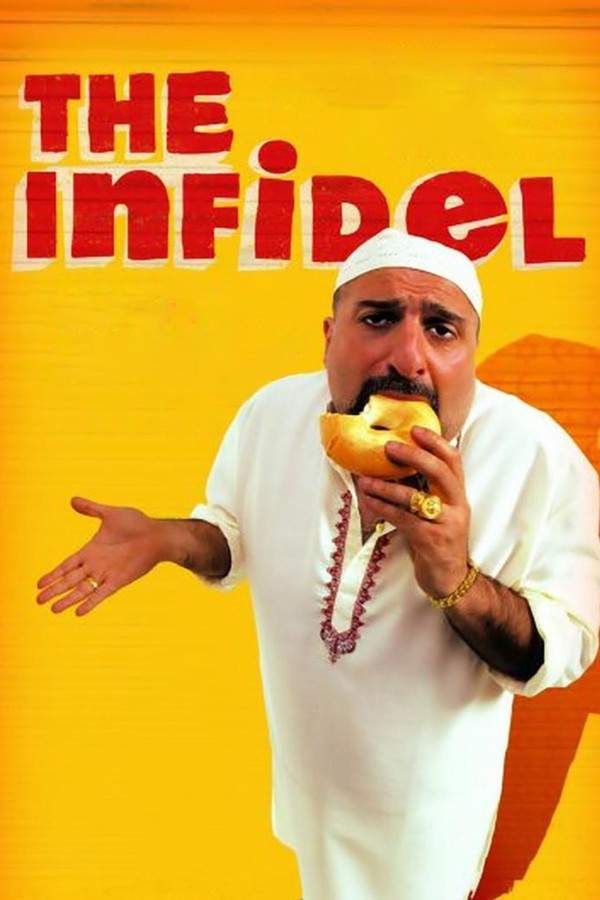
The Infidel 2010

Directed by

Josh Appignanesi
Made by

Tribeca Films
Where to Watch The Infidel
See current US streaming, rental, and purchase options for The Infidel (2010) via JustWatch.










The Infidel Plot Summary
Read the complete plot summary and ending explained for The Infidel (2010). From turning points to emotional moments, uncover what really happened and why it matters.
Mahmud Nasir is a husband, father, and a British Muslim who enjoys rock music and the occasional drink, living with a sense of ordinary restraint until a web of secrets and loyalties tests everything he believes about himself. When his son Rashid plans to marry his fiancée Uzma, the couple seeks the blessing of Uzma’s devout Muslim stepfather, Arshad Al-Masri. Mahmud agrees to play the part of a deeply devout Muslim for the sake of the family’s happiness, even as he harbors suspicions about Arshad’s rumored links to extremism. The arrangement pulls Mahmud into a tension-filled balance between appearances and honesty, a balance he hopes to maintain even as his life begins to tilt.
In the quiet hours of cleaning out his recently deceased mother’s house, Mahmud uncovers an adoption certificate that reveals an astonishing truth: he was adopted when he was two weeks old. His birth name is Solomon “Solly” Shimshillewitz, and his biological parents were Jewish. This revelation unsettles him, exposing a latent anti-Semitic streak that surfaces in his uneasy interactions with his American Jewish neighbor, Leonard “Lenny” Goldberg. A heated argument with Lenny becomes a turning point, as Mahmud inadvertently exposes his ethnicity and his real name, and Lenny mentions a local man named Isaac “Izzy” Shimshillewitz who could be Mahmud’s biological father.
Driven by curiosity and a need for belonging, Mahmud traces Izzy to a Jewish old age home. A rabbi there refuses him entry, arguing that it would be too shocking for Izzy to see his son, a Muslim, and advising Mahmud to learn to act more like a Jew if he truly wants to meet his father before he dies. Lenny steps in, offering to teach Mahmud what he knows about being Jewish—from dancing in the style of Topol to picking up basic Yiddish. But the frequent trips to Lenny’s home begin to raise suspicions among Mahmud’s family, especially after a kippah is spotted at a Free Palestine rally. In a moment of despair and desperation, Mahmud publicly burns the kippah, signaling a dramatic act of resistance against Zionism in the eyes of his community.
Mahmud and Lenny continue to press their luck, attending a Bar Mitzvah where, in broken Yiddish, Mahmud ends up telling a very crude joke to a room full of attendees. The crowd’s laughter suggests a less hostile reception than he anticipated, yet the rabbi still refuses him entry into Izzy’s world when Mahmud cannot recite the Sh’ma or name the Five Books of Moses in Hebrew. A growing rift comes into view: Mahmud’s desire to fit into both identities collides with the rigid expectations of the communities around him.
Tension erupts at home when Mahmud’s attempts to maintain a double life come under scrutiny. After a bitter argument with Lenny, Mahmud storms back to his family, only to find Arshad and Uzma and their friends gathered, apparently impressed by Mahmud’s displayed religiosity after seeing him burn the kippah on television. The scene escalates when police, the media, and a crowd of angry Jews and supportive Muslims arrive to arrest Mahmud for burning the kippah. In a moment of public honesty, he proclaims that he is Jewish, attempting to exonerate himself in front of everyone. The revelation shocks Arshad, who leaves with Uzma and his entourage in tow.
The fallout is severe. Mahmud’s family distance themselves, a colleague resigns from his job, and he sinks into despair and drinking. He is eventually rescued by Lenny, who saw the news coverage and reaches out. Mahmud returns to the old age home, determined to see Izzy, only to learn Izzy has already passed away. Inside Izzy’s room, Mahmud finds a video recording of his own announcement — a message sent by Lenny to Izzy — and a single sticker bearing the name “Solly.” It is a small, potent symbol that Izzy never forgot his long-lost son.
Armed with a newfound resolve, Mahmud reappears at Arshad’s next rally and speaks on behalf of himself, Jewish citizens, and Muslims alike. In a startling revelation, he also discloses another discovery: Arshad is actually Gary Page, the once-famous figure who staged his own death after a racist onstage tirade, only to reemerge later with a completely new identity as a devout Muslim cleric. Arshad flees the scene, dressed in his old Gary Page clothes. In the aftermath, Rashid and Uzma are married in a ceremony that unites both Muslim and Jewish communities, underscoring a theme of shared humanity. Lenny finds new work with a taxi firm that is primarily run by Muslims, symbolizing a bridge between communities that once seemed irreconcilable.
Throughout this journey, the film maintains a careful, thoughtful tone that explores how identity can be constructed, contested, and ultimately reconciled. It delves into the fragile lines between faith, heritage, and personal truth, showing how the pressure to perform belonging can push people toward deception, yet how moments of vulnerability and courage can forge unexpected connections. The final image leaves us with a sense of cautious hope: even after missteps and revelations, people can come together to honor memory, celebrate unity, and move forward with a broader sense of community.
The Infidel Timeline
Follow the complete movie timeline of The Infidel (2010) with every major event in chronological order. Great for understanding complex plots and story progression.
Mahmud discovers his adoption and Jewish roots
During a clear-out of his recently deceased mother's house, Mahmud discovers an adoption certificate that reveals his birth name Solly Shimshillewitz. He learns his biological parents were Jewish, which shocks him and challenges his long-held prejudices. The revelation deepens his internal conflict between his Muslim identity and this newfound Jewish lineage.
A neighbor's hint about a possible father
In a heated exchange with his American Jewish neighbor, Lenny Goldberg, Mahmud reveals his ethnicity and birth name. Lenny mentions the name Izzy Shimshillewitz and suggests he might be Mahmud's biological father, planting the seed of a possible family connection. The idea unsettles Mahmud and pushes him to pursue the truth.
Search for Izzy begins at a Jewish home
Mahmud tracks the potential father to a Jewish old age home and tries to visit. A rabbi refuses him entry, warning that Izzy would be shocked to see his Muslim son and advising Mahmud to study how to act more like a Jew first.
Lessons in Judaism with Lenny
Lenny agrees to teach Mahmud about being Jewish, including dancing like Topol and learning basic Yiddish. Their frequent trips to Lenny's house raise suspicion from Mahmud's family, especially after a kippah is spotted at a Free Palestine rally.
Public act of defiance on TV
On television, Mahmud publicly burns the kippah in a dramatic gesture, claiming to reject Zionism. The act triggers anger and embarrassment among his family and community, while his attempt at solidarity with Jewish friends backfires.
Bar Mitzvah encounter and humor
Mahmud attends a Bar Mitzvah with Lenny and unintentionally delivers a crude joke in broken Yiddish. The crowd's laughter creates an awkward moment that complicates his quest for acceptance and belonging.
Rabbi blocks another visit to Izzy
Mahmud and Lenny try again to see Izzy, but the rabbi still refuses entry because he cannot recite the Sh'ma or name the Five Books of Moses in Hebrew.
Home confrontation and forced alliance dissolves
Mahmud's bitter argument with Lenny ends as he returns home to find Arshad, Uzma, and their friends waiting; Arshad, impressed by Mahmud's supposed devotion after the TV stunt, blesses Rashid and Uzma's union. Police, the media, and a crowd of angry Jews and supportive Muslims arrive to arrest Mahmud for burning the kippah. In a desperate moment, he proclaims that he is Jewish, seemingly exonerating himself, and Arshad leaves with Uzma.
Descent into despair and isolation
Mahmud's family rejects him, and a colleague at work resigns in response to the scandal. He descends into despair and turns to alcohol as a coping mechanism, further isolating himself from both communities.
Search for Izzy continues and memory surfaces
Lenny, who saw Mahmud's news announcement, helps him reconnect with his past. Mahmud goes to the old age home to demand to see his father but learns Izzy has already died. Inside Izzy's room he discovers a video of his own announcement, and a sticker bearing the name 'Solly' shows that Izzy did remember him.
A unifying rally and a shocking reveal
At Arshad's next rally, Mahmud delivers a speech on behalf of himself, Jewish citizens and Muslims. He reveals that Arshad is actually Gary Page, who staged his own death after a racist rant, resurfacing with a new identity. Arshad escapes from the rally in his old Gary Page clothes.
Wedding and new cross-community ties
Rashid and Uzma are married in a ceremony attended by both Muslims and Jews, symbolizing reconciliation. Lenny has taken a job with the mostly-Muslim taxi firm where Mahmud works, underscoring a new era of cross-community ties.
The Infidel Characters
Explore all characters from The Infidel (2010). Get detailed profiles with their roles, arcs, and key relationships explained.
Mahmud Nasir
A husband and father who enjoys rock music and occasional drinking, Mahmud is shaken when he learns he was adopted and has Jewish birth parents named Solly Shimshillewitz. He wrestles with prejudices and a growing urge to perform a devout Muslim identity to please his in-laws. His public missteps—burning a kippah and delivering embarrassing jokes—unravel his relationships and spark a quest for truth.
Lenny Goldberg
An American Jewish neighbour who becomes Mahmud's reluctant guide to Jewish culture, teaching basic Yiddish and even how to dance like Topol. His visits raise suspicion among Mahmud's family, yet he provides practical support and a steady voice amid the chaos. Lenny's friendship underscores the possibility of cross-cultural understanding in a charged environment.
Izzy Shimshillewitz
Mahmud's biological father, a Jewish man living in a Jewish old-age home. Mahmud's search for him is hindered by a rabbi's refusal to admit him, and Izzy ultimately dies before they can meet. A video left in Izzy's room preserves a memory of Mahmud's public announcement, hinting at a lifelong connection that transcends years.
Arshad Al-Masri
The devout Muslim cleric who is presented to Mahmud's circle as a model of piety, but is later revealed to be Gary Page, the pop singer who faked his death after a racist rant. His orchestration of a new identity and his public persona drive the central conflict, culminating in a dramatic rally and escape in old Gary Page clothes.
Rashid
Mahmud's son who wishes to marry Uzma and seeks his father's blessing. Rashid embodies the hope for a harmonious union between Muslim and Jewish communities and anchors the family’s stakes in the film’s finale.
Uzma
Rashid's fiancée whose marriage to Rashid becomes a focal point for interfaith acceptance. Uzma's relationship with Rashid and her willingness to bridge communities underscore the film's themes of belonging and reconciliation.
The Infidel Settings
Learn where and when The Infidel (2010) takes place. Explore the film’s settings, era, and how they shape the narrative.
Time period
Early 2010s
The story unfolds in contemporary Britain during the early 2010s, a period marked by debates on multiculturalism and religious identity. Real-world cues like rallies and televised moments frame Mahmud's personal crisis. The timeframe emphasizes how identity and belonging are contested in the public eye.
Location
London, United Kingdom
Set in urban Britain with a focus on London's multicultural landscape. The city brings together Muslim families, Jewish neighbours, and a media-saturated public sphere. The setting highlights contemporary Britain where personal identity collides with public perception.
The Infidel Themes
Discover the main themes in The Infidel (2010). Analyze the deeper meanings, emotional layers, and social commentary behind the film.
🧭
Identity
Mahmud discovers his birth name Solly Shimshillewitz and confronts how chosen and inherited identities shape his sense of self. His struggle to reconcile adopted roots with current beliefs drives the emotional arc. The narrative probes how personal history and lineage influence belonging.
🕌
Faith vs. Facade
Mahmud pretends to be a devout Muslim to win acceptance, exposing the tension between outward display and inner beliefs. The discovery that a public persona can mask deeper loyalties tests trust within his family and community. The twist with Arshad as a performer of faith underscores themes of deception and authenticity.
🤝
Coexistence
The story weaves together Muslim and Jewish communities, culminating in a wedding that unites both sides. Interfaith tensions and moments of solidarity show a society trying to navigate differences. The narrative highlights dialogue, respect, and surprising common ground.
🎭
Performance
Public acts—burning a kippah, telling a crude joke in Yiddish, and a dramatic public announcement—serve as turning points that reveal character and motive. The theme examines how performance, fear, and pride can drive a person to expose their true colors. Repercussions force Mahmud to confront the consequences of his fabrications.

Coming soon on iOS and Android
The Plot Explained Mobile App
From blockbusters to hidden gems — dive into movie stories anytime, anywhere. Save your favorites, discover plots faster, and never miss a twist again.
Sign up to be the first to know when we launch. Your email stays private — always.
Explore the mobile appThe Infidel Spoiler-Free Summary
Discover the spoiler-free summary of The Infidel (2010). Get a concise overview without any spoilers.
In a modest London suburb, Mahmud Nasir balances the ordinary rhythm of family life with the subtle pressures of cultural expectation. He shares a home with his wife Saamiya and their two children, while his teenage son Rashid navigates the hopeful milestone of an upcoming marriage. The prospective bride, Uzma, brings her own family into the picture, most notably her devout step‑father Arshad Al‑Masri, a charismatic figure whose reputation hints at a more complicated world beyond the neighbourhood’s calm.
The film paints this setting with a gentle, observant tone, blending everyday British life with the nuances of faith, identity, and community. Mahmud is far from a textbook believer; his love of rock music and the occasional drink marks him as a modern, laid‑back Muslim who nonetheless feels the weight of appearances when his son’s future hinges on securing Arshad’s blessing. This delicate dance of sincerity and performance creates a quiet tension that underlies the household’s everyday interactions.
A turning point arrives when Mahmud sifts through his late mother’s papers and uncovers an adoption certificate that rewrites his personal history. The revelation of his birth name, Solomon “Solly” Shimshillewitz, and his Jewish lineage introduces a fresh layer of introspection. Suddenly, the borders between his present life and an uncharted heritage begin to blur, prompting him to reassess the narratives he has lived by.
Against the backdrop of multicultural London, the story follows Mahmud as he grapples with the intertwining threads of religion, family loyalty, and self‑discovery. The tone remains thoughtful and sometimes wry, inviting the audience to contemplate how identity is shaped by both choice and circumstance, and how the quiet courage of questioning can set the stage for unexpected connections.
Movies with Similar Twists and Themes
Uncover films that echo the narrative beats, emotional arcs, or dramatic twists of the one you're exploring. These recommendations are handpicked based on story depth, thematic resonance, and spoiler-worthy moments — perfect for fans who crave more of the same intrigue.


Featured on this page

What's After the Movie?
Not sure whether to stay after the credits? Find out!
Check out our other apps:

SAT Sphere
Build confidence for the Digital SAT.

Mori Atlas
Discover wild places worth protecting.

Luntero
Search smarter for a home in Amsterdam.

Plot Explained
Unravel movie endings and hidden clues.

Pokechamp
Dive into Pokémon data and battle logic.

Driving Theory
Get ready for your European theory test.

Movie Dust
Plan your next cinema trip with ease.

Musemap
Find art and culture as you travel.

Selkobase
Compare credentials before committing.

Local Manual
Turn an unfamiliar country into practical next steps.

Lernavi
Compare school systems before your next move.

GymRoam
Find a workout stop wherever your plans take you.
Explore Our Movie Platform
New Movie Releases (2026)
Famous Movie Actors
Top Film Production Studios
Movie Plot Summaries & Endings
Major Movie Awards & Winners
Best Concert Films & Music Documentaries
Movie Collections and Curated Lists
© 2026 What's After the Movie. All rights reserved.
Privacy Policy