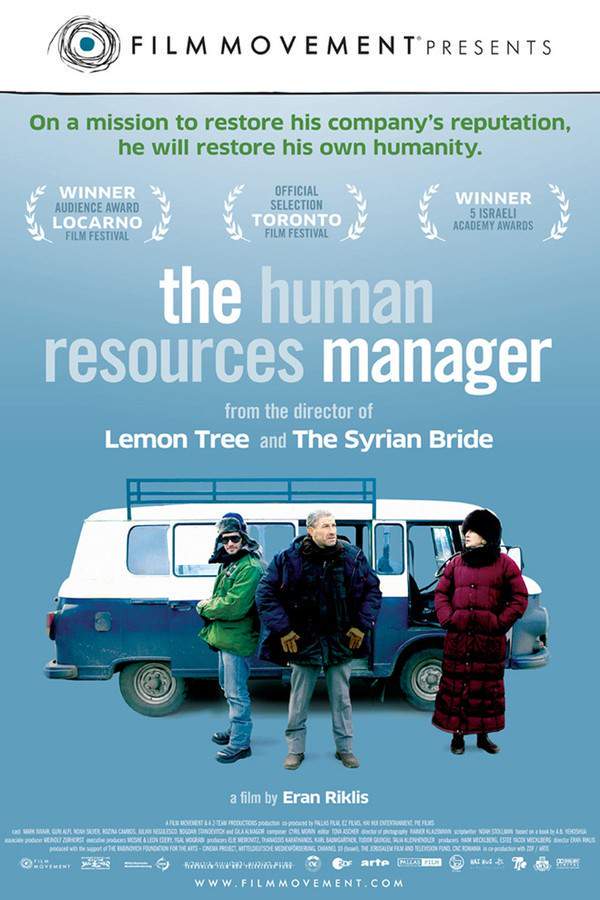
The Human Resources Manager 2011


Directed by

Eran Riklis
Made by

"DIA" Productions GmbH & Co. KG
Where to Watch The Human Resources Manager
See current US streaming, rental, and purchase options for The Human Resources Manager (2011) via JustWatch.











The Human Resources Manager Plot Summary
Read the complete plot summary and ending explained for The Human Resources Manager (2011). From turning points to emotional moments, uncover what really happened and why it matters.
Yulia, a foreign worker from Eastern Europe who came to work in Israel, is murdered in a terrorist attack in Jerusalem. Her body remains unclaimed in the morgue. Based on her belongings, it becomes clear that she worked at a Jerusalem bakery (Berman’s Bakery), and a journalist from a local Jerusalem newspaper (played by Guri Alfi) accuses the bakery of being indifferent to her fate. The owner of the bakery (Gila Almagor), known as “The Widow,” instructs the human resources manager (Mark Ivanir) to take the deceased back to her homeland for burial.
The film follows the journey of the human resources manager from Jerusalem to the deceased’s hometown, until she is laid to rest. He is accompanied by the journalist, and in the destination country in Romania, they are joined by the deputy Israeli consul (Julian Negulesco), who is married to the consul (Rozina Cambos), and Yulia’s young son (Noah Silver).
The film’s plot faithfully mirrors that of the book. The main significant difference between the two is that in the book, the owner of the bakery is a man, “The Old Man,” whereas in the film, it is a woman, “The Widow.”
The Human Resources Manager Timeline
Follow the complete movie timeline of The Human Resources Manager (2011) with every major event in chronological order. Great for understanding complex plots and story progression.
Yulia's Arrival in Israel
Yulia, a foreign worker from Eastern Europe, arrives in Israel seeking better opportunities. She starts working at Berman's Bakery in Jerusalem, hoping to build a new life for herself.
Tragic Murder
Tragically, Yulia's dreams are cut short when she is murdered in a terrorist attack in Jerusalem. This shocking event sends ripples through the community and highlights the dangers faced by foreign workers.
Yulia's Body in the Morgue
Following her murder, Yulia's body remains unclaimed in the morgue. Her belongings provide clues about her life in Israel, prompting concern over her fate.
Journalist's Investigation
A local journalist, played by Guri Alfi, becomes interested in Yulia's story and begins to investigate. He accuses Berman's Bakery, where Yulia worked, of neglecting the situation and not caring for their employee.
The Widow Takes Action
Gila Almagor, the owner of the bakery known as 'The Widow,' instructs her human resources manager to arrange for Yulia's body to be taken back to her homeland. This decision reflects her recognition of the tragedy and her responsibilities toward her employee.
Journey Begins
The human resources manager sets out from Jerusalem to Yulia's hometown in Romania. Accompanying him is the journalist, who aims to uncover more about Yulia's background and story during their travels.
Meeting the Deputy Consul
Upon arriving in Romania, the duo is joined by the deputy Israeli consul, Julian Negulesco. His presence adds a level of diplomacy to the situation, highlighting the international implications of Yulia's story.
Unexpected Companion
Yulia's young son is also introduced, adding a poignant element to the narrative. His presence underscores the personal loss and tragedy experienced by Yulia's family back home.
Cultural and Personal Connections
As they travel, the human resources manager and the journalist explore the cultural significance of Yulia's life. They reflect on her sacrifices and the connections between East and West.
Arriving at Final Destination
The group finally reaches Yulia's hometown, a moment filled with mixed emotions. They prepare for a burial that acknowledges her life and legacy, bringing closure to her tragic story.
Burial Ceremony
A heartfelt burial ceremony takes place, offering a chance for the community and Yulia's family to honor her memory. The attendees reflect on her struggles and contributions as a foreign worker.
Aftermath and Reflection
In the aftermath of the burial, the human resources manager and the journalist reflect on the journey they took. They comprehend the broader implications of Yulia's story, including issues of migrant workers in Israel.
Return to Israel
The human resources manager and the journalist return to Israel, changed by their experiences. They carry with them the memories of Yulia and the importance of acknowledging the lives of those who often go unnoticed.
Media Coverage
The story of Yulia's tragic fate gains media attention back in Israel. It brings to light the struggles faced by foreign workers and opens up conversations about their treatment in society.
Legacy and Change
Yulia's story prompts changes in policies towards foreign workers in Israel. Her legacy continues to influence discussions, creating a lasting impact on the community she was part of.
The Human Resources Manager Characters
Explore all characters from The Human Resources Manager (2011). Get detailed profiles with their roles, arcs, and key relationships explained.
Mark Ivanir
The human resources manager is depicted as a reluctant yet honorable figure tasked with a challenging mission. Throughout the film, he evolves from a bureaucratic worker into a compassionate individual who grapples with the implications of his actions. His journey reflects not only a professional obligation but also a personal awakening to the value of human life.
The Widow (Gila Almagor)
The owner of Berman's Bakery, known as 'The Widow,' is a strong-willed and pragmatic character who faces the consequences of the tragedy that befalls her employee. Her directive to send Yulia home for burial reflects her understanding of responsibility beyond business, shedding light on the humanity within the harsh realities of life.
Journalist (Guri Alfi)
The journalist serves as the societal mirror, whose accusations challenge the bakery's indifference toward Yulia's fate. His character embodies the struggle of seeking truth in a world often coated in bureaucracy, and he plays a pivotal role in driving the human resources manager toward a deeper understanding of the implications of loss.
The Human Resources Manager Settings
Learn where and when The Human Resources Manager (2011) takes place. Explore the film’s settings, era, and how they shape the narrative.
Time period
The film addresses contemporary social issues, reflecting the challenges faced by foreign workers in an increasingly complex world. It also portrays the bureaucratic and cultural obstacles encountered during the journey, emphasizing the timeless nature of loss and the need for closure.
Location
Jerusalem, Romania
Jerusalem, a city with profound historical and cultural significance, serves as the backdrop for the film, representing both hope and tragedy. Known for its diverse population and iconic landmarks, it is a place where the conflict between lived experiences and global issues is palpable. Romania, the final destination for the protagonist's journey, adds a layer of Yulia's personal history and cultural roots.
The Human Resources Manager Themes
Discover the main themes in The Human Resources Manager (2011). Analyze the deeper meanings, emotional layers, and social commentary behind the film.
💔
Loss
The theme of loss permeates the film, as Yulia's tragic death leaves a void in her community and among those who knew her. It explores the emotional toll on the human resources manager and highlights how bureaucracy often impedes the grieving process. The journey to return Yulia to her homeland symbolizes a quest for reconciliation with loss and a hope for dignity.
🤝
Human Connection
The film delves into the importance of human connections amid tragedy and indifference. Through the interactions between the characters, particularly between the human resources manager and the journalist, it showcases how shared experiences can foster understanding and compassion. Their collaboration in honoring Yulia's memory becomes a testament to the enduring impact of empathy.
🚶♂️
Journey
The physical journey from Jerusalem to Romania serves as a metaphor for emotional and personal discovery. As the human resources manager makes this trek, he navigates not only the logistics of repatriation but also his own emotional landscape. This journey invites reflections on identity, home, and belonging.

Coming soon on iOS and Android
The Plot Explained Mobile App
From blockbusters to hidden gems — dive into movie stories anytime, anywhere. Save your favorites, discover plots faster, and never miss a twist again.
Sign up to be the first to know when we launch. Your email stays private — always.
Explore the mobile appThe Human Resources Manager Spoiler-Free Summary
Discover the spoiler-free summary of The Human Resources Manager (2011). Get a concise overview without any spoilers.
In the bustling, stone‑lined streets of Jerusalem, bureaucracy collides with the city’s ancient pulse. the human resources manager, a quietly competent but weary employee of a modest bakery, finds his routine shattered when a tragedy touches the life of a foreign worker under his care. The incident forces him to confront the distance between his paperwork‑filled world and the raw human stories that swirl just beyond his office window, setting a tone of quiet introspection against the city’s vibrant, uneasy coexistence of cultures.
Tasked by the bakery’s matriarch, known only as The Widow, the manager is asked to do something far outside the scope of a typical HR file—return the fallen worker’s remains to the land she once called home. Her insistence carries both an unspoken guilt and a lingering hope, hinting at deeper connections that bind the shop’s modest walls to a world far beyond Jerusalem’s walls. The request becomes a catalyst, pulling the manager from the safety of routine into the uncertain terrain of personal responsibility.
Joining him is a determined journalist, the reporter, whose sharp eye for truth adds a layer of urgency and moral questioning to the venture. As the convoy begins its long trek toward the icy reaches of Romania, they are later joined by a deputy Israeli consul, the consul, whose diplomatic poise offers a strange comfort amid the unfolding journey, and the young son of the departed woman, whose silent presence speaks louder than any report. The ensemble moves through stark landscapes that contrast sharply with Jerusalem’s sun‑baked streets, each mile echoing with quiet contemplation.
The film’s mood is one of measured melancholy tempered by fleeting moments of unexpected warmth. It explores how an ordinary professional can be thrust into a path of redemption, where the simple act of carrying a body becomes a pilgrimage toward empathy, connection, and a renewed sense of purpose. The journey promises a thoughtful meditation on grief, responsibility, and the invisible threads that bind strangers together.
Movies with Similar Twists and Themes
Uncover films that echo the narrative beats, emotional arcs, or dramatic twists of the one you're exploring. These recommendations are handpicked based on story depth, thematic resonance, and spoiler-worthy moments — perfect for fans who crave more of the same intrigue.
Featured on this page

What's After the Movie?
Not sure whether to stay after the credits? Find out!
Check out our other apps:

SAT Sphere
Build confidence for the Digital SAT.

Mori Atlas
Discover wild places worth protecting.

Luntero
Search smarter for a home in Amsterdam.

Plot Explained
Unravel movie endings and hidden clues.

Pokechamp
Dive into Pokémon data and battle logic.

Driving Theory
Get ready for your European theory test.

Movie Dust
Plan your next cinema trip with ease.

Musemap
Find art and culture as you travel.

Selkobase
Compare credentials before committing.

Local Manual
Turn an unfamiliar country into practical next steps.

Lernavi
Compare school systems before your next move.

GymRoam
Find a workout stop wherever your plans take you.
Explore Our Movie Platform
New Movie Releases (2026)
Famous Movie Actors
Top Film Production Studios
Movie Plot Summaries & Endings
Major Movie Awards & Winners
Best Concert Films & Music Documentaries
Movie Collections and Curated Lists
© 2026 What's After the Movie. All rights reserved.
Privacy Policy