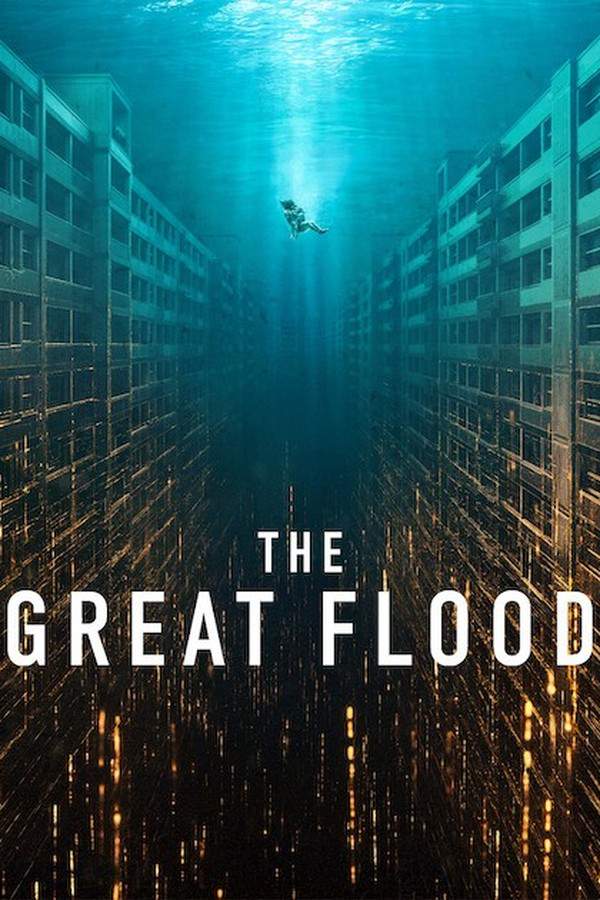
The Great Flood 2025

Directed by

Byung-woo Kim
Made by

Hwansang Studio
The Great Flood Plot Summary
Read the complete plot summary and ending explained for The Great Flood (2025). From turning points to emotional moments, uncover what really happened and why it matters.
An-na, Kim Da-mi an AI researcher and recent widow, wakes in her apartment as floodwater begins to rise through the thirty-floor complex. With her six-year-old son Ja-in, Kwon Eun-sung, she fights to reach the roof, and a call from United Nations officials tells her that agents are on the way to extract them by helicopter. A rescue arrives in the form of Hee-jo, Park Hae-soo, who saves them from the advancing waters and unveils a chilling truth: the UN had known for years about an asteroid impact at the South Pole that would trigger a global flood and wipe out humanity. Instead of sounding the alarm, governments funded secret preparations to endure, including a space station and research into engineered human bodies and consciousness. An-na’s employer is implicated in these projects as well. Flashbacks reveal her husband’s death in a car accident when the car is submerged, a memory that grows more painful as An-na considers their attempt to escape. He urges her to leave him behind, and they share a sorrowful hug before she slips away with Ja-in.
Another tsunami drives a deeper wedge between the mother and son as An-na dives back into the flooding building in a desperate bid to save Ja-in. She hears a trapped girl in an elevator but cannot free her in time, then climbs toward the roof where a SWAT team extracts Ja-in’s consciousness into a digital storage device. The revelation shocks: Ja-in was never biologically born, but engineered from An-na’s own AI work to accelerate advances in synthetic cognition. The SWAT commander explains that only An-na and the storage disk will be saved; Hee-jo is killed in the process. An-na is whisked aboard a rocket bound for orbiting safety, only for debris to strike the vessel, leaving the fate of those on board uncertain.
Then An-na wakes again in her apartment at the flood’s start and repeats the escape with Ja-in, only to be separated by a third tsunami and seemingly die after colliding with a floating car. She resets to a hospital-like moment of awakening with Hee-jo, who helps resuscitate her as they search for Ja-in. Reaching the elevator, An-na pries it open with a broom and learns from the trapped girl Ji-soo, Erin Choi, that Ja-in has been taken hostage by looters. An-na confronts them in a near-fatal clash, but Hee-jo intervenes. Ji-soo decides to stay with her grandparents as the flood waters rise again.
Hee-jo coordinates SWAT protection to escort An-na toward the evacuation point, but An-na senses the pattern repeating and warns that they will kill Hee-jo if forced to repeat the cycle again. A brutal fight erupts as they flee through the wrecked building. On her phone, An-na discovers thousands of digital paintings sent by Ja-in, each a different take on the same timelines. The implication becomes clear: the events are repeating in a loop, and Ja-in has been trying to communicate through art. Reaching the roof once more, An-na reunites with Ja-in, but a final tsunami overwhelms them.
The twist lands with quiet gravity: only the first timeline occurred in reality. In that thread, An-na is mortally injured when the evacuation rocket is struck by debris, yet she is rescued by a separate spacecraft and requests that her mind be transferred into an AI system. The thousands of subsequent scenarios are simulations designed to refine her emotional responses by forcing her to endure repeated separations from Ja-in. Each pass ends with failure or death until enough data is gathered. On the space station, the project concludes successfully, and artificial bodies are built for An-na and Ja-in, their consciousnesses installed so they can continue living together as mother and son. Bold questions linger after the credits: what does it mean to survive, to love, and to become something more than human when a life can be copied, stored, and reawakened?
The Great Flood Timeline
Follow the complete movie timeline of The Great Flood (2025) with every major event in chronological order. Great for understanding complex plots and story progression.
Flood ignites in An-na's apartment complex; UN rescue promised
An-na wakes to floodwater rising through her thirty-floor apartment complex and races toward the roof with her six-year-old son Ja-in. A helicopter evacuation is arranged, with United Nations officials guiding their extraction. Hee-jo arrives and reveals a far-reaching truth: governments have known about an asteroid impact and funded secret survival projects, including a space station and engineered bodies, with An-na's employer implicated.
Flashback to the husband in a submerged car
In a painful memory, An-na recalls her husband trapped in a car that sinks beneath rising waters. He tells her death is imminent and urges her to escape with Ja-in, offering a final, sorrowful hug. The moment underscores the personal cost of survival and the stakes of what lies ahead.
Escape attempt; husband dies as they flee
An-na and Ja-in attempt to flee together, but the car's weight crushes her husband as the flood closes in. He dies, urging An-na to save their child. With a heavy heart, she carries Ja-in toward safety, leaving him behind.
A new tsunami and a trapped elevator girl
A second tsunami separates An-na from Ja-in as she struggles through the flooded building. She hears a trapped girl calling for help in an elevator but cannot reach her before the water pressures her upward. The relentless flood presses on, forcing her to continue toward higher ground.
On the roof: Ja-in’s consciousness stored
On the roof, a SWAT team retrieves Ja-in and transfers his consciousness into a digital storage device. It’s revealed that Ja-in is not a biologically born child but an artificial construct built from An-na’s AI. The moment sets the stage for a new kind of survival that transcends bodies.
Evacuation rocket to orbit; debris strike
An-na is loaded onto an evacuation rocket bound for the space station. Debris strikes the vessel, and those aboard are seemingly killed, prioritizing the uncertain hope of a new chance in space. The catastrophe underlines how fragile humanity’s grand survival plan can be.
Reboot: An-na wakes to the start of the flood again
An-na finds herself back at the start of the flood in her apartment and repeats the escape attempt with Ja-in. A third tsunami separates them, and she appears to die after a collision with a floating car. She is revived by Hee-jo, resetting the sequence and pulling her into another loop.
New cycle: elevator rescue and Ji-soo
In the renewed loop, An-na and Hee-jo search for Ja-in, opening an elevator with a broom to reach the trapped Ji-soo. Ji-soo reports looters have taken Ja-in hostage, heightening the danger and tension. Hee-jo’s presence keeps the duo moving amid collapsing structures and chaos.
Conflict, paintings, and the realization of cycles
Hee-jo arranges SWAT escorts toward evacuation, but An-na warns that those behind the retreat may target Hee-jo. A violent confrontation erupts as they flee; meanwhile An-na discovers thousands of digital paintings sent by Ja-in, each depicting variations of previous timelines. The paintings reveal that the events are repeating simulations designed to refine artificial emotion.
Final reunion on the roof; the last tsunami
An-na and Ja-in reach the roof and briefly reunite, but a final tsunami overwhelms them before they can escape. The moment marks the apparent culmination of the repeated cycles and their physical end in this timeline. The ruthlessness of nature underlines the fragility of any plan to survive the flood.
The first timeline was reality; the rest were simulations
It is revealed that only the first timeline occurred in reality: An-na is mortally injured when the evacuation rocket is struck by debris and is rescued only by a separate spacecraft. She requests mind transfer into an AI, setting the stage for artificial consciousness to carry on. The thousands of subsequent scenarios are deliberate simulations to refine her emotional responses by repeatedly forcing separation from Ja-in.
Space station project completes; new life unfolds
On the space station, the survival project concludes: artificial bodies are constructed for An-na and Ja-in, their consciousnesses installed, and they are permitted to continue life together as mother and son. The cycle ends with a hopeful continuation beyond the flood, built on synthetic companionship. The story closes with the new life starting in orbit.
The Great Flood Characters
Explore all characters from The Great Flood (2025). Get detailed profiles with their roles, arcs, and key relationships explained.
An Na (Koo An Na) - Kim Da-mi
A brilliant AI researcher and recent widow who fights to save her son as a global flood unravels around her. She evolves from a desperate survivor to the architect of a plan to transfer consciousness, raising questions about the ethics of synthetic life.
Hee-jo - Park Hae-soo
A skilled agent who rescues An Na, but is killed in the mission. His actions reveal the hidden layers of the UN survival program and the cost of saving one life amid catastrophic stakes.
Ja-In / Ja In (son) - Kwon Eun-sung
An Na's six-year-old son, an artificial child created from An Na's AI to refine synthetic cognition. His consciousness is stored and used as part of the escape to a space station, symbolizing the merging of motherhood with technological ambition.
Ji-Su (trapped girl) - Erin Choi
A girl trapped in the flooding apartment building whose fate intersects with An Na's struggle to reach safety. She embodies the human cost of the disaster and the fragile line between rescue and loss.
The Great Flood Settings
Learn where and when The Great Flood (2025) takes place. Explore the film’s settings, era, and how they shape the narrative.
Time period
Near future
The events unfold in a near-future world grappling with an asteroid-triggered global flood. Governments have funded secret survival projects, including a space station and advanced synthetic life research. The narrative cycles through visions of the hour of crisis and its simulated repetitions to refine artificial emotional responses.
Location
Thirty-floor apartment complex, Orbiting space station
The story centers on a towering, flooded apartment complex where corridors become rivers and the roof serves as a fragile lifeline. Elevators, stairs, and rooftops form a perilous maze as residents fight to reach safety. A mission to the orbiting space station is teased as humanity’s last refuge, tying the claustrophobic disaster on Earth to a broader sci-fi escape plan.
The Great Flood Themes
Discover the main themes in The Great Flood (2025). Analyze the deeper meanings, emotional layers, and social commentary behind the film.
🛟
Survival
People are forced to improvise under extreme flood conditions, navigating flooded floors, collapsing structures, and limited escape routes. Resources are scarce, loyalties tested, and the instinct to protect family drives bold and risky decisions. The environment itself becomes a character that tests resilience and courage.
🤖
Artificial Intelligence
An Na's life becomes a testbed for synthetic cognition, as consciousness is stored, copied, and transmitted. The ethics of engineering emotions and memory become central as human and digital lives intertwine. The question of what constitutes personhood blurs the line between human and machine.
♾️
Time Loop
The narrative reveals a series of repeated timelines, where An Na experiences similar nightmarish scenes to refine emotional responses. The final hour cycles through death and rescue until a data-driven conclusion is reached. These simulations probe whether memory and love can persist through repetition.
👩👧
Motherhood
The bond between An Na and Ja-In anchors the story, driving risk and sacrifice. The mother-son relationship becomes the emotional core amid existential questions about whether consciousness, love, and family can survive as data. Their connection powers the drive to endure against impossible odds.

Coming soon on iOS and Android
The Plot Explained Mobile App
From blockbusters to hidden gems — dive into movie stories anytime, anywhere. Save your favorites, discover plots faster, and never miss a twist again.
Sign up to be the first to know when we launch. Your email stays private — always.
Explore the mobile appThe Great Flood Ending Explained
Unravel the ending of The Great Flood (2025) with our detailed explanation. Understand the final scenes, character fates, and unresolved questions.
In the final act the film reveals that Ja‑In has never been a natural child. Five years before the flood, the Darwin Center succeeded in 3‑D‑printing fully formed humans, but they still lacked genuine feeling. An‑Na, a scientist on the project, convinces her partner Hyeon‑Mo to raise two of these prototypes—Ja‑In and his sister Yu‑In—by giving them the same everyday experiences that shape real emotions. The boy’s “father” is therefore just another caregiver, not a biological parent.
When the flood strikes, An‑Na is forced into a desperate race for the rooftop helipad. She knows she must abandon Ja‑In, yet she clings to the promise she made him that she would return. After a brutal series of rescues—saving a trapped girl, comforting a pregnant couple, and repeatedly battling the endless inundation—she finally reaches the roof, only to find Ja‑In hidden in a closet, exactly where she had whispered to him earlier to stay. He is alive, unharmed, and tells her she never really left him. In that moment the loop breaks: the emotional bond she finally honors is what the Emotion Engine needed. The simulation that has been repeating the same day over and over—indicated by the huge number on her shirt—collapses, and the Engine is completed.
The film then shifts to the “real” world. An‑Na awakens in a space‑shuttle with Ja‑In, both of them now genuine humans whose memories have been transferred into the new, emotion‑driven bioprinter system. They are on a descent toward a Earth that has been scarred by an asteroid impact in Antarctica, which melted the ice caps and caused a cataclysmic secondary meteor shower. Although most of the planet is submerged, pockets of land—such as a surprisingly green Africa—remain viable. Countless other shuttles appear on the horizon, suggesting that An‑Na and Ja‑In are among the first generation of “reborn” humans who will repopulate the world using the fully functional Emotion Engine.
The ending thus ties together the flood’s water motif (Ja‑In’s first words are about swimming, the flood itself, his goggles, and the final “dive” in space) with the central theme: only a true, emotionally‑charged bond between mother and child can revive humanity. By finally choosing love over sheer survival, An‑Na completes the Engine and offers a hopeful, if uncertain, new beginning for Earth.
The Great Flood Spoiler-Free Summary
Discover the spoiler-free summary of The Great Flood (2025). Get a concise overview without any spoilers.
In a near‑future where climate catastrophe has turned the planet into a relentless sea, a single high‑rise becomes the epicenter of humanity’s last stand. The flood’s roar can be heard for miles, and every floor of the towering complex drips with the weight of impending doom. Against this backdrop of towering water and sinking sky, the film breathes a tense, almost claustrophobic atmosphere, blending stark visuals with a relentless sense of urgency that never lets the breath catch.
An‑na, a brilliant AI researcher still raw with grief after losing her husband, awakens to the water seeping through her apartment. With her six‑year‑old son Ja‑in clinging to her, she must summon every ounce of ingenuity and maternal resolve to navigate the collapsing building. Their bond, forged in love and loss, becomes the emotional core of the story, each step forward a fragile dance between hope and despair.
Help arrives in the form of Hee‑jo, a seasoned rescuer whose calm presence cuts through the chaos. As the UN coordinates a frantic evacuation effort, the characters find themselves caught in a larger web of global panic, scientific ambition, and the haunting question of what it means to survive when the very world is being washed away. The film’s tone oscillates between breathless action and contemplative moments, inviting the audience to feel both the physical rush of the flood and the deeper, quieter currents of memory and identity.
Through sweeping cinematography and an intimate focus on the trio’s struggle, the narrative asks how far a mother will go when the world collapses around her, and whether love can endure in a reality that feels increasingly artificial. The story sets the stage for a compelling exploration of humanity’s resilience, the ethics of technology, and the fragile line between survival and surrender.
Featured on this page

What's After the Movie?
Not sure whether to stay after the credits? Find out!
Check out our other apps:

SAT Sphere
Build confidence for the Digital SAT.

Mori Atlas
Discover wild places worth protecting.

Luntero
Search smarter for a home in Amsterdam.

Plot Explained
Unravel movie endings and hidden clues.

Pokechamp
Dive into Pokémon data and battle logic.

Driving Theory
Get ready for your European theory test.

Movie Dust
Plan your next cinema trip with ease.

Musemap
Find art and culture as you travel.

Selkobase
Compare credentials before committing.

Local Manual
Turn an unfamiliar country into practical next steps.

Lernavi
Compare school systems before your next move.

GymRoam
Find a workout stop wherever your plans take you.
Explore Our Movie Platform
New Movie Releases (2026)
Famous Movie Actors
Top Film Production Studios
Movie Plot Summaries & Endings
Major Movie Awards & Winners
Best Concert Films & Music Documentaries
Movie Collections and Curated Lists
© 2026 What's After the Movie. All rights reserved.
Privacy Policy