
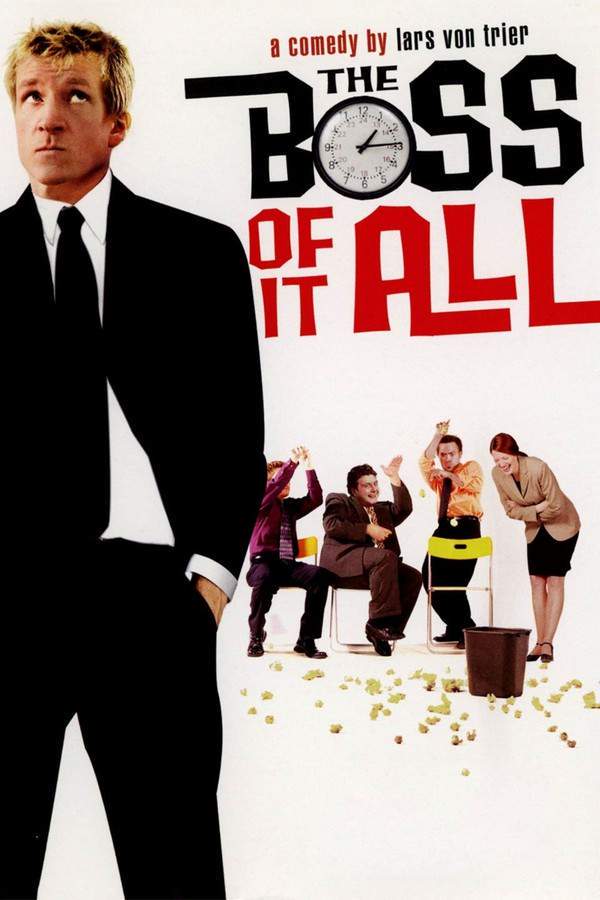
What Is The Boss of It All About?
The premise of The Boss of It All in 341 words, with nothing given away. The full story follows below.
In a world where corporate ambition collides with absurdist theater, the film opens with a self‑referential wink from a behind‑the‑scenes figure, setting a breezy, off‑kilter tone that invites the audience to treat everything that follows with a playful skepticism. The sleek, modern offices of a Danish IT firm become a stage for the kind of dry humor and existential bemusement that feels both contemporary and oddly timeless, hinting at deeper questions about identity and authority while never taking itself too seriously.
Ravn, the founder of the company, has spent years shielding himself behind a fabricated “boss of it all,” an imagined executive who exists only in emails and whispered anecdotes. Faced with a high‑stakes sale that could finally free him from his own invention, he decides that the only way forward is to give his phantom CEO a flesh‑and‑blood face. This decision propels him into a uniquely comic predicament: he must enlist someone to embody the very persona he himself has conjured.
Enter Kristoffer, a down‑on‑his‑luck actor whose devotion to a obscure literary idol fuels his yearning for a breakout role. When he accepts the gig, he steps into a corporate environment that is as bewildering as any theatre set, where meetings feel like rehearsals and every casual remark carries the weight of a line delivered to a live audience. His earnest attempts to navigate office politics are layered with the tension of performance versus reality, creating a rich vein of humor that explores how far one will go to assume a role that isn’t truly theirs.
Around them, a quirky cast of employees and enigmatic outsiders hover, each adding their own flavor to the surreal corporate circus. Their interactions hint at hidden loyalties, unspoken expectations, and the fragile balance between personal aspiration and collective responsibility. The film’s mood is a bright, slightly irreverent blend of satire and empathy, promising a journey where the line between the script and life is constantly being rewritten, all while inviting viewers to wonder who really holds the reins in a world built on illusion.
What Happens in The Boss of It All?
The complete story of The Boss of It All, from the first scene to the last, in 572 words (about 2 minutes). Spoilers throughout.
Spoilers ahead
The film kicks off with a unique introduction featuring Lars von Trier, whose presence is only felt through a reflection in a camera crane positioned in front of a building. He directly acknowledges the audience, humorously stating that this film is not to be taken with any seriousness. At the heart of the narrative is Ravn, an IT company owner in a bit of a pickle, who resorts to hiring an unemployed actor, Kristoffer, driven by a peculiar obsession with Pier Antonio Quarantotti Gambini. Ravn’s intention is to have Kristoffer impersonate him during a pivotal meeting aimed at selling the company to a rival Icelandic firm.
However, the meeting spirals into chaos when the irate Icelandic representative unleashes his frustration about what he perceives as excessive sentimentality and verbosity from the Danes. In the aftermath, Ravn reveals to Kristoffer that he is, in fact, the actual boss, but had been too anxious to step into the role himself. For the past decade, he had crafted a fictitious narrative to the employees, claiming that the true owner of the company resided in America, only communicating through email, blaming the faceless “boss of it all” for any troubles that arose.
Intrigued by this new position, Kristoffer takes on the role, immersing himself with the staff over the subsequent days as they prepare for the next meeting concerning the sale of the company. This leads to a series of comedic moments, particularly as Kristoffer grapples with misunderstandings. One notable incident arises when he attempts to respond to a vague query from an employee, unaware that he previously sent an email proposing marriage. The laughter escalates as Kristoffer frequently seeks Ravn’s guidance in public spaces, trying to navigate the murky waters of corporate interactions and his newfound authority.
As the plot unfolds, Kristoffer learns a startling secret from Lise, one of the original six staff members. Each of them had invested $15,000 in Ravn’s business endeavors, under the belief that they hold a stake in the company. Yet, unbeknownst to them, Ravn is planning to sell the company and dismiss all of them, pocketing the profits for himself. Disturbed by this revelation, Kristoffer feels compelled to change the course of events and persuades Ravn to come clean to the staff about their current situation. However, when Ravn attempts to pass the blame onto the “boss,” the deception continues.
At a subsequent meeting with the Icelandic company’s president, Kristoffer boldly negotiates an additional $50 million on top of the initial offer of $254 million, which leads to another tumultuous fallout as the president storms out in anger. In a climactic final meeting where the six original staff members are present, Ravn gathers his courage and admits the truth about being the boss. Surprisingly, the staff responds with unexpected equanimity and instead choose to retain the company rather than going through with the sale. Yet, Kristoffer still possesses the legal rights as the owner, leaving him at a moral crossroads as he weighs his options.
Ultimately, despite his better judgment, when the Icelandic boss mentions Gambini, Kristoffer finds himself swept away by the admiration and unexpectedly agrees to sign the deal. The film concludes with a poignant scene of everyone vacating the premises while Kristoffer channels his inner Gambini, performing a passionate monologue directed at the astounded Icelandic boss. With laughter, deception, and unexpected twists, this film delivers a rich tapestry of corporate intrigue wrapped in comedic absurdity.
The Boss of It All Timeline: Every Key Event in Order
13 key events in the order they happen, from “Film Introduction” to “Final Departure”.
- 1
Film Introduction
The film opens with Lars von Trier appearing only through a reflection, addressing the audience directly. He emphasizes that the following narrative should not be taken seriously, setting a comedic tone for the events that will unfold.
- 2
Ravn's Job Offer
Ravn, the owner of an IT company, hires an out-of-work actor named Kristoffer to impersonate him during a key meeting. This meeting is crucial as Ravn is looking to sell his company to an Icelandic firm.
Where:Ravn's office
- 3
The Disastrous Meeting
During the meeting with the Icelandic company, chaos unfolds as the Icelandic representative becomes furious. He accuses Danes of being overly sentimental, leading to a complete breakdown of negotiations.
- 4
Ravn's Confession
After the disastrous meeting, Ravn reveals a shocking truth to Kristoffer. He admits that he has been misleading his staff for ten years, claiming that the actual boss was residing in America and blaming the boss for operational failures.
- 5
Kristoffer's New Role
Kristoffer continues to pretend to be Ravn, working closely with the staff. However, he quickly learns that he is woefully unprepared and clueless about the company's inner workings.
- 6
Misunderstood Proposal
Kristoffer finds himself in a humorous predicament when he realizes that a vague email he sent was actually a marriage proposal. His lack of awareness results in a comical exchange with a confused employee.
- 7
Lise's Revelation
Kristoffer learns from Lise that the original six staff members invested $15,000 each to help Ravn start the business. This revelation complicates matters as they are under the impression they own part of the company.
- 8
Ravn's Deceit
Ravn's plan becomes increasingly dubious when Kristoffer realizes he intends to fire the six seniors and pocket the profits from selling the company without informing them. Kristoffer sees this as unethical.
- 9
Bargaining Gone Wrong
In a follow-up meeting with the Icelandic company president, Kristoffer attempts to negotiate a staggering $50 million increase over the original offer. His aggressive bargaining leads to the president storming out in frustration.
- 10
Final Meeting
A crucial final meeting is held with the Icelandic company, where the original six staff members are present. In a surprising twist, Ravn admits he is the true boss, a confession that is met with unexpected acceptance from everyone.
Show the other 3 events of The Boss of It All Hide the last 3 events
- 11
Contemplation of Power
Despite the successful meeting, Kristoffer wrestles with the power dynamics now that he legally owns the company. He reflects on whether to sell or maintain control, weighing his options carefully.
- 12
The Decision to Sell
After hearing the Icelandic CEO mention Gambini, Kristoffer is intrigued and decides to sell the company. Despite his previous thoughts of keeping it, he finalizes the decision impulsively.
- 13
Final Departure
As the film closes, the staff begins to pack their belongings, signaling the end of an era. Kristoffer delivers a dramatic Gambini monologue for the Icelandic boss, adding a whimsical touch to the ending.
Who Are the Main Characters in The Boss of It All?
2 characters, among them Kristoffer and Ravn: who each one is and the part they play in the story.
- K
Kristoffer
Kristoffer is an out-of-work actor who becomes the unlikely stand-in for the elusive boss of an IT company. His portrayal of the boss is marked by ignorance and comedic blunders, as he stumbles through various interactions with the staff. Despite his lack of knowledge, Kristoffer's attempts to navigate the corporate world reveal both his naivety and underlying integrity.
- 🎭 Actor
- 🤷♂️ Naive
- 😂 Comedic Relief
- R
Ravn
Ravn is the owner of the IT company who orchestrates the entire deception regarding the ownership and management of the business. His fear of confrontation drives him to lie, but he ultimately relies on Kristoffer to maintain the facade. Ravn's character reveals the insecurities that often lie behind corporate leadership and the lengths one might go to safeguard their position.
- 👔 Executive
- 🤔 Manipulative
- 🔒 Secretive
Where and When Is The Boss of It All Set?
The Boss of It All is set in Iceland and Denmark. Here is why the place matters to the story.
When
The time period appears to be contemporary, reflecting modern corporate practices and the tech industry. This era is characterized by increased globalization and the rise of technology-driven businesses, setting the stage for the film's exploration of corporate dynamics and personal identity.
Where
Iceland, Denmark
The film features a backdrop of Iceland and Denmark, showcasing the cultural differences between Danes and Icelanders. Iceland is known for its dramatic landscapes and rich Viking history, while Denmark offers a blend of modernity and quaint charm. The interaction between the two locations highlights the comedic misunderstandings and contrasts in business practices.
- 🇮🇸 Iceland
- 🇩🇰 Denmark
What Are the Themes of The Boss of It All?
3 ideas the story keeps returning to, among them Identity, Corporate Deception and Comedy of Errors.
-
01
Identity
The theme of identity is central to the narrative as Kristoffer adopts the role of the 'boss' without understanding the responsibilities it entails. This confusion leads to humorous interactions that examine how identity can be shaped by perception and expectation. The film pokes fun at the facades people create to hide their insecurities.
-
02
Corporate Deception
Corporate deception plays a significant role in the storyline, where Ravn constructs an elaborate lie about the existence of a boss supposedly based in America. The repercussions of this deception unfold humorously yet poignantly, illuminating the ethical dilemmas faced in business environments and the difference between appearance and reality.
-
03
Comedy of Errors
The film embodies a comedy of errors, where miscommunication and misunderstandings drive the plot forward. Each interaction Kristoffer has with the staff and Ravn leads to increasingly absurd situations, highlighting how simple mistakes can spiral into larger issues. This theme emphasizes the humor in everyday misunderstandings and human folly.
What Kind of Film Is The Boss of It All?
Whimsical in tone, with steady pacing and a moderate story, going by the plot summary.
- Tone
- Whimsical
- Pacing
- Steady
- Story
- Moderate
- Intensity
- Medium
- Ending
- Ambiguous
A whimsical and satirical corporate comedy that playfully explores the absurdity of performance and identity, filled with misunderstandings and humorous twists but anchored by a light emotional touch.
- quirky
- absurd
- satirical
- humorous
- playful
- meta-fictional
- corporate deception
- identity performance
- acting vs reality
- satire of capitalism
Quiz
How well do you remember The Boss of It All? Test yourself on the story.
