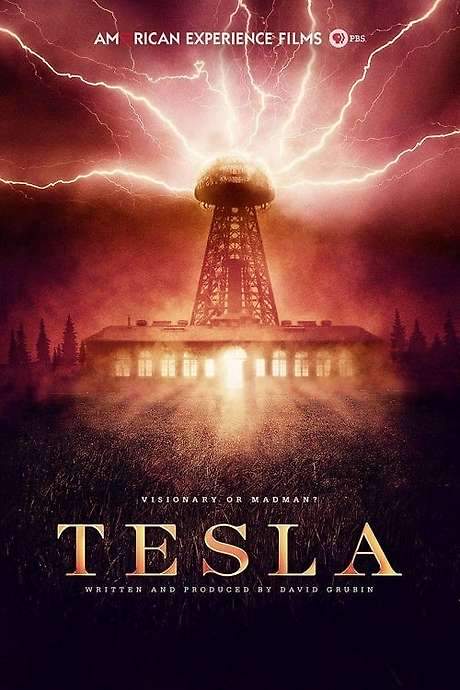
Tesla 2016


Directed by

David Grubin
Made by

Where to Watch Tesla
See current US streaming, rental, and purchase options for Tesla (2016) via JustWatch.






Tesla Plot Summary
Read the complete plot summary and ending explained for Tesla (2016). From turning points to emotional moments, uncover what really happened and why it matters.
Nikola Tesla’s fascinating life story unfolds through the voice of Michael Murphy, who guides us through the key moments and discoveries of this visionary inventor. The narrative begins with a childhood memory, where Tesla, as a young boy, experiences a sudden flash of electrical energy while petting his pet cat, hinting at his innate connection to electricity and his future pursuits.
In the bustling streets of 1884 New York City, Tesla (portrayed by Ethan Hawke) is working alongside Thomas Edison (Kyle MacLachlan), who doesn’t seem to hold Tesla in high regard. Their relationship is filled with tension, especially after a heated confrontation where they smash ice cream cones into each other’s faces—a petty but illustrative moment of their rivalry. During this period, Tesla struggles with financial hardship and is overshadowed by Edison, whose fame and influence far surpass Tesla’s initial recognition. Despite this, Tesla’s innovative mind relentlessly pushes forward, leading to his development of the induction motor, a breakthrough innovation that begins to attract attention and respect from others in the industry.
A scene features Anne Morgan (Eve Hewson), who appears as the narrator, suggesting that history may not be as straightforward as it seems. She notes that when one searches for Tesla, only a few images and stories pop up, whereas Edison’s results are much more plentiful. She emphasizes Tesla’s early hardships with poverty and showcases his first flashes of inspiration, hinting that these moments laid the groundwork for his groundbreaking inventions.
Tesla’s journey takes him into collaborations with prominent figures like George Westinghouse, who acquires Tesla’s patents for his inventions, and helps bring Tesla’s AC (alternating current) technology to the forefront by overseeing its production in Pittsburgh. This rivalry with Edison intensifies, as Edison champions direct current and dismisses Tesla’s alternating current as dangerous. The film also captures the personal side of Tesla’s life—his relationship with Anne, who is the daughter of JP Morgan (Donnie Keshawarz). Their love story develops amidst the chaos of industrial battles and the fight for electrical supremacy.
Tesla’s experiments expand, with notable scenes including the successful demonstration of his Tesla coil in Colorado, which impresses but also causes chaos when it blows up a local generator. His pioneering inventions continue to attract interest, and Morgan invests a significant sum to support Tesla’s vision of transforming global electricity. The story depicts the clash of ambitions and the struggle to balance invention, finance, and personal dreams.
The narrative also hints at darker moments, like the gruesome execution of William Kemmler with an electric chair, which Edison initially claims as proof of the dangers of Tesla’s alternating current. Meanwhile, Tesla’s infatuation with actress Sarah Bernhardt (Rebecca Dayan) adds a layer of personal longing and distraction, culminating in tense encounters with Edison, who resents Tesla’s growing success.
As Tesla’s achievements become more widely recognized—especially after the 1893 World’s Columbian Exposition where Tesla’s technology is showcased—the rivalry begins to soften. Edison, in a rare moment of concession, admits he was wrong, but the narrator clarifies that this reconciliation never truly happened. Instead, Edison’s bitterness remains, while Tesla’s innovations continue to gain prominence.
Tesla’s relationship with JP Morgan begins to take a more serious turn as he pitches his ideas for revolutionary technologies, including a device to map brain waves and signals that could potentially originate from Mars—an ambitious and controversial claim that reflects Tesla’s visionary mindset. Morgan, skeptical yet intrigued, invests a considerable amount of money into Tesla’s projects, but the landscape remains uncertain. The film dives into Tesla’s later years, revealing his struggles to find support and recognition for his increasingly ambitious inventions.
Throughout the story, Tesla’s personal sacrifices and loneliness are highlighted, as he outlives many of his contemporaries, including Edison, Westinghouse, Bernhardt, and Morgan. In the end, Tesla dies alone at the age of 87, just as Anne Morgan reflects on his enduring legacy, suggesting that perhaps he overreached or that the world was built on dreams he first envisioned. She concludes with the poignant thought that maybe, just maybe, the world we live in is one that Tesla dreamed first.
The film masterfully blends historical fact with reflection, underscoring Tesla’s brilliant yet often misunderstood contributions to science and technology, and leaving viewers to ponder the elusive nature of genius and innovation.
Tesla Timeline
Follow the complete movie timeline of Tesla (2016) with every major event in chronological order. Great for understanding complex plots and story progression.
Tesla's Childhood and First Encounter with Electricity
As a young child, Nikola Tesla saw a flash of electricity when petting his cat, hinting at his future fascination with the power. This early experience sparked his curiosity and set him on the path to become an inventor and scientist. The narrator suggests that Tesla's innate sensitivity to electricity was a recurring theme throughout his life.
Tesla Arrives in New York City, 1884
In 1884, Tesla begins working in New York City for Thomas Edison, who doesn’t seem to regard him highly. Tesla faces struggles and financial hardships during this period, but remains determined to develop his ideas despite Edison's dismissiveness. Tensions between Tesla and Edison begin to develop as they compete over electrical inventions.
Tesla Presents His Motor Inventions
Tesla pitches his induction motor to potential investors, receiving high praise for his innovation. With the support of his friend Anthony Szigeti, Tesla begins working on his motor, aiming to revolutionize electrical engineering. His inventions begin to gain recognition within the scientific community.
Meeting Anne Morgan and JP Morgan's Support
Tesla meets Anne Morgan, the daughter of financier JP Morgan, and later presents his findings to her father. Impressed by Tesla's ideas, Morgan invests in Tesla's inventions, providing crucial financial backing. This support helps Tesla move forward with his groundbreaking work on electrical systems.
Westinghouse Buys Tesla’s Patents
George Westinghouse purchases Tesla’s patents for his electrical inventions and brings Tesla to Pittsburgh to oversee production. The rivalry between Tesla’s alternating current and Edison’s direct current heats up, with Edison championing the latter. Tesla’s AC system begins to demonstrate its potential as a viable power supply.
Edison’s Direct Current vs. Tesla’s Alternating Current
Edison dismisses Tesla’s AC system, insisting direct current is superior and campaigning against Tesla’s technology. Despite the opposition, Tesla’s alternating current gains acceptance, especially after powering the 1893 World’s Fair. The technological race between the two systems becomes a central theme of their rivalry.
Edison’s Failed Electric Execution Event
William Kemmler becomes the first person to be executed using electric induction, but the process is gruesomely botched, damaging Edison’s reputation. Edison blames the doctors and attempts to discredit Tesla’s electrical systems, intensifying the public debate over electric power.
Tesla’s Success at the World’s Fair
In 1893, Tesla’s alternating current is successfully used to power the World’s Fair, showcasing its safety and efficiency. Edison’s efforts to discredit AC are overshadowed by its impressive performance. This event marks a turning point, establishing Tesla’s technology as a leading electrical system.
Tesla’s Move to Colorado and the Tesla Coil
Tesla relocates to Colorado, where he develops the Tesla coil. His invention demonstrates powerful electrical discharges, but also causes accidents, such as blowing up a local generator. Tesla offers to pay for damages, showing his commitment to his innovations despite setbacks.
Tesla’s Meeting with JP Morgan and Funding
Tesla showcases his technological potential to JP Morgan, convincing him to invest $100,000 in his projects. Despite skepticism from Morgan, Tesla’s ideas about using his machines to benefit the world begin to gain traction. Tesla’s ambitious visions continue to drive his research forward.
Tesla’s Brain Wave Mapping and Excessive Ambition
Tesla discusses developing technology to map brain waves for mind control and signals from Mars, showcasing his increasingly visionary and experimental ideas. These pursuits highlight his desire to push the boundaries of science, even as some see his ambitions as overreach. Tesla’s reputation as a pioneering scientist is solidified.
Tesla’s Later Years and Isolation
As Tesla’s inventions and ambitions grow more ambitious, he becomes increasingly isolated. He moves to the French countryside to work on health initiatives for children and away from the electrical world he once aimed to revolutionize. He eventually dies alone at the age of 87, reflecting on a life of groundbreaking yet often overlooked achievements.
Tesla Characters
Explore all characters from Tesla (2016). Get detailed profiles with their roles, arcs, and key relationships explained.
Tesla (Ethan Hawke)
Tesla is depicted as a brilliant and visionary inventor driven by curiosity and a desire to advance humanity. His character struggles with recognition and the challenges of commercialization, often torn between scientific idealism and financial reality.
Anne Morgan (Eve Hewson)
Anne serves as the narrator and a thoughtful observer of Tesla's life, reflecting on his achievements and personal sacrifices. She embodies a perspective of admiration and contemplation on the impact of Tesla's work and legacy.
Thomas Edison (Kyle MacLachlan)
Edison is portrayed as a rival and skeptic of Tesla’s alternating current, emphasizing the competitive and commercial conflicts of the era. His character embodies pragmatic innovation and the cutthroat nature of the industrial age.
Tesla Settings
Learn where and when Tesla (2016) takes place. Explore the film’s settings, era, and how they shape the narrative.
Time period
1880s to early 1900s
The film covers a period from the 1880s, when Tesla begins his work in electricity, through the early 20th century, highlighting the technological advancements, rivalries, and societal context of that transformative era in industrial America.
Location
New York City, Pittsburgh, Colorado
The movie is primarily set in late 19th and early 20th century locations, including bustling New York City where Tesla works at the Edison labs, industrial Pittsburgh where Tesla collaborates with Westinghouse, and Colorado, where Tesla develops the Tesla coil amidst mountainous landscapes. These locations reflect the technological innovation and expansion during that era.
Tesla Themes
Discover the main themes in Tesla (2016). Analyze the deeper meanings, emotional layers, and social commentary behind the film.
⚡
Innovation
The movie explores Tesla's pioneering work with electricity and technological inventions, depicting his relentless pursuit of innovation. It emphasizes how groundbreaking ideas can reshape the world yet also face skepticism and opposition.
🎭
Fame and Obscurity
Tesla's rise to fame contrasts with his later solitude, illustrating themes of recognition, exploitation, and the fleeting nature of celebrity. His journey reflects both the brilliance and the loneliness often associated with revolutionary inventors.

Coming soon on iOS and Android
The Plot Explained Mobile App
From blockbusters to hidden gems — dive into movie stories anytime, anywhere. Save your favorites, discover plots faster, and never miss a twist again.
Sign up to be the first to know when we launch. Your email stays private — always.
Explore the mobile appTesla Spoiler-Free Summary
Discover the spoiler-free summary of Tesla (2016). Get a concise overview without any spoilers.
In a restless era where the glow of new streetlights mixes with the clatter of industry, the film follows the restless spark of Nikola Tesla, a prodigious mind whose curiosity for electricity feels almost otherworldly. Guided by a reflective narration that feels like a gentle lecture from a distant mentor, the story opens on a city that is both a playground for invention and a battlefield for ambition. The tone is wistful yet electric, inviting the audience to feel the hum of possibility that surrounds every workshop and laboratory.
Tesla is portrayed as a dreamer whose brilliance is matched only by his unconventional methods and lingering solitude. His magnetic personality draws the attention of visionary financiers and collaborators, while his rivalry with the pragmatic and outspoken Thomas Edison sets up a clash of ideals that reverberates through the bustling streets of 1880s New York. The tension between their approaches to harnessing power provides a constant undercurrent, hinting at both professional respect and personal frustration without revealing the outcomes of their contests.
Supporting figures such as the shrewd industrialist George Westinghouse and the enigmatic patron JP Morgan orbit the inventor, offering both opportunity and restraint. Meanwhile, the poised presence of Anne Morgan, who serves as a narrative compass, frames the story with a thoughtful commentary on how history remembers brilliance. Through fleeting glances, quiet conversations, and lingering moments of wonder, the film paints a portrait of an inventor whose personal sacrifices are as profound as his technological triumphs.
All the while, the audience is left to contemplate the fragile line between genius and isolation, the allure of dreams that outpace their time, and the quiet echo of a mind that imagined a world forever illuminated by his vision. The mood remains evocative and contemplative, urging viewers to wonder whether the world we live in today is, in fact, a legacy of the unbridled imagination first sparked by Tesla.
Featured on this page

What's After the Movie?
Not sure whether to stay after the credits? Find out!
Check out our other apps:

SAT Sphere
Build confidence for the Digital SAT.

Mori Atlas
Discover wild places worth protecting.

Luntero
Search smarter for a home in Amsterdam.

Plot Explained
Unravel movie endings and hidden clues.

Pokechamp
Dive into Pokémon data and battle logic.

Driving Theory
Get ready for your European theory test.

Movie Dust
Plan your next cinema trip with ease.

Musemap
Find art and culture as you travel.

Selkobase
Compare credentials before committing.

Local Manual
Turn an unfamiliar country into practical next steps.

Lernavi
Compare school systems before your next move.

GymRoam
Find a workout stop wherever your plans take you.
Explore Our Movie Platform
New Movie Releases (2026)
Famous Movie Actors
Top Film Production Studios
Movie Plot Summaries & Endings
Major Movie Awards & Winners
Best Concert Films & Music Documentaries
Movie Collections and Curated Lists
© 2026 What's After the Movie. All rights reserved.
Privacy Policy