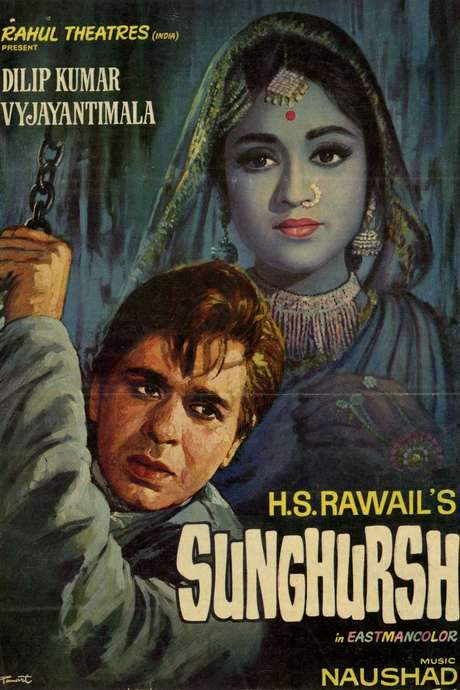
Sunghursh 1968

Directed by

Harnam Singh Rawail
Made by

Rahul Theatres
Where to Watch Sunghursh
See current US streaming, rental, and purchase options for Sunghursh (1968) via JustWatch.

Amazon Video
SD
Google Play Movies
SD
YouTube
SD Streaming availability powered by 
Sunghursh Plot Summary
Read the complete plot summary and ending explained for Sunghursh (1968). From turning points to emotional moments, uncover what really happened and why it matters.
Kashi, a city renowned for its spiritual significance, is the backdrop for the complex and intense story of Bhavani Prasad, a powerful Shakta priest who is deeply devoted to the black goddess Kali. However, beneath his devout exterior lies a dark secret. Bhavani Prasad, played by [Dilip Kumar], is also a thuggee—a murderous criminal who practices ritualistic killings of wealthy travelers staying at his pilgrim guesthouse. These victims are offered up as sacrifices to Kali in accordance with his twisted beliefs, creating a sinister aura around his religious devotion.
The story unfolds through the life of his son, Shankar. Shankar, portrayed by [Sanjeev Kumar], opposes his father’s ruthless methods and refuses to partake in the murderous rituals. His moral stance puts him at odds with Bhavani Prasad, leading him to decide to leave the village along with his wife and their three children: Kundan, Yashoda, and Gopal. Bhavani Prasad, determined to carry on his dark legacy, forcibly takes Kundan away from his family to follow in his footsteps. He forbids Kundan from seeing his mother and siblings, raising the young boy in a strict and oppressive environment.
Kundan, now being brought up by his grandfather Bhawani Prasad, harbors the hope of becoming the successor—serving as the head of a temple and the pilgrim guesthouse located on the banks of the Ganges river. Tensions escalate when a deep family secret is revealed: Bhavani Prasad had murdered his own son (Kundan’s father), then falsely accused his enemy and nephew, Naubatlal, of the crime. Naubatlal, played by [D.K. Sapru], was previously attacked by Bhavani Prasad, who also had a history of killing Naubatlal’s father. When Naubatlal uncovers the truth, he becomes consumed with revenge, but Bhavani Prasad manages to kill him before he can act.
Naubatlal’s family, devastated and seeking justice, migrates to Calcutta, where his two young sons—Dwarka and Ganeshi Prasad—grow into merchants. The brothers, played by [Sanjeev Kumar] and other supporting actors, learn about their father’s murder from their mother (Mumtaz Begum) and vow to avenge his death at any cost. Their mission sets the stage for a saga of revenge, betrayal, and familial conflict.
Meanwhile, Kundan, while serving in a temple in Banaras, refuses to partake in the violent rituals of his grandfather. As he develops a sense of morality and independence, he gets an invitation to his sister Yashoda’s wedding—a rare opportunity to reconnect with his family after many years in seclusion. During this visit, Kundan reunites with his mother and siblings. It is here that he meets Laila-E-Aasmaan, a courtesan from Calcutta who has come to Banaras after her madam’s death. Through her, Kundan rediscovers his childhood friend, Munni, and falls in love. However, his love story is complicated by his grandfather’s machinations; Bhavani Prasad opposes their union, suspecting Laila’s motives.
The plot thickens as Kundan attempts to forge peace with Dwarka, seeking to end the cycle of violence that has haunted their family for generations. Unfortunately, Dwarka is not easily moved. In a confrontation that leads to tragedy, Dwarka attacks Kundan, only to be killed by him in self-defense. Driven by guilt over his grandfather’s sins and the bloodshed, Kundan adopts a new identity as Bajrangi—a symbol of his desire to break free from the cycle of violence.
Yet, as Kundan tries to find his own path, he uncovers that Ganeshi, played by another character, is secretly in love with Laila and desires to marry her as his second wife. The web of loyalties, revenge, love, and moral conflict continues to grow more tangled, amplifying the complex nature of this multi-layered tale.
Throughout the story, the film explores themes of religious fanaticism, family loyalty, moral integrity, and the struggle for redemption. Kundan’s journey from a innocent young boy caught in family feuds to a man seeking justice and peace forms the emotional core of this compelling narrative. The film masterfully weaves together elements of drama, tragedy, and spirituality, culminating in a powerful reflection on the consequences of blind faith and ruthless vengeance.
Sunghursh Timeline
Follow the complete movie timeline of Sunghursh (1968) with every major event in chronological order. Great for understanding complex plots and story progression.
Introduction to Bhavani Prasad
Bhavani Prasad is depicted as a powerful Shakta priest residing in Kashi, known for his radical and violent religious practices. He is a devotee of Kali and secretly involves himself in the thuggee tradition of murdering wealthy travelers to offer sacrifices to Kali. His authority and influence are rooted in his religious and criminal activities within the village.
Shankar's opposition and departure
Shankar, Bhavani Prasad's son, opposes his father's violent practices and the thuggee tradition. He decides to leave the village with his wife and children to escape the dangerous environment and start anew elsewhere. His departure marks a break from the violent legacy of his family.
Kundan is taken by Prasad
Prasad forcibly takes his grandson Kundan to raise him in his own image, with the intention of making Kundan his successor in running a temple and a pilgrim guesthouse on the Ganges. This decision sets the stage for Kundan's upbringing amidst the complex interplay of faith and violence.
Prasad's murder of his son and blame on Naubatlal
Bhavani Prasad kills his own son, Shankar, and falsely blames his enemy, Naubatlal, for the deed. This act of murder is driven by Prasad's desire to eliminate his enemies and protect his reputation, revealing the dark side of his character.
Naubatlal's family moves to Calcutta
Naubatlal's widow and children, Dwarka and Ganeshi Prasad, relocate to Calcutta after the death of Naubatlal. Embittered by their father's murder, they vow to seek revenge against Bhavani Prasad for his role in his death.
Kundan serves in the Banaras temple
Kundan grows older and continues serving in the temple at Banaras, but he rejects his grandfather's violent thuggee practices and chooses a different spiritual path. His moral stance begins to contrast with his grandfather's earlier actions.
Kundan's family reunion
Kundan gets a rare opportunity to meet his family at Yashodha’s marriage, reconnecting with his mother and siblings after years of separation. This reunion rekindles old familial ties amidst the ongoing tension between his past and present.
Kundan meets Laila and discovers her true identity
Kundan encounters Laila-E-Aasmaan, a courtesan from Calcutta who was sent to seduce him, only to realize she is his childhood friend, Munni. Their reunion deepens the emotional complexity of Kundan's life and love.
Kundan's proposal and family tactics
Kundan proposes marriage to Laila, but Prasad disapproves, suspecting her motives and her connection to his enemies. Meanwhile, the ongoing feud with Dwarka remains unresolved and tense.
Conflict with Dwarka and his death
Dwarka attacks Kundan during an attempt to undermine him, but Kundan fights back and kills Dwarka in self-defense. This event signifies Kundan's tragic entanglement in the cycle of violence.
Kundan adopts a new identity for peace
To atone for his family's sins, Kundan adopts the identity of Bajrangi and seeks to serve Ganeshi, aiming to make peace with his heritage. This decision reflects his inner conflict and desire for redemption.
Ganeshi's love for Laila
It is revealed Ganeshi Prasad, another family member, is in love with Laila and desires to marry her as his second wife. This introduces a new layer of complication and rivalry within the familial relationships.
Sunghursh Characters
Explore all characters from Sunghursh (1968). Get detailed profiles with their roles, arcs, and key relationships explained.
Kundan / Bajrangi (Dilip Kumar)
Kundan is a conflicted protagonist raised in a religious setting but opposed to his grandfather's violent practices. He seeks to reconcile his faith with his moral beliefs, demonstrating complexity, compassion, and a desire for peace. His transformation into Bajrangi symbolizes his effort to atone for familial sins.
Yashoda S. Prasad (Anju Mahendru)
Yashoda is Kundan’s sister and a key family member who bridges the traditional and modern aspects of the story. Her marriage is a significant event that reconnects Kundan with his family, representing familial bonds amidst conflict.
Dwarka N. Prasad (Sanjeev Kumar)
Dwarka is driven by revenge against Prasad, embodying the quest for justice. His actions reflect the theme of familial loyalty and the destructive effects of revenge, as his life is intertwined with hatred and loss.
Ganeshi N. Prasad (Balraj Sahni)
Ganeshi is a merchant caught in the family feud who holds hopes for peace and reconciliation. His character embodies the selfless desire to end the cycle of violence and to restore harmony.
Laila-E-Aasmaan / Munni (Vyjayanthimala)
Laila is a courtesan with a mysterious past who rekindles childhood friendships and romances. Her character adds layers of love and conflict, representing the intersection of personal desire and societal expectations.
Sunghursh Settings
Learn where and when Sunghursh (1968) takes place. Explore the film’s settings, era, and how they shape the narrative.
Time period
20th century
The story takes place during the 20th century, a period marked by social change, traditional beliefs, and urban development in India. It reflects the era's complex social dynamics, including religious practices and familial feuds that shape the characters' lives.
Location
Kashi, Banaras, Calcutta
The movie is set primarily in Kashi (Banaras), a sacred city on the banks of the Ganges known for its temples and spiritual significance. It also features the bustling city of Calcutta, a major commercial and cultural hub. The contrasting locations highlight the spiritual versus modern worlds, and are central to the characters' journeys.
Sunghursh Themes
Discover the main themes in Sunghursh (1968). Analyze the deeper meanings, emotional layers, and social commentary behind the film.
🔥
Revenge
Revenge drives much of the plot, with characters seeking justice or payback for past wrongs. Naubatlal's family vows to avenge his death, and Kundan's actions are influenced by his desire to address familial sins. Revenge intertwines with themes of morality and justice throughout the story.
🕉️
Religion
Religion, especially Hindu rituals and beliefs, deeply influences the characters and the plot. The worship of Kali, the practice of sacrifice, and temple life are central to the narrative, reflecting the tension between spiritual duty and moral righteousness.

Coming soon on iOS and Android
The Plot Explained Mobile App
From blockbusters to hidden gems — dive into movie stories anytime, anywhere. Save your favorites, discover plots faster, and never miss a twist again.
Sign up to be the first to know when we launch. Your email stays private — always.
Explore the mobile appSunghursh Spoiler-Free Summary
Discover the spoiler-free summary of Sunghursh (1968). Get a concise overview without any spoilers.
In the timeless city of Banaras, where river‑banks echo with prayers and the scent of incense pervades every alley, a palpable tension clings to the ancient stone. The film immerses you in a world where devotion and danger coexist, the luminous rituals of the Shakta tradition casting shadows that hint at hidden rites. Within this sacred tapestry moves a charismatic figure who commands reverence as a priest while privately steering a far darker enterprise.
Bhavani Prasad is the spine of that enterprise—an imposing presence whose public piety masks an unyielding desire to cement his legacy through blood‑bound succession. His eldest son, Shankar, cannot bear the weight of his father’s ruthless path and chooses exile, taking his wife and children away from the holy precincts. The departure creates a rift that reverberates through generations, leaving the youngest heir, Kundan, at the crossroads of faith and family expectation.
Caught between the solemn chants of the temple and the ominous expectations of his forebear, Kundan is raised under the austere tutelage of his grandfather, taught that honor and duty are inseparable from the lineage he inherits. Yet the boy’s quiet curiosity and innate sense of rightness set him apart, suggesting a potential break from the cycle that has bound his clan for decades. Across the river, the distant cousin Naubat Lal represents another branch of the same tangled family tree, a reminder that old grievances linger beneath the surface of communal life.
The mood is one of brooding intensity, where the flickering oil lamps of the ghats illuminate both devotion and desperation. As the story unfolds, the audience feels the weight of inherited obligation and the pull of personal conscience, inviting a lingering question: can a soul born into darkness ever find its own light?
Featured on this page

What's After the Movie?
Not sure whether to stay after the credits? Find out!
Check out our other apps:

SAT Sphere
Build confidence for the Digital SAT.

Mori Atlas
Discover wild places worth protecting.

Luntero
Search smarter for a home in Amsterdam.

Plot Explained
Unravel movie endings and hidden clues.

Pokechamp
Dive into Pokémon data and battle logic.

Driving Theory
Get ready for your European theory test.

Movie Dust
Plan your next cinema trip with ease.

Musemap
Find art and culture as you travel.

Selkobase
Compare credentials before committing.

Local Manual
Turn an unfamiliar country into practical next steps.

Lernavi
Compare school systems before your next move.

GymRoam
Find a workout stop wherever your plans take you.
Explore Our Movie Platform
New Movie Releases (2026)
Famous Movie Actors
Top Film Production Studios
Movie Plot Summaries & Endings
Major Movie Awards & Winners
Best Concert Films & Music Documentaries
Movie Collections and Curated Lists
© 2026 What's After the Movie. All rights reserved.
Privacy Policy