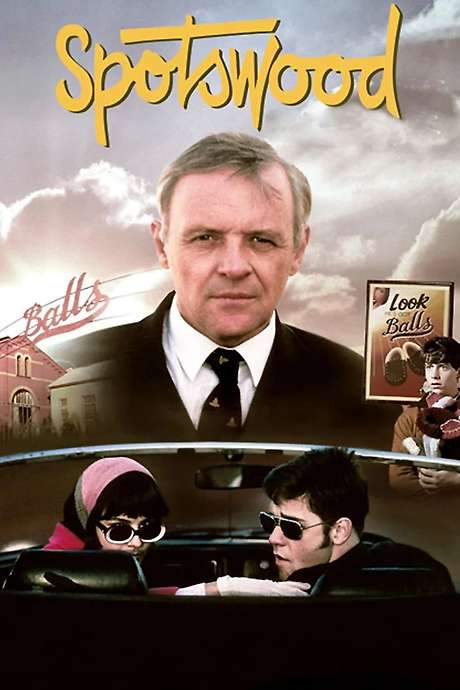
Spotswood 1991


Directed by

Mark Joffe
Made by

Australian Film Commission
Where to Watch Spotswood
See current US streaming, rental, and purchase options for Spotswood (1991) via JustWatch.

Amazon Prime Video
HD
Amazon Prime Video with Ads
HD
fuboTV
HD
Darkroom
HD
Fawesome
HD
Hoopla
SD
Kanopy
HD
Amazon Prime Video Free with Ads
HD
Fandango at Home Free
HD
Plex
HD
Plex Channel
HD
The Roku Channel
HD
Tubi TV
SD
Amazon Video
HD
Apple TV Store
HD Fandango At Home
HD
Google Play Movies
SD
YouTube
SD Streaming availability powered by 
Spotswood Plot Summary
Read the complete plot summary and ending explained for Spotswood (1991). From turning points to emotional moments, uncover what really happened and why it matters.
In Melbourne, Errol Wallace, [Anthony Hopkins], is a financial business consultant hired by the board of Durmack, an automotive components manufacturer, to assess a large-scale workforce redundancy and he recommends major layoffs.
Balls, a moccasin factory located in the Melbourne suburb of Spotswood, is his next client. Mr. Ball, [Alwyn Kurts], the owner, is affable and treats his employees benevolently. Wallace on a factory tour finds the conditions wanting with shabbiness, old machinery and the workers’ lackadaisical attitude.
A young worker at Balls, Carey, [Ben Mendelsohn], who is finding his place in the world and life, is asked by Wallace to assist in his review, compiling worker condition and performance information. Carey is reluctant until he learns that Mr. Ball’s daughter Cheryl, [Rebecca Rigg], whom he fancies, is part of the review staff.
Wallace learns that there is an instigator in the midst, his colleague Jerry, [John Walton], who leaks the Durmack report, inflating the quantity of sackings as a means to demoralise the union.
Kim Barry, [Russell Crowe], a salesman at Balls who also has his sights set on the boss’s daughter, shows his ruthlessness and ulterior motives when he comes to Wallace’s home one night with a complete set of the company financial records that detail non-existent profit for years and reveal that Ball has been selling off company assets to keep the outfit afloat.
Wallace realises that whatever productivity improvements have been implemented are not enough to save the company even with an elimination of workers and yet that is his recommendation. Mr. Ball responds, > “It’s not just about dollars and cents. It’s about dignity, treating people with respect.”
Wallace’s mindset starts to change when his car is vandalised and some Ball workers come to his aid, workers who then start to include him in their off-hours activities. Mr. Ball announces the work force redundancies and Wallace is clearly uncomfortable seeing them, knowing that it was his recommendation that sealed their fate.
The union at Durmack capitulates and management celebrates with a party during which Wallace becomes further disenchanted by what he sees as the rash sackings. He then realises that Balls may have a competitive advantage that could potentially make the company profitable. If Balls stop trying to compete on price on a few products, but instead have a very large product range, then all the perceived inefficiencies (old machinery and a large number of highly skilled experienced workers), become opportunities for growth.
Carey realises he has feelings for his work mate and friend Wendy, [Toni Collette], and together they climb up onto the roof of the factory and hold hands. In the final shot, they look out over the West Gate Bridge, which opened in 1978 — an ending which deliberately leaves it ambiguous as to when the film is actually set.
Spotswood Timeline
Follow the complete movie timeline of Spotswood (1991) with every major event in chronological order. Great for understanding complex plots and story progression.
Wallace is hired by Durmack to assess redundancies
Wallace is hired by the Durmack board to assess a planned large-scale workforce redundancy. He conducts analysis, interviews, and weighs the financials to determine the impact of layoffs. He concludes that major job cuts are necessary, setting a tense tone for the corporate purge.
Carey joins the Balls review
Carey, a young Balls worker, is asked to assist Wallace with the workplace review. He is reluctant at first until he learns that Ball's daughter Cheryl is part of the review staff, which motivates him. The collaboration foreshadows the tensions between workers and management.
Wallace tours Balls factory, notes shabby conditions
Wallace tours the Balls moccasin factory and sees shabby facilities, old machinery, and a workforce that appears driftless. He notes how these conditions reflect inefficiency and potential for improvement. This initial visit builds the case for his later recommendations.
Jerry leaks the Durmack report
Wallace learns that a colleague, Jerry, has leaked the Durmack report to inflate layoff numbers and demoralize the union. The leak creates tension between management and the workers and colors Wallace's perspective. It becomes a catalyst for power struggles within the company.
Kim Barry exposes falsified profits
Kim Barry arrives at Wallace's home with the company records, revealing that profits have been non-existent for years and that assets have been sold to keep the business afloat. The revelation undermines trust and complicates the case for layoffs. Wallace confronts the reality of corporate deception.
Wallace confronts the limits of productivity gains
Wallace realises that productivity improvements and staff reductions won't save Balls. Despite this, he still recommends layoffs, which deepens his moral conflict. The moment marks a turning point as he begins to see the human cost of the decision.
Vandalism and solidarity from workers
Wallace's car is vandalised, but Balls workers come to his aid and begin including him in their off-hours activities. The act of solidarity shifts his perception of the workers from adversaries to potential allies. He starts to feel the human impact of the decision.
Ball announces redundancies
Ball publicly announces the workforce redundancies, and Wallace watches with clear discomfort, realizing the human cost of his recommendation. The scene cements the conflict between managerial pragmatism and worker dignity. The atmosphere turns sour as the layoffs loom.
Union capitulates and management party
The union at Durmack capitulates as management celebrates with a party. Wallace becomes increasingly disillusioned with the ruthlessness of the purge and the superficial corporate victories. The party-setting underscores the separation between decision-makers and workers.
A new perspective: diversification as a growth path
Wallace begins to rethink Balls' competitive position, considering that a very large product range could convert inefficiencies into opportunities for growth. Rather than pure price competition, diversification could offer profits without wholesale layoffs. The idea marks a potential shift away from his earlier stance.
Carey and Wendy rooftop moment
Carey realises his feelings for Wendy and they climb onto the factory roof to hold hands. The moment adds a human and hopeful counterpoint to the industrial conflict. It hints at a personal future beyond the factory.
Final shot: West Gate Bridge ambiguity
In the final shot, Carey and Wendy look out over the West Gate Bridge, whose opening in 1978 anchors a sense of time while deliberately leaving the film's setting ambiguous. The ending invites multiple interpretations about when the events occurred. The bridge serves as a thematic backdrop for the unresolved question of time and progress.
Spotswood Characters
Explore all characters from Spotswood (1991). Get detailed profiles with their roles, arcs, and key relationships explained.
Errol Wallace (Anthony Hopkins)
A sharp financial consultant hired to evaluate Balls and push for redundancies, whose journey shifts from strict cost-cutting to a humane consideration of the workers' dignity and relationships.
Carey (Ben Mendelsohn)
A young factory worker who assists with the review and wrestles with his ambitions, loyalty to colleagues, and personal feelings for Cheryl.
Kim Barry (Russell Crowe)
A ruthless salesman who uncovers non-existent profits and asset sales, exposing the darker underbelly of the company’s survival strategies.
Wendy Robinson (Toni Collette)
Carey’s workmate and love interest who embodies hope and humanity amid the industrial crisis; they share a symbolic rooftop moment.
Mr. Ball (Alwyn Kurts)
Factory owner who appears affable and supportive of his workers, striving to keep the business afloat while acknowledging the dignity of his staff.
Jerry Finn (John Walton)
A colleague who leaks the audit to demoralize the union, representing internal sabotage and the escalating industrial tension.
Cheryl Ball (Rebecca Rigg)
Daughter of Mr Ball and a member of the review staff; her presence intersects personal affection with professional scrutiny, influencing the audit’s dynamics.
Spotswood Settings
Learn where and when Spotswood (1991) takes place. Explore the film’s settings, era, and how they shape the narrative.
Time period
The exact year is left unspecified, but the film evokes late 20th-century Australia and industrial decline. Clues such as the West Gate Bridge’s 1978 opening place it in a era where manufacturing faced modernization pressures, labor unions remained influential, and corporate restructuring was common.
Location
Spotswood, Melbourne, Australia
The action centers on Spotswood, a Melbourne suburb dominated by a moccasin factory that anchors the community. The Balls factory represents a working-class industrial enclave with aging machinery and a close-knit workforce. The surrounding city of Melbourne provides the urban backdrop for the workers’ struggles and for Wallace’s audit.
Spotswood Themes
Discover the main themes in Spotswood (1991). Analyze the deeper meanings, emotional layers, and social commentary behind the film.
🏭
Dignity at work
The film centers on workers' dignity beyond profits. Wallace’s encounter with the Balls workforce reveals that treating people with respect matters as much as productivity, challenging the cold logic of downsizing.
💼
Profit vs people
Durmack’s redundancies and Ball’s precarious finances raise questions about balancing efficiency with human impact. The narrative tracks how financial pressures can threaten worker security and community morale.
🤝
Solidarity and trust
A growing bond forms between Wallace and the workers after acts of support, shifting him from observer to participant. The workers’ collective response contrasts with management strategies that seek to demoralize unions.
🕰️
Ambiguous era
The film deliberately defers a precise setting, using an industrial Melbourne milieu and a rooftop finale over the West Gate Bridge to suggest a transitional period rather than a fixed year.

Coming soon on iOS and Android
The Plot Explained Mobile App
From blockbusters to hidden gems — dive into movie stories anytime, anywhere. Save your favorites, discover plots faster, and never miss a twist again.
Sign up to be the first to know when we launch. Your email stays private — always.
Explore the mobile appSpotswood Spoiler-Free Summary
Discover the spoiler-free summary of Spotswood (1991). Get a concise overview without any spoilers.
In the gritty industrial heart of Melbourne, a city where factories hum and the scent of leather lingers, a seasoned efficiency consultant arrives with a briefcase full of spreadsheets and a reputation for ruthless numbers. Errol Wallace has built his career cutting through corporate red tape, and his latest assignment sees him evaluating a massive workforce reduction for Durmack, a dominant auto‑parts manufacturer. The film opens with Wallace’s methodical precision set against boardroom power plays, hinting at the personal toll such calculations can exact.
Just a short drive away, the modest streets of Spotswood cradle a very different world. Balls, a small‑scale moccasin workshop, still echoes with the clatter of antiquated machinery and the camaraderie of craftsmen who have long accepted the rhythm of their trade. The owner, Mr. Ball, runs the place with a paternal kindness that feels almost anachronistic in a rapidly modernising city. Wallace is sent here to determine whether the shop can survive the relentless push for efficiency, setting the stage for a clash between nostalgic craftsmanship and cold corporate logic.
Among the workers, a restless young man named Carey is reluctantly drawn into Wallace’s assessment, hoping to prove his worth while quietly nursing a crush on the owner’s daughter, Cheryl. A colleague back at Durmack, Jerry, seems to have his own agenda, while Kim Barry, a savvy salesman with his eye on the family, adds another layer of ambition and intrigue. Wendy, Carey’s fellow employee, offers a glimpse of loyalty and the subtle bonds that hold the workshop together, hinting at the personal stories woven throughout the factory floor.
The tone of the film balances the sterile efficiency of corporate boardrooms with the warm, lived‑in atmosphere of a community workshop. It explores themes of loyalty, desire, and the human cost of change, all framed by Melbourne’s industrial landscape and the quiet melancholy of a town on the cusp of transformation. The mood invites curiosity about how each character will navigate the inevitable tension between progress and preservation.
Movies with Similar Twists and Themes
Uncover films that echo the narrative beats, emotional arcs, or dramatic twists of the one you're exploring. These recommendations are handpicked based on story depth, thematic resonance, and spoiler-worthy moments — perfect for fans who crave more of the same intrigue.



Featured on this page

What's After the Movie?
Not sure whether to stay after the credits? Find out!
Check out our other apps:

SAT Sphere
Build confidence for the Digital SAT.

Mori Atlas
Discover wild places worth protecting.

Luntero
Search smarter for a home in Amsterdam.

Plot Explained
Unravel movie endings and hidden clues.

Pokechamp
Dive into Pokémon data and battle logic.

Driving Theory
Get ready for your European theory test.

Movie Dust
Plan your next cinema trip with ease.

Musemap
Find art and culture as you travel.

Selkobase
Compare credentials before committing.

Local Manual
Turn an unfamiliar country into practical next steps.

Lernavi
Compare school systems before your next move.

GymRoam
Find a workout stop wherever your plans take you.
Explore Our Movie Platform
New Movie Releases (2026)
Famous Movie Actors
Top Film Production Studios
Movie Plot Summaries & Endings
Major Movie Awards & Winners
Best Concert Films & Music Documentaries
Movie Collections and Curated Lists
© 2026 What's After the Movie. All rights reserved.
Privacy Policy