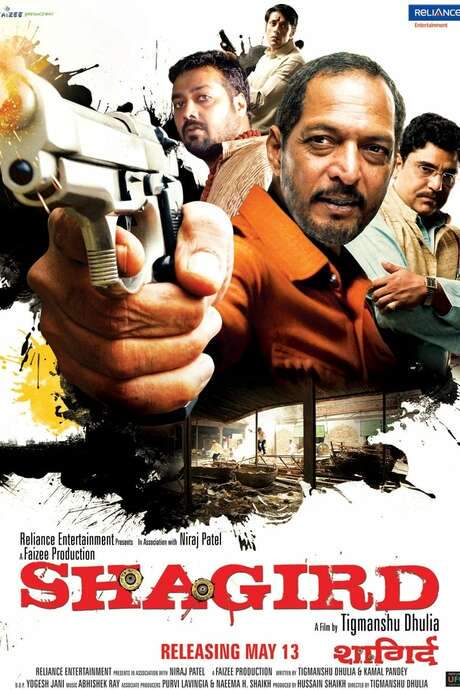
Shagird 2011

Directed by

Anurag Kashyap
Made by

Reliance Entertainment
Where to Watch Shagird
See current US streaming, rental, and purchase options for Shagird (2011) via JustWatch.

Fawesome
HD
Plex
HD
Plex Channel
HD
Tubi TV
SD
Amazon Video
SD Streaming availability powered by 
Shagird Plot Summary
Read the complete plot summary and ending explained for Shagird (2011). From turning points to emotional moments, uncover what really happened and why it matters.
The movie begins with Anurag Kashyap portraying Bunty Bhaiya, a notorious gangster who is eventually arrested in Ghaziabad by Inspector Shukla. His arrest sheds light on the widespread political-mafia nexus infiltrating various layers of the country’s institutions. The story then shifts to Delhi, where Mohit Ahlawat is about to join the Crime Branch as a sub-inspector, under the guidance of Senior Inspector Hanumant Singh, played by Nana Patekar. Mohit quickly becomes involved with Hanumant and his team, which includes Shamsher and Rathi. They are shown engaging in corrupt practices, taking bribes from land developers and accepting commissions from land mafias that threaten local landowners with violence.
Hanumant Singh is depicted as a formidable figure, who is feared by both the criminals and the officials. His views about justice are stark: he believes in taking brutal, decisive actions against offenders. For example, he visits a land mafia boss, Choudhary, from Rajasthan, with the intention of eliminating him, and succeeds in killing him and his gang. The film captures this act as a display of Hanumant’s ruthless approach, as he surrounds the remaining gang members and quickly implements his own form of justice.
During the incident, a news crew led by Varsha Mathur from the Aaj Tak channel arrives to report on the situation. Hanumant, ever the tactician, mimics a cameraman and, at the moment the gang members emerge from hiding, shoots them, claiming they were wanted terrorists. This act underscores the gray morality that characterizes Hanumant’s methods, blending official law enforcement with vigilante justice.
Later, Hanumant and his team pick up Mohit for a ride, during which the contrast between their personalities is subtly emphasized. Hanumant, aware of Mohit’s potential ties to influential figures, probes into his background, revealing that he has gained his high-level posting through influence rather than merit. This discussion exposes the corrupt fabric of the system, and Mohit dismisses Hanumant’s bribe as an “income of sin.” Their relationship is further complicated when Hanumant takes Mohit to a party where it’s revealed that they are childhood friends and that Mohit harbors a long-standing crush on Varsha.
The story takes a darker turn when Hanumant receives a threat to his family from an unknown attacker, demanding they leave India, hinting at the dangerous world he is entangled in. Subsequently, Bunty Bhaiya is transferred to jail, where he’s treated as a high-profile prisoner. In prison, Bunty befriends two terrorists of Lashkar-E-Haq, hinting at his deep connections with larger terrorist networks and political figures like Rajmani Yadav. The political connections reveal an intricate web of power, as Rajmani, portrayed by Zakir Hussain, has recently been appointed as the Foreign Minister.
Hanumant Singh is shown attending Rajmani’s birthday celebration, where Rajmani presses Hanumant to eliminate a rival, Ali, a man suspected of being involved in criminal activities. Rajmani believes that removing Ali will secure his position. Before the encounter, Hanumant intercepts and sabotages a drug deal, which leads to a tense situation where Mohit saves Hanumant’s life in a daring rescue. Following these events, Hanumant secretly sends his wife and son to New Zealand for their safety, underscoring the constant danger he faces.
The plot thickens as terrorists belonging to Lashkar-E-Haq kidnap journalists, including Varsha, demanding the release of Bunty Bhaiya from Tihar jail. The authorities, under Rajmani’s orders, try to eliminate Bunty covertly, with Hanumant tasked with killing him in jail. Mohit, acting on his own initiative, infiltrates Tihar to uncover the terrorists’ plans and begins to beat information out of them. His efforts lead to the murder of journalist Vijay Jindal, a consequence of the terrorists’ retaliation.
In a series of betrayals, it’s revealed that Hanumant is orchestrating events to trap Rajmani. He fakes Bunty’s death and secretly leads Bunty to a safe house, revealing that his own boss, Rajmani, wants Bunty eliminated. Hanumant also arranges for cash to be sent to New Zealand via Hawala, further illustrating the illegal dealings he’s involved in. As the tension escalates, Hanumant eliminates Shamsher, staging it as a suicide, and demands a ransom of 15 crores from Rajmani for Bunty’s life, threatening to release footage of Bunty’s confessions if his demands aren’t met.
The film intensifies as Hanumant himself is ambushed and shot by Mohit, who then takes him to the hospital. In the hospital, Hanumant discovers that Mohit has been working for Rajmani all along. Despite this revelation, Hanumant chooses to share his ransom money with Mohit, planning to profit from Rajmani’s corruption. They devise a scheme to increase the ransom from 15 to 25 crores by secretly recording Bunty with Mohit, unaware that this footage would later backfire.
As their plan unfolds, and money exchanges hands, Bunty’s location is compromised, and Rajmani orders his assassination. In a tragic twist, Rajmani shoots Bunty dead after luring him into a trap. Meanwhile, Mohit is also killed during a citywide chase, with his previous efforts to uncover the truth coming to a tragic end. Hanumant, having reached the peak of his dangerous game, is shot multiple times by Kamlesh, his own trusted aide, who admits he needs the money for his family and succumbs to greed. With Hanumant’s death, the story closes on a grim note, as his life ends listening to old Hindi songs on his TV, symbolizing the tragic toll of a life immersed in violence, corruption, and betrayal.
Throughout the narrative, themes of corruption, morality, and the complex nature of justice are explored, painted against a backdrop of political intrigue and criminal enterprise. The film’s storyline presents a gritty, realistic view of law enforcement’s blurred lines and the brutal choices made by those caught in the web of power and crime.
Shagird Timeline
Follow the complete movie timeline of Shagird (2011) with every major event in chronological order. Great for understanding complex plots and story progression.
Bunty Bhaiya's Arrest
The film begins with gangster Bunty Bhaiya being arrested in Ghaziabad by Inspector Shukla. Bunty's arrest aims to reveal the pervasive political-mafia nexus that influences various sections of the country. His capture sets the stage for the unfolding story of crime, corruption, and power struggles.
Introduction of Mohit Kumar
In Delhi, Mohit Kumar prepares to join the Crime Branch as a sub-inspector, meeting senior officer Hanumant Singh and his team. Mohit learns about the corrupt practices involving land mafias and bribes within the police force. His arrival introduces a new character whose integrity is tested amidst a corrupt system.
Hanumant Kills Land Mafia Choudhary
Hanumant Singh visits land mafia lord Choudhary and eliminates him along with his gang, signaling his tough, brutal approach to crime. The incident attracts media attention, as Hanumant disguises the killing as an anti-terror operation, showcasing his feared reputation. This action demonstrates his complex morality and commitment to his version of justice.
Threat Against Hanumant's Family
Hanumant's wife receives threats, warning him of consequences if he continues his activities. He is advised to leave India for their safety. Meanwhile, Hanumant continues to operate in the shadows, balancing his responsibilities with personal danger.
Bunty Bhaiya in Jail and Connection to Politicians
Bunty Bhaiya is transferred to Delhi jail where he befriends terrorists and maintains ties with politician Rajmani. Bunty's high-profile presence and political connections highlight the intersection of crime and politics. Bunty's influence remains a crucial element in the power dynamics.
Hanumant Encounters Rajmani
Hanumant and Mohit attend Rajmani's birthday party, where Rajmani schemes to eliminate threats including the assassin Ali. Hanumant sabotages a drug deal by taking bribe money and drugs, and Mohit saves Hanumant's life during the encounter, cementing their complex relationship.
Kidnapping of Journalists and Bunty's Imprisonment
Omar Muktar Gazni and terrorists kidnap journalists, demanding the release of Bunty Bhaiya from Tihar jail. Rajmani orders Hanumant to kill Bunty, forcing Hanumant into a morally ambiguous position, revealing the dangerous nexus of crime, religion, and politics.
Hanumant's Deception and Kidnapping of Bunty
Hanumant secretly attacks the terrorists and convinces Bunty that Rajmani intends to kill him. Hanumant then secretly takes Bunty to a safe house, revealing to the audience that he orchestrated the kidnapping to manipulate the situation for his own ends.
Hanumant's Confrontation with Rajmani
Hanumant demands ransom money from Rajmani for Bunty's life, threatening to release confessional videos if his demands are not met. Meanwhile, Hanumant plans to fake his own death after being shot, escalating the web of deception and betrayal.
Shamsher's Assassination and Hanumant's Hospitalization
Hanumant kills Shamsher Rana after learning of a plot against him, faking it as a suicide. He is then admitted to a hospital where he begins to realize Mohit's true allegiance lies with Rajmani, setting the stage for the final acts of betrayal.
Final Ransom and the Death of Bunty
Hanumant and Mohit increase the ransom amount and orchestrate a plan to fake Bunty's death, leading to a confrontation with Rajmani. Bunty is shot dead by Rajmani after being lured into a trap, marking the climax of the power struggle.
Mohit's Death and Betrayal
Following the death of Bunty, Mohit attempts to escape and confronts Rajmani but is killed in a car chase. His death completes the cycle of betrayal, emphasizing the destructive nature of corruption and violence.
Hanumant's Final Moments
Hanumant, after being shot multiple times by Kamlesh, reflects on his life listening to Hindi songs. His death signifies the tragic end of a complex, morally ambiguous cop caught in a web of crimes and corruption.
Shagird Characters
Explore all characters from Shagird (2011). Get detailed profiles with their roles, arcs, and key relationships explained.
Hanumant Singh (Nana Patekar)
A tough, morally complex police officer who is willing to cross ethical lines to fight crime and corruption. His actions reveal a deep sense of duty coupled with a willingness to operate outside the law to achieve justice.
Mohit Ahlawat (Mohit Ahlawat)
A young, idealistic police officer who initially seeks justice but becomes entangled in corruption and criminal schemes. His journey reflects moral conflicts and the corrupting influence of power and money.
Varsha Mathur (Rimi Sen)
An ambitious journalist who covers the political and criminal landscape, her role highlights media’s power and vulnerabilities. She is caught between truth and sensationalism, risking her life for journalistic integrity.
Rajmani Yadav (Zakir Hussain)
A powerful politician with secret ties to criminal activities, representing the corrupt political class. His actions drive much of the conflict, showcasing the nexus between politics and crime.
Shagird Settings
Learn where and when Shagird (2011) takes place. Explore the film’s settings, era, and how they shape the narrative.
Time period
Contemporary/Modern era
The movie is set in the current or recent past, depicting modern criminal and political activities with references to contemporary police work, media, and international relocation. It illustrates a period marked by high-tech crime, political corruption, and complex law enforcement operations typical of the 21st century.
Location
Ghaziabad, Delhi, Rajasthan, New Zealand
The movie predominantly takes place across various parts of India, including Ghaziabad and Delhi, known for their bustling city life and political hubs. Rajasthan features as an area of land dealings and mafia activity, while New Zealand is seen as a safe haven for the protagonist's family. The settings reflect a mix of urban chaos, political intrigue, and international escape.
Shagird Themes
Discover the main themes in Shagird (2011). Analyze the deeper meanings, emotional layers, and social commentary behind the film.
🕵️♂️
Corruption
Corruption is central to the film, portraying how political figures, police officers, and criminals intertwine for personal gain. The narrative explores the moral ambiguities faced by law enforcement and the influence of bribery and political power on justice.
🔥
Vigilantism
The story emphasizes themes of vigilante justice and moral ambiguity as characters resort to extrajudicial measures. Hanumant's actions blur lines between law enforcement and criminality, reflecting the complex nature of justice.
🎥
Media Influence
Media plays a significant role, with journalists caught in the conflict, shaping public perception. The film examines how media coverage can influence political power and legal proceedings, often intertwined with sensationalism and corruption.

Coming soon on iOS and Android
The Plot Explained Mobile App
From blockbusters to hidden gems — dive into movie stories anytime, anywhere. Save your favorites, discover plots faster, and never miss a twist again.
Sign up to be the first to know when we launch. Your email stays private — always.
Explore the mobile appShagird Spoiler-Free Summary
Discover the spoiler-free summary of Shagird (2011). Get a concise overview without any spoilers.
In a Delhi where the line between law and power blurs, the city’s streets pulse with a restless energy that feels both ordinary and hostile. The Crime Branch operates under a heavy shadow of political patronage, with officials and underworld figures moving in a silent dance of favors and pressure. The atmosphere is gritty and unvarnished, a world where justice is often measured by influence rather than principle, and where every conversation can carry a hidden demand.
Enter Hanumant Singh, a senior inspector whose reputation for getting results is matched only by his unconventional, and sometimes unsettling, methods. He navigates the murky corridors of corruption with a mix of street‑wise intuition and a willingness to bend rules that would make many balk. His presence commands both fear and respect, and his approach to policing feels like a pragmatic survival tactic in a system that rewards flexibility over legality.
The arrival of Mohit Ahlawat, a fresh recruit to the Crime Branch, disturbs the uneasy equilibrium. Though outwardly eager and seemingly upright, his background hints at connections that could either reinforce or challenge the status quo. As he steps into the team, the contrast between his demeanor and Hanumant’s seasoned cynicism creates a subtle tension, suggesting a clash of philosophies that will test loyalties and motivations.
Against this backdrop of political machinations and quiet desperation, the film sets a tone that is both stark and compelling. The narrative hints at a world where moral choices are rarely black and white, and where each character must decide how far they are willing to go to protect what matters most. The stage is set for a confrontational dance between tradition and ambition, leaving the audience to wonder whether the newcomer will reshape the balance or become another pawn in an ever‑shifting game.
Featured on this page

What's After the Movie?
Not sure whether to stay after the credits? Find out!
Check out our other apps:

SAT Sphere
Build confidence for the Digital SAT.

Mori Atlas
Discover wild places worth protecting.

Luntero
Search smarter for a home in Amsterdam.

Plot Explained
Unravel movie endings and hidden clues.

Pokechamp
Dive into Pokémon data and battle logic.

Driving Theory
Get ready for your European theory test.

Movie Dust
Plan your next cinema trip with ease.

Musemap
Find art and culture as you travel.

Selkobase
Compare credentials before committing.

Local Manual
Turn an unfamiliar country into practical next steps.

Lernavi
Compare school systems before your next move.

GymRoam
Find a workout stop wherever your plans take you.
Explore Our Movie Platform
New Movie Releases (2026)
Famous Movie Actors
Top Film Production Studios
Movie Plot Summaries & Endings
Major Movie Awards & Winners
Best Concert Films & Music Documentaries
Movie Collections and Curated Lists
© 2026 What's After the Movie. All rights reserved.
Privacy Policy