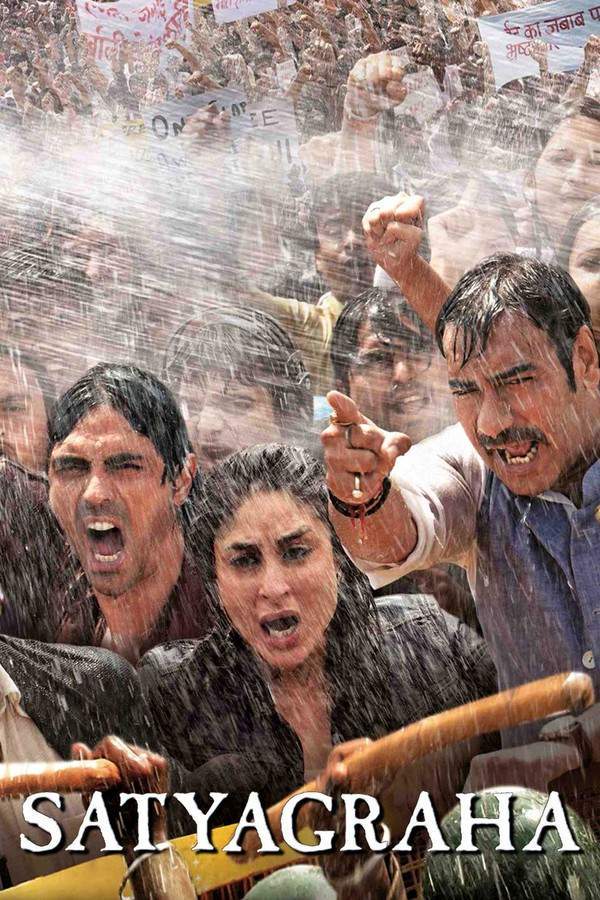
Satyagraha 2013

Directed by

Prakash Jha
Made by

Satyagraha Plot Summary
Read the complete plot summary and ending explained for Satyagraha (2013). From turning points to emotional moments, uncover what really happened and why it matters.
Dwarka Anand is a retired teacher and former principal living in Ambikapur, where he embodies steadfast idealism. He shares a simple life with his engineer son, Akhilesh, and Akhilesh’s wife, Sumitra. The film sets its stage around Akhilesh’s friend, Manav, an ambitious capitalist who respects his friend deeply. Tragedy strikes when Akhilesh dies in a road accident that is revealed to have been orchestrated by Sangram Singh, the brother of the powerful minister Balram Singh. Unknown to the nation, Balram Singh is the architect behind Akhilesh’s murder, and the revelation sets off a chain of consequences that exposes a broader struggle against corruption and injustice.
Despite the grim truth, Balram Singh publicly offers compensation, a gesture that remains out of reach for Sumitra as she faces constant delays and bureaucratic hurdles in securing what is owed. The situation escalates when Dwarka Anand confronts the system so bluntly that he slaps the district magistrate (DM), an act that lands him in prison. The imprisonment becomes a rallying point for a larger movement: Manav leverages social media to mobilize support for Dwarka’s release, enlisting Arjun Singh and journalist Yasmin to amplify the cause. What begins as a personal grievance soon swells into a mass agitation, drawing hopeful students, hungry workers, and a growing middle class into a chorus demanding accountability and reform. The political class starts to feel the pressure as the online campaign gains momentum and visibility.
Dwarka’s release comes only after relentless pressure compels the DM to withdraw the complaint—pressure that comes from Balram Singh, whose grip over the system is challenged by popular demand for justice. Once freed, Dwarka does not retreat from the fight. He issues a stark ultimatum: a 30-day deadline for the government to clear all pending claims in the district. The campaign intensifies, and a hunger strike is declared to press for an ordinance that would reorganize the district’s governance to better serve the public. The movement is marked by a tragic turn when Lal Bahadur, a young supporter, takes his own life to signal his commitment to the cause. His cortege becomes a flashpoint, and four policemen are killed by a violent mob, triggering riots that push Balram Singh to unleash a paramilitary response.
The violence spirals, and in the midst of chaos, Dwarka is shot—killed in Manav’s arms as he pleads with the crowd to quell the violence and restore calm. The murder shocks the public and brings swift police action that leads to Balram Singh’s eventual arrest. In the aftermath, the motives behind the struggle crystallize: Manav and Arjun resolve to channel this crisis into a new regional political effort aimed at eradicating corruption and rebuilding the system with the welfare of ordinary people at the core. The narrative closes on a note of renewed civic purpose, underscoring a faith that organized, peaceful political action can transform a broken system, even as it bears the heavy costs borne by those who stand at the forefront of reform.
Satyagraha Timeline
Follow the complete movie timeline of Satyagraha (2013) with every major event in chronological order. Great for understanding complex plots and story progression.
Dwarka Anand's idealistic life in Ambikapur
Dwarka Anand is a retired teacher and ex-principal who lives in Ambikapur with his engineer son Akhilesh and daughter-in-law Sumitra. He is portrayed as a principled idealist who cares deeply about social justice and public welfare. His values set the emotional ground for the events to come.
Akhilesh's death engineered on the road
Akhilesh, the friend of Manav, dies in a road accident that is maliciously engineered by Sangram Singh. Balram Singh is revealed as the mastermind behind Akhilesh's murder. Manav begins to suspect a larger conspiracy that implicates powerful interests.
Compensation promised but out of reach
Balram Singh announces compensation for Akhilesh's family, but Sumitra cannot obtain it despite submitting daily applications. The bureaucratic hurdles and political maneuvering highlight the system's inefficiency. The injustice fuels public outrage and personal desperation.
Dwarka slaps the DM and is imprisoned
Dwarka Anand publicly slaps the District Magistrate in protest of the perceived injustice and bureaucratic impotence. As a consequence, he is imprisoned, turning a moment of moral stand into a political flashpoint. The arrest galvanizes his supporters and heightens the tension in Ambikapur.
Manav launches a campaign to free Dwarka
Manav starts a social-media driven campaign to secure Dwarka's release, leveraging online activism and public sympathy. He allies with Arjun Singh and journalist Yasmin to broaden the movement's reach. The campaign reframes the issue as a fight against corruption and political oppression.
Mass mobilization across the district
Hopeful students, hungry laborers, and angry middle-class citizens rally to support Dwarka and demand accountability. Politicians begin to panic as the movement grows beyond a single protest. The agitation illustrates the sustained demand for systemic change.
Dwarka's release under pressure
Under pressure from Balram Singh, the DM withdraws the complaint and Dwarka Anand is released. The victory is framed as a procedural concession, but it fuels a broader push to reform the district’s governance. The community sees the result as a partial triumph that comes with costs.
Notice to clear pending claims district-wide
Dwarka issues a 30-day ultimatum to the government to clear all pending claims in the entire district. The demand signals a shift from individual grievances to structural redress. It also sets the stage for further escalation if demands are not met.
Hunger strike and ordinance demand
Dwarka undertakes a hunger strike, pressing the government to pass an ordinance to address the district's grievances. The move heightens the symbolic weight of the movement and draws broader public attention. The tactic underscores his willingness to sacrifice personal comfort for collective reform.
Lal Bahadur's suicide and the deadly cortege
Lal Bahadur, a youth supporting the agitation, commits suicide to symbolize solidarity. During his cortege, four policemen are killed by the mob, escalating the violence and widening the cycle of retaliation. The tragedy intensifies public fear and outrage across the district.
Riots erupt and the crackdown tightens
Riots erupt across parts of the district as crowds clash with security forces. Balram Singh orders a paramilitary deployment to quell the protests and reassert control. The confrontation tests the resilience of the protesters and the capacity of the state to manage chaos.
Dwarka is shot; he dies in Manav's arms
Balram Singh's henchman shoots Dwarka Anand as the violence peaks. He dies in Manav's lap, muttering a plea for the people to stop the riots. The death becomes a defining moment that cements the demand for systemic change.
A new political path emerges
Balram Singh is ultimately captured, and Manav with Arjun Rampal commits to building a regional party aimed at eliminating corruption and reconstructing the system for the common welfare. The film closes with this strategic political realignment as the next phase of the movement begins.
Satyagraha Characters
Explore all characters from Satyagraha (2013). Get detailed profiles with their roles, arcs, and key relationships explained.
Dwarka Anand (Amitabh Bachchan)
A retired teacher and ex-principal with a steadfast belief in justice. He embodies moral courage, challenging bureaucratic power and sparking a wide-reaching movement. His willingness to risk personal freedom for public welfare highlights the film’s core ideal of principled leadership. His actions catalyze the chain of events that drive the activism forward.
Akhilesh (Indraneil Sengupta)
Dwarka’s engineer son, initially supportive of his father’s ideals. His unexpected death in a staged road accident becomes a catalyst for public outrage and mobilization. The tragedy personalizes the fight against corruption and accelerates the movement's urgency. He embodies the costs borne by ordinary families in the struggle for justice.
Sumitra (Amrita Rao)
Akhilesh’s wife who faces systemic denial of compensation despite persistent appeals. She joins the broader protest, representing the middle-class grievances demanding accountability. Her role highlights how personal hardship fuels collective action. She becomes a symbol of resilience within the community’s fight for justice.
Manav (Ajay Devgn)
A friend of Akhilesh and an ambitious capitalist who initiates a social media-driven campaign to free Dwarka. He harnesses modern communication tools to mobilize citizens and galvanize public opinion. His involvement demonstrates how private interests can intersect with public activism for systemic change. He helps catalyze the formation of a reformist political agenda.
Balram Singh (Manoj Bajpayee)
A powerful minister and the mastermind behind Akhilesh’s murder. He uses political influence to suppress claims and manipulate outcomes. His actions trigger riots and a brutal crackdown, underscoring the corrupt machinery at the heart of the conflict. His eventual downfall exposes the vulnerabilities of entrenched power.
Arjun Singh (Arjun Rampal)
A journalist and ally who collaborates with Manav to channel the movement into a broader political platform. He leverages media influence to shape public perception and pressure authorities. His strategic involvement showcases the power of information in democratic reform. He represents the integration of journalism and activism within the campaign.
Yasmin (Kareena Kapoor Khan)
A journalist who documents the agitation and amplifies the voices of the oppressed. She provides critical coverage that sustains momentum and informs national discourse. Her reporting frames the ethical questions surrounding state violence and civil rights. She embodies the role of the press as a public watchdog during a political crisis.
Satyagraha Settings
Learn where and when Satyagraha (2013) takes place. Explore the film’s settings, era, and how they shape the narrative.
Time period
Early 2010s
The events unfold in a contemporary India, where social media campaigns and mass mobilizations increasingly influence public policy. The period emphasizes a modern democratic landscape with citizen-led pressure on authorities. The storyline reflects a time when traditional politics meets new-age activism, reshaping how justice is sought.
Location
Ambikapur, Chhattisgarh, India
Ambikapur serves as the central setting for the political drama, depicted as a typical Indian district town where citizens confront injustice and demand accountability. The city frames the movement from local grievances to national attention, illustrating the ripple effect of activism. Its streets become the stage for protests, rallies, and governmental responses that shape the narrative's momentum.
Satyagraha Themes
Discover the main themes in Satyagraha (2013). Analyze the deeper meanings, emotional layers, and social commentary behind the film.
🕊️
Nonviolent Resistance
The film centers on peaceful means to challenge power, prioritizing moral authority over force. Dwarka Anand guides others toward nonviolent action, even as tensions rise. The movement demonstrates how civic discourse, public morale, and organized protests can pressure authorities. Tragedy underscores the cost of principled nonviolence, while leaving a legacy of activism.
💼
Corruption
Corruption is depicted as a pervasive force that distorts justice and protects elite interests. The mastermind Balram Singh wields political influence to suppress complaints and manipulate outcomes. The narrative shows how bureaucracy and power can entrench inequality, fueling public anger. The struggle centers on unveiling wrongdoing and demanding accountability.
🗳️
Democratic Reform
The plot arcs toward political renewal through citizen-driven change and regional political action. Dwarka’s movement catalyzes the formation of a party aimed at eradicating graft and reforming governance. The story explores how democratic processes and new coalitions can recalibrate a flawed system. It emphasizes that lasting reform arises from collective action and legal avenues.

Coming soon on iOS and Android
The Plot Explained Mobile App
From blockbusters to hidden gems — dive into movie stories anytime, anywhere. Save your favorites, discover plots faster, and never miss a twist again.
Sign up to be the first to know when we launch. Your email stays private — always.
Explore the mobile appSatyagraha Spoiler-Free Summary
Discover the spoiler-free summary of Satyagraha (2013). Get a concise overview without any spoilers.
In the quiet district of Ambikapur, a modest community is anchored by the steady presence of a retired teacher who has spent his life championing ideals. Dwarka Anand shares his home with his engineer son and his son’s devoted wife, forming a close‑knit family whose everyday rhythms are suddenly disrupted by a profound personal loss. The grief that follows becomes a catalyst, stirring the quiet town and pulling its residents into a larger conversation about responsibility, compassion, and the price of silence.
Meanwhile, a young woman, newly awakened to the possibility of love, navigates the delicate balance between personal yearning and the expectations of a society in flux. At the same time, her husband’s ambitious friend, an enterprising businessman, watches the unfolding turmoil with a mixture of respect and restless energy. Manav finds his own convictions tested as he observes the intersecting struggles of the grieving father, the hopeful lover, and a community yearning for change. Alongside him, a determined political figure, Arjun Singh, and a principled journalist, Yasmin, begin to sense that the personal grievances echo deeper, systemic disquiet.
As the town’s ordinary citizens—students, workers, and middle‑class families—feel the growing pressure of unanswered grievances, the atmosphere thickens with a mix of righteous anger and cautious optimism. The tone is one of quiet intensity, where everyday conversations hint at larger unrest, and the landscape itself seems to hold its breath. Within this charged environment, each character’s personal journey intertwines with a collective desire for justice, setting the stage for a story that explores loss, love, and the relentless pursuit of a fairer world.
Featured on this page

What's After the Movie?
Not sure whether to stay after the credits? Find out!
Check out our other apps:

SAT Sphere
Build confidence for the Digital SAT.

Mori Atlas
Discover wild places worth protecting.

Luntero
Search smarter for a home in Amsterdam.

Plot Explained
Unravel movie endings and hidden clues.

Pokechamp
Dive into Pokémon data and battle logic.

Driving Theory
Get ready for your European theory test.

Movie Dust
Plan your next cinema trip with ease.

Musemap
Find art and culture as you travel.

Selkobase
Compare credentials before committing.

Local Manual
Turn an unfamiliar country into practical next steps.

Lernavi
Compare school systems before your next move.

GymRoam
Find a workout stop wherever your plans take you.
Explore Our Movie Platform
New Movie Releases (2026)
Famous Movie Actors
Top Film Production Studios
Movie Plot Summaries & Endings
Major Movie Awards & Winners
Best Concert Films & Music Documentaries
Movie Collections and Curated Lists
© 2026 What's After the Movie. All rights reserved.
Privacy Policy