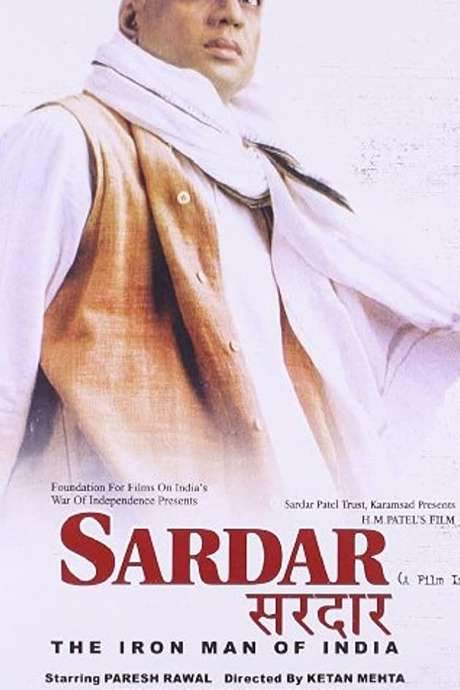



Sardar Plot Summary
Read the complete plot summary and ending explained for Sardar (1993). From turning points to emotional moments, uncover what really happened and why it matters.
The film opens with a young Sardar Patel, Paresh Rawal sitting around a card table with friends, where he mocks Mahatma Gandhi’s methods for achieving independence. His stance shifts when his brother introduces him to Gandhi; after listening to a stirring lecture, he joins the movement. He soon channels his energy into organizing a network of nonviolent protests across Gujarat, leading peaceful, well-coordinated actions that showcase both discipline and political acumen.
As the country moves toward independence, the story follows Patel through the Quit India era and the mounting pressures that shape the road to partition. He becomes a pivotal voice within the Congress Working Committee and toward Jawaharlal Nehru, Benjamin Gilani, urging them to consider a plan that would partition the subcontinent in the face of rising communal violence. Patel realizes that delaying action could spark civil war, and his calculations weigh heavily as riots erupt and the nation teeters on the brink.
Following partition, Patel shifts his focus to stitching together a fractured map by coaxing the princely states to join the Indian Union. The film details his handling of Kashmir, Junagadh, and Hyderabad, balancing diplomacy, power, and the realities on the ground as he negotiates with rulers and local leaders alike. It also portrays his tensions with Nehru and, after Gandhi’s death, the ways in which the two men work toward a shared vision for a young nation.
The closing scenes frame Patel in the quiet desert village of Shahpura in Rajasthan, reflecting on a country that stretches from Kashmir to Kanyakumari—one independent nation. The portrait emphasizes his lifelong drive to unify a diverse land through pragmatic leadership, conciliatory diplomacy, and a unifying vision.
Sardar Timeline
Follow the complete movie timeline of Sardar (1993) with every major event in chronological order. Great for understanding complex plots and story progression.
Patel ridicules Gandhi's policies in his youth
The film opens with a young Sardar Patel playing cards with friends and ridiculing Mahatma Gandhi and his policies for independence. This moment signals his initial doubt about nonviolent methods. It sets up his later transformation when he is exposed to Gandhi's ideas.
Brother introduces Gandhi; Patel joins the freedom struggle
Patel is introduced to Gandhi by his brother, and after listening to a Gandhi lecture, he joins the struggle for independence. This marks the beginning of his active political life. He moves from skepticism to commitment to Gandhian methods.
Patel leads Satyagrahas across Gujarat
He successfully organizes various Satyagrahas throughout Gujarat, galvanizing local populations. The campaigns showcase his organizational skill and growing influence within the freedom struggle. These actions lay the groundwork for his future leadership at the national level.
Quit India Movement and the road to independence
The film moves into the Quit India Movement, where Patel plays a key role in mobilizing resistance. His leadership helps drive the movement toward India's eventual freedom from British rule. The period culminates in a new political landscape for the country.
Advocating partition to avert civil war amid Direct Action riots
Patel is instrumental in persuading the Indian National Congress working committee and Nehru to accept a proposal for the partition of India. This comes as riots erupt following Direct Action Day, and he argues that partition may prevent a broader civil war. The decision shapes the subcontinent's future in profound ways.
Partition accepted; focus shifts to integrating princely states
With partition accepted, Patel concentrates on getting all princely states to join the Union of India. He navigates complex negotiations to avoid fragmentation and ensure a united nation. This period marks the practical challenges of unification after independence.
Kashmir accession crisis and Patel's diplomatic handling
The film portrays Patel's handling of the Kashmir issue, working to secure accession to India amid regional tensions. His diplomatic effort aims to prevent a broader conflict and align Kashmir with the new Indian state. The events unfold in the late 1940s.
Junagadh's accession and Patel's role in reunification
Patel deals with Junagadh's secessionist moves and works to bring the state into the Indian Union. His strategy blends diplomacy and firm political will to preserve national integrity. The resolution reinforces the central government's authority over princely states.
Hyderabad's accession and the balance of power
The film highlights Patel's efforts to integrate Hyderabad, addressing the Nizam's defiance and the security implications for the newly formed nation. The ensuing political maneuvering underscores the complexities of state unification. The Hyderabad episode tests Patel's resolve and leadership.
Differences with Nehru and the Gandhian era ends
Patel's differences with Nehru are portrayed, yet they work together after Gandhi's death to shape the fledgling republic. The film shows how personal visions of the country's future influence policy and strategy. Despite tensions, Patel remains a central figure in the leadership dynamic.
Cementing the union: joint efforts in the early Republic
Following Gandhi's death, Patel and Nehru collaborate to solidify the union, tackling ongoing integration challenges and setting the direction for India's governance. The partnership reflects a mature approach to differing opinions for the greater national good. The period is marked by consolidation rather than expansion of influence.
Patel's final resting place and unification motto
The film closes with Patel resting in Shahpura, Rajasthan, reflecting on a united nation from Kashmir to Kanyakumari. His vision of a single independent country endures as the narrative signs off. The moment symbolizes the lasting impact of his efforts on India's territorial integrity.
Sardar Characters
Explore all characters from Sardar (1993). Get detailed profiles with their roles, arcs, and key relationships explained.
Sardar Patel (Paresh Rawal)
Patel starts as a skeptic of Gandhi’s policies but undergoes a transformation after meeting Gandhi and hearing his lectures. He becomes a driving force behind organizing Satyagrahas in Gujarat and later plays a pivotal role in uniting the princely states into the Indian Union. His leadership is shown as both pragmatic and resolute, balancing political realism with national aspirations.
Mahatma Gandhi (Annu Kapoor)
Gandhi is portrayed as the spiritual and strategic mentor whose nonviolent philosophy inspires Patel and others. His ideas shape the movement’s methods and the moral framework of the struggle for independence. The film emphasizes his influence on shaping a nonviolent path to freedom.
Jawaharlal Nehru (Benjamin Gilani)
Nehru is depicted as a key political leader whose stance and decisions intersect with Patel’s strategic plans. The film suggests Patel’s role in convincing the INC Working Committee and Nehru to consider the partition plan, illustrating the complexities of consensus-building in a diverse movement.
Mohammad Ali Jinnah (Shri Vallabh Vyas)
Jinnah appears as a central figure in the drive for a Muslim-majority state, with his calls contributing to the momentum of the Direct Action movement and the eventual push toward Partition. The portrayal underscores the political maneuvering and the path toward a divided subcontinent.
Lord Mountbatten of Burma (Tom Alter)
Mountbatten is shown in his role guiding the transition of power and overseeing the partition planning. His interactions with Indian leaders highlight the British perspective on exit strategies and the negotiation dynamics that shaped the newborn Indian state.
Sardar Settings
Learn where and when Sardar (1993) takes place. Explore the film’s settings, era, and how they shape the narrative.
Time period
1940s
The film is set during the 1940s, the tense lead-up to India's independence. It covers the Quit India Movement and the critical period around the Partition. These years are depicted as a clash of ideals, negotiations, and the urgent drive to form a unified nation.
Location
Gujarat, Kashmir, Junagadh, Hyderabad, Shahpura (Rajasthan)
The story unfolds across key Indian locales—Gujarat where Patel drives satyagraha campaigns, Kashmir and Junagadh as contested princely states, Hyderabad as a symbolic challenge, and Shahpura in Rajasthan where personal resolve is tested. These places anchor the narrative of national integration, partition, and diplomacy. The varied landscapes reflect the political stakes of unifying a diverse subcontinent.
Sardar Themes
Discover the main themes in Sardar (1993). Analyze the deeper meanings, emotional layers, and social commentary behind the film.
🕊️
Unity
A central thread shows Patel pursuing the integration of princely states into a single Indian Union. The narrative emphasizes diplomacy, compromise, and the balance between communal interests and national harmony. It portrays unity as a pragmatic goal achieved through tough political decisions and consensus-building.
🔥
Partition
The film portrays the pressures and tensions leading to Partition, including riots and the moral urgency to prevent civil war. It highlights the difficult choice between splitting the country and preserving the integrity of the emerging nation. The consequences of partition drive the characters to navigate fear, violence, and political negotiation.
🎯
Leadership
Patel's strategic leadership is shown as he moves from skepticism to decisive action. The story focuses on his ability to coordinate a broad coalition, manage conflicting interests, and steer India toward a stable future. Leadership here is depicted as a blend of bold vision and pragmatic compromises.

Coming soon on iOS and Android
The Plot Explained Mobile App
From blockbusters to hidden gems — dive into movie stories anytime, anywhere. Save your favorites, discover plots faster, and never miss a twist again.
Sign up to be the first to know when we launch. Your email stays private — always.
Explore the mobile appSardar Spoiler-Free Summary
Discover the spoiler-free summary of Sardar (1993). Get a concise overview without any spoilers.
In a time when the subcontinent pulses with the restless energy of a people yearning for self‑determination, the film opens against a backdrop of crowded streets, courtrooms and quiet villages that together sketch the fraught landscape of late‑colonial India. The atmosphere is charged with both hope and uncertainty, a mixture of rousing speeches and hushed strategy sessions that hint at the massive transformation looming on the horizon. Light and shadow play across bustling markets and solemn gatherings, underscoring a world poised between the weight of tradition and the promise of a new political order.
At the heart of this canvas stands Sardar Vallabhbhai Patel, a charismatic and pragmatic figure whose early skepticism toward the prevailing methods of resistance gives way to an unexpected alliance with the movement’s moral beacon, Mahatma Gandhi. Driven by a fierce sense of duty, Patel’s evolution from a carefree youth to a committed leader is marked by his keen intellect, quiet determination, and the respect he commands among peers. His interactions with Gandhi reveal a dynamic tension—ideals colliding with practical concerns—that fuels his internal journey and sets the tone for the larger narrative.
The story unfolds as a measured, character‑driven drama that balances the grandeur of national aspiration with intimate moments of personal reckoning. Jawaharlal Nehru and other emerging voices of the freedom struggle orbit Patel, providing a rich tapestry of relationships that illuminate both collaboration and subtle rivalry. As the nation inches toward independence, the film hints at the monumental task of stitching together a mosaic of diverse regions into a single, coherent whole. Through measured dialogue, evocative cinematography, and a restrained yet stirring score, the movie invites viewers to witness the emergence of a leader whose steadfast resolve will shape the very foundation of a new India.
Movies with Similar Twists and Themes
Uncover films that echo the narrative beats, emotional arcs, or dramatic twists of the one you're exploring. These recommendations are handpicked based on story depth, thematic resonance, and spoiler-worthy moments — perfect for fans who crave more of the same intrigue.




Featured on this page

What's After the Movie?
Not sure whether to stay after the credits? Find out!
Check out our other apps:

SAT Sphere
Build confidence for the Digital SAT.

Mori Atlas
Discover wild places worth protecting.

Luntero
Search smarter for a home in Amsterdam.

Plot Explained
Unravel movie endings and hidden clues.

Pokechamp
Dive into Pokémon data and battle logic.

Driving Theory
Get ready for your European theory test.

Movie Dust
Plan your next cinema trip with ease.

Musemap
Find art and culture as you travel.

Selkobase
Compare credentials before committing.

Local Manual
Turn an unfamiliar country into practical next steps.

Lernavi
Compare school systems before your next move.

GymRoam
Find a workout stop wherever your plans take you.
Explore Our Movie Platform
New Movie Releases (2026)
Famous Movie Actors
Top Film Production Studios
Movie Plot Summaries & Endings
Major Movie Awards & Winners
Best Concert Films & Music Documentaries
Movie Collections and Curated Lists
© 2026 What's After the Movie. All rights reserved.
Privacy Policy