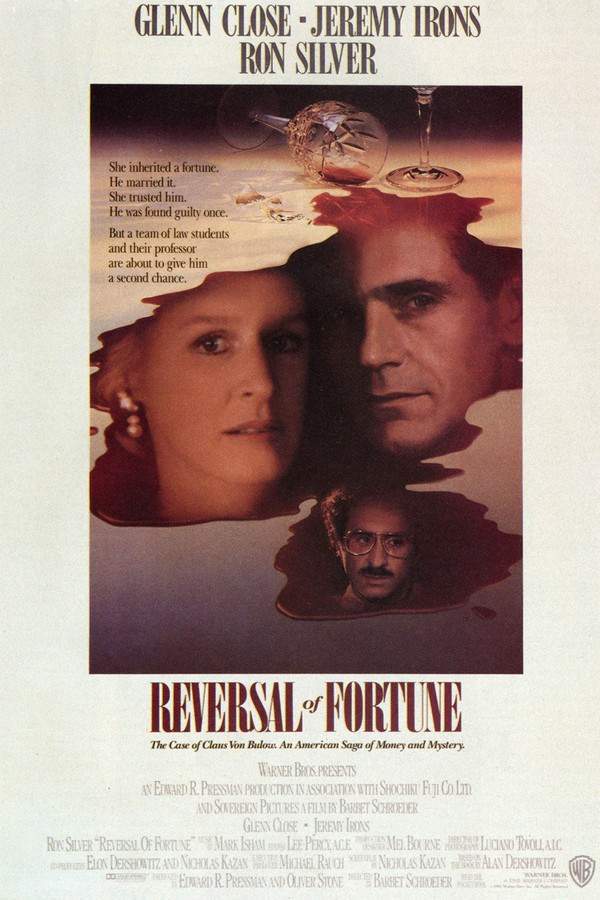
Reversal of Fortune 1990

Directed by

Barbet Schroeder
Made by

Warner Bros. Pictures
Where to Watch Reversal of Fortune
See current US streaming, rental, and purchase options for Reversal of Fortune (1990) via JustWatch.







Reversal of Fortune Plot Summary
Read the complete plot summary and ending explained for Reversal of Fortune (1990). From turning points to emotional moments, uncover what really happened and why it matters.
Sunny von Bülow, Glenn Close, a millionaire heiress and socialite, lies in a hospital bed in a persistent vegetative state after slipping into a coma from diabetic shock on December 21, 1980. A year earlier, she had fallen into a coma on December 26, 1979, but was revived. Her husband Claus von Bülow, Jeremy Irons, is charged with attempted murder by injecting the hypoglycemic Sunny with an overdose of insulin. During the trial, it is revealed that Claus was having an affair with actress Alexandra Isles and stood to gain financially if Sunny had died. He is found guilty on two counts of attempted murder.
While Claus von Bülow is released on bond, he files an appeal and seeks representation from Harvard law professor Alan Dershowitz. Dershowitz agrees only if Claus pays him three hundred dollars an hour, as he also works on a separate case where he tries to save two young black brothers from the electric chair. As he reviews the case, Dershowitz becomes convinced Claus is guilty based on the testimony of Maria, the von Bülows’ maid. He is given 45 days to file an appeal and assembles several of his law students to help review the details.
Dershowitz is later informed of David Marriott, a potential witness. At Marriott’s New York apartment, Marriott confesses that he worked as a drug trafficker, but Dershowitz remains skeptical about his reliability. Meanwhile, Dershowitz’s team learns that Robert Brillhoffer, the plaintiff’s attorney, had illegally withheld notes that could aid Claus’s defense. They are also alerted to a magazine interview given by Truman Capote, who stated that Sunny enjoyed mixing drugs and alcohol and taught herself how to self-inject.
Claus lunches with Dershowitz’s legal team and is questioned about Sunny’s overdose on aspirin three weeks before her second coma. Claus is unclear on what could have motivated her to suicide, but he assumes she was unhappy. After Sunny is revived from her first coma, she reprimands Claus for calling a doctor and implies that he would be better off if she had died.
Dershowitz’s defense team receives a toxicology report on the encrusted needle, which reveals no trace of insulin. Marriott arrives again at Dershowitz’s house, claiming his affidavit is not accurate. He covertly records their conversation, then edits the recording to make it look as if Dershowitz agreed to pay Marriott as a witness. Before the trial, Claus recounts what led up to Sunny’s second coma, describing how he found her lying face down on the bathroom floor with the windows open in frigid room temperature. Based on Claus’s testimony, Dershowitz believes Claus is innocent and tells his team that he will seek to overturn the conviction on grounds of insufficient evidence.
When Dershowitz dismisses his class, his students inform him that the jury reversed two convictions and they have obtained Brillhoffer’s notes. He arrives at a New York hotel suite where Claus is staying and hands him the notes, having uncovered conflicting circumstantial evidence that could exonerate Claus in his second trial. Relieved, Claus agrees to pay Dershowitz his legal fees. While Dershowitz calls it a legal victory, he delivers a blunt moral warning: > Morally, you are on your own.
Claus von Bülow is tried for a second time and acquitted, while the two young brothers remain on death row.
Reversal of Fortune Timeline
Follow the complete movie timeline of Reversal of Fortune (1990) with every major event in chronological order. Great for understanding complex plots and story progression.
Sunny's first coma and revival
Sunny Von Bülow falls into a coma on December 26, 1979 after a diabetic shock and is revived about a year later. The hospital ordeal marks the onset of the medical mystery at the center of the case.
Sunny's second coma
A year after the first episode, Sunny falls into a second coma on December 21, 1980 and remains in a vegetative state. The severity and timing of her comas propel the criminal case against Claus von Bülow.
Claus von Bülow charged
Claus von Bülow is charged with attempted murder for allegedly injecting Sunny with a lethal insulin overdose. The charge sets the stage for a high profile legal battle about intent, wealth, and influence.
Trial reveals affair and motive
During the trial, authorities uncover Claus's affair with actress Alexandra Isles and suspect a financial motive for Sunny's death. The revelation contributes to a jury finding Claus guilty on two counts of attempted murder.
Bond release and appeal launched
Claus is released on bond as he files an appeal. He hires Harvard law professor Alan Dershowitz, who charges three hundred dollars an hour and aims to save two black brothers on death row, adding a larger moral dimension to the case.
Dershowitz's case review begins
Dershowitz begins reviewing the case and becomes convinced, at least initially, by the maid Maria's testimony that points toward Claus's guilt. He has 45 days to file an appeal and assembles several law students to help review the record.
A potential witness and questions of reliability
David Marriott, a potential witness, confesses to drug trafficking, but Dershowitz questions his reliability. The defense team considers his affidavit and testimony with caution as the case moves forward.
Evidence issues surface
The defense learns that Brillhoffer, the plaintiff's attorney, illegally withheld notes that could aid Claus's defense. They also encounter a Capote interview suggesting Sunny enjoyed mixing drugs and teaching herself to self-inject.
Aspirin overdose questioned
Claus lunches with the Dershowitz team and they question him about an aspirin overdose three weeks before Sunny's second coma. He is unsure what could have motivated a suicide and speculates Sunny may have been unhappy.
Farewell to an affair
Claus reveals that he had told Sunny about his affair with Alexandra Isles during the summer of 1979. This admission adds to the complexity of their relationship and the case.
Sunny's reproach after the first coma
After Sunny is revived from the first coma, she reprimands Claus for calling a doctor and suggests that she would have been better off if she had died. The moment shapes the defense's understanding of Sunny's possible will and intent.
Forensic finding: no insulin on needle
The toxicology report on the encrusted needle reveals no trace of insulin, complicating the prosecution's case and providing a potential defense point.
Marriott's hotel visit and recording
Marriott arrives at Dershowitz's house, covertly records a conversation, and asserts he supplied drugs to Sunny. The recording is later manipulated to make Dershowitz appear to agree to pay him, tainting witness credibility.
Second coma details emerge
Before the second trial, Claus details what led to Sunny's second coma: he finds her lying face down on the bathroom floor with windows open in a frigid room. The description strengthens the defense by outlining the circumstances rather than insulin poisoning.
Second trial and acquittal
With new evidence and testimony in hand, Claus is tried again and acquitted. The film notes that two young brothers remain on death row as a consequence of the initial convictions.
Reversal of Fortune Characters
Explore all characters from Reversal of Fortune (1990). Get detailed profiles with their roles, arcs, and key relationships explained.
Claus von Bülow (Jeremy Irons)
A wealthy, high-society husband accused of attempting murder by insulin overdose. The case reveals his extramarital affair and potential financial motive, painting him as morally ambiguous. Throughout the film, he navigates public suspicion, legal pressure, and a high-stakes defense that culminates in a second trial and acquittal.
Sunny von Bülow (Glenn Close)
A millionaire socialite who falls into a coma, becoming the central figure of the legal drama. Her comatose state and reported behavior influence both the prosecution and defense narratives. Her interactions with Claus hint at personal conflict and a complicated marriage.
Alan Dershowitz
Harvard Law professor hired to lead Claus’s appeal. He builds a defense team, reevaluates evidence, and presses for new notes and witnesses. The character evolves from a initially skeptical advocate to someone who believes in Claus’s possible innocence based on emerging, conflicting evidence.
Maria (the maid)
A key witness whose testimony influences early perceptions of the case. Her statements contribute to the defense’s interpretation of events surrounding Sunny’s overdose and the surrounding circumstances.
David Marriott
A drug trafficker who becomes a potential witness. His affidavits and later actions introduce complexities and alleged unreliability, complicating the defense’s case.
Alexandra Isles
Actress linked to Claus’s affair, adding a personal dimension to the motive and public intrigue surrounding the case.
Robert Brillhoffer
The plaintiff’s attorney accused of withholding notes that could aid Claus’s defense. This element highlights concerns about fairness and investigative ethics within the trial.
Truman Capote
Noted writer who gave a high-profile interview related to Sunny’s case, illustrating the era’s fascination with sensational aspects of the law.
Reversal of Fortune Settings
Learn where and when Reversal of Fortune (1990) takes place. Explore the film’s settings, era, and how they shape the narrative.
Time period
late 1970s–1980
Sunny falls into coma first in 1979 and a second time in 1980, with the ensuing trial and appeals spanning months to years. The late 1970s setting mirrors a media-saturated era of celebrity cases and aggressive legal maneuvering. The timeline centers on evolving testimonies, new evidence, and shifting beliefs leading to Claus's second trial and acquittal.
Location
New York City
Set primarily in New York City, the drama moves between Sunny's hospital bed, Claus's luxury home, Dershowitz's New York apartment and hotel suite, and the courtroom where the trials unfold. The urban setting amplifies the high-society glamour and intense media attention surrounding the case. The city serves as a backdrop for a legal battle that tests public perception against private truth.
Reversal of Fortune Themes
Discover the main themes in Reversal of Fortune (1990). Analyze the deeper meanings, emotional layers, and social commentary behind the film.
⚖️
Guilt vs Innocence
The narrative probes whether Claus von Bülow is morally culpable despite a legal victory. It contrasts courtroom rulings with private conduct, showing how doubt, motive, and testimony shape the sense of justice. The story questions whether truth is discoverable in law or filtered by perception and prejudice. The eventual overturning of convictions in the wake of new evidence highlights the fragility of certainty.
📰
Media & Perception
The case unfolds under intense public gaze, with interviews and press coverage shaping how the story is told. Media figures and public curiosity pressurize the legal process and influence narrative champions and skeptics alike. The film demonstrates how headlines can overshadow complex legal realities. Capote’s involvement underscores the era’s appetite for sensational detail.
🧠
Law, Strategy & Evidence
Dershowitz’s strategic defense showcases how lawyers navigate incomplete or contested evidence. The plot tracks the gathering and withholding of notes, witness affidavits, and opposing testimony, illustrating how legal teams construct or deconstruct narratives. It also contrasts academic idealism with real-world courtroom pragmatism, revealing how strategy can determine outcomes even when moral questions linger.

Coming soon on iOS and Android
The Plot Explained Mobile App
From blockbusters to hidden gems — dive into movie stories anytime, anywhere. Save your favorites, discover plots faster, and never miss a twist again.
Sign up to be the first to know when we launch. Your email stays private — always.
Explore the mobile appReversal of Fortune Spoiler-Free Summary
Discover the spoiler-free summary of Reversal of Fortune (1990). Get a concise overview without any spoilers.
In the glittering world of Manhattan’s elite, a celebrated socialite finds herself caught in a bewildering medical crisis that shatters the veneer of her opulent life. The intrigue surrounding her condition draws the attention of a press hungry for scandal and a legal system eager to make sense of the inexplicable. The atmosphere is one of hushed whispers behind polished façades, where wealth and reputation become both shield and target in a story that feels as much about public perception as it is about private truth.
At the center of the unfolding drama is Claus von Bülow, a charismatic husband whose polished exterior conceals inner conflicts that surface under the relentless glare of scrutiny. His marriage to the afflicted heiress places him under a magnifying glass, forcing him to confront personal doubts and the stark divide between public persona and hidden realities. The tension between his charming demeanor and the swirling allegations creates a compelling portrait of a man navigating an increasingly precarious existence.
Enter Alan Dershowitz, a Harvard law professor famed for his sharp intellect and courtroom flair, who is drawn to the case by a combination of professional challenge and a desire to uncover the truth. With an air of confident curiosity, he assembles a team of bright minds and delves into the murky waters of evidence, media frenzy, and moral ambiguity. The narrative is suffused with the weighty ambience of high‑stakes litigation, where every conversation crackles with latent tension and each revelation hints at deeper, unseen layers. Together, these figures inhabit a world where privilege collides with suspicion, setting the stage for a battle of wits that promises to test the limits of justice, loyalty, and personal conviction.
Movies with Similar Twists and Themes
Uncover films that echo the narrative beats, emotional arcs, or dramatic twists of the one you're exploring. These recommendations are handpicked based on story depth, thematic resonance, and spoiler-worthy moments — perfect for fans who crave more of the same intrigue.





Featured on this page

What's After the Movie?
Not sure whether to stay after the credits? Find out!
Check out our other apps:

SAT Sphere
Build confidence for the Digital SAT.

Mori Atlas
Discover wild places worth protecting.

Luntero
Search smarter for a home in Amsterdam.

Plot Explained
Unravel movie endings and hidden clues.

Pokechamp
Dive into Pokémon data and battle logic.

Driving Theory
Get ready for your European theory test.

Movie Dust
Plan your next cinema trip with ease.

Musemap
Find art and culture as you travel.

Selkobase
Compare credentials before committing.

Local Manual
Turn an unfamiliar country into practical next steps.

Lernavi
Compare school systems before your next move.

GymRoam
Find a workout stop wherever your plans take you.
Explore Our Movie Platform
New Movie Releases (2026)
Famous Movie Actors
Top Film Production Studios
Movie Plot Summaries & Endings
Major Movie Awards & Winners
Best Concert Films & Music Documentaries
Movie Collections and Curated Lists
© 2026 What's After the Movie. All rights reserved.
Privacy Policy