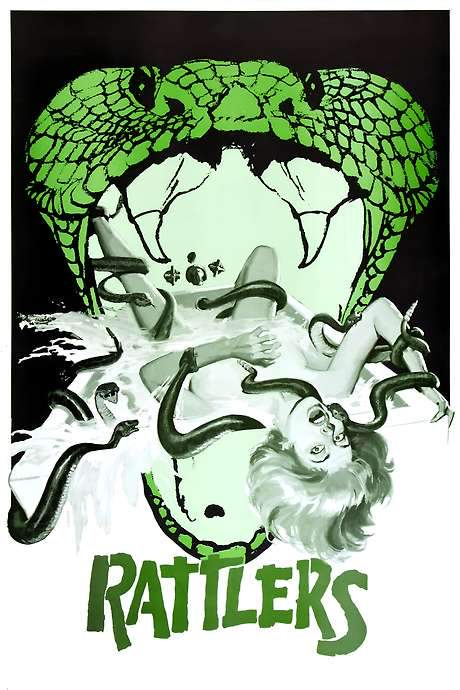
Rattlers 1976


Where to Watch Rattlers
See current US streaming, rental, and purchase options for Rattlers (1976) via JustWatch.

FlixFling
SD
FlixHouse
HD
Mometu
HD
Tubi TV
SD
Amazon Video
SD
Apple TV Store
SD
Fandango At Home
SD
Google Play Movies
SD
YouTube
SD Streaming availability powered by 
Rattlers Plot Summary
Read the complete plot summary and ending explained for Rattlers (1976). From turning points to emotional moments, uncover what really happened and why it matters.
When two young boys are savagely attacked and killed by a legion of rattlesnakes in a small California desert town, the local sheriff calls upon herpetologist Dr. Tom Sam Chew Jr. Parkinson, a Los Angeles college professor, to uncover why the snakes are displaying abnormal aggression and swarming behavior. The sheriff teams Parkinson with war photographer Elisabeth Chauvet as Ann Bradley to help document and understand the phenomenon.
As more people in the desert community fall to the deadly reptiles, Parkinson’s and Bradley’s investigation leads them to a nearby army base, where the commanding officer, Colonel Dan Priest Stroud, seems strangely reluctant to help them. The base’s chief medical officer, Captain Ronald Gold Delaney, offers limited support, but his presence provides a crucial foothold for the inquiry.
Shortly afterward, Palmer Darwin Joston and Woodley Gary Van Ormand, two soldiers on night patrol, stop to change a flat tire on their jeep and are killed by a horde of rattlesnakes, heightening the sense of danger and raising questions about the base’s role in the mounting crisis. Delaney then summons Parkinson and Bradley back to the base, this time without Stroud’s knowledge, so they can investigate the soldiers’ strange deaths more closely.
Parkinson’s findings point to a chilling conspiracy: the colonel ordered, and then concealed, the illegal disposal of an experimental nerve gas called CT3 in a desert cave. The exposure of the snakes to CT3 has altered their behavior, making them unusually aggressive and hard to predict. When Delaney confronts Stroud and threatens to expose the crime, Stroud kills him, before engaging the local sheriff’s department in a gun battle that ends with Stroud’s own death.
Rattlers Timeline
Follow the complete movie timeline of Rattlers (1976) with every major event in chronological order. Great for understanding complex plots and story progression.
Two boys attacked by snakes trigger investigation
Two young boys are savagely attacked and killed by a legion of rattlesnakes in a small California desert town. The sheriff calls in Dr. Tom Parkinson, a Los Angeles college professor and herpetologist, to figure out why the snakes are behaving abnormally. Parkinson teams with war photographer Ann Bradley to start the inquiry.
Parkinson and Bradley join the investigation
Parkinson and Bradley marshal the local resources and begin interviewing witnesses to understand the unusual snake behavior. They partner with the sheriff to map out the growing pattern of attacks and to plan further field work. The stakes rise as the town fears further casualties.
Snake killings escalate across the town
As more residents fall prey to deadly rattlesnakes, the investigation widens beyond the initial scene. The team searches for an explanation for the snakes' unusual aggression. The case grows more alarming as the deaths accumulate.
Clues point toward a nearby army base
The investigators trace the pattern of deaths to a military installation nearby. Col. Stroud shows reluctance to help, creating friction between the base and the town investigators. The base's chief medical officer, Captain Delaney, offers limited cooperation.
Palmer and Woodley are killed on night patrol
Two soldiers, Palmer and Woodley, on a routine night patrol stop to change a flat tire and are killed by a swarm of rattlesnakes. The casualty triggers heightened urgency to understand the cause behind the lethal snake behavior.
Delaney summons Parkinson and Bradley back to base
Captain Delaney orders Parkinson and Bradley back to the base to investigate the soldiers' deaths, acting without Col. Stroud's knowledge. The reevaluation brings the investigators deeper into the base's operations. Tension rises as military secrecy clashes with public safety.
Discovery of illegal nerve gas disposal
Parkinson uncovers that Col. Stroud ordered and concealed the illegal disposal of an experimental nerve gas called CT3 in a local desert cave. Exposure of the snakes to CT3 has made them unusually aggressive. The revelation links the town's terror to a human crime.
Delaney confronts Stroud about the crime
Delaney confronts Stroud in a drunken confrontation, threatening to expose his crime. Stroud reacts violently, escalating the conflict and exposing the lengths he will go to protect the cover-up.
Stroud kills Delaney
Stroud shoots and kills Captain Delaney during the confrontation. The murder removes the sole ally who might reveal the truth, consolidating Stroud's control and complicating the investigation.
Stroud engages the sheriff's department
Stroud engages the local sheriff's department in a gun battle, attempting to maintain control and silence dissent about the base's illicit activities. The firefight marks a violent clash between the base's leadership and town law enforcement.
Stroud is killed during the gun battle
During the ensuing gunfight, Stroud is killed, ending his bid to cover up the nerve gas crime. The base's influence collapses as the truth begins to surface.
The nerve gas link to the snakes is confirmed
With Stroud dead, the investigators confirm that the snakes' aggression was caused by exposure to the CT3 nerve gas and that the disposal of the gas was the root crime behind the deadly attacks. The town's terror is resolved through exposure of the wrongdoing.
Rattlers Characters
Explore all characters from Rattlers (1976). Get detailed profiles with their roles, arcs, and key relationships explained.
Dr. Tom Parkinson (Sam Chew Jr.)
A Los Angeles college professor and herpetologist who is called to explain the deadly rattlesnake attacks. He approaches the case with scientific rigor, methodical reasoning, and a willingness to confront hazardous truths.
Ann Bradley (Elisabeth Chauvet)
A war photographer who partners with Parkinson to document the terror and uncover the cause behind the snake attacks. She is resourceful, fearless, and pushes for evidence even when danger mounts.
Colonel Stroud (Dan Priest)
The base commander who orders and then hides the illegal disposal of nerve gas. He is calculating, manipulative, and willing to sacrifice others to protect his agenda, ultimately meeting his end in a gunfight.
Captain Delaney (Ronald Gold)
The base's chief medical officer who assists Parkinson and Bradley. He attempts to expose the base's misconduct and faces lethal consequences when confronted by Stroud.
Sheriff Gates (Tony Ballen)
The local law enforcement figure who navigates the crisis on the civilian side and becomes entangled in the conflict sparked by the base's secrets.
Palmer (Darwin Joston)
A soldier on night patrol who is killed by the rattlesnake swarm after stopping to change a tire, underscoring the immediate danger of the mutated snakes.
Woodley (Gary Van Ormand)
Another soldier from the patrol who falls to the rattlesnake attack, highlighting the human cost of the escalating crisis.
Rattlers Settings
Learn where and when Rattlers (1976) takes place. Explore the film’s settings, era, and how they shape the narrative.
Location
California desert town, near a military base
The story unfolds in a remote California desert town framed by harsh heat and isolation. A nearby military base looms as the source of secret activity, linking civilian fear to state power. The desert setting amplifies danger as wildlife and covert experiments intersect with law enforcement.
Rattlers Themes
Discover the main themes in Rattlers (1976). Analyze the deeper meanings, emotional layers, and social commentary behind the film.
⚗️
Biohazard
Nerve gas exposure in a desert cave mutates local wildlife into an unusually aggressive threat. The film probes how scientific experimentation can outpace ethics and public accountability. A military cover‑up exposes the cost of power when safety is sacrificed for control.
🕵️♀️
Investigation
Dr. Parkinson and Ann Bradley piece together the cause of the snakes' behavior, navigating resistance from the base and dangerous confrontations. Clues, testimonies, and tense encounters drive the mystery forward, highlighting the tension between truth and secrecy.
⚖️
Conspiracy
Colonel Stroud's illegal disposal of CT3 reveals a deliberate crime that pits duty against civilian safety. The ensuing gunfight with the sheriff's department tests loyalties and shakes public trust. The theme underscores the moral costs of corrupt power and the fragility of institutional accountability.

Coming soon on iOS and Android
The Plot Explained Mobile App
From blockbusters to hidden gems — dive into movie stories anytime, anywhere. Save your favorites, discover plots faster, and never miss a twist again.
Sign up to be the first to know when we launch. Your email stays private — always.
Explore the mobile appRattlers Spoiler-Free Summary
Discover the spoiler-free summary of Rattlers (1976). Get a concise overview without any spoilers.
In the arid quiet of a remote California desert town, a sudden surge of deadly rattlesnake attacks shatters the fragile calm. The heat‑baked landscape becomes a stage for an unsettling blend of natural horror and covert danger, where the hiss of venomous fangs echoes against the distant hum of nearby military exercises. The atmosphere teeters between stark realism and an almost mythic dread, inviting anyone who dares to step into its shadow to confront a menace that slithers beyond ordinary wildlife.
Dr. Tom Parkinson, a meticulous herpetologist and Los Angeles college professor, is called in to untangle the strange aggression of the snakes. His expertise grounds the investigation in scientific rigor, yet the abnormal behavior hints at something far more insidious than ordinary instinct. By his side is Ann Bradley, a war‑seasoned photographer whose eye for stark, haunting images pulls the unseen layers of the crisis into stark focus. Their partnership fuses analytical precision with visceral storytelling, each drawing the other deeper into a world where biology and secrecy intersect.
As the two probe the widening trail of attacks, the ever‑present silhouette of the nearby army base looms large, its routine drills and distant murmurs suggesting a hidden influence on the desert’s ecosystem. Rumors of a mysterious nerve gas dumped in the sand begin to surface, offering a chilling hint that the snakes’ newfound ferocity may be engineered rather than natural. The mood remains tense and inquisitive, balancing the stark beauty of the wasteland with an undercurrent of looming, unseen threat—setting the stage for a suspense‑filled quest for answers that could reshape the community’s understanding of nature itself.
Movies with Similar Twists and Themes
Uncover films that echo the narrative beats, emotional arcs, or dramatic twists of the one you're exploring. These recommendations are handpicked based on story depth, thematic resonance, and spoiler-worthy moments — perfect for fans who crave more of the same intrigue.







Featured on this page

What's After the Movie?
Not sure whether to stay after the credits? Find out!
Check out our other apps:

SAT Sphere
Build confidence for the Digital SAT.

Mori Atlas
Discover wild places worth protecting.

Luntero
Search smarter for a home in Amsterdam.

Plot Explained
Unravel movie endings and hidden clues.

Pokechamp
Dive into Pokémon data and battle logic.

Driving Theory
Get ready for your European theory test.

Movie Dust
Plan your next cinema trip with ease.

Musemap
Find art and culture as you travel.

Selkobase
Compare credentials before committing.

Local Manual
Turn an unfamiliar country into practical next steps.

Lernavi
Compare school systems before your next move.

GymRoam
Find a workout stop wherever your plans take you.
Explore Our Movie Platform
New Movie Releases (2026)
Famous Movie Actors
Top Film Production Studios
Movie Plot Summaries & Endings
Major Movie Awards & Winners
Best Concert Films & Music Documentaries
Movie Collections and Curated Lists
© 2026 What's After the Movie. All rights reserved.
Privacy Policy