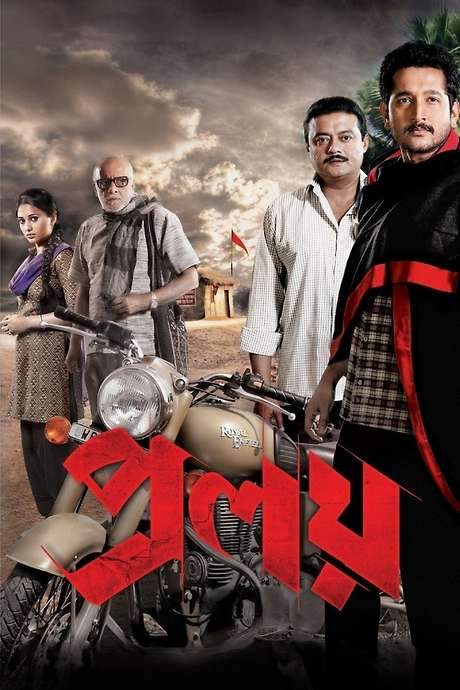
Proloy 2013
Directed by

Raj Chakraborty
Made by

SVF Entertainment
Where to Watch Proloy
See current US streaming, rental, and purchase options for Proloy (2013) via JustWatch.

Streaming availability powered by 
Proloy Plot Summary
Read the complete plot summary and ending explained for Proloy (2013). From turning points to emotional moments, uncover what really happened and why it matters.
In the rural village of Dukhia, nestled in the fields of Bengal, a brutal pattern of violence grips the community as a gang of criminals uses fear and sexual violence to maintain control. Gang rapes have become a horrifying routine, affecting even the most vulnerable—children and elderly women—while complicit police forces turn a blind eye, protected by the unholy patronage of a powerful local political leader who treats protection as a right rather than a service. In this hostile environment, a beacon of moral resolve emerges: an idealist local teacher, Barun Biswas, who refuses to accept the status quo and dares to challenge the pervasive corruption.
Driven by a sense of social responsibility, Barun forms an activist group named Jagaran Mancha, rallying the frightened villagers to demand accountability and the immediate arrest of the criminals. His courage reshapes the village’s psyche, inspiring many to join the cause, and his actions illuminate a path toward justice that had previously seemed unattainable. Yet the cost of standing up to entrenched power proves immense. One fateful day, Barun is murdered while returning from the school, and his death becomes a crucible that forces the community to confront the depth of the rot that has gripped Dukhia.
Enter Binod Bihari Dutta, a man who met Barun and was deeply moved by his vision of a fairer society. Shocked by Barun’s killing and the revelation of how easily the criminals slipped through the cracks of a corrupt system, Binod rushes to Dukhia to honor Barun’s memory and to understand the full scope of the menace. He learns how the criminals have exploited the hollowed-out machinery of the law, and he resolves to galvanize the villagers to carry Barun’s mission forward, even as he confronts the possibility that justice may be a long, arduous battle.
Arriving in Dukhia is a Special Branch Officer, Animesh Dutta, a no-nonsense cop whose arrival seems almost fated. He learns of Barun’s murder through Binod and brings a different, sharper edge to the struggle. As the narrative unfolds, friction arises between Binod’s idealistic, communal approach and Animesh’s more unconventional, semi-legal tactics. Amid the tension, rumors begin to swirl in the village that Barun has returned from the dead to punish his killers, a suggestion that unsettles the already fragile balance between vigilante action and official justice. Animesh, wary of the disruptive potential of Jagaran Mancha, vows to safeguard what he believes to be the last criminal, interpreting his duty as a public servant to mean protecting the living over the dead reckoning of vengeance.
What emerges in a startling turn is a morally complex truth: Binod Dutta has been carrying out a vigilante campaign of his own, aided by a few members of Jagaran Mancha. He has been killing the criminals in carefully calculated ways, a clandestine effort that sits at odds with the law but speaks to a community fed up with inaction. The climax reveals Binod’s final act—killing the last criminal by ripping his stomach open—and, in a wrenching twist, Animesh rescues Binod from the scene and discreetly withdraws him from the village, choosing to bury the case rather than ignite an official confrontation. In the closing moments, Animesh shares a deeply personal admission: he has become a father and plans to name his son Barun, a quiet, somber tribute that underscores the film’s enduring question about the costs of justice, the line between right and wrong, and the price of moral courage in a system bent by power.
Throughout, the story tracks the tension between reformist zeal and the murky ethics of vigilantism, presenting a stark meditation on how a community fights back against brutality when every institutional safeguard seems compromised. It is a narrative that refuses easy answers, instead inviting viewers to weigh loyalty, justice, and the haunting idea that sometimes the person who seeks to protect the living is the one who shadows themselves with questionable means. The result is a deeply examined portrait of a village at a crossroads, where memory, sacrifice, and the memory of a teacher’s idealism linger long after the final act.
Proloy Timeline
Follow the complete movie timeline of Proloy (2013) with every major event in chronological order. Great for understanding complex plots and story progression.
Terror in Dukhia
A gang of criminals terrorizes the village of Dukhia, with many women and children becoming victims of brutal violence. The crimes thrive because the police and local politicians tolerate or actively support the gang. The atmosphere is one of fear and impunity as residents suffer in silence.
Barun Biswas begins Jagaran Mancha
Idealist local teacher Barun Biswas forms the activist group Jagaran Mancha to mobilize villagers and demand the criminals' arrest. He travels door to door, speaks out against patronage, and encourages collective action. The group becomes a beacon of resistance in the face of entrenched power.
Rising confrontation against patronage
Barun and his supporters confront the political patronage that shields the criminals. They organize protests and demand accountability from the authorities. The local leadership grows hostile to Barun's campaign, signaling escalating risk.
Barun Biswas is murdered
Barun Biswas is murdered while returning from school. The brutal killing shocks the village and hardens the resolve of his supporters. His death exposes the depth of the protection enjoyed by the criminals.
Binod Dutta travels to seek justice
Binod Bihari Dutta learns of Barun's murder and travels to Dukhia to seek justice in memory of his friend. He is inspired by Barun's idealism and recognizes the need to continue the fight. He decides to rally villagers to keep the movement alive.
Animesh Dutta arrives in Dukhia
Special Branch Officer Animesh Dutta arrives in Dukhia and pledges to investigate Barun's murder. He comes with a tough, no-nonsense attitude and immediately notices the tension between law and popular justice. He sees Binod as both ally and potential obstacle.
Friction between activism and policing
Conflict arises between Binod's open activism and Animesh's more guarded, semi-legal methods. They clash over strategy and the proper way to confront the criminals. The differing approaches threaten the unity of the anti-crime efforts.
Criminals are murdered one by one
Criminals are found murdered one after another, creating a chilling pattern across the village. Rumors swirl that Barun has returned from the dead to punish his killers. The investigations stall as fear spreads.
Animesh suspects Jagaran Mancha
Animesh suspects Jagaran Mancha and believes the killings are revenge for Barun's murder. He vows to protect the last criminal as his duty as police officer and public servant. He contends with the idea that justice may require extra-legal steps.
Revelation of Binod's killings
It is revealed that Binod Dutta has been killing criminals with the secret help of a few Jagaran Mancha members. The killings are framed as a social rebellion rather than mere vigilantism. The truth creates moral ambiguity around the movement and its leaders.
Final confrontation
Binod kills the last criminal by ripping his stomach open, sealing a brutal cycle of vengeance. Animesh rescues Binod from the scene and removes him from the village, choosing to bury the case rather than expose it publicly. The act marks a controversial resolution to the violence.
Epilogue: a legacy remembered
In the final scene, Animesh reveals he has become a father and intends to name his son Barun, honoring the activist's memory. The film closes on a quiet note about legacy, justice, and the costs of fighting corruption. The villagers are left to reflect on what justice truly means.
Proloy Characters
Explore all characters from Proloy (2013). Get detailed profiles with their roles, arcs, and key relationships explained.
Barun Biswas
An idealistic local teacher who forms the Jagaran Mancha to challenge gang violence and political patronage in Dukhia. He stands up for the vulnerable, risking his safety to demand accountability. His murder becomes a catalyst that awakens the village to demand justice and continue the fight.
Animesh Dutta
A Special Branch Officer with a tough, no-nonsense approach. He uses unconventional methods and wrestles with the morality of taking a law into his own hands. He initially seeks to protect the last criminal, while wrestling with the pressure to bury the case.
Binod Bihari Dutta
A driven observer inspired by Barun who returns to Dukhia to act against the criminals. He orchestrates a covert campaign with Jagaran Mancha members, leading to deadly confrontations. His actions complicate the village’s pursuit of justice and culminate in him killing the final criminal before the case is buried.
Criminal gang
A gang that terrorizes Dukhia, raping and exploiting villagers while enjoying political patronage. Their ruthlessness drives the conflict and highlights the scales of corruption that the villagers confront.
Proloy Settings
Learn where and when Proloy (2013) takes place. Explore the film’s settings, era, and how they shape the narrative.
Location
Dukhia village, rural Bengal, India
Set in the remote village of Dukhia in rural Bengal, the town is a backdrop of fear where criminals operate with impunity. Local authorities and political patrons complicate justice, letting violence go unchecked. The setting highlights stark social hierarchies and the impact of corruption on everyday life.
Proloy Themes
Discover the main themes in Proloy (2013). Analyze the deeper meanings, emotional layers, and social commentary behind the film.
⚖️
Justice
Barun Biswas embodies a moral call for justice in a village overwhelmed by crime. The film examines how legal institutions fail when politics interferes with police work. Activism through Jagaran Mancha represents grassroots responses to systemic abuse. The tension between lawful process and vigilantism shows the complexities of seeking justice in a corrupt environment.
🛡️
Courage
Individuals risk their safety to confront killers and protect the vulnerable. Barun's fearless stance becomes a catalyst inspiring others to organize. The story puts a human face on moral courage in the face of threats.
🏛️
Power & Corruption
Criminals thrive on political patronage and police complicity. The film shows how power structures protect criminals, creating a cycle of impunity. Binod and Animesh's dynamic reveals how corruption can taint justice systems while individuals resist.

Coming soon on iOS and Android
The Plot Explained Mobile App
From blockbusters to hidden gems — dive into movie stories anytime, anywhere. Save your favorites, discover plots faster, and never miss a twist again.
Sign up to be the first to know when we launch. Your email stays private — always.
Explore the mobile appProloy Spoiler-Free Summary
Discover the spoiler-free summary of Proloy (2013). Get a concise overview without any spoilers.
In the quiet fields of rural Bengal lies the village of Dukhia, a place where ordinary life is shadowed by a troubling undercurrent of fear. The community’s rhythms are disrupted by a pervasive sense that some injustices have become accepted, almost invisible, beneath the surface of daily routine. The atmosphere is a blend of pastoral calm and an unspoken tension that keeps the air heavy, hinting at deeper fractures within the social fabric.
Barun Biswas, a schoolteacher whose conviction is as steady as the rows of crops surrounding the town, refuses to let this quiet acceptance persist. With a voice that cuts through complacency, he steps forward to challenge the entrenched norms, rallying villagers around a shared hope for change. His determination ignites a spark of collective courage, turning whispered discontent into open conversation and offering a glimpse of what solidarity might achieve in a place long accustomed to silence.
Into this volatile mix arrives Binod Bihari Dutta, a man whose own life has been touched by Barun’s ideals. Drawn to Dukhia by a desire to understand the community’s struggle, he becomes an uneasy ally to the burgeoning movement, embodying the tension between personal conviction and the weight of local realities. Simultaneously, Animesh Dutta, a Special Branch officer, steps onto the scene, bringing with him the procedural rigor of the law and a perspective that both clashes with and complements the villagers’ grassroots energy.
The film weaves these intersecting paths together with a tone that is both gritty and lyrical, foregrounding the moral ambiguities that surface when ordinary people confront systemic wrongs. Its visual palette captures the dusty, sun‑baked landscape while the narrative pulse mirrors the village’s unsettled heart. As the characters navigate loyalty, courage, and the cost of speaking out, the story invites viewers to linger on the uneasy space between hope and hardship, leaving the outcome of their struggle intriguingly open.
Featured on this page

What's After the Movie?
Not sure whether to stay after the credits? Find out!
Check out our other apps:

SAT Sphere
Build confidence for the Digital SAT.

Mori Atlas
Discover wild places worth protecting.

Luntero
Search smarter for a home in Amsterdam.

Plot Explained
Unravel movie endings and hidden clues.

Pokechamp
Dive into Pokémon data and battle logic.

Driving Theory
Get ready for your European theory test.

Movie Dust
Plan your next cinema trip with ease.

Musemap
Find art and culture as you travel.

Selkobase
Compare credentials before committing.

Local Manual
Turn an unfamiliar country into practical next steps.

Lernavi
Compare school systems before your next move.

GymRoam
Find a workout stop wherever your plans take you.
Explore Our Movie Platform
New Movie Releases (2026)
Famous Movie Actors
Top Film Production Studios
Movie Plot Summaries & Endings
Major Movie Awards & Winners
Best Concert Films & Music Documentaries
Movie Collections and Curated Lists
© 2026 What's After the Movie. All rights reserved.
Privacy Policy