What Is Prisoner of War About?
The premise of Prisoner of War in 302 words, with nothing given away. The full story and the ending follow below.
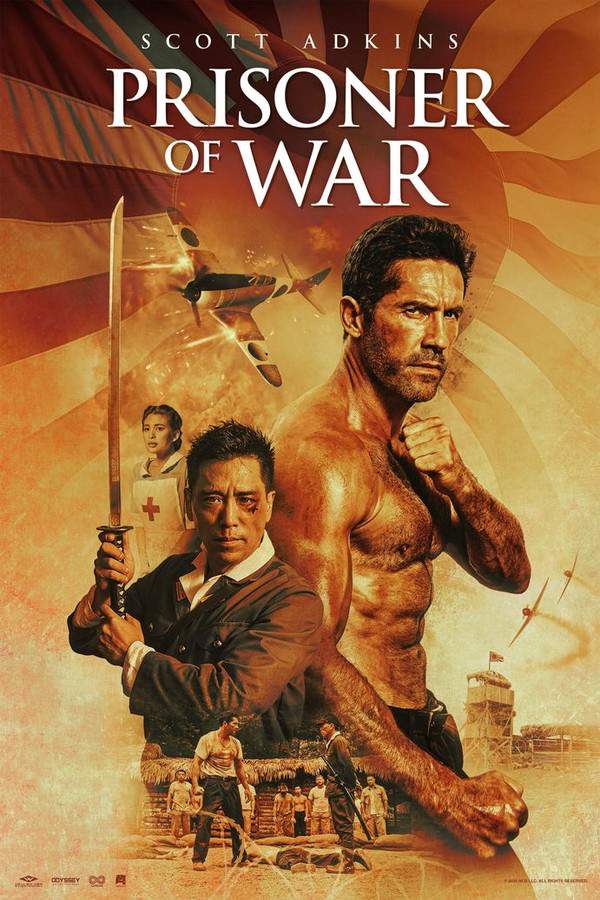
In the waning days of World War II, a grim POW camp sprawls across the Philippine jungle, its barbed fences and watchtowers a stark reminder of the conflict’s unforgiving reach. The atmosphere is heavy with humidity, the lingering echo of artillery, and a palpable tension as the camp readies itself for the infamous Bataan Death March. Within this confined world, the daily grind of forced labor and scarce provisions forms a bleak backdrop for a story that blends historical hardship with visceral action.
James Wright arrives as a British SAS officer whose past is marked by rigorous military discipline and a deep-rooted mastery of martial arts learned long before the war. His training gives him a rare blend of physical precision and mental resilience, setting him apart among the mixed ranks of Allied prisoners. Though his skills hint at a latent power, the environment forces him to confront not only external enemies but also the limits of his own endurance and moral compass.
The captors, seeking perverse entertainment, stage brutal combat matches that pit prisoners against one another in savage spectacles. These forced duels become more than mere survival; they are a crucible that tests the fighters’ resolve, camaraderie, and will to retain their humanity amid dehumanizing conditions. The matches underscore a stark contrast between the disciplined poise of the combatants and the chaotic cruelty of those who watch.
Amidst this relentless pressure, the bonds forged between the prisoners grow into a quiet source of strength. Their shared struggle against oppression creates a tense, gritty narrative where every glance carries unspoken questions about honor, sacrifice, and the thin line between victory and loss. The film’s tone is unflinching and kinetic, inviting viewers to feel the claustrophobic dread of the camp while marveling at the indomitable spirit that burns behind every measured strike.
What Happens in Prisoner of War?
The complete story of Prisoner of War, from the first scene to the last, in 420 words (about 2 minutes). Spoilers throughout.
Spoilers ahead
In 1950, a man named James Wright [Scott Adkins] breaks into Ito Dojo and confronts Sensei Shunsuke Ito [Kansuke Yokoi], asking about his father, Benjiro Ito.
A flashback to 1942, during the Battle of Bataan in World War II, follows Royal Air Force Wing Commander James Wright as he is shot down over the Philippines. He is captured by Japanese forces and taken to a brutal POW camp where Allied soldiers endure forced labor, hunger, and daily brutality under Lt. Col. Ito. Ito orders his right-hand man Captain Hirano [Shane Kosugi] to execute Wright, but Wright fights back, killing Hirano and two soldiers before escaping, only to be recaptured.
Inside the camp, officers organize underground fighting matches to entertain the guards. Wright is initially hesitant, but he is pushed to fight after seeing resisters executed. His prior martial arts training in Hong Kong gives him an edge; he defeats Koji, the camp’s top fighter, though his victories draw the ire of Ito and his enforcer Captain Endo [Masanori Mimoto]. Ito goes as far as to execute troops who fail to defeat Wright. His fascination grows as he realizes Wright’s techniques are forbidden, and he even seems to recognize the master who trained Wright.
As the fights escalate, Wright forms bonds with fellow prisoners, including American Captain Collins [Donald Cerrone] and Filipino sergeant Gabriel Villanueva [Michael Copon]. Theresa [Gabbi Garcia], a nurse compelled to work at the camp, provides medical aid and helps keep the group alive. Together, they hatch a plan to escape and pass along intelligence about Japanese troop movements to the outside.
James steals a radio from the camp and uses it to contact American reinforcements. Collins and Villanueva share the news that help is coming, and they decide to exploit an upcoming air raid to slip away. Ito grows more unsettled and brutal as the plan advances.
They slip outside to inspect a downed glider as a potential route, but Collins’s earlier action—killing a guard during the breakout—draws his own fate and leads to his execution later.
When Allied bombs begin to strike, James, Theresa, and Villanueva push their escape and, in a climactic confrontation, James defeats Ito. Ito stops his men from killing James out of respect for the martial artist’s skill, and James, Theresa, and Villanueva escape.
Back in the present, Shunsuke reveals that Ito has died years ago from illness and asks James to demonstrate his forbidden technique. James defeats Shunsuke, and Shunsuke returns Ito’s medallion, which Ito had stolen from James years ago.
Prisoner of War Timeline: Every Key Event in Order
13 key events in the order they happen, from “Wright is shot down and captured over the Philippines” to “James defeats Shunsuke and recovers the medallion”. 13 events name a place, across 5 locations.
- 1
Wright is shot down and captured over the Philippines
Royal Air Force Wing Commander James Wright is shot down during a mission over the Philippines in 1942. He is captured by Japanese forces and taken to a brutal prisoner-of-war camp commanded by Lt. Col. Benjiro Ito. Wright endures forced labor, deprivation, and daily brutality as the camp tightens its grip.
When:1942 Where:Philippines (Battle of Bataan)
- 2
Ito orders Hirano to execute Wright; escape and recapture
Ito orders his right-hand man Captain Hirano to execute Wright, but Wright fights back, killing Hirano and two soldiers before briefly escaping. He is quickly recaptured and returned to the camp. The incident hardens the camp's attitude toward him.
When:1942 Where:POW camp
- 3
Underground fighting begins
Camp officers stage underground fighting matches to entertain their guards, forcing prisoners to gamble with their lives. Wright initially hesitates but is pressured to fight after witnessing resisters be executed. The brutal arena becomes a test of Wright's martial arts talents.
When:1942 Where:POW camp arena
- 4
Wright defeats Koji using his Hong Kong training
Wright's prewar martial arts training gives him an edge as he defeats Koji, the camp's top fighter. His victories draw Ito's ire and put him squarely in the crosshairs of Ito and his enforcer Endo. The camp’s brutal system treats any success as a threat.
When:1942 Where:POW camp arena
- 5
Ito discovers Wright's forbidden techniques
Ito realizes that Wright's martial art techniques are forbidden by the camp's rules. This discovery deepens Ito's interest in Wright and foreshadows a dangerous obsession with the master who trained him. Ito begins to scheme around Wright's abilities.
When:1942 Where:POW camp
- 6
Prisoner bonds form and plans evolve
Wright forms alliances with fellow prisoners Captain Collins and Sergeant Gabriel Villanueva. The growing bonds give the group practical ideas for escape and surviving under increasingly brutal conditions. They also gather information that could aid their plan.
When:1942 Where:POW camp
- 7
Theresa offers medical aid and covert help
Theresa, a local nurse compelled to work at the camp, provides medical care to prisoners and secretly supports the escape plan. Her discreet assistance helps keep injured prisoners alive during the growing crackdown. She becomes a crucial link between the prisoners and potential outside help.
When:1942 Where:POW camp
- 8
The escape plan hinges on intelligence and air raids
The group aims to deliver intelligence on Japanese troop movements to the Allies and time their escape with an anticipated air raid. The plan grows more urgent as the camp tightens its security and threats to prisoners escalate. They count on external bombardments to mask their breakout.
When:1942 Where:POW camp
- 9
Radio stolen; reinforcement promised
Wright steals a radio from the camp to call for U.S. reinforcement. Collins confirms that Allied reinforcements are on the way and that the air raids will offer a chance to slip away. The plan shifts from waiting to acting as the opportunity nears.
When:1942 Where:POW camp
- 10
Escape plan escalates to the glider; a guard is killed
The trio heads toward a downed glider to plan an escape, accelerating their timetable as conditions worsen. Collins kills a guard during the covert breakout, and is subsequently executed by Ito's men.
When:1942 Where:POW camp
Show the other 3 events of Prisoner of War Hide the last 3 events
- 11
Allied bombardment allows escape; Wright defeats Ito
As Allied air power pounds the camp, James, Theresa, and Villanueva seize their chance to break free. James confronts Ito and defeats him; in a show of respect, Ito orders his men to refrain from killing James as they flee.
When:1942 Where:POW camp, Philippines
- 12
Back in the present, Ito is revealed to be dead
In the present, Shunsuke Ito reveals that Ito died years earlier from illness. He asks James to demonstrate the forbidden technique, bridging the past and present.
When:1950 Where:Ito Dojo
- 13
James defeats Shunsuke and recovers the medallion
James demonstrates the forbidden technique in the dojo and defeats Shunsuke Ito. Shunsuke returns the medallion that Ito stole from James years ago, ending the duel and restoring the artifact to its rightful owner.
When:1950 Where:Ito Dojo
Who Are the Main Characters in Prisoner of War?
7 characters, among them James Wright (Scott Adkins), Lt. Col. Benjiro Ito and Shunsuke Ito: who each one is and the part they play in the story. Every profile links to the actor’s page.
-

James Wright (Scott Adkins)
Played by Scott Adkins
Royal Air Force Wing Commander Wright is captured during the Battle of Bataan and subjected to brutal conditions in a Japanese POW camp. Trained in Hong Kong martial arts, his skill makes him both a target and a beacon for fellow prisoners. He seeks information about his father, Benjiro Ito, and leads a dangerous plan to escape while upholding a strict code of honor.
- 🗡️ Martial Artist
- 🛡️ Leader
- 🧭 Determined
- LC
Lt. Col. Benjiro Ito
Played by Peter Shinkoda
The brutal camp commander who enforces discipline with executions and hard rules. He wields authority with a cold efficiency and is connected to James Wright's family history, adding personal tension to their clashes. His iron control over the camp fuels Wright's resolve to resist and escape.
- 🔥 Brutal
- 🗡️ Enforcer
- 🏛️ Authority
- SI
Shunsuke Ito
Played by Kansuke Yokoi
The Sensei of Ito Dojo, Shunsuke Ito is a master whose presence dominates the training grounds. He recognizes Wright's forbidden techniques and later reveals the legacy of Ito's discipline. When Ito dies years later, Shunsuke confronts Wright and returns the medallion that Ito had stolen.
- 🎎 Sensei
- 🧭 Mentor
- 🗡️ Mastery
- CH
Captain Hirano
Played by Shane Kosugi
Ito's ruthless right-hand man, determined to crush resistance and enforce brutal punishment. He orders executions when prisoners fail to defeat Wright, embodying the camp's terror. Wright defeats Hirano in the course of the escape attempt, marking a turning point in the prisoners' fight for freedom.
- 🗡️ Enforcer
- 🔥 Ruthless
- 🛡️ Loyalist
-

Captain Collins
Played by Donald Cerrone
An American captain who informs Wright and the prisoners that reinforcements are coming and that they must act before transfer to an even worse prison. He contributes to the escape plan and provides critical intelligence about troop movements.
- 🧭 Informant
- 🛡️ Ally
- 🗺️ Strategist
- CG
Captain Gabriel Villanueva
Played by Michael Copon
A Filipino sergeant who bonds with Wright and other prisoners, sharing in the planning and risk of escape. His presence highlights cross-cultural solidarity among captured Allied forces.
- 🤝 Ally
- 🛡️ Loyalist
- 🗺️ Collaborator
- T
Theresa
Played by Gabbi Garcia
A local nurse compelled to work at the camp who provides medical support and secret aid to the prisoners. Her quiet courage helps sustain the prisoners during brutal days and supports the escape plan.
- 💉 Caregiver
- 🕊️ Ally
- 🗝️ Informant
Where and When Is Prisoner of War Set?
Prisoner of War is set in Philippines, Ito Dojo and POW camp (1950). Here is why the time and place matter to the story.
When
1950
The primary action takes place in 1950 in the Philippines, against the backdrop of post-war occupation and renewed Allied air raids. The narrative also flashes back to 1942 during the Battle of Bataan, detailing Wright's capture, the camp's brutal regime, and the dojo's role in shaping the prisoners. This contrast between war-time brutality and post-war escape drives the film's tension.
Where
Philippines, Ito Dojo, POW camp
The story unfolds in the Philippines at a brutal Japanese POW camp centered around the Ito Dojo. The camp is a harsh environment where Allied prisoners are forced into labor and subjected to daily brutality. The dojo within the camp serves as a focal point for training, ritual, and resistance.
- 🇵🇭 Philippines
- 🏯 Japanese Prison Camp
What Are the Themes of Prisoner of War?
3 ideas the story keeps returning to, among them War, Martial Arts and Escape.
-
01
War
The film places its characters inside a brutal POW camp where survival hinges on endurance and strategic thinking. It examines how war erodes individuality and forges loyalties among prisoners. The captors' brutal authority and the prisoners' resilience create a tense, moral battleground.
-
02
Martial Arts
Wright's mastery of martial arts becomes a lifeline in an environment that criminalizes forbidden techniques. The martial arts motif stands for personal dignity and resistance against oppression. Clashes with Ito's enforcers reveal how discipline can both shield the oppressed and challenge the oppressor.
-
03
Escape
An elaborate escape plan unfolds as air raids approach, relying on courage, secrecy, and improvisation. Trust among prisoners is tested, and alliances form around survival. The culmination tests leadership, skill, and the will to break free from captivity.
How Does Prisoner of War End?
The last act of Prisoner of War and what it means, in 291 words. The ending lands as bittersweet. Big spoilers: read the plot summary first if you have not seen it.
The final act, in full
John Wright and Sergeant Gabriel finally seize a moment of chaos when Allied aircraft bomb the Japanese prison camp. The sudden destruction throws Colonel Ito into a murderous frenzy, ordering his men to fire on every captive. In the pandemonium the two nurses, Theresa and Ana, hand the prisoners knives and flares, and the POWs rally together. Captain Collins, despite his broken ankle, battles the lieutenant Endo and briefly gains the upper hand before being cut down by Ito’s gunfire. Wright confronts Ito in the camp’s courtyard; the colonel draws his sword, but Wright’s mastery of the forbidden martial art disables him, leaving Ito humbled and defeated. Before Wright can finish the fight, Gabriel drags him toward a battered glider the Allies have managed to drop in, and with the help of the overhead forces they manage to launch it, escaping the inferno of the camp.
Years later, Wright travels to Tokyo, intent on finding the man who once commanded his torment. He discovers that Ito’s dojo is now run by the colonel’s son, a young swordsman who initially scoffs at the British officer’s intrusion. When Wright demands answers, the son orders his students to attack, but they are quickly overwhelmed. In a final, quiet exchange, the son reveals that his father died long ago and hands back the Victoria Cross that Ito had taken during the war—fulfilling the old man’s promise to return it if Wright ever came seeking it. The son then begs Wright to demonstrate the forbidden technique that once terrified his father; Wright obliges, delivering the move that closes the circle of vengeance and honor. This final confrontation ties together the war’s brutality with a personal reckoning, leaving Wright’s quest for justice both resolved and strangely unfinished.
What Kind of Film Is Prisoner of War?
Tense in tone, with fast pacing and a straightforward story, going by the plot summary.
- Tone
- Tense
- Pacing
- Fast
- Story
- Straightforward
- Intensity
- High
- Ending
- Bittersweet
A relentlessly tense and brutal War Thriller that delivers a high-intensity viewing experience focused on survival against oppressive cruelty, punctuated by savage fight scenes and a desperate escape attempt.
- oppressive
- brutal
- tense
- grim
- desperate
- resilient
- prisoner of war
- survival
- martial arts
- brutality
Content notes: war violence, torture, execution, forced labor, starvation.
Quiz
How well do you remember Prisoner of War? Test yourself on the story.