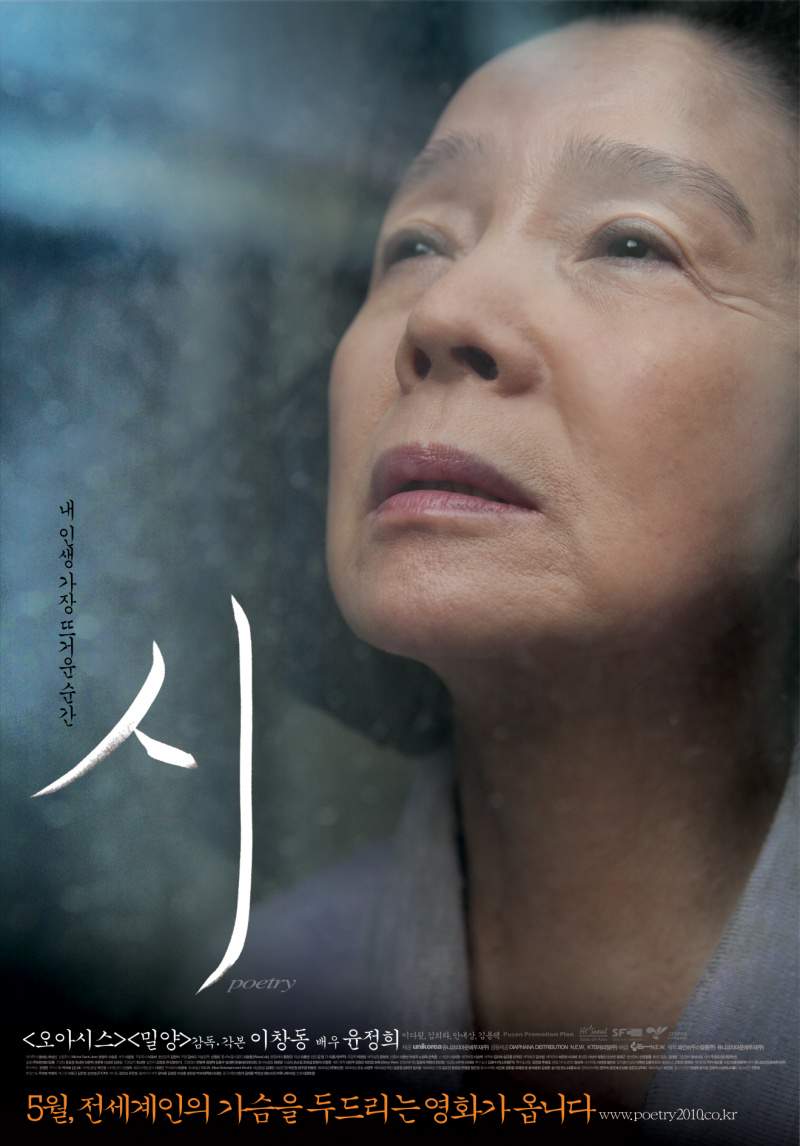
Poetry 2011


Directed by

Chang-dong Lee
Made by

Kino International
Where to Watch Poetry
See current US streaming, rental, and purchase options for Poetry (2011) via JustWatch.









Poetry Plot Summary
Read the complete plot summary and ending explained for Poetry (2011). From turning points to emotional moments, uncover what really happened and why it matters.
Yang Mi-ja is a 66-year-old grandmother living on government welfare, balancing a quiet, fragile existence with the responsibility of caring for an elderly, stroke-stricken man and supervising her ill‑mannered, 16-year-old grandson, Jong-wook, whose mother lives in Busan. The film opens with a haunting river scene: children play on the bank while the body of a girl in a school uniform drifts by, a memory that will echo through Mi-ja’s days. As she navigates her own fading memory and the pressures of poverty, Mi-ja’s world begins to intersect with a crisis she never expected to face, one that tests loyalty, morality, and the price of truth.
A visit to the hospital reveals Mi-ja’s growing forgetfulness and a diagnosis that hints at early stage Alzheimer’s. The doctor urges caution and perhaps a deeper look from a specialist, but the moment also places her in a state of quiet vulnerability. On the street outside, she witnesses a woman overwhelmed by grief, her 16-year-old daughter having drowned, a scene that shadows Mi-ja’s own sense of vulnerability and aging. Back at home, Mi-ja’s daily life is intimate and demanding: she supports the wealthy, ailing man she cares for, and she shoulders the burdens of Jong-wook’s unruly adolescence while his divorced mother remains distant. When Mi-ja asks Jong-wook about the drowned classmate, his evasive response underscores a widening chasm between generations and a sense that the truth about the girl’s fate may be harder to face than he can bear.
A chance to reinvent herself arrives when Mi-ja notices a poster for a poetry class at a local community center. Motivated by a simple classroom assignment—to compose one poem by the month’s end—she begins to see the world with a poet’s eye. Under her teacher’s guidance, she starts keeping notes about what she sees, gravitating toward imagery of flowers and the ordinary beauty of daily life. The new project offers Mi-ja a form of solace and a way to express memories she struggles to articulate, a bridge between her fading memory and a present that feels increasingly elusive.
Meanwhile, Jong-wook’s nights take on a more troubling texture. He invites five of his schoolmates over to their home at odd hours, and Mi-ja, ever trying to be a gracious grandparent, offers snacks and warmth before they vanish into Jong-wook’s private space. A later confrontation with one of the boys’ fathers reveals a far darker truth: the group has repeatedly raped a girl named Agnes over the past six months. The discovery is not shared with most of the school or the wider community, but the mothers and fathers fear retaliation and scandal, and they propose a settlement of 30 million won to Agnes’s widowed mother to avert a police inquiry. Mi-ja, who cannot afford her five-million-won share, is pressured to obtain the money from her daughter, Jong-wook’s mother, creating a painful knot of obligation and secrecy. The gravity of the situation is compounded by Mi-ja’s own fragile health: she is once again diagnosed with Alzheimer’s, and she remains reticent about the full truth of what she has heard, quietly choosing to shield her family rather than reveal the uglier details of the crime.
As Mi-ja tries to navigate these pressures, she becomes a regular at the local poetry readings, where she encounters a brash man who reads luminous poetry only to follow it with crude sexual jokes that offend her. An amateur poet explains to Mi-ja that this man is a policeman with a good heart, recently reassigned from Seoul after exposing corruption within its police force. The tension between beauty and bluntness, between craft and crude behavior, mirrors Mi-ja’s own struggle to maintain dignity while the world around her grows more complicated.
A painful boundary is crossed when Mi-ja, after a sexual advance from the elderly man she cares for, temporarily quits her job. She eventually returns, compelled by a memory—the journey to the river where Agnes jumped, a hat slipping into the water, and a walk down to the riverbank where she writes in the rain. After this visit, she allows herself to be intimate with the elderly man again, but she does so with an emotion that feels strangely absent, as if the act is a performance for a memory rather than a connection in the moment.
A reporter begins to press Mi-ja for details about the settlement and the granddaughter’s mother’s willingness to accept the money. Mi-ja’s casual answers hint at more truth than she intends to reveal, and the interview leaves her unsettled as she realizes how easily her words might be weaponized. She later repeats what she told the reporter to the fathers, who react with a mixture of disappointment and resignation.
Mi-ja is then sent to the countryside to persuade Agnes’s mother to accept the settlement. In the fields, she finds the mother and a quiet, ordinary life that briefly distracts Mi-ja from her task. She talks at length about the weather, flowers, trees, and fruit, and for a moment forgets the urgent purpose of her visit. She turns away, embarrassed by the memory of her mission, and continues on her way, leaving the crucial negotiation unresolved. The encounter marks a turning point in Mi-ja’s conscience, exposing the gap between the social pressure to settle and the moral weight of failing to confront the truth.
Back at the poetry readings, Mi-ja sits outside afterward, crying quietly. A policeman who had attended the reading notices her distress and asks why she cries; she remains reticent, slipping away and making a phone call that signals she is trying to connect with someone who might help her navigate the storm within. When she returns home, she takes out a photo of Agnes—the image she gathered at the memorial service—and places it on the table so her grandson will see it.
In the days that follow, Mi-ja faces the reality that she cannot contribute her portion of the settlement. Agnes’s mother, who previously seemed bound to the arrangement, accepts the revised terms and the compromise that will end the case. Mi-ja summons the elderly man and asks for the money she needs, deliberately withholding the reason. He pays her, and with the funds now secured, she phones her daughter to come home and issues simple, practical orders: Jong-wook should bathe and trim his nails. That night, the same crude policeman and his partner come to take Jong-wook away, and Mi-ja does not protest. The sense of complicity in an entire system of oversight and silence becomes more pronounced, even as the family’s immediate needs are met.
The film closes with a quiet, haunting image: the poetry teacher discovers a bouquet on the podium beside Mi-ja’s poem, “Agnes’s Song,” but Mi-ja herself is absent from the room. Her daughter returns to an empty home and calls Mi-ja’s phone, receiving no answer. The teacher begins to read Mi-ja’s poem aloud to the class, while Mi-ja’s voice enters in a reflective, almost ethereal narration. Then Agnes’s own voice takes over midway through, following her from the science lab where she was assaulted, to the bus, and finally to the bridge where she would leap. Agnes turns toward the camera with a half-smile, and the film ends on an ambiguous, unresolved note about Mi-ja’s fate and the truth of what has been witnessed, leaving the audience to ponder the cost of memory, silence, and the moral weight of communal complicity.
Poetry Timeline
Follow the complete movie timeline of Poetry (2011) with every major event in chronological order. Great for understanding complex plots and story progression.
Opening river scene
The film opens on a river where children play along the bank. A girl's body in a school uniform floats past, signaling tragedy and the mystery that frames the story. The tranquil scene is a grim prologue to the events that follow.
Mi-ja's health and memory
Yang Mi-ja, a 66-year-old grandmother surviving on government welfare, visits a doctor because of forgetfulness and is referred to a specialist. As she leaves the hospital, she sees a woman overwhelmed by grief after her 16-year-old daughter drowns. The encounter foreshadows the weight of memory and loss to come.
Home life and Jong-wook
Mi-ja handles caregiving for an aging, ill-mannered grandson, Jong-wook, while his divorced mother lives in Busan. At home he leaves at night to socialize with five other boys, creating tension and concern. Mi-ja tries to keep the household orderly despite the underlying strain.
Poetry class begins
Mi-ja notices a poster for a poetry class at the community center and enrolls, seeking meaning through verse. The course requires one poem by the end of the month, so she starts jotting notes about what she sees, especially flowers.
Agnes's tragedy and settlement
Jong-wook and five other boys are implicated in the brutal rape of Agnes, a 16-year-old girl, and her death follows. The school and the fathers fear scandal, so the parents offer a settlement of 30 million won to Agnes's widowed mother. Mi-ja is pressured to contribute her share of 5 million won but cannot afford it.
Alzheimer's diagnosis and silence
Mi-ja is diagnosed with early-stage Alzheimer's disease, but she keeps it to herself. She attempts to confront Jong-wook about his actions, but he ignores her.
Weekly poetry readings
Mi-ja attends local weekly poetry readings, where a brash man reads beautiful verse followed by crude sexual jokes that offend her. A fellow poet explains that the man is a policeman with a good heart, recently reassigned from Seoul after exposing corruption.
A troubled night with the elderly man
Mi-ja temporarily quits her job after a desperate sexual advance from the elderly man she cares for. She later visits the river and the bridge where Agnes jumped; her hat flies into the water as she wanders to the riverbank, where she sits and writes poetry in the rain. She returns to the elderly man and, though emotionally altered, agrees to have sex.
Reporter questions Mi-ja
A reporter questions Mi-ja about the settlement and whether Agnes's mother will accept. She inadvertently reveals too much and the interview grows tense as he presses her for answers. She hurries away and calls someone on the phone.
Countryside mission
In a further meeting with the fathers, Mi-ja is told to travel to the countryside to persuade Agnes's mother to accept the settlement. She finds the mother in a field and, after a pleasant exchange about weather and flowers, becomes lost in the moment and forgets her task, leaving before addressing the settlement.
Settlement secured
Mi-ja returns to the fathers to admit she cannot pay her portion, but Agnes's mother agrees to settle nonetheless. The elderly man pays the required money after she asks him for it, resolving the financial aspect of the case. She calls her daughter to come home and tells Jong-wook to shower.
Jong-wook taken away
That night, the crude policeman from the poetry readings arrives with a partner to take Jong-wook away, and Mi-ja does not protest. The consequences of the boys' actions begin to catch up with them in a decisive moment.
Ending: Agnes's Song
A bouquet is found at the poetry class podium along with Mi-ja's poem 'Agnes's Song'. The teacher reads the poem to the class, but Mi-ja is absent. The film ends with Mi-ja's voiceover interwoven with Agnes's memory, leaving the fate ambiguous.
Poetry Characters
Explore all characters from Poetry (2011). Get detailed profiles with their roles, arcs, and key relationships explained.
Yang Mi-ja (Yoon Jeong-hee)
A 66-year-old grandmother on government welfare who cares for an ill elderly man and an unruly 16-year-old grandson. She discovers poetry and joins a local class, using writing to observe the world around her. Living under strain, she wrestles with memory loss and difficult moral choices as she confronts the consequences of others’ actions.
Jong-wook (Lee David)
Mi-ja's 16-year-old grandson, who spends late nights out with a group of boys and shows a troubling disregard for boundaries. He ignores Mi-ja’s questions and becomes a central figure in a network of abuse that knows no easy answers. His actions propel the film's tension between family obligation and collective guilt.
Agnes
A 16-year-old girl whose rape by several boys and subsequent suicide become the focal tragedy. Her diary surfaces, revealing the violence that the school and parents attempt to suppress. Agnes's memory haunts Mi-ja and drives the moral questions at the story's heart.
Policeman (Brash Poet)
A frequent, bluntly humorous poet who is also a police officer newly reassigned from Seoul after exposing corruption. His presence at the poetry readings contrasts beauty with crude jokes, complicating Mi-ja’s trust in the room’s safety and sincerity.
Poetry Teacher
Mi-ja's poetry instructor who encourages her to write and reflect on the world around her. The teacher guides the class’s exploration of memory, beauty, and pain, providing a frame for Mi-ja’s evolving inner life.
Elderly Man (Stroke Victim)
The man Mi-ja cares for who has had a stroke. He makes a desperate sexual advance, and Mi-ja’s decision to continue the arrangement reveals the precarious balance between survival, consent, and personal boundaries within caretaking relationships.
Agnes's Mother
A poor farming widow who receives the settlement offer for Agnes's death. She becomes a focal point of the negotiation between the families and the school, embodying the vulnerable party in a system pressuring quiet resolution.
Fathers (Group of Fathers)
The fathers of the five boys who assaulted Agnes push for a settlement to avert scandal. They fear retribution and aim to protect reputations, reflecting a community that values appearance over truth.
Poetry Settings
Learn where and when Poetry (2011) takes place. Explore the film’s settings, era, and how they shape the narrative.
Time period
2010s
Set in contemporary South Korea, the events occur in the late 2000s to early 2010s. The period reflects modern urban life, welfare constraints, and a school environment where misconduct and cover-ups test community conscience. The timeframe grounds the story in a society negotiating memory, accountability, and the fragility of aging.
Location
South Korea, Busan, Seoul
The film unfolds across contemporary South Korea, moving between urban neighborhoods and rural areas. Key locations include a riverbank and a bridge tied to Agnes's tragedy, a local community center where Mi-ja attends a poetry class, and Mi-ja's daily routine caring for an elderly man on welfare. The setting highlights economic disparity, family duty, and the tension between private pain and public perception.
Poetry Themes
Discover the main themes in Poetry (2011). Analyze the deeper meanings, emotional layers, and social commentary behind the film.
⚖️
Guilt & Complicity
Mi-ja becomes entangled in the settlement offered to Agnes's mother, a choice driven by poverty and fear of scandal. The fathers, the school, and the broader community push to avoid police investigation, revealing the line between justice and social convenience. The film asks who bears moral responsibility when harm is hidden behind money and silence.
🧠
Memory & Aging
Mi-ja's early-stage Alzheimer's shapes how she perceives and remembers events, complicating truth-telling and accountability. The narrative contrasts her fading memory with Agnes's remembered story through diaries and memorials, creating tension between memory, guilt, and silence. This theme underlines how memory can illuminate or erode justice.
🎨
Art as Refuge
Poetry class and readings become Mi-ja's solace and a means of processing suffering. Writing 'Agnes's Song' anchors the film's ethical struggle and provides a counterpoint to the town's moral evasions. The arts offer a space for honesty, connection, and quiet resistance against cruelty.

Coming soon on iOS and Android
The Plot Explained Mobile App
From blockbusters to hidden gems — dive into movie stories anytime, anywhere. Save your favorites, discover plots faster, and never miss a twist again.
Sign up to be the first to know when we launch. Your email stays private — always.
Explore the mobile appPoetry Spoiler-Free Summary
Discover the spoiler-free summary of Poetry (2011). Get a concise overview without any spoilers.
In a modest South Korean neighborhood, Yang Mi‑ja lives on the edge of memory, her days marked by a quiet routine of caring for an ailing elder and navigating the challenges of poverty. At sixty‑six, she is already confronting the early signs of Alzheimer’s, a condition that makes each moment both fragile and precious. Her world is a tapestry of ordinary details—a river that runs through the town, the hum of a community center, the rhythm of poetry classes that offer a gentle escape from the relentless march of forgetfulness.
Sharing the cramped apartment with her sixteen‑year‑old grandson, Jong‑wook, Mi‑ja balances the demands of teenage turbulence with her own fading recollections. Jong‑wook’s mother, living far away in Busan, leaves the responsibility of his upbringing squarely on Mi‑ja’s shoulders, creating a bond that is simultaneously tender and strained. Their relationship, steeped in love and obligation, becomes the emotional core of the story, highlighting the generational gap and the weight of guardianship in a household stretched thin.
When the community is shaken by the tragic loss of a classmate—a girl whose death reverberates through the school and the town—Mi‑ja finds herself inadvertently drawn into the ensuing crisis that surrounds her grandson. The film uses this backdrop to explore themes of responsibility, the silences that families keep, and the moral complexities that arise when personal hardships intersect with collective grief.
Through understated cinematography and a measured, contemplative tone, the narrative immerses the audience in a world where ordinary lives are tinged with uncertainty. Poetry becomes a subtle motif, offering Mi‑ja a way to capture fleeting moments and to articulate the emotions that words often fail to convey. The story invites viewers to contemplate the cost of memory, the quiet strength of caregiving, and the delicate balance between truth and protection in a family bound by love and hardship.
Featured on this page

What's After the Movie?
Not sure whether to stay after the credits? Find out!
Check out our other apps:

SAT Sphere
Build confidence for the Digital SAT.

Mori Atlas
Discover wild places worth protecting.

Luntero
Search smarter for a home in Amsterdam.

Plot Explained
Unravel movie endings and hidden clues.

Pokechamp
Dive into Pokémon data and battle logic.

Driving Theory
Get ready for your European theory test.

Movie Dust
Plan your next cinema trip with ease.

Musemap
Find art and culture as you travel.

Selkobase
Compare credentials before committing.

Local Manual
Turn an unfamiliar country into practical next steps.

Lernavi
Compare school systems before your next move.

GymRoam
Find a workout stop wherever your plans take you.
Explore Our Movie Platform
New Movie Releases (2026)
Famous Movie Actors
Top Film Production Studios
Movie Plot Summaries & Endings
Major Movie Awards & Winners
Best Concert Films & Music Documentaries
Movie Collections and Curated Lists
© 2026 What's After the Movie. All rights reserved.
Privacy Policy