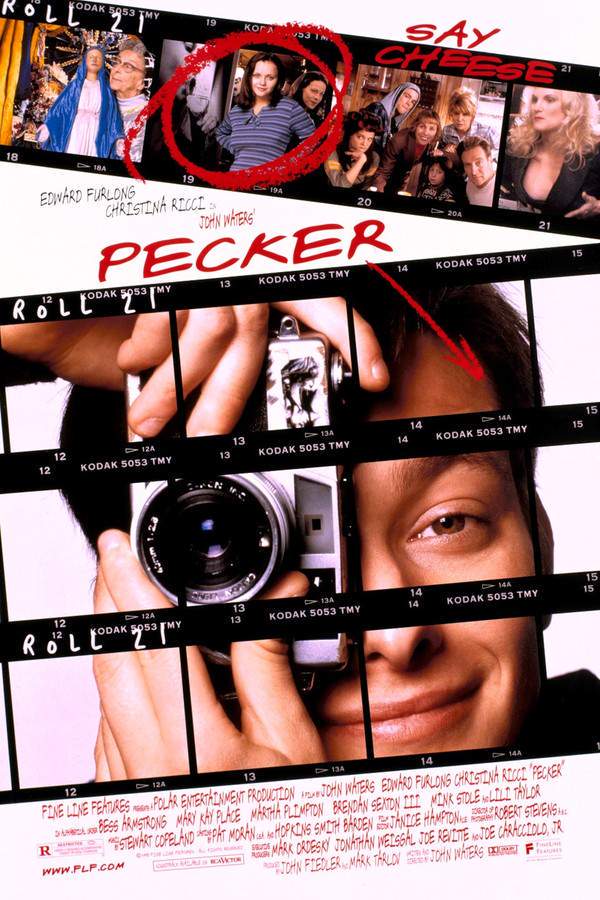


Where to Watch Pecker
See current US streaming, rental, and purchase options for Pecker (1998) via JustWatch.






Pecker Plot Summary
Read the complete plot summary and ending explained for Pecker (1998). From turning points to emotional moments, uncover what really happened and why it matters.
Pecker is an unassuming 18-year-old in a Baltimore neighborhood known for its thickest local accent. By day he works in a sandwich shop, and by night he quietly photographs his loving but peculiar circle of family and friends. His camera of choice is a cheap Canon Canonet 28, and the resulting images are dark, grainy, and deliberately unglamorous—yet they feel intimate and real. These raw, non-glossy portraits strike a chord with New York art collectors who are hungry for something that feels true to everyday life.
Things take a sharp turn when a savvy New York art dealer, Rorey Wheeler, discovers his work and begins to push him toward a larger stage. What begins as a lucky break quickly reveals the downsides of instant exposure: the offbeat world Pecker captures threatens to be overwhelmed by the glare of the art market. The push to transform him into a celebrated sensation tempts him to depart from his simple, low-key roots, and he eventually abandons his trusty old rangefinder in favor of a new, more feature-rich Nikon N50 in hopes of refining his craft.
As fame grows, practical consequences ripple through his life. Pecker’s best friend Matt can no longer shoplift with the same ease, now that Pecker’s photographs have brought him new visibility. At the same time, Shelley, Pecker’s obsessive girlfriend who runs a laundromat, wrestles with distress as the press labels her a “stain goddess,” misreading her good-natured, pin-up poses as something salacious. The tabloids’ attention turns his entire circle into public spectacles, and the family begins to feel the crushing glare of stardom.
The personal pressure mounts for Pecker’s mother Joyce, who can no longer freely dispense fashion tips to the homeless customers at her thrift shop, and for Memama, his grandmother, who endures embarrassment when a statue of the Virgin Mary is photographed and splashed across a national art magazine. Tina, his older sister who once emceed go-go dancing at a gay bar, is fired from her job because Pecker’s edgy photos chronicle the club’s patrons and their intimate moments. Even Little Chrissy, his six-year-old sister, faces consequences as her eating disorder is exposed to the public, prompting concerns from child welfare agencies and a misdiagnosis of ADHD that leads to treatment with Ritalin.
Seeing how quickly fame can destabilize the lives around him, Pecker refuses to participate in a scheduled Whitney Museum of Art show. Instead, he invites New York art collectors to Baltimore to view his latest work in the place that inspired him, presenting portraits that include the very people who had dismissed his family. One shocking image shows Lynn Wentworth adjusting her breasts in a mirror, a provocative moment that fuels further debate about art, privacy, and the boundaries of depiction.
When pressed about his next steps, Pecker quietly expresses a future ambition: he would like to direct a film. The film remains a candid, humorous, and humane look at how fame can upend ordinary life, a portrait of a young photographer trying to navigate authenticity in a world that suddenly insists on perception over reality.
Pecker Timeline
Follow the complete movie timeline of Pecker (1998) with every major event in chronological order. Great for understanding complex plots and story progression.
Pecker's quiet Baltimore life begins
Pecker is an unassuming 18-year-old who works in a sandwich shop and quietly photographs his loving but peculiar family and friends. His grainy, unglamorous images capture a realism that resonates beyond his neighborhood. The habit of 'pecking' at his food becomes a nickname that hints at his curious, observant nature.
Rorey Wheeler discovers Pecker’s work
A savvy New York art dealer named Rorey Wheeler stumbles upon Pecker’s photographs and sees a rare, candid voice in them. The simple, grainy images strike a chord with art collectors despite their lack of polish. The discovery sets Pecker on a path toward a wider, uncomfortable fame.
Canon to Nikon: a career move
To capitalize on his sudden attention, Pecker abandons his trusty Canon for a full-featured Nikon N50, signaling a push toward a bigger market. The new gear promises sharper images, but it also foreshadows the intrusive exposure of his private life. He questions whether the trade-off is worth disturbing the life behind the pictures.
Friendship strained as visibility grows
Pecker’s rising profile affects his circle, most notably his best friend Matt, who can no longer shoplift without attracting attention. The increased visibility of Pecker’s world spills into Matt’s life, creating tensions and awkward consequences. The line between friendship and fame becomes uncomfortable for both.
Shelley’s distress over ‘stain goddess’ press
Shelley, Pecker’s girlfriend who runs a laundromat, grows anxious as the press dubs her a 'stain goddess' and misreads her pin‑up style as pornographic. Her frustration mirrors the way fame distorts ordinary, private personas. The couple struggles to maintain a sense of normalcy amid sensational attention.
The 'culturally challenged' label and stardom’s glare
An overzealous critic brands Pecker’s family as 'culturally challenged', forcing them into the glare of the art world. What started as affectionate curiosity becomes invasive scrutiny that unsettles their daily lives. The family must cope with unwanted publicity while trying to stay true to themselves.
Memama’s statue moment goes national
Memama’s experience with a talking Virgin Mary statue is captured for a national audience when it appears on the cover of a major art magazine. The public ridicule that follows intrudes on a private, homegrown symbol of wisdom and memory. The incident underscores how Pecker’s work turns ordinary life into spectacle.
Tina loses her job over the photograph
Tina, Pecker’s older sister who emcees go-go dancing at a gay bar, is fired after Pecker’s edgy photographs chronicle the club’s sex practices. The firing demonstrates how Pecker’s art penetrates work and reputation beyond his immediate circle. The family feels the cost of fame in tangible professional consequences.
Chrissy’s troubles go public
Little Chrissy’s eating disorder becomes front-page material, drawing nosy child welfare attention and a mistaken ADHD diagnosis, leading to a prescription of Ritalin. The exposure destabilizes a young girl’s life and highlights how fame spills into the most private corners of a family. The family experiences unintended, harmful consequences of Pecker’s growing notoriety.
Pecker rejects the Whitney show
Having seen how fame disrupts his loved ones, Pecker refuses to participate in a scheduled Whitney Museum of American Art show. Instead, he brings the New York collectors to Baltimore to view his latest photographs, including images that poke fun at the people who disparaged his life. The move cements his desire to control how his work is presented.
The Lynn Wentworth nude-in-a-mirror moment
One photo shows Lynn Wentworth adjusting her breasts in a mirror, a provocative choice that stirs controversy among critics and collectors. The image becomes a flashpoint for debates about taste, class, and the boundaries of art. The episode illustrates how one shot can polarize an entire audience.
Pecker’s next dream: directing a film
When asked about what comes next, Pecker reveals a desire to direct a film, signaling a new artistic ambition beyond still photography. The remark hints at a future where his eye might shape moving images as much as static ones. The ending leaves open the possibility that fame could be balanced with personal creative control.
Pecker Characters
Explore all characters from Pecker (1998). Get detailed profiles with their roles, arcs, and key relationships explained.
Pecker — Edward Furlong
An unassuming 18-year-old Baltimore photographer whose grainy, intimate studies of family and friends resonate with art collectors. His growth is tempered by loyalty to his roots and discomfort with the sudden, outsized attention his work attracts. He ultimately rejects a high-profile Whitney show to invite collectors to Baltimore, insisting on presenting his subjects on his own terms.
Shelley — Christina Ricci
Pecker’s obsessive girlfriend who runs a laundromat and becomes entangled in the media’s mislabeling of her as a ‘stain goddess.’ She embodies a blend of affection and pressure, illustrating how fame can distort intimate relationships. Her reactions to publicity reveal the strain between personal identity and public perception.
Joyce
Pecker’s mother, a practical, loving matriarch who tips and tips-toe through her thrift-shopped world. Her life is upended as the family’s fame bleeds into public spaces, revealing the limits of generosity when scrutiny intensifies. She remains a stabilizing force amid the shifts caused by Pecker’s notoriety.
Memama
Pecker’s grandmother, a figure of wisdom whose life experiences become national news after a talking statue of the Virgin Mary is covered by a magazine. Her dignity and humor resilience anchor the family’s reaction to fame and its ridiculousness. She embodies a generation shaped by faith and practicality.
Tina
Pecker’s older sister who navigates work as a go-go dancer and faces job consequences when Pecker’s work encroaches on the boundaries of privacy and propriety. Her arc highlights the collateral impact of fame on the siblings who share the spotlight.
Matt
Pecker’s best friend whose own behavior shifts as the photographer’s visibility grows. Once a collaborator in shoplifting, his sense of camaraderie is tested by the new social hierarchy and the pressures of being connected to a suddenly famous figure.
Rorey Wheeler
A savvy New York art dealer who discovers Pecker and catalyzes his transformation into a contemporary art phenomenon. His push for sensational promotion sets the stage for a collision between authentic, unpolished work and market-driven hype.
Lynn Wentworth
An overzealous critic who labels Pecker’s family as culturally challenged, embodying the harsh judgments of the art press. She functions as a critique of how critics can shape a narrative to fit a particular market or trend.
Little Chrissy
Pecker’s six-year-old sister whose eating disorder and public exposure draw attention from child welfare agencies. Her experience underscores the vulnerable costs of celebrity and media in a family’s life.
Pecker Settings
Learn where and when Pecker (1998) takes place. Explore the film’s settings, era, and how they shape the narrative.
Time period
Late 1990s
The narrative is grounded in the late 1990s, an era of analog photography and rising celebrity culture. Pecker uses a Canonet 28 and later a Nikon N50, signaling a pre-digital, film-based era of image-making. The period mood amplifies the tension between authentic, unglamorous subjects and commodified art-world fame.
Location
Baltimore, Maryland, New York City, New York
The film unfolds in a working-class Baltimore neighborhood, where everyday life centers around family, thrift shops, and a loyal circle of friends. As Pecker’s fame begins to bloom, the story shifts to the high-stakes New York art world, highlighting the stark contrast between his humble origins and the glamorous gallery scene. The setting underscores how a local photographer’s life can be upended by sudden exposure to the international art market.
Pecker Themes
Discover the main themes in Pecker (1998). Analyze the deeper meanings, emotional layers, and social commentary behind the film.
✨
Fame
Fame arrives suddenly for Pecker through a gallery system that values striking images over lived reality. The attention reshapes how his family is seen, turning private moments into public spectacle. The film questions whether genuine art can survive the glare of sudden celebrity without losing its soul.
🏠
Family
Fame pressures Pecker’s family, exposing their quirks and vulnerabilities to critics and fans alike. The thrift shop mother, the grandmother’s publicized moment, and the sister’s workplace all become fodder for the art world’s gaze. The story uses intimate domestic scenes to contrast with the cold spectacle of public attention.
⚖️
Ethics
The rise of Pecker’s images highlights ethical questions about intrusion, exploitation, and consent in art. The press and dealers blur lines between admiration and sensationalism as they shape a family’s narrative for a market. The film scrutinizes whether art can remain honest when it thrives on other people’s exposure.
🎨
Art World
The film portrays the art world as a system of gatekeepers, critics, and collectors who monetize authenticity. Rorey Wheeler’s push for a sensational promotion clashes with Pecker’s preference for quiet, unglamorous subjects. It critiques how artistic value can be manufactured through publicity and prestige.

Coming soon on iOS and Android
The Plot Explained Mobile App
From blockbusters to hidden gems — dive into movie stories anytime, anywhere. Save your favorites, discover plots faster, and never miss a twist again.
Sign up to be the first to know when we launch. Your email stays private — always.
Explore the mobile appPecker Spoiler-Free Summary
Discover the spoiler-free summary of Pecker (1998). Get a concise overview without any spoilers.
In a tight‑knit Baltimore neighborhood where the local accent sounds like a rhythm in itself, Pecker spends his days flipping sandwiches and his nights wandering the streets with a battered Canonet 28. He captures his world in grainy, unglamorous frames that feel more like intimate confidences than polished compositions. The camera is simply a tool for him, a way to hold a moment steady—an ordinary slice of life that somehow glows with a quiet intensity.
Around him a cast of off‑beat characters adds color to every shot. His devoted but eccentric girlfriend Shelley runs a laundromat, his loyal buddy Matt is always up for a mischievous plan, and his multigenerational family—mother Joyce, grandmother Memama, older sister Tina, and the spirited little sister Chrissy—each bring their own quirks to the frame. Their daily rituals, small struggles, and unpretentious humor become the heart of his photographs, turning the mundane into something oddly heroic.
When a savvy New York art dealer named Rorey Wheeler stumbles upon Pecker’s work, the raw honesty of his portraits catches the eye of a world hungry for authenticity. The invitation to step onto a larger stage hints at both opportunity and disruption, suggesting that the line between personal truth and public spectacle may soon blur. The prospect of traveling beyond Baltimore’s familiar streets, swapping his trusty rangefinder for a flashier Nikon, teases a tension between staying grounded and chasing acclaim.
The film balances a breezy, comedic tone with sincere observation, inviting viewers to wonder how a young artist navigates the sudden ripple of attention that follows his candid lens. It paints a portrait of ambition, community, and the delicate dance of staying true to oneself when the world suddenly insists on seeing you.
Movies with Similar Twists and Themes
Uncover films that echo the narrative beats, emotional arcs, or dramatic twists of the one you're exploring. These recommendations are handpicked based on story depth, thematic resonance, and spoiler-worthy moments — perfect for fans who crave more of the same intrigue.


Featured on this page

What's After the Movie?
Not sure whether to stay after the credits? Find out!
Check out our other apps:

SAT Sphere
Build confidence for the Digital SAT.

Mori Atlas
Discover wild places worth protecting.

Luntero
Search smarter for a home in Amsterdam.

Plot Explained
Unravel movie endings and hidden clues.

Pokechamp
Dive into Pokémon data and battle logic.

Driving Theory
Get ready for your European theory test.

Movie Dust
Plan your next cinema trip with ease.

Musemap
Find art and culture as you travel.

Selkobase
Compare credentials before committing.

Local Manual
Turn an unfamiliar country into practical next steps.

Lernavi
Compare school systems before your next move.

GymRoam
Find a workout stop wherever your plans take you.
Explore Our Movie Platform
New Movie Releases (2026)
Famous Movie Actors
Top Film Production Studios
Movie Plot Summaries & Endings
Major Movie Awards & Winners
Best Concert Films & Music Documentaries
Movie Collections and Curated Lists
© 2026 What's After the Movie. All rights reserved.
Privacy Policy