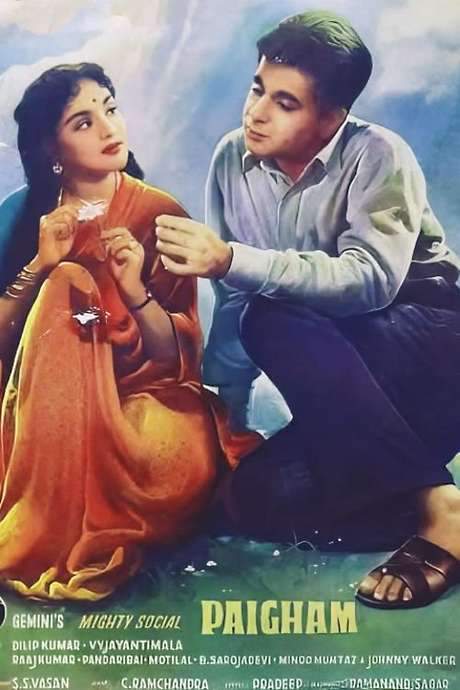



Where to Watch Paigham
See current US streaming, rental, and purchase options for Paigham (1959) via JustWatch.

Streaming availability powered by 
Paigham Plot Summary
Read the complete plot summary and ending explained for Paigham (1959). From turning points to emotional moments, uncover what really happened and why it matters.
The film follows Pratima Devi as Mrs. Lal, a widowed mother who heads a bustling household. Her two sons, Raaj Kumar as Ram Lal and Dilip Kumar as Ratan Lal, live with their unmarried sister Sheela and Ram’s wife, Pandari Bai as Parvati, along with their children. The family portrait shows how duty, affection, and economic pressures shape daily life in their town.
On Ratan’s return from Calcutta, he is offered a job at the same mill and quickly falls for a typist named Manju, portrayed by Vyjayanthimala. This romance touches a nerve with Malti Sewakram, the mill owner’s daughter, B. Saroja Devi, hinting at a clash between personal loyalties and the business world.
Trouble deepens when Ratan uncovers defrauding practices at the mill. He resolves to organize the workers and push for a fairer system, a move met with opposition from the mill’s powerful owner, Motilal as Seth Sewakram. The conflict escalates into a strike, and the household fractures as Raaj Kumar as Ram Lal, loyal to the mill, stands in opposition to the union idea. The fallout sees Ram ejecting Ratan from the family home, and Ratan finding himself blacklisted.
Meanwhile, Sheela’s engagement to Kundan ends when the marriage is canceled, dealing a blow to the family’s prestige in the community. Kurupanju plays Kundan, a figure in these social pressures.
The story asks whether the workers can break Sewakram’s hold and whether the Lal family can reunite. The latter half of the film settles these questions through a tapestry of loyalties, reconciliation, and renewed ties.
Paigham Timeline
Follow the complete movie timeline of Paigham (1959) with every major event in chronological order. Great for understanding complex plots and story progression.
Ratan studies engineering in Calcutta
Ratan is pursuing engineering studies in Calcutta, indicating his aspirations beyond the family mill. His education sets the stage for later decisions that affect the family’s fortunes. The film uses this background to contrast his ambitions with the family’s traditional loyalties.
Ratan returns home and falls for Manju
Ratan returns to the family and is offered a job at the mill, tying his future to the family business. He falls in love with Manju, a typist at the mill, which upset Malti, Sewakram's daughter. The romance introduces social tensions that complicate the family dynamics.
Ratan uncovers fraud at the mill
Ratan learns that Sewakram has been defrauding mill employees, exposing corruption at the heart of the business. The discovery motivates him to seek reform and stand up for the workers. The revelation strains relations with Sewakram and the powerful owners.
Ratan forms a union
Inspired by the fraud, Ratan decides to form a workers' union to push for fair practices and accountability. He faces opposition from the mill leadership and from within his own family. The move heightens the fight over control of the mill.
Ram opposes the union
Ram, loyal to Sewakram, opposes his brother Ratan's union plans, creating a rift between the siblings. His stance reflects the tension between personal loyalty and social justice. The household becomes a battleground for competing loyalties.
Workers strike
The union drive leads the workers to go on strike, challenging the operations of the mill. The action tests the resolve of both the workers and the mill owners. Public opinion begins to shift as the conflict escalates.
Ratan is expelled from the house
In a heated confrontation, Ram throws Ratan out of the house, marking a dramatic break in the family’s unity. The act deepens the fracture between the brothers and threatens the household’s stability. The community begins to see the Lal family through the lens of the dispute.
Ratan is blacklisted
Word spreads that Ratan is working against Sewakram, and he is blacklisted by the mill and other employers. The blacklist cuts off his employment prospects and isolates him from the industry. The social stigma reinforces his resolve to pursue change, though at a personal cost.
Sheela's marriage is canceled
Sheela’s planned marriage to Kundan is canceled, dealing a blow to the family’s prestige. The cancellation underscores the social consequences of the ongoing dispute with Sewakram. The Lal family’s standing in the community continues to erode as a result.
The central conflict looms over the future
With the strike and the family’s divisions ongoing, the central question remains whether the workers can resist Sewakram’s control. The narrative thickens as more stakeholders take sides. The tension mounts as the community awaits a resolution.
Latter half addresses the reunion and fate
The latter half of the film begins to address whether the Lal family will be re-united and how the workers’ struggle will unfold. The story shifts toward closure, testing both the family bonds and their collective strength. The outcome is framed as a turning point for all involved.
Resolution emerges (without spoilers)
As the narrative moves toward resolution, the film presents the consequences of the choices made by Ram, Ratan, and the community. The final act focuses on the impact of these decisions on the family and the workers, leaving some tensions acknowledged but unresolved in detail.
Paigham Characters
Explore all characters from Paigham (1959). Get detailed profiles with their roles, arcs, and key relationships explained.
Malti Sewakram (B. Saroja Devi)
Malti is the mill owner's daughter who sits at the center of the social and business conflict. Her loyalties are torn between family interests and genuine care for the workers and the man she loves. She embodies the tension between aristocratic privilege and evolving social conscience.
Ram Lal (Raaj Kumar)
Ram Lal remains fiercely loyal to the mill and its traditions. He opposes the idea of a workers’ union and ejects his brother-in-law when the conflict escalates. His stance anchors the family’s resistance to reform and highlights the costs of rigid allegiance.
Ratan Lal (Dilip Kumar)
Ratan Lal returns from Calcutta, offers a new vision for the mill, and falls in love with Manju. He takes a stand against defrauding practices and seeks to organize the workers for fair treatment. His actions drive the social upheaval that the family must navigate.
Parvati (Pandari Bai)
Parvati is Ram Lal’s wife and a steady moral presence in the household. She embodies traditional values while navigating the shifting loyalties within the family. Her stance helps anchor the family amid the strike and social pressures.
Manju (Vyjayanthimala)
Manju is a typist who becomes the love interest of Ratan Lal. Her relationship with Ratan navigates class and professional boundaries while challenging the assumptions of the mill's social circle. She represents hope and personal choice amidst upheaval.
Mrs. Lal (Pratima Devi)
Mrs. Lal is the widowed matriarch who heads the bustling household. She embodies duty and resilience, striving to keep the family together as economic pressures mount. Her leadership anchors the narrative through generations of change.
Seth Sewakram (Motilal)
Seth Sewakram is the mill owner who wields power over workers and the town’s social order. His defrauding practices and resistance to unionization reveal how wealth can corrode ethics. His clashes with Ratan Lal set the story’s central conflict into motion.
Kundan (Kurupanju)
Kundan is engaged to Sheela, a social tie that represents prestige and the town’s expectations. The engagement’s collapse exposes the fragility of reputations and the pressure to conform. He embodies conventional social values that resist change.
Sheela
Sheela is Ram Lal’s sister whose engagement to Kundan exposes the community’s reliance on arranged ties and reputational concerns. Her storyline highlights how personal choices are constrained by social norms. The cancellation of the engagement marks a blow to family prestige.
Paigham Settings
Learn where and when Paigham (1959) takes place. Explore the film’s settings, era, and how they shape the narrative.
Location
Calcutta, Mill Town
The story unfolds in a bustling mill town where the textile mill is the economic heartbeat. The urban setting creates social hierarchies and a tight-knit community that feels the pressure of duty and reputation. Calcutta's broader social backdrop also influences the romance and labor tensions that drive the plot.
Paigham Themes
Discover the main themes in Paigham (1959). Analyze the deeper meanings, emotional layers, and social commentary behind the film.
⚖️
Labor & Strike
The plot centers on workers' grievances at the mill, Ratan's push for fair practices, and the resulting strike. It examines power dynamics between industry owners and laborers, and how reform can collide with entrenched interests. Loyalties within the Lal family and their community are tested as justice and survival hang in the balance.
💔
Family vs Duty
The Lal family is divided by competing loyalties—toward kin, the mill, and the broader community. Personal happiness clashes with economic pressure and social expectations. The film uses household fractures to explore how duty can override affection, and vice versa. Reconciliation becomes the central resolve that threads through the narrative.
💼
Power & Wealth
Seth Sewakram's control of the mill reveals how wealth can bend relationships and suppress reform. The narrative traces how money-backed authority resists unionization and accountability. The scramble for profit clashes with ethical responsibility, driving the conflict forward. The outcome hinges on a shift in power dynamics within the town.

Coming soon on iOS and Android
The Plot Explained Mobile App
From blockbusters to hidden gems — dive into movie stories anytime, anywhere. Save your favorites, discover plots faster, and never miss a twist again.
Sign up to be the first to know when we launch. Your email stays private — always.
Explore the mobile appPaigham Spoiler-Free Summary
Discover the spoiler-free summary of Paigham (1959). Get a concise overview without any spoilers.
The story centers on the bustling household of Mrs. Lal, a widowed matriarch navigating the complexities of family life in an industrial town. Her home is a microcosm of affection and duty, shared with her sons Ram and Ratan, daughter Sheela, and Ram’s wife, Parvati. While Ram toils in the local mill, embodying stability and a deep sense of responsibility, Ratan returns from his engineering studies in Calcutta with a fresh education and a new outlook. This return disrupts the quiet rhythm of their lives, as the household must now reconcile the different paths the two brothers walk—one rooted in the status quo, the other looking toward change.
Into this settled routine walks Manju, a typist at the mill who captures Ratan’s attention, sparking a connection that defies the rigid lines of their social environment. This developing romance draws the ire of Malti Sewakram, the mill owner’s daughter, who harbors her own interest in the young engineer. This emotional triangle serves as a backdrop for the larger power plays at hand, weaving personal ambition with the rigid hierarchies of the town. As Ratan navigates these shifting dynamics, the atmosphere thickens with unspoken rivalries and the weight of expectations from both the family and the factory floor.
The central tension arises when Ratan’s principles lead him to question the practices of the mill’s owner, Seth Sewakram. Finding himself caught between conscience and survival, he seeks to organize the workers, a stance that places him in direct opposition to Ram, who remains loyal to the establishment. This ideological rift threatens to tear the family apart, forcing each member to choose sides in a conflict that blurs the lines between brotherhood and betrayal. The film sets the stage for a profound struggle, asking whether the bonds of kinship can withstand the crushing weight of industrial injustice.
Featured on this page

What's After the Movie?
Not sure whether to stay after the credits? Find out!
Check out our other apps:

SAT Sphere
Build confidence for the Digital SAT.

Mori Atlas
Discover wild places worth protecting.

Luntero
Search smarter for a home in Amsterdam.

Plot Explained
Unravel movie endings and hidden clues.

Pokechamp
Dive into Pokémon data and battle logic.

Driving Theory
Get ready for your European theory test.

Movie Dust
Plan your next cinema trip with ease.

Musemap
Find art and culture as you travel.

Selkobase
Compare credentials before committing.

Local Manual
Turn an unfamiliar country into practical next steps.

Lernavi
Compare school systems before your next move.

GymRoam
Find a workout stop wherever your plans take you.
Explore Our Movie Platform
New Movie Releases (2026)
Famous Movie Actors
Top Film Production Studios
Movie Plot Summaries & Endings
Major Movie Awards & Winners
Best Concert Films & Music Documentaries
Movie Collections and Curated Lists
© 2026 What's After the Movie. All rights reserved.
Privacy Policy