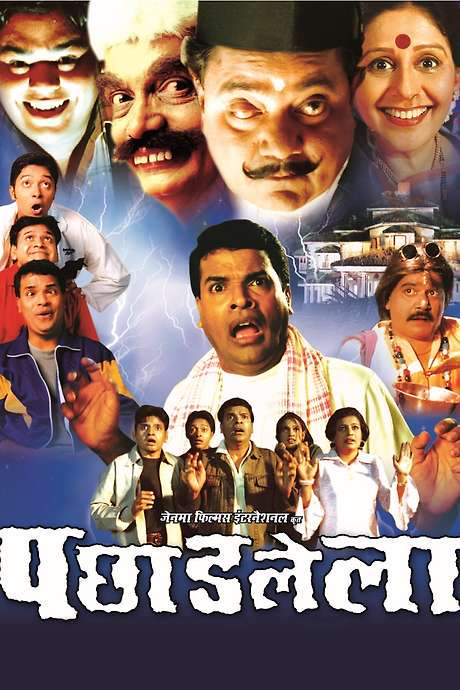


Pachhadlela Plot Summary
Read the complete plot summary and ending explained for Pachhadlela (2004). From turning points to emotional moments, uncover what really happened and why it matters.
Bharat Bharat Jadhav, Ravi Shreyas Talpade and Sameer Abhiram Bhadkamkar are reassigned to the village branch of their bank and are granted an old wada as their living quarters. They settle in with a mix of camaraderie and skepticism, and it isn’t long before they begin to experience unexplained, eerie disturbances that seem to focus on Bharat. The trio’s initial disbelief gives way to tense curiosity as strange sounds, cold spots, and fleeting shadows creep through the halls of the ancient house.
On Ravi’s engagement day, a force uses Bharat as a vessel and exposes deep-seated ritual troubles that derail the ceremony, leaving the whole clan dazzled by fear and confusion. The episode leaves Bharat overwhelmed, and he is soon admitted to a mental asylum, his friends torn between doubt and worry. The mystery deepens when Inspector Mahesh Jadhav [Mahesh Kothare] arrives with answers that trace the haunting back to the wada’s history.
Long before the trio moved in, Inamdar Bhusnale [Dilip Prabhavalkar] was the wealthy, arrogant owner of the house, living alongside a son named Babya [Ameya Hunaswadkar] who suffered from a serious mental illness and a dangerous obsession with marriage. A renowned priest suggests a plan to secure Babya’s “cure” by arranging a marriage to a girl from outside the village, a scheme Bhusnale hopes will mask his son’s illness. As the priest predicts, a wedding would supposedly bring relief—yet Durga Maushi [Vandana Gupte], Bhusnale’s outspoken neighbor, uncovers the plan and courageously disrupts the ceremony. The truth comes out to the girl’s family, and they withdraw, dealing a severe blow to Bhusnale’s reputation.
The shock of the failed wedding drives Babya to collapse, and he is institutionalized where he ultimately takes his own life. Bhusnale, haunted by guilt and rage, dies of a heart attack soon after. From that day on, Babya’s spirit, Bhusnale’s, and their custodian Kirkire linger in the wada, seeking a medium to avenge Durga Maushi’s meddling. Bharat, Sameer, Ravi—and their circle of friends—team up with Vetale Guruji [Laxmikant Berde] to confront the malevolent presence and restore peace.
A carefully planned ritual becomes the turning point. Following a recipe from Vetale’s great‑grandfather, a master ghost hunter, Vetale places three dolls, each paired with a personal object belonging to Bhusnale, Babya, and Kirkire. When the dolls are activated, the spirits enter them, and the trio of dolls combusts in a ritual fire. With the ritual complete, Durga Maushi’s spirit finds release and departs, leaving the wada at last quiet and at peace.
Pachhadlela Timeline
Follow the complete movie timeline of Pachhadlela (2004) with every major event in chronological order. Great for understanding complex plots and story progression.
Move-in day at the old wada
Bharat Jadhav, Ravi, and Sameer are reassigned to the village branch of their bank and move into an old wada as their living quarters. The setup brings a mix of camaraderie and skepticism among them. Almost immediately, eerie disturbances begin to ripple through the halls, suggesting the house has a history that won't stay quiet.
First signs of haunting
Initial disbelief gives way to fear as strange sounds, cold spots, and fleeting shadows creep across the corridors. The disturbances seem to target Bharat in particular, sharpening the trio's curiosity and unease. The atmosphere grows heavier as the wada's past starts to feel dangerously present.
Bharat possessed on Ravi's engagement day
On Ravi's engagement day, a malevolent force uses Bharat as a vessel and derails the ceremony. The ritual overtones behind the hauntings become undeniable as fear spreads through the clan. The incident marks a turning point from skepticism to a chilling acknowledgment of the supernatural.
Bharat's asylum and growing worry
Bharat's grip on sanity slips and he is admitted to a mental asylum. His friends are torn between doubt and worry as they grapple with the possibility of a haunting beyond explanation. The line between reality and menace blurs in the wake of the possession.
Inspector Jadhav arrives with history
Inspector Mahesh Jadhav arrives with a history-based explanation that ties the haunting to the wada's past. He traces the disturbances to the house's previous owners and the trauma embedded in its walls. The revelation shifts the mystery from personal fear to a cursed inheritance.
Backstory: Bhusnale and the marriage plan
Long before the trio moved in, Inamdar Bhusnale was a wealthy and arrogant owner of the house, living with a son named Babya who suffered from a serious mental illness and a dangerous obsession with marriage. A priest proposes a plan to cure Babya by arranging a marriage to a girl from outside the village, hoping to mask the illness. Bhusnale clings to the scheme, setting the stage for tragedy.
Durga Maushi disrupts the wedding plan
Durga Maushi uncovers the plan and courageously disrupts the wedding, exposing Bhusnale's scheme. The girl's family withdraws, leaving Bhusnale humiliated and the community unsettled. The failed wedding seeds the undercurrent of guilt and rage that will haunt the wada.
Babya collapses and is institutionalized
Babya collapses under the weight of the failed wedding and is institutionalized. The strain of the plan takes a toll, and his health deteriorates under institutional care. The tragedy binds the family to the house's dark legacy.
Babusale's suicide and Bhusnale's death
Babya's time in the institution ends tragically when he takes his own life, a moment that compounds Bhusnale's guilt. Bhusnale himself dies of a heart attack soon after, leaving the estate heavier with sorrow and unresolved anger. The two deaths seal the families' ties to the wada's dark history.
Spirits linger in the wada
From that day on, Babya’s spirit, Bhusnale’s spirit, and the custodian Kirkire linger in the wada, seeking a medium to avenge Durga Maushi’s meddling. Their presence marks a malevolent wind that refuses to fade until it is given a voice. The house becomes a battleground for lingering souls.
Team-up with Vetale Guruji
Bharat, Sameer, Ravi, and their circle of friends band together with Vetale Guruji to confront the malevolent presence and restore peace. They commit to a plan that respects the house's history while confronting the spirits head-on. The alliance marks a turning point from fear to purposeful resistance.
Vetale's three-doll ritual plan
Vetale uses a recipe from his great-grandfather, the master ghost hunter, to place three dolls, each paired with a personal object belonging to Bhusnale, Babya, and Kirkire. The ritual is carefully prepared to bind the spirits to the dolls and trigger a cleansing sequence. The stage is set for a life-or-death confrontation that could free the wada or doom it to perpetual unrest.
Ritual activation and final release
When the dolls are activated, the spirits enter them and the dolls combust in a ritual fire. Durga Maushi's spirit finds release and departs, leaving the wada quiet at last. Peace returns to the house, but the events linger in the memories of those who survived.
Pachhadlela Characters
Explore all characters from Pachhadlela (2004). Get detailed profiles with their roles, arcs, and key relationships explained.
Ravi — Shreyas Talpade
A practical bank employee who moves into the wada with Bharat and Sameer. Initially skeptical of the supernatural, he becomes brave and decisive as the disturbances escalate. He pushes the group to investigate the wada’s past and to seek a resolution that protects his friends.
Bharat — Bharat Jadhav
The reserved, grounded member of the trio who bears the brunt of the haunting. His crisis leads to a stint in a mental asylum, revealing how fear and shame can affect a person’s life. He remains a crucial link to the wada’s history as the paranormal events unfold around him.
Sameer — Abhiram Bhadkamkar
A loyal, curious friend who helps piece together clues about the mansion’s past. He stays hopeful even as danger mounts and supports his friends through moments of doubt. His observations help drive the investigation and the plan to confront the spirits.
Durga — Vandana Gupte
The outspoken neighbor who disrupts Bhusnale’s plan and becomes a key ally to the trio. She represents the community’s voice of conscience and resistance against deception. Her actions help uncover the truth and protect others from being harmed by the wada’s past.
Vetale Guruji — Laxmikant Berde
A master ghost hunter whose lineage and knowledge guide the trio toward a solution. He provides ritual expertise and spiritual perspective, linking the present haunting to the wada’s history. His presence anchors the plan to confront and calm the spirits.
Babya — Ameya Hunaswadkar
A troubled son whose illness and obsession with marriage drive the house’s grim backstory. His fate casts a long shadow over the present events, as his actions and the tragedy surrounding him echo through the wada’s walls.
Inamdar Bhusnale — Dilip Prabhavalkar
The wealthy, arrogant owner who orchestrates a plan to marry Babya off to mask his son’s illness. His actions trigger a cascade of consequences and haunt the living with guilt and revenge after his death.
Kirkire — Vijay Chavan
The wada custodian who remains as a link to the estate’s past. His presence embodies the relics of tradition and the weight of unresolved stories. He becomes part of the plan to calm the spirits alongside the trio and Vetale.
Pachhadlela Settings
Learn where and when Pachhadlela (2004) takes place. Explore the film’s settings, era, and how they shape the narrative.
Time period
Present-day
The action unfolds in modern times, with Bharat, Ravi, and Sameer moving into the wada as their living quarters after a bank reassignment. Paradoxically, the disturbances connect to a centuries-old legacy that surfaces through flashbacks and whispered memories. The narrative threads between their contemporary challenges and the wada’s dark past, including the ill-fated marriage scheme and the deaths that followed. The supernatural events become a mirror of unresolved guilt and vengeance across generations.
Location
Village wada (old ancestral mansion)
An old, sprawling wada sits at the heart of a quiet village, its walls thick with history. The house’s corridors become the stage for eerie disturbances that target Bharat and his friends. Its legacy includes a wealthy, arrogant owner, a failed marriage plan, and a priest’s controversial schemes that haunt the present. The setting blends everyday village life with a palpable supernatural weight.
Pachhadlela Themes
Discover the main themes in Pachhadlela (2004). Analyze the deeper meanings, emotional layers, and social commentary behind the film.
👻
Haunting
A malevolent presence stalks the wada, turning its halls into a stage for past sins. The haunting expresses guilt and revenge buried in the estate’s history rather than relying on cheap jump scares. The spirits interact with the living, forcing the characters to confront secrets long kept hidden. Only by understanding the wada’s wrongs can they hope to find peace.
🤝
Friendship
Three friends rely on loyalty and teamwork to face the unknown. Their bond is tested as fear and doubt threaten to fracture the group, but they pull together to uncover the truth. Each discovery strengthens their resolve to protect one another and confront the spirits. The theme suggests friendship as a form of courage against darkness.
📜
History
The wada's backstory reveals how wealth, pride, and a failed marriage scheme seeded the present curse. Clues about Inamdar Bhusnale, Babya, and the priest's plot emerge through the characters' investigations. These revelations show that the haunting is driven by unresolved guilt across generations. Understanding this history is essential to breaking the cycle.
⚖️
Ritual Ethics
A carefully planned ritual, using dolls and personal objects, becomes the turning point in driving the spirits to release. The film explores the morality of ritual intervention—whether humans should manipulate the dead to protect the living. The ritual succeeds, but not without considering the cost and responsibility that such acts incur. The ending suggests peace is earned through careful, respectful action rather than bravado.

Coming soon on iOS and Android
The Plot Explained Mobile App
From blockbusters to hidden gems — dive into movie stories anytime, anywhere. Save your favorites, discover plots faster, and never miss a twist again.
Sign up to be the first to know when we launch. Your email stays private — always.
Explore the mobile appPachhadlela Spoiler-Free Summary
Discover the spoiler-free summary of Pachhadlela (2004). Get a concise overview without any spoilers.
In a quiet village where the old‑world charm of a centuries‑old wada meets the modern routine of a bank, three coworkers find themselves handed an unlikely residence. The mansion, steeped in local legend, carries an unsettling reputation that whispers through its creaking corridors and shadowed rooms. Its weathered walls and lingering chill set a tone that feels both nostalgic and oddly foreboding, inviting curiosity while hinting at secrets that have long been kept hidden.
The trio—Bharat, a good‑natured soul with an easy laugh; Ravi, whose steady demeanor often grounds the group; and Sameer, the quick‑witted planner—move in together, eager to turn the inconvenient assignment into a chance for camaraderie. Their banter and shared routines quickly give way to an uneasy awareness that the house is more than a backdrop; it seems to listen, reacting to their every step. The contrast between their urban sensibilities and the rural, almost mythic atmosphere fuels a dynamic that is equal parts light‑hearted and tense.
Soon, an unexpected pattern emerges: Bharat becomes the unintentional conduit for a series of bewildering episodes. Unseen forces repeatedly take hold of him, turning ordinary moments into comic misunderstandings that leave his friends both amused and wary. The bizarre possessions are hinted to be the work of lingering spirits, whose restless presence injects a playful yet unsettling energy into the day‑to‑day life of the household. This blend of humor and the supernatural creates a unique tonal balance, where laughter often masks a deeper, more ominous undercurrent.
As the friends navigate the mansion’s eccentricities, they begin to sense that the house holds a story of its own—an old grievance that quietly permeates the air. The atmosphere swirls with hints of ritual, folklore, and an unspoken promise that the past may yet reach out to claim its due, leaving the trio poised on the edge of discovery while the walls continue to watch.
Featured on this page

What's After the Movie?
Not sure whether to stay after the credits? Find out!
Check out our other apps:

SAT Sphere
Build confidence for the Digital SAT.

Mori Atlas
Discover wild places worth protecting.

Luntero
Search smarter for a home in Amsterdam.

Plot Explained
Unravel movie endings and hidden clues.

Pokechamp
Dive into Pokémon data and battle logic.

Driving Theory
Get ready for your European theory test.

Movie Dust
Plan your next cinema trip with ease.

Musemap
Find art and culture as you travel.

Selkobase
Compare credentials before committing.

Local Manual
Turn an unfamiliar country into practical next steps.

Lernavi
Compare school systems before your next move.

GymRoam
Find a workout stop wherever your plans take you.
Explore Our Movie Platform
New Movie Releases (2026)
Famous Movie Actors
Top Film Production Studios
Movie Plot Summaries & Endings
Major Movie Awards & Winners
Best Concert Films & Music Documentaries
Movie Collections and Curated Lists
© 2026 What's After the Movie. All rights reserved.
Privacy Policy