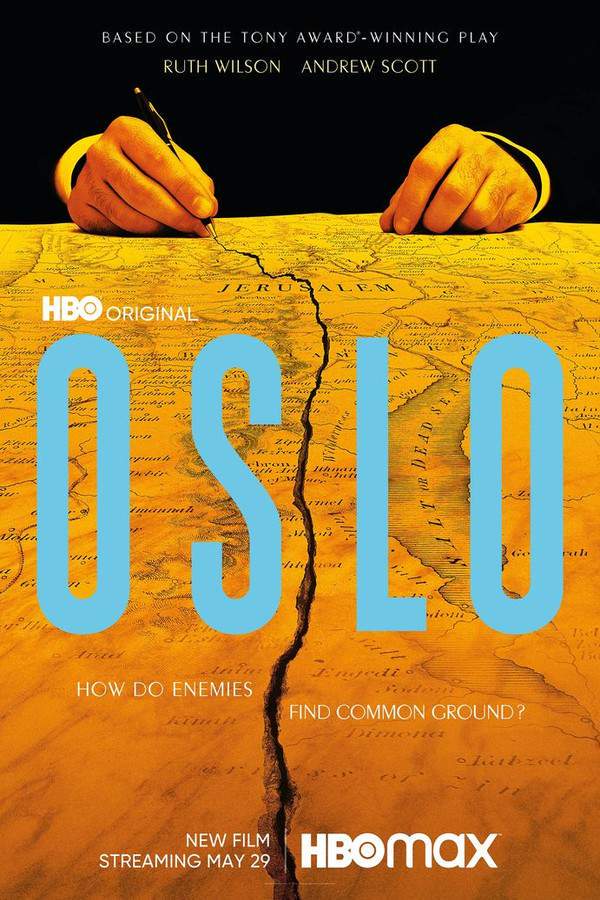
Oslo 2021


Directed by

Bartlett Sher
Made by

Home Box Office (HBO)
Where to Watch Oslo
See current US streaming, rental, and purchase options for Oslo (2021) via JustWatch.








Oslo Plot Summary
Read the complete plot summary and ending explained for Oslo (2021). From turning points to emotional moments, uncover what really happened and why it matters.
In December 1992, Mona Juul at the Norwegian Ministry of Foreign Affairs reaches out to her husband, Terje Rød-Larsen, who is stationed in Jerusalem. He heads straight into a conversation with Yossi Beilin, who outlines a persistent deadlock in the peace talks: both sides insist on getting everything they want at once. Terje counters with a bold new idea—a unilateral shift to a more neutral ground for dialogue, proposing that an Israeli representative meet a Palestinian counterpart away from the usual environments.
The tension shifts to London, where [Mona Juul] again plays a pivotal mediator as she and Terje introduce Ahmed Qurei to the discussion and pair him with Yair Hirschfeld, an Israeli economist by training. The session remains chilly at first, but gradually warms as the parties begin to see the potential for progress. A crucial element of this phase is the sense that smaller, informal exchanges could unlock bigger formal talks.
A follow-up meeting takes place at a manor near Oslo, with Hassan Asfour joining as a Palestinian representative alongside Qurei, and Hirschfeld pairing with Ron Pundak to represent Israel. The atmosphere, while formal, relaxes as participants share meals and social moments, slowly yielding the first drafts of what would become a Declaration of Principles (DOP). Yet because neither Hirschfeld nor Pundak hold official government status, the talks teeter on the edge of collapse as the process grows entangled in national prerogatives and procedural questions.
In a bid to keep things alive, Terje makes a provocative claim—that he could recruit a bona fide Israeli official into the talks. Mona, recognizing the fragility of the moment, decides to break her “facilitate only” rule and confides in Johan Jørgen Holst, the Norwegian foreign minister, who then arranges a direct meeting with Uri Savir from the Israeli foreign ministry to review the evolving DOP.
The encounter between Savir and Qurei begins with sharp accusations and a fierce exchange of blame, but it soon shifts as Savir reveals a willingness to consider concessions: he suggests ceding the Gaza Strip and Jericho as an autonomous Palestinian region, a move that could unlock broader agreement. Savir then brings the draft to Joel Singer, the Israeli Ministry of Foreign Affairs legal adviser, who presses to rewrite the document. The tension rises again, threatening to derail the entire process.
At Hirschfeld’s urging, Mona steps into the fray with a personal perspective, offering her own experiences from the conflict to humanize the negotiations. The film employs flashbacks to hint at the experiences that shaped her viewpoint, weaving memory into the present negotiations and helping to defuse the stalemate.
From this point, the Oslo process begins to move toward a formal conclusion. A long-awaited telephone conference between Shimon Peres and Yasser Arafat is arranged, with Arafat still in exile in Tunis. Qurei speaks on behalf of Arafat and the Palestinian leadership, translating the English dialogue so the other side can follow. After a drawn-out exchange, both sides acknowledge each other’s legitimacy and agree to defer the most controversial issue—Jerusalem—long enough to finalize the broader framework.
The film closes with a montage of real-world consequences and milestones that followed the Oslo Accord: Rabin’s famous White House address—“We who have fought against you, the Palestinians, we say to you today, in a loud and clear voice: ‘enough of blood and tears, enough’”—and the grim later history that includes his assassination in 1995 and ongoing debates over Jerusalem. It also nods to the onset of the Second Intifada in 2000, reminding viewers that the road to peace remained fraught and uncertain. Yet the narrative affirms the Oslo meeting as a turning point that underscored dialogue and mutual recognition as essential tools for peace.
The ensemble cast contributes to a richly textured portrayal of the negotiations, including Jan Egeland and Yigal Naor in supporting roles, whose presence emphasizes the broader international and regional dynamics at play.
Oslo Timeline
Follow the complete movie timeline of Oslo (2021) with every major event in chronological order. Great for understanding complex plots and story progression.
Mona Juul initiates backchannel talks from Oslo
Mona Juul, serving at the Norwegian Ministry of Foreign Affairs, calls her husband Terje Rød-Larsen in December 1992 to propose a new backchannel approach. Terje travels to Jerusalem to discuss with Yossi Beilin, and Mona and Terje outline a plan for an Israeli-Palestinian meeting on neutral ground. The aim is to break the deadlock by enabling talks outside official channels.
Secret London meeting with Ahmed Qurei and Yair Hirschfeld
In London, Mona Juul and Terje introduce Ahmed Qurei to Yair Hirschfeld in a setting kept secret because Israeli officials were not allowed to speak with Palestinians. The discussion starts cold but gradually warms as they explore possibilities for a new approach. They agree to meet again to continue the talks.
Oslo-area follow-up meeting yields draft DOP
A follow-up meeting is held in a manor near Oslo with Qurei and Hassan Asfour representing the Palestinians and Hirschfeld and Ron Pundak representing Israel. The talks start formal and cool but progressively soften as the participants socialize and debate, leading to the first drafts for a Declaration of Principles. The session marks a pivotal shift toward a negotiable framework.
Risk of stalemate and secret facilitation path opened
Because Hirschfeld and Pundak are not Israeli officials, the talks risk ending in stalemate. Terje claims he can bring in an Israeli official to join, increasing the pressure to progress. Mona then reveals the secret to Johan Jørgen Holst, the Norwegian foreign minister, triggering a formal facilitation path with Uri Savir.
Holst brokers a review with Uri Savir
Johan Jørgen Holst arranges a meeting with Uri Savir of the Israeli Foreign Ministry to review the DOP. This session becomes a crucial step toward moving the talks from informal backchannels to a more official process. The participants push to test the feasibility of the draft in broader circles.
Savir-Qurei session moves from confrontation to negotiation
The Savir-Qurei meeting begins with sharp accusations of terrorism and murder but gradually warms as proposals are discussed. Savir signals a willingness to consider autonomy steps, including the Gaza Strip and Jericho, as an autonomous Palestinian region. The dialogue starts to shift from blame to potential compromises.
Singer's rewrite threat and Mona's intervention
Uri Savir brings the evolving draft to Joel Singer, the legal adviser of the Israeli Ministry of Foreign Affairs, who pushes to rewrite the document. This pressure threatens to derail the process and derail consensus. Hirschfeld asks Mona to drop her 'facilitate only' restraint, prompting her to become more actively involved.
Mona shares her personal story to defuse tensions
To defuse the tensions, Mona shares her own experiences with the conflict, aided by flashbacks that appear throughout the film. Her personal testimony helps the negotiators see the human cost and softens hardened positions. The emotional connection becomes a turning point in the discussions.
Finalization via telephone: Peres-Arafat-Qurei
The Oslo Accord is slated to be finalized via a telephone conference involving Shimon Peres and Yasser Arafat (speaking through Qurei, who is fluent in English). Arafat is in exile in Tunis, and the Palestinian side is represented by Qurei. After a long exchange, they agree to accept each other’s legitimacy and postpone the controversial issue of Jerusalem for future negotiations.
Rabin's White House speech as a symbol of the peace effort
The film ends with a montage of archival footage following Oslo, including Yitzhak Rabin's landmark speech at the White House. Rabin declares a hopeful message about moving beyond blood and tears, signaling international acknowledgment of the process. The moment remains a powerful symbol of the peace effort.
Rabin's assassination underscores the peace fragility
The montage recalls Rabin's assassination in 1995, a brutal reminder of the fragile nature of peace efforts. The event casts a long shadow over the ongoing negotiations and the willingness of leaders to pursue compromise. It underscores the persistent political risks facing any peace process.
Second Intifada and the enduring Jerusalem question
The summary notes that Jerusalem's status remains a sticking point, and the Israeli-Palestinian conflict experiences a renewed wave of violence with the onset of the Second Intifada. This highlights the lasting challenges to implementing the Oslo framework. Despite these setbacks, the film emphasizes Oslo's role in opening dialogue and the possibility of future diplomacy.
Oslo Characters
Explore all characters from Oslo (2021). Get detailed profiles with their roles, arcs, and key relationships explained.
Terje Rød-Larsen (Andrew Scott)
Norwegian diplomat whose bold idea to move talks to neutral ground sets the tone for the process. He pushes informal channels and creative diplomacy, balancing risk with potential gains. His persistence and willingness to test unconventional approaches drive the negotiation forward, even when opposition intensifies. His role anchors the film’s belief in dialogue over dictated terms.
Mona Juul (Ruth Wilson)
A pivotal mediator who steers discussions between parties and foregrounds human consequences. She uses her own experiences to humanize the conflict and moves beyond a strict facilitation role. When the moment is fragile, she risks stepping into the fray to foster direct contact between negotiators. Her perspective helps shift the tone from obstruction to possibility.
Hassan Asfour (Waleed Zuaiter)
Palestinian representative who participates in the talks, providing a Palestinian voice in the proceedings. He embodies pragmatism in the face of deep-seated fears and competing narratives. His role helps to balance Israeli concerns with Palestinian aspirations and demonstrates the potential for mutual concessions. He acts as a conduit for the Palestinian perspective within the negotiation
Ron Pundak (Rotem Keinan)
Israeli negotiator who teams with Hirschfeld to represent Israel. Although not an official government figure in the film, he brings strategic insight and a willingness to explore creative compromises. His partnership with Hirschfeld highlights the role of non-official channels in shaping state-level decisions. He helps translate complex positions into workable draft ideas.
Yair Hirschfeld (Doval'e Glickman)
Israeli economist and negotiator who prefers analytical approaches to diplomacy. He partners with Pundak to ground proposals in practical economics and feasibility. His non-official status pushes the talks toward flexible, innovative solutions. He serves as a bridge between idealism and practicality within the process.
Yossi Beilin (Itzik Cohen)
Israeli politician who contributes to the negotiation strategy with a combination of realism and persistence. He helps translate high-level concepts into negotiable language and maintains momentum when disagreements arise. His involvement underscores the political complexity of turning dialogue into a tangible framework.
Uri Savir (Jeff Wilbusch)
Israeli foreign ministry official who initially challenges concessions but ultimately engages in a willingness to consider substantial shifts. His evolution from hardline stance to conciliatory proposals demonstrates the pressure and practicality faced by negotiators. He plays a key role in moving the draft toward a formalized framework.
Jan Egeland (Tobias Zilliacus)
International mediator whose involvement emphasizes the global dimension of the peace process. He provides a broader perspective that helps align regional aspirations with international expectations. His presence underscores the importance of external facilitation in achieving durable agreements. He helps stabilize the negotiation environment through neutral, global insight.
Yigal Naor
Supporting figure whose presence highlights the broader international and regional dynamics at play. He represents the ancillary voices that shape the atmosphere and potential outcomes of the talks. His role underscores how a wide array of actors influences the trajectory of negotiations.
Salim Dau
Palestinian delegate in the negotiation context (character name not specified in the summary). Participates in rounds of discussion and represents Palestinian involvement in the process. The role illustrates the collective nature of the negotiating table beyond the named principals.
Oslo Settings
Learn where and when Oslo (2021) takes place. Explore the film’s settings, era, and how they shape the narrative.
Time period
Early 1990s (December 1992)
The narrative unfolds during a pivotal period of Middle East diplomacy in the early 1990s, beginning in December 1992. The story moves through key moments of the Oslo process as it gradually shifts from stalemate to a framework for negotiation. The timeline interweaves political risk, cautious optimism, and the emergence of informal dialogue as a path toward peace. It also nods to the real-world milestones and consequences that followed.
Location
Oslo, London, Jerusalem, Tunis
Oslo serves as the hinge of the peace process, with tense yet hopeful sessions that redefine traditional venue dynamics. London hosts a series of back-channel discussions that progressively warm toward formal negotiation. The film also depicts a manor near Oslo, contrasting official government spaces with intimate, candid exchanges. These environments symbolize the shift from confrontation to dialogue that underpins the Oslo Accords.
Oslo Themes
Discover the main themes in Oslo (2021). Analyze the deeper meanings, emotional layers, and social commentary behind the film.
🕊️
Peace Process
The film treats peace as a dialogue-driven project rather than a victory won in battle. It highlights how trust is built through informal exchanges, personal testimonies, and small concessions. The narrative suggests that human connection can unlock political stalemates and foster mutual recognition. Ultimately, it frames the Oslo talks as a turning point that demonstrates dialogue's potential to transform conflict.
🤝
Negotiation Dynamics
Back-channel discussions, strategic positioning, and cautious concessions drive the plot. The characters negotiate not only policy but perception, navigating national prerogatives and procedural hurdles. The film shows how mediators and unconventional venues can nudge parties toward a draft agreement. It also underscores the fragility of progress when official status is uncertain.
💬
Dialogue and Memory
Flashbacks reveal how past traumas shape present bargaining stances and emotional stakes. The dialogue is enriched by personal experience, which humanizes opponents and broadens the scope of acceptable compromises. Memory is used to illuminate motivations without hardening positions. The film argues that memory, when humanized, can be a bridge rather than a barrier to agreement.

Coming soon on iOS and Android
The Plot Explained Mobile App
From blockbusters to hidden gems — dive into movie stories anytime, anywhere. Save your favorites, discover plots faster, and never miss a twist again.
Sign up to be the first to know when we launch. Your email stays private — always.
Explore the mobile appOslo Ending Explained
Unravel the ending of Oslo (2021) with our detailed explanation. Understand the final scenes, character fates, and unresolved questions.
In the end, the film portrays the complex and often fragile process of peace negotiations, highlighting that while the Oslo Accords marked a significant step towards dialogue, they did not resolve all conflicts permanently. The assassination of Israeli Prime Minister Yitzhak Rabin in 1995 was a tragic blow to the peace process, illustrating the deep-rooted divisions and opposition that still existed. When the film’s characters meet again in 2000 at Camp David, hopes for a final resolution are dashed by renewed violence, leading Mona to conclude that Oslo was ultimately a failure. Yet, amid these setbacks, she believes that establishing a secret dialogue channel was still a worthwhile effort. The film leaves us with a poignant reminder that striving for peace—despite inevitable setbacks—is a noble pursuit, driven by the hope that understanding and compassion can eventually bridge even the deepest divides. The story emphasizes that real progress often happens quietly and behind closed doors, and that the human desire for peace remains powerful, even in the midst of relentless conflict. Ultimately, the film ends on a note of cautious optimism, recognizing that peace is a continuous journey, not a final destination.**
Oslo Spoiler-Free Summary
Discover the spoiler-free summary of Oslo (2021). Get a concise overview without any spoilers.
In the quiet corridors of Oslo’s foreign ministry, a single phone call sets an unlikely partnership in motion. Mona Juul, a diligent diplomat, discovers that her husband, Terje Rød‑Larsen, stationed in Jerusalem, has been drawn into a dead‑end peace effort. Together they become the covert bridge between two worlds that have long refused to speak directly. The film’s atmosphere is one of hushed urgency, where every whispered conversation could tip the fragile balance of a region already fraught with mistrust.
The story unfolds against a backdrop of secret rooms, hotel lounges, and a secluded manor that becomes a neutral sanctuary for dialogue. Here, seasoned figures such as Yossi Beilin, an Israeli advisor, and Ahmed Qurei, the Palestinian finance minister, meet for the first time without the weight of official scrutiny. Their tentative exchanges are shadowed by the ever‑present sense that any misstep could unravel years of effort. The Norwegian couple, while technically “facilitators only,” find themselves navigating the fine line between observer and participant, their personal convictions gradually intertwining with the political stakes.
The tone remains tense yet intimate, blending the cold formality of diplomacy with moments of unexpected humanity. Characters like Yair Hirschfeld, an Israeli economist, and Ron Pundak, his colleague, bring scholarly idealism that collides with the raw realities of the conflict. As the negotiations progress, the film hints at the emergence of fragile bonds—shared meals, candid anecdotes, and quiet laughter—that illuminate the possibility of common ground. Within this delicate dance, the Norwegian officials wrestle with their own sense of purpose, wondering how far they can go when the world expects them to remain merely behind the scenes. The narrative invites viewers to feel the weight of history pressing on each discreet handshake, while the subtle hope of dialogue lingers just out of reach.
Movies with Similar Twists and Themes
Uncover films that echo the narrative beats, emotional arcs, or dramatic twists of the one you're exploring. These recommendations are handpicked based on story depth, thematic resonance, and spoiler-worthy moments — perfect for fans who crave more of the same intrigue.




Featured on this page

What's After the Movie?
Not sure whether to stay after the credits? Find out!
Check out our other apps:

SAT Sphere
Build confidence for the Digital SAT.

Mori Atlas
Discover wild places worth protecting.

Luntero
Search smarter for a home in Amsterdam.

Plot Explained
Unravel movie endings and hidden clues.

Pokechamp
Dive into Pokémon data and battle logic.

Driving Theory
Get ready for your European theory test.

Movie Dust
Plan your next cinema trip with ease.

Musemap
Find art and culture as you travel.

Selkobase
Compare credentials before committing.

Local Manual
Turn an unfamiliar country into practical next steps.

Lernavi
Compare school systems before your next move.

GymRoam
Find a workout stop wherever your plans take you.
Explore Our Movie Platform
New Movie Releases (2026)
Famous Movie Actors
Top Film Production Studios
Movie Plot Summaries & Endings
Major Movie Awards & Winners
Best Concert Films & Music Documentaries
Movie Collections and Curated Lists
© 2026 What's After the Movie. All rights reserved.
Privacy Policy