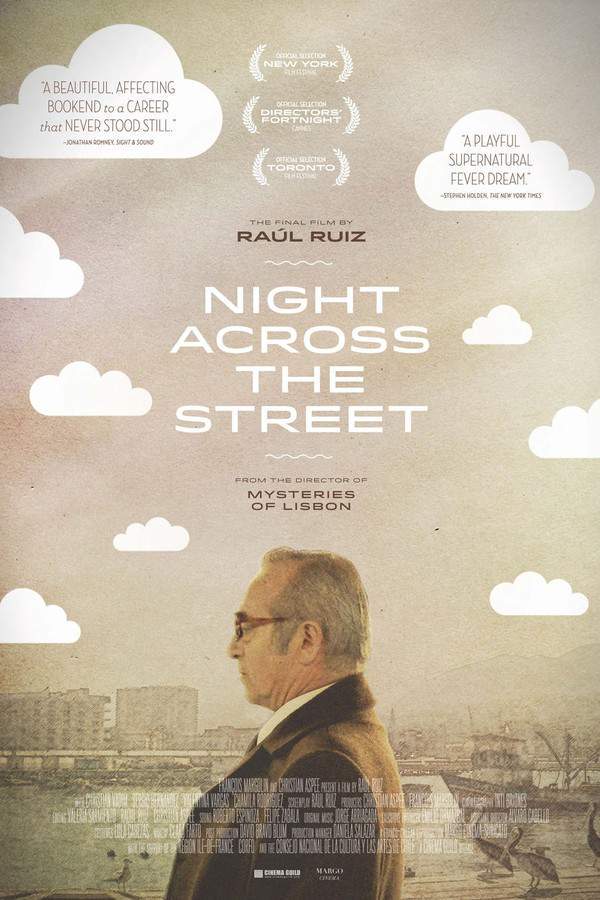
Night Across the Street 2013

Directed by

Raoul Ruiz
Made by

Cinema Guild
Where to Watch Night Across the Street
See current US streaming, rental, and purchase options for Night Across the Street (2013) via JustWatch.




Streaming availability powered by 
Night Across the Street Plot Summary
Read the complete plot summary and ending explained for Night Across the Street (2013). From turning points to emotional moments, uncover what really happened and why it matters.
In his final completed film, Ruiz boldly examines the multifaceted nature of death, presenting audiences with a complex narrative that weaves through three dimensions of time. To help clarify this intricate concept, the film metaphorically likens time to marbles, suggesting an infinite chain of experiences that can be adorned as a unique necklace.
The story begins with Don Celso, portrayed by Sergio Hernández, attending a thought-provoking class led by Jean Giono, played by Christian Vadim. During the class, an alarm from Don Celso’s pocket interrupts the flow, signaling it’s time for his medication. Their discussion about the passage of time acts as a central theme, with Don Celso suggesting that one can perceive time through the lens of their memories and fantasies, both as an adult and as a child.
As the narrative unfolds in the present, we find Don Celso engaged in his office job at a poetry-writing desk, deeply absorbed in his thoughts. He exhibits peculiar behavior reminiscent of a puppet master, reenacting his earlier conversation with Jean Giono until his boss interrupts to remind him about his upcoming retirement party. This transition signifies a critical moment in his life, foretelling the events to come.
In a fascinating shift to the third dimension, we see young Rhododendron Celso, affectionately called Rodo, portrayed by Santiago Figueroa. Rodo encounters the legendary Long John Silver, played by Pedro Villagara, who he perceives as a real-life figure from history. This encounter embodies Ruiz’s thematic exploration of fantasy and memory, as he constructs separate worlds filled with imagination.
The narrative then circles back to the first dimension, where Don Celso confides that he is awaiting his own death, a realization that encapsulates his journey throughout the film. Moving back to Rodo’s perspective, we see the young boy declaring Beethoven as his favorite historical figure, leading to a whimsical, comedic dialogue with a non-deaf Beethoven, as portrayed by Sergio Schmied. This interaction unveils 20th-century inventions and critiques the conventional norms of cinema with humor as Rodo reflects, “People go to the movies for fun, not to learn anything,” exploring the contrast between intelligence and reality.
Transitioning to the second dimension, we encounter Rolo Pedro, played by Christian Gajardo, who is deceitfully plotting to murder Don Celso for his riches. Don Celso’s repeated invocation of Rolo Pedro’s name, humorously miscalling him Rhododendron, intertwines their fates, emphasizing a looming threat.
As the narrative weaves through different dimensions, we witness tragic events unfold at Don Celso’s boarding home, leaving him as the solitary survivor. A conversation between the past and present self of Rodo raises poignant questions about identity and reality. The film intricately blurs the lines between imagination and reality, especially during Don Celso’s interactions with Long John Silver.
The complexity escalates with rapid cuts between dimensions, leading to a climactic exchange between Rodo and Don Celso, culminating in a shocking confrontation where Rodo shoots Don, propelling him into an ethereal realm inhabited by the deceased. Within this new dimension, Don Celso seeks to grasp the nature of existence and eventually reunites with pivotal figures in a funeral-like assembly, culminating in heartfelt eulogies from his co-workers that poignantly acknowledge the essence of Ruiz’s cinematic legacy.
Night Across the Street Timeline
Follow the complete movie timeline of Night Across the Street (2013) with every major event in chronological order. Great for understanding complex plots and story progression.
Don Celso's Class
The film opens with Don Celso attending a class led by Jean Giono. An alarm from his pocket interrupts their discussion about the passage of time, a theme that resonates throughout the film.
Don Celso's Reflection
While engaging in his office job, Don Celso reflects on his earlier conversation with Jean Giono. His thoughts reveal a peculiarity as he reenacts their discussion, signifying deep contemplation about his life.
Retirement Party Reminder
Don Celso's boss interrupts him to remind him of his upcoming retirement party. This moment serves as a crucial turning point, marking the transition into a new chapter in his life.
Rodo's Encounter
In a fascinating shift to the past, young Rodo meets Long John Silver, whom he recognizes as a historical figure. This encounter highlights the blend of fantasy and memory central to the film's narrative.
Rodo's Fascination with Beethoven
Rodo declares Beethoven as his favorite figure in a comedic dialogue with him. This interaction humorously critiques the conventional cinematic experience, exploring deeper themes of perception and reality.
The Murder Plot
Transitioning to Rolo Pedro, he devises a deceitful plan to murder Don Celso for his wealth. This plot intertwines the fates of the characters while underscoring the film's thematic tension.
The Boarding Home Tragedy
Tragedy strikes at Don Celso's boarding home, leaving him as the sole survivor. This event significantly impacts Don Celso's journey and adds emotional weight to the storyline.
Rodo and Don Celso's Conversation
A poignant conversation unfolds between the past and present selves of Rodo and Don Celso. This dialogue raises essential questions about identity, memory, and reality, essential themes in the film.
Climactic Confrontation
The narrative reaches a climax when Rodo shoots Don Celso in a shocking confrontation. This act propels Don Celso into an ethereal realm that further explores the existential themes of the film.
Exploration of Existence
In the ethereal realm, Don Celso seeks to understand the nature of existence. He encounters deceased figures from his life, leading to profound realizations about the connections between life and death.
Funeral Assembly
The story culminates in a funeral-like assembly where co-workers deliver heartfelt eulogies for Don Celso. This poignant moment acknowledges the legacy and essence of Ruiz's cinematic creations.
The Essence of Time
Throughout the film, the metaphor of time as marbles is revisited, representing the infinite experiences of life. This creative concept emphasizes the diverse perspectives of time through memories and fantasies.
Blurring of Reality
The narrative intricately blurs the lines between imagination and reality at various points. Don Celso's interactions with figures from his past reveal the complexity of human consciousness and memory.
Night Across the Street Characters
Explore all characters from Night Across the Street (2013). Get detailed profiles with their roles, arcs, and key relationships explained.
Don Celso
A reflective and complex character, Don Celso navigates the intricacies of his impending death while rooted in his poetry and memories. He exhibits peculiar behaviors that bridge his past, present, and future, serving as a conduit for the film's exploration of time. His encounters with various figures ultimately illuminate his profound loneliness and existential musings.
Rhododendron Celso (Rodo)
Rodo is a curious and imaginative young boy who embodies the essence of childhood wonder. His whimsical interactions, particularly with figures like Long John Silver and Beethoven, illustrate his rich inner world. Rodo serves as a bridge between the dimensions of reality and fantasy, raising questions about identity and the perception of historical figures.
Rolo Pedro
Rolo Pedro presents a misleading and sinister demeanor, plotting to usurp Don Celso’s riches. His deceitful actions introduce conflict into the narrative and amplify the tension between characters. With a humorous interplay of names and identity, his character serves to highlight the looming threat against Celso’s life.
Night Across the Street Settings
Learn where and when Night Across the Street (2013) takes place. Explore the film’s settings, era, and how they shape the narrative.
Time period
20th century
Set in the 20th century, the film explores various inventions and societal norms that were prevalent during this time. It captures a significant shift in cultural perceptions, offering insights into how individuals perceive time and memory as they navigate through life. The characters' interactions reflect the complexities of this era, particularly regarding the humor and struggles of existential thoughts.
Location
Boarding home, Poetry-writing desk
The boarding home serves as a significant backdrop for the tragic events that unfold, highlighting themes of solitude and memory. It is where Don Celso grapples with the nuances of life and death while interacting with various characters. The poetry-writing desk is a symbolic space, embodying creativity and introspection where Celso contemplates his thoughts and artistic expressions.
Night Across the Street Themes
Discover the main themes in Night Across the Street (2013). Analyze the deeper meanings, emotional layers, and social commentary behind the film.
⏳
Death & Time
The film intricately examines the multifaceted nature of death, contrasting it with the passage of time. Through the lenses of memory and fantasy, it presents a profound exploration of how individuals cope with their mortality. This theme allows audiences to reflect on their own experiences and the connections between past and present.
🎭
Fantasy & Reality
Fantasy and reality intertwine throughout the narrative, as characters like Rodo interact with historical figures and imaginary friends. This theme challenges the audience's perception of what is real and encourages contemplation on the power of imagination in shaping our understanding of existence. The whimsical dialogues highlight this contrast, providing comedic yet poignant insights.

Coming soon on iOS and Android
The Plot Explained Mobile App
From blockbusters to hidden gems — dive into movie stories anytime, anywhere. Save your favorites, discover plots faster, and never miss a twist again.
Sign up to be the first to know when we launch. Your email stays private — always.
Explore the mobile appNight Across the Street Spoiler-Free Summary
Discover the spoiler-free summary of Night Across the Street (2013). Get a concise overview without any spoilers.
In a quiet city where the hum of daily life is punctuated by the soft ticking of clocks, an elderly office worker finds his world slipping between the familiar and the fantastical. He spends his days at a modest desk, drafting verses that echo the fleeting nature of memory, while the walls of his modest apartment become a canvas for imagined conversations that feel just as real as the coffee he sips each morning. The film’s visual language is deliberately dream‑like, stitching together muted office lighting with bursts of vivid, almost tactile reverie, inviting the audience to question where reality ends and imagination begins.
Don Celso’s routine is gently destabilized when he attends a thought‑provoking class led by Jean Giono, a charismatic teacher who uses the metaphor of marbles strung into a necklace to illustrate the endless chain of moments that compose a life. Their dialogue about the passage of time becomes a quiet refrain that reverberates through the protagonist’s mind, urging him to view his own history as a collection of intertwined beads—each memory, each daydream, a shining fragment of a larger whole. The classroom scenes are bathed in warm, amber light, contrasting with the sterility of the office and underscoring the pull between the external world and his inner narrative.
Meanwhile, the film offers glimpses of the younger version of its central figure—Rodo—a boy whose imagination conjures larger‑than‑life personalities such as the swash‑buckling Long John Silver and a whimsical, hearing‑unconstrained Beethoven. These encounters are not literal events but rather the building blocks of a mental tapestry where history, literature, and personal longing intermingle. Through these playful reveries, the story hints at a life lived as much in the mind’s corridors as in the streets outside the window.
The tone remains contemplative and lyrical, drawing viewers into a serene yet unsettling meditation on how we remember, how we dream, and how the inevitable approach of death colors every recollection. As Don Celso drifts between his present duties and the echo of his past fantasies, the film invites a quiet curiosity—an invitation to linger in the spaces where memory and imagination meet, and to consider what it means to finally see the whole necklace of one’s own time.
Movies with Similar Twists and Themes
Uncover films that echo the narrative beats, emotional arcs, or dramatic twists of the one you're exploring. These recommendations are handpicked based on story depth, thematic resonance, and spoiler-worthy moments — perfect for fans who crave more of the same intrigue.


Featured on this page

What's After the Movie?
Not sure whether to stay after the credits? Find out!
Check out our other apps:

SAT Sphere
Build confidence for the Digital SAT.

Mori Atlas
Discover wild places worth protecting.

Luntero
Search smarter for a home in Amsterdam.

Plot Explained
Unravel movie endings and hidden clues.

Pokechamp
Dive into Pokémon data and battle logic.

Driving Theory
Get ready for your European theory test.

Movie Dust
Plan your next cinema trip with ease.

Musemap
Find art and culture as you travel.

Selkobase
Compare credentials before committing.

Local Manual
Turn an unfamiliar country into practical next steps.

Lernavi
Compare school systems before your next move.

GymRoam
Find a workout stop wherever your plans take you.
Explore Our Movie Platform
New Movie Releases (2026)
Famous Movie Actors
Top Film Production Studios
Movie Plot Summaries & Endings
Major Movie Awards & Winners
Best Concert Films & Music Documentaries
Movie Collections and Curated Lists
© 2026 What's After the Movie. All rights reserved.
Privacy Policy