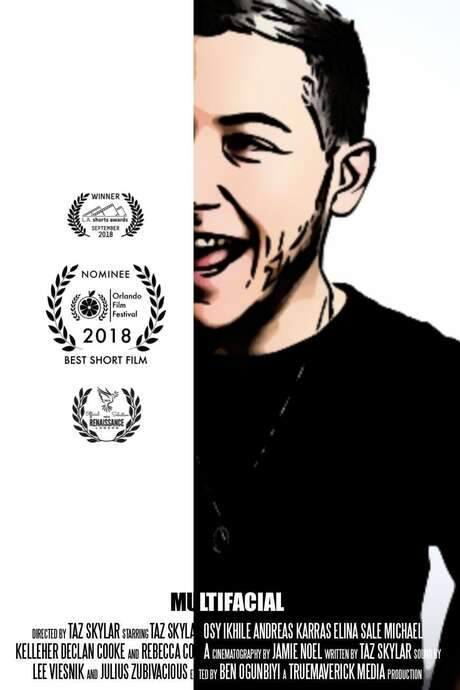


Multi-Facial Plot Summary
Read the complete plot summary and ending explained for Multi-Facial (2018). From turning points to emotional moments, uncover what really happened and why it matters.
Mike, Taz Skylar, a struggling actor with a tattooed arm, auditions for an Italian-American role and delivers a shocking anecdote in a New York Italian accent. He recounts a violent outburst in a restaurant—how a man looked at his girlfriend, only for Mike to discover the man was gay and redirect his rage at his partner, beating her and then being stunned when she stops calling. The casting director shows interest and has Mike perform a bit of Italian, then explains they’ll be in touch. When asked where the monologue came from, Mike claims it’s a true story that happened to a friend. Later, he phones his manager to vent about the monologue, insisting it wasn’t true and that it could ruin his chances. He wipes the fake tattoo from his arm and moves on to the next audition.
In the waiting room of another audition, Mike chats with a Black actor about the job market. He repeats his grievance about the monologue, while the other actor shares that he has just landed an international commercial. Mike dismisses the idea of doing commercials, arguing that no great actors ever did them. A director then sniffs that Mike’s skin is “a little too light,” suggesting he shouldn’t bother auditioning and proposing a Spanish role in a soap opera instead.
At another audition, Mike reads opposite a Cuban-leaning accent alongside a Hispanic actress. They attempt a heated exchange, but when the actress slips into Spanish, Mike falters and can’t continue. As they leave, the actress chides him for pretending to speak Spanish and encourages him to try for a soap opera still seeking Hispanic actors; Mike refuses again, insisting he won’t do soap operas because no great actors ever did them. He pushes forward to a new session, where his scene partner tells him she believes he could do well. He delivers a reading with a heavy urban cadence, and the judges interrupt the take, noting they’re looking for a different “Wesley type,” leaving Mike with a sense of missed fit.
Moving on, Mike returns to another audition where the staff notice on his résumé that he can rap. He launches into a hip-hop routine, then shifts into a monologue about watching his father in a stage production of Raisin in the Sun. He explains that his father’s dream for him was to become a great actor, a goal that transcended color and lineage. Although the casting team is impressed, they admit the role isn’t a fit for someone with his look, particularly if dreadlocks are required. He leaves with a wary promise that they’ll reach out if they can cast him differently.
The day culminates in a quiet moment of tension and reflection inside a diner. Mike sits in silent anger, overhearing an actress lamenting being typecast as a blonde bimbo. When the waitress arrives, the actress orders coffee that is “not too light, not too dark.” Mike quietly processes the irony of the moment, mouthing the exact line to himself as a small, rueful smile crosses his face.
Throughout these encounters, the film sketches a portrait of a talent trapped between self-expression and industry demands, a man who arms himself with stubborn pride while repeatedly facing the gatekeepers who filter who gets to tell certain stories. The rhythm of auditions—language, race, authenticity, and image—becomes the echo chamber of Mike’s ambitions, revealing the price of pursuing a dream in a world quick to categorize and quick to judge.
Multi-Facial Timeline
Follow the complete movie timeline of Multi-Facial (2018) with every major event in chronological order. Great for understanding complex plots and story progression.
Italian-American audition opens the day
Mike auditions for an Italian-American role, delivering an explicit anecdote in a New York Italian accent about getting into a fight with another man in a restaurant for looking at his girlfriend. The anecdote reveals a brutal moment and the complex emotions he hopes to channel into the performance. The casting director expresses interest and asks Mike to speak Italian during the audition.
Director questions the origin of the monologue
After the piece, the director asks Mike where the monologue came from. Mike says it is a true story that happened to a friend, trying to lend authenticity to the tale. This exchange highlights the line between truth and performance that haunts his auditions.
Manager call and tattoo removal
Mike calls his manager to complain that the monologue was offensive and not a true story. He wipes off the fake tattoo on his arm, attempting to shed the persona the audition demanded. With this act behind him, he heads to the next audition, trying to reset his approach.
Commercial audition and skin tone note
In the waiting room of a commercial audition, Mike chats with a Black actor who just landed an international commercial. The actor notes the prestige, while Mike laments that great actors rarely do commercials. The director interrupts, telling Mike his skin is a little too light for the part and advises him not to bother auditioning, suggesting instead a Spanish role in a soap opera.
Cuban/Hispanic audition and Spanish hesitation
Mike goes to another audition and reads with a Cuban accent alongside a Hispanic actress. As they perform an argument, the actress switches to Spanish, and Mike struggles to continue. Leaving the room, she calls him out for pretending to speak Spanish but suggests he try a soap opera that looks for Hispanic actors; Mike refuses to do soap operas.
Rap and Raisin in the Sun moment
At a later audition, the director notices on Mike's résumé that he can rap and prompts him to perform. He launches into a hip-hop routine and then sits to deliver a monologue about being a young man watching his father on stage in Raisin in the Sun. He reflects on how his father seemed to want him to be a great actor regardless of skin color, and the director is impressed though they acknowledge the look the role requires.
Dreadlocks note and departure
The casting director tells him they still need an actor with dreadlocks and may contact him if that person becomes available. Mike leaves the room with a cautious sense of hope, knowing the fit wasn’t quite right. This moment underscores the gap between talent and appearance.
Diner scene and the not too light line
Mike sits in silent anger at a diner, replaying the day’s auditions in his head. He overhears an actress complaining about being typecast as a blonde bimbo. When the waitress serves coffee, the actress orders not too light, not too dark, and Mike mutters the line under his breath.
Recurring themes of race and identity emerge
Across the day, Mike’s experiences highlight the ongoing tension between talent and identity in the acting world. The industry’s expectations about appearance and race shape his opportunities as much as his skills. These moments crystallize the film’s central critique of typecasting.
Tattoo as a symbol of performance
The fake tattoo symbolizes the persona Mike uses to chase opportunities; wiping it away marks his attempt to separate himself from a manufactured image. This act emphasizes the struggle to be seen for his true talent rather than for appearances. It also foreshadows more difficult choices ahead in his career.
Reflection on the audition journey
Back in the city, Mike contemplates how he must navigate both race and craft to land a role. He recognizes that appearance can influence outcomes as much as ability. The sequence leaves him determined to persevere, regardless of the barriers.
Resolve to keep pursuing opportunities
Despite the setbacks and mixed feedback, Mike resolves to continue auditioning and to refine his craft. He accepts that authenticity and adaptability are essential to advance in a challenging industry. The final moment reinforces the film’s message about persistence in the pursuit of a dream.
Multi-Facial Characters
Explore all characters from Multi-Facial (2018). Get detailed profiles with their roles, arcs, and key relationships explained.
Mike (Taz Skylar)
A determined yet anxious aspiring actor with a tattooed arm, Mike frantically navigates a barrage of auditions across New York. He grapples with insecurity about whether his talent, race, or appearance will unlock a breakthrough, often using humor to cope with rejection. His journey exposes the fragility and tenacity required to chase a dream in a competitive industry.
Multi-Facial Settings
Learn where and when Multi-Facial (2018) takes place. Explore the film’s settings, era, and how they shape the narrative.
Time period
1990s
Set in the mid-1990s New York audition circuit, the story captures the grit of an actor scrambling for work in a pre-digital era. The period emphasizes live auditions, in-person callbacks, and a rough, immediate path to opportunity. The era's open yet challenging casting landscape reflects the struggle to stand out in a crowded market.
Location
New York City
New York City serves as the backdrop for Mike's auditions and the dense, competitive film industry climate. The city is a launching pad for actors seeking TV, film, and commercial work, and it thrives on fast-paced, high-stakes casting. Its melting pot of cultures highlights the pressures of representation in media and the constant quest for break-through opportunities.
Multi-Facial Themes
Discover the main themes in Multi-Facial (2018). Analyze the deeper meanings, emotional layers, and social commentary behind the film.
🎭
Identity
The film probes how Mike navigates race, appearance, and authenticity while chasing roles. His performance shifts across accents and personas to fit the parts, exposing the fragility of representation. Casting decisions reveal biases that shape an actor's sense of self and value. The story asks what it means to be seen as a talented actor beyond surface traits.
🧭
Ambition
Mike's relentless pursuit of work shows the tension between dream and reality in a tough industry. The auditions become a test of resilience, self-belief, and willingness to adapt. The narrative suggests that persistence, not luck, often separates hopefuls from success. It also examines the emotional cost of chasing a breakthrough.
🌐
Casting realism
The story highlights the demand for specific looks, accents, and identities in casting, revealing how talent competes with market expectations. Mike's struggles with being asked to alter his voice or appearance expose the commodification of actors. The film uses these moments to critique stereotyping in the audition process.

Coming soon on iOS and Android
The Plot Explained Mobile App
From blockbusters to hidden gems — dive into movie stories anytime, anywhere. Save your favorites, discover plots faster, and never miss a twist again.
Sign up to be the first to know when we launch. Your email stays private — always.
Explore the mobile appMulti-Facial Spoiler-Free Summary
Discover the spoiler-free summary of Multi-Facial (2018). Get a concise overview without any spoilers.
In the bustling, multicultural streets of contemporary London, the film follows Mike, a talented yet racially ambiguous actor whose yearning for genuine expression collides with an industry that thrives on easy categorisation. Every audition becomes a micro‑court where language, skin tone and perceived authenticity are weighed against one another, turning the simple act of reading a line into an intricate negotiation of identity. The city itself pulses with possibility, its theatres and casting offices serving as both stage and tribunal for those who dare to occupy the uncertain spaces between labels.
The world the story inhabits is a gritty, hyper‑real portrait of the modern performing arts scene—waiting rooms buzzing with nervous energy, casting directors wielding stereotypes as scripts, and fellow artists sharing fragmented victories and quiet frustrations. The tone balances raw realism with a subtle, almost lyrical introspection, allowing the audience to feel the palpable tension that hangs over each moment of possibility. The film’s visual palette mirrors this mood, using muted lighting and close‑ups to capture the fleeting hopes reflected in mirrored makeup tables and the lingering doubt etched on the backs of audition rooms.
At the heart of the narrative is a protagonist who carries both a fierce pride in his craft and an ever‑growing awareness of the invisible walls erected by the very industry he loves. His interactions with other actors, casting agents, and the broader cultural expectations of race and talent highlight a universal struggle: the desire to be seen for one’s art rather than reduced to a marketable trope. As he navigates a cascade of opportunities and rejections, the film invites viewers to contemplate the cost of ambition in a world that constantly asks performers to fit into pre‑written roles before they ever step onto the stage.
Featured on this page

What's After the Movie?
Not sure whether to stay after the credits? Find out!
Check out our other apps:

SAT Sphere
Build confidence for the Digital SAT.

Mori Atlas
Discover wild places worth protecting.

Luntero
Search smarter for a home in Amsterdam.

Plot Explained
Unravel movie endings and hidden clues.

Pokechamp
Dive into Pokémon data and battle logic.

Driving Theory
Get ready for your European theory test.

Movie Dust
Plan your next cinema trip with ease.

Musemap
Find art and culture as you travel.

Selkobase
Compare credentials before committing.

Local Manual
Turn an unfamiliar country into practical next steps.

Lernavi
Compare school systems before your next move.

GymRoam
Find a workout stop wherever your plans take you.
Explore Our Movie Platform
New Movie Releases (2026)
Famous Movie Actors
Top Film Production Studios
Movie Plot Summaries & Endings
Major Movie Awards & Winners
Best Concert Films & Music Documentaries
Movie Collections and Curated Lists
© 2026 What's After the Movie. All rights reserved.
Privacy Policy