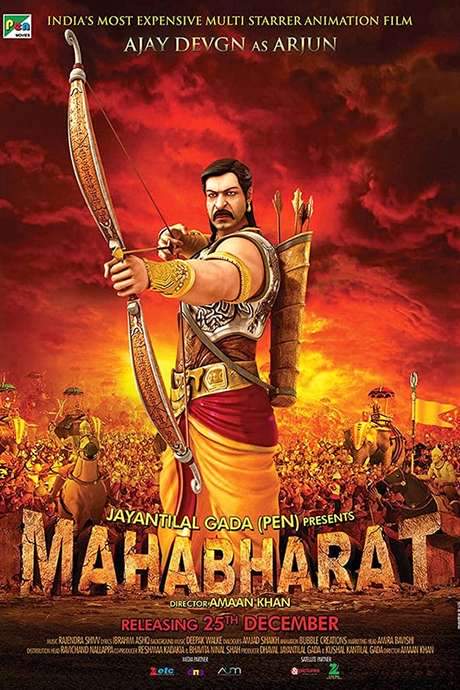
Mahabharat 2013

Directed by

Amaan Khan
Made by

Bubble Creations Digital Studios
Where to Watch Mahabharat
See current US streaming, rental, and purchase options for Mahabharat (2013) via JustWatch.


Streaming availability powered by 
Mahabharat Plot Summary
Read the complete plot summary and ending explained for Mahabharat (2013). From turning points to emotional moments, uncover what really happened and why it matters.
Mahabharat is considered the greatest and longest epic in world literature, a sprawling saga that weaves together conflict, duty, sacrifice, heroism, truth, justice, romance, adventure, fantasy, and complex relationships into one endlessly fascinating narrative.
Kunti, Deepti Naval, is granted a secret mantra by the sage Durvasa to call gods for sons. She uses the power of the mantra as a test, and the Sun God answers, begetting Karna, Anil Kapoor. Yet she remains unmarried and, bound by circumstance, entrusts Karna to the river Ganga. Later, she marries Pandu and bears three god-kissed sons: Yudhisthir, Manoj Bajpayee, Bheem, Sunny Deol, and Arjun, Ajay Devgn. Pandu’s joint wife Madri bears Nakul and Sahdev. Pandu’s elder brother Dhritarashtra, Paresh Rawal, is blind and married to Gandhari, Reema Lagoo. They have a hundred sons, with Duryodhan, Jackie Shroff as the eldest. All the royal princes are trained by Dronacharya, Ashutosh Rana.
Years pass, Pandu dies, and Dhritarashtra becomes king. A royal assembly is convened to present the princes to the people under the stern watch of Bhishma, Amitabh Bachchan. Drona singles out Arjun as the finest archer in the land, and a clash between Bheem and Duryodhan ends in a draw. Karna challenges Arjun, while Shakuni, Anupam Kher, the maternal uncle of Duryodhan, and Dushasana, Vrajesh Hirjee, his younger brother, lurk in the background. Arjun refuses to fight Karna when Bheem points out that the challenger is the son of a charioteer, and Kunti recognizes Karna as her son but stays quiet. Shakuni seizes the moment, and Duryodhan names Karna the King of Anga to pit him against Arjun. The duel between Arjun and Karna ends in a draw, stirring the seeds of the wars to come.
In the royal verdict, Bhishma and Vidur declare Yudhisthira the crown prince, but Duryodhana feels cheated of his rightful seat. Shakuni engineers a ruthless plan to burn the Pandavas alive in a palace built of combustible materials, a scheme that is foiled with Vidur’s help as the brothers escape. The Pandavas cross the river with Vidur’s guidance, beginning a period of exile and concealment. During this time, Bheem protects his brothers in the forest, and a romance sprouts when Hidimba falls for him. Bheem defeats Hidimb, at the cost of his rival’s life, while Kunti arranges a boon through Hidimba for her son.
Back in the world of courts and contests, King Drupad announces Draupadi’s swayamvar, drawing many kings, including Karna and Duryodhan. Arjun arrives in disguise as a sage, and Draupadi declines to marry the son of a charioteer. Arjun later appears as a Brahmin, and Duryodhan objects, trying to kidnap Draupadi. Krishna, Shatrughan Sinha, intervenes and reveals Arjun’s true identity, allowing him to win the Swayamvar. Draupadi returns home with Arjun, and a miscommunication leads Kunti to tell her sons to share whatever they receive, not realizing Draupadi’s own wishes. Krishna explains that Draupadi had asked Shiva for a husband in a previous life and, in this life, received a boon that binds her to five husbands, so the Pandavas must return to Hastinapur after five years of exile.
Back at Hastinapur, Bhishma urges the division of the kingdom, but Shakuni’s scheming shuffles land and power until the Pandavas are driven to Desolate lands. Indraprastha is then conceived as a majestic city through Vishwakarma’s crafts, directed by Indra’s command to build a palace that will house the eventual rule of the Pandavas. Bheem defeats Jarasandha, releasing a hundred kings who align with Yudhisthira and pledge loyalty to the new monarch. Arjun’s alliance with Subhadra, Krishna’s sister, is sealed as Subhadra bears Abhimanyu, and Draupadi’s presence heightens the stakes of every move on Hastinapur’s chessboard.
Duryodhan visits the magical Indraprastha palace and Draupadi’s courage in a later encounter with a water-filled moat becomes a symbol of honor and retribution. Arjun and Yudhisthira assure Draupadi that their earlier dispute is behind them, but the insult sows a quiet, burning revenge beneath the surface. A fateful gambling match then tests Yudhisthira’s weakness: he loses the kingdom, his brothers, and finally himself—and even Draupadi. Dushasana drags Draupadi to the court and Duryodhan orders her public disrobing. The insult becomes the spark that intensifies the conflict, and Bheem vows retribution, while Draupadi vows not to wash her hair until Dushasana’s blood is shed. Krishna steps in to halt the outrage, and Dhritarashtra shies away from the mounting crisis, restoring the Pandavas’ rights only to see the family fracture again as exile looms.
The Pandavas retreat to the forest, where Bheem meets Hanuman and gains the strength of a hundred elephants, and Arjun earns powerful weapons from Shiva and Parvati. After twelve years of disguise, they choose to reveal themselves in the Virat realm. Bheem works as a cook, Draupadi as a maid, Arjun as a dance master, Nakul as a weapons keeper, Sahdev as a stable boy, and Yudhisthira as the king’s advisor, living incognito until the term ends. Krishna arrives at Hastinapur to press for the Pandavas’ share, and Duryodhan refuses even the modest proposal of five villages, prompting Krishna to reveal his Vishnu form and depart, leaving the issue unresolved and the war looming.
War preparations begin in earnest. Bhishma is named commander-in-chief, vowing not to fight Karna. Armies gather, and Arjun’s doubts resurface until Krishna, again, offers the story of the Gita and reveals a broader, eternal vision that convinces him to take up arms. To defeat Bhishma, Shikhandi is placed in front of Arjun; Bhishma recognizes Shikhandi as the woman he wronged in a past life, and Arjun unleashes a relentless storm of arrows that finally brings Bhishma to a bed of arrows.
Dronacharya becomes the next commander and launches the Chakravyuh, with Abhimanyu stepping forward to breach the formation. Although he fights valiantly, Shakuni’s support falters as Abhimanyu is killed, cut down in the net of warriors. After Drona’s death, Karna is appointed chief in command. Kunti reveals to him that she is his mother and begs mercy for her sons; Karna promises to spare all but Arjun, explaining that he has already sacrificed his solar armor to Indra, who disguised himself as a beggar. The ferocity of the battle crescendos with Karna’s death when his chariot becomes stuck, and Arjun, at Krishna’s insistence, seals the fate of the warrior who had slain Abhimanyu while he was vulnerable.
The conflict culminates in Shakuni’s death at Sahdev’s hand, and Duryodhan’s retreat when Bhim yanks Dushasan’s arm and blood is offered to Draupadi to wash and bind her hair anew. The Pandavas relentlessly pursue the remaining Kauravas to a pond where Duryodhan is slain by Bhim, who breaks his thigh in a final act of vengeance. In the aftermath, Yudhisthira is crowned king of Hastinapur. In a final, public acknowledgment, Kunti reveals Karna as her son, and Yudhisthira vows to carry Karna’s legacy forward by donating gold every day, a pledge that binds the fates of all who have walked this legendary, entwined path.
Mahabharat Timeline
Follow the complete movie timeline of Mahabharat (2013) with every major event in chronological order. Great for understanding complex plots and story progression.
Kunti bears Karna and sends him to the Ganga
Kunti uses the mantra granted by Durvasa to invoke the Sun God, and Karna is born. Being unmarried, she places the newborn in a basket and sends him down the Ganga river to keep him safe. The summary identifies Karna as the Sun's son who is thus set on a separate path from the Pandavas.
Birth of the Pandavas and Nakul/Sahdev
Kunti bears Yudhisthira, Bhima, and Arjun. Madri, Pandu's second wife, bears Nakul and Sahdev. The brothers are thus born under different mothers, setting the stage for a united dynasty.
Dhritarashtra's reign and Dronacharya trains the princes
Pandu dies and Dhritarashtra becomes king, with Gandhari by his side. The Kaurava princes, led by Duryodhan, are trained by Dronacharya. The stage is set for rising tensions between the Pandavas and Kauravas.
Royal assembly and Yudhishthira is crowned prince
A grand royal assembly is organized to introduce the princes to the masses under Bhishma's watch. After Pandu's death, Bhishma oversees the proceedings and declares Yudhishthira the crown prince. This fuels the rivalry with Duryodhan.
Karna's challenge and Kunti's secret
Drona proclaims Arjun the best archer in the land, and Karna challenges him to a duel. Although Kunti recognizes Karna as her son, she keeps silent about their relation. Shakuni and Duryodhana soon install Karna as the King of Anga to pit him against Arjun.
Duryodhana's palace fire plot and escape
Duryodhana engineers a trap by constructing a palace of combustibles to burn the Pandavas alive. With Vidur's help, the Pandavas learn of the plot and escape the fire, fleeing across a river to safety. Their survival marks the beginning of their exile.
Vidur's counsel and exile begins
Vidur advises the Pandavas to gather allies while in exile, traveling incognito to seek support. The brothers comply, forming strategies and plans away from Hastinapur's prying eyes. Their bond and resolve are tested during this period.
Hidimba and Bheem's alliance
Bheem defeats Hidimb in the forest and wins Hidimba's love. She agrees to marry him, and they begin a lasting alliance that strengthens the Pandava camp. The relationship adds an element of romance amid their hardship.
Draupadi swayamvar and Arjun's victory
Draupadi's swayamvar is held, and Arjun, in disguise as a sage, wins her hand. Krishna intervenes and reveals Arjun's true identity, preventing a kidnapping and ensuring Draupadi becomes a wife of the Pandavas. The sum total of their marriages foreshadows the five-husband arrangement.
Indraprastha founded after five-year plan
Krishna explains Draupadi's boon of five husbands from her past life, prompting the Pandavas to return after five years. Vishwakarma is invoked to construct a majestic city and palace, giving rise to Indraprastha. The new capital marks a turning point in their sovereignty.
Draupadi's boon and return planning
With Draupadi's boon and Krishna's guidance, the Pandavas set their sights on Hastinapur, planning a return that could clash with the Kauravas. The period includes intrigue, alliance-building, and sharpening martial prowess in preparation for the looming conflict.
Krishna's Gita and war prep
As war approaches, Bhishma is appointed commander-in-chief. Arjun doubts whether to fight, and Krishna imparts the essence of the Gita to resolve his moral dilemma. The epic inner struggle culminates in a vow to engage in the battle.
Bhishma falls and Drona's Chakravyuh
In the war, Bhishma falls after using Shikhandi as a shield. Dronacharya adapts and launches the Chakravyuh to trap Yudhisthira, while Abhimanyu fights valiantly and dies in the trap.
Karna's death and the fall of Duryodhana’s camp
Karna dies after a fierce duel when his chariot gets stuck; Shakuni is slain by Sahdev; Duryodhana is killed by Bhima after a climactic confrontation. The Pandavas' victory comes at the cost of immense tragedy and moral reckoning.
Yudhishthira's coronation and Karna's kinship revealed
Yudhishthira is crowned king of Hastinapur, and Kunti publicly acknowledges Karna as her son. To honor Karna's legacy, Yudhishthira vows to donate 50 kgs of gold daily in his memory.
Mahabharat Characters
Explore all characters from Mahabharat (2013). Get detailed profiles with their roles, arcs, and key relationships explained.
Arjun (Ajay Devgn)
Arjun is introduced as the finest archer on the land, celebrated for his skill and focus. He initially hesitates to fight Karna when told of their shared lineage, illustrating his internal conflict between duty and personal history. Arjun’s journey centers on fulfilling his role as a Pandava while navigating moral doubts and divine guidance. He ultimately embraces his duty to fight for justice.
Karna (Anil Kapoor)
Karna is the son of Kunti and the Sun God, raised as a charioteer’s son and denied his rightful royal status. He accepts the mantle of Anga’s king at Shakuni’s prompting, placing him in direct contest with Arjun. Bound by loyalty to his foster mother and a personal sense of honor, he confronts Arjun in an epic duel. His arc hinges on loyalty, identity, and the tragedy of unrecognized nobility.
Bhishma (Amitabh Bachchan)
Bhishma is the elder statesman and commander who upholds his vow to remain faithful, including his pledge not to fight Karna. He leads the Kuru forces with profound duty and maturity, becoming a moral compass and a monumental obstacle. His autumn of power culminates in a strategic withdrawal and a battlefield fall.
Draupadi (Vidya Balan)
Draupadi is central as the wife of the five Pandavas, whose honor is publicly insulted, catalyzing the war’s vengeance. Her presence binds the Pandavas, and her treatment exposes the gendered politics of the court. Her journey—from stoking conflict to reminding the heroes of their shared vow—drives many pivotal moments.
Duryodhan (Jackie Shroff)
Duryodhan is the eldest Kaurava, driven by envy and a hunger for power. He orchestrates schemes—like the attempted disrobing of Draupadi—to discredit the Pandavas and secure his throne. His obstinacy and cunning make him the primary foil to the Pandavas, culminating in a climactic war.
Krishna (Shatrughan Sinha)
Krishna serves as the divine guide and strategist, steering the Pandavas with wisdom and timely interventions. He reveals his Vishnu form to inspire Arjun and provides the Gita’s doctrine to dispel doubt. His presence blends mysticism with politics, shaping the war’s moral framework.
Dronacharya (Ashutosh Rana)
Dronacharya is the master who trains both Pandavas and Kauravas, enforcing discipline and competitive prowess. He orchestrates strategic moves like the Chakravyuh and embodies the tragic cost of loyalty to one’s student and code of warfare.
Yudhisthir (Manoj Bajpayee)
Yudhisthir is the crown prince whose steadfast sense of duty guides the Pandavas. His gambling weakness leads to loss of kingdom and honor, testing his resolve to reclaim justice and rebuild his people’s throne.
Shakuni (Anupam Kher)
Shakuni is the master schemer whose plots fuel the Kaurava rivalry, manipulating events to turn brothers against brothers. His maternal kinship to Duryodhan gives him influence over political moves, including the fateful dice game.
Dushasana (Vrajesh Hirjee)
Dushasana antagonizes the Pandavas by dragging Draupadi into court and trying to disrobe her, marking a brutal turning point in the war’s history. He ultimately falls in combat in the epic endgame.
Mahabharat Settings
Learn where and when Mahabharat (2013) takes place. Explore the film’s settings, era, and how they shape the narrative.
Time period
Ancient mythic era
Set in the legendary era of the Kuru dynasty, where gods and sages mingle with mortal rulers. Kings, princes, and warriors duel, gamble, and plotting reshapes kingdoms. The period blends divine interventions with human flaws, creating a saga of dharma, destiny, and war.
Location
Hastinapur, Indraprastha, Khandavprastha, the forest
The action spans the ancient royal capital Hastinapur, a seat of power where court politics and feuding families drive the plot. Indraprastha, the magnificent city built for the Pandavas after exile, symbolizes their rise and the shifting balance of power. The story also traverses Khandavprastha’s harsh desert and the forest where the Pandavas survive in exile, highlighting contrasts between opulence and hardship.
Mahabharat Themes
Discover the main themes in Mahabharat (2013). Analyze the deeper meanings, emotional layers, and social commentary behind the film.
⚖️
Dharma
Duty and righteousness form the backbone of the narrative, testing what is right against personal desire. Yudhisthira’s unwavering commitment to truth, Arjun’s duties as a warrior, and Karna’s loyalties to his upbringing create a complex moral landscape. The story repeatedly asks how to balance obligation to family, kingdom, and truth, often at great cost. Choices made in the name of dharma shape destinies and fuel conflicts.
👑
Power
The crown represents the ultimate prize and the source of political machinations, alliances, and betrayals. Shakuni and Duryodhan scheme to secure kingship while Krishna’s guidance tempers ambition. The pursuit of power exposes character flaws and tests loyalty, setting the stage for epic war. The epic shows how leadership requires sacrifice, wisdom, and moral restraint.
⚔️
War
War is depicted as a grand, perilous theatre where glory and brutality coexist. The battles honor skill and strategy, yet claim countless lives and raise questions about justice. The deaths of Bhishma, Drona, Abhimanyu, and Karna illustrate the human cost of conflict. Divine intervention and fate weave through combat, affecting outcomes and moral judgments.

Coming soon on iOS and Android
The Plot Explained Mobile App
From blockbusters to hidden gems — dive into movie stories anytime, anywhere. Save your favorites, discover plots faster, and never miss a twist again.
Sign up to be the first to know when we launch. Your email stays private — always.
Explore the mobile appMahabharat Spoiler-Free Summary
Discover the spoiler-free summary of Mahabharat (2013). Get a concise overview without any spoilers.
In an age where destiny is whispered by the wind and duty is etched into the very stones of the kingdom, a sprawling realm of royal courts, dense forests, and sacred rivers forms the backdrop for an unforgettable saga. The world blends the ordinary with the divine, where mortals walk alongside gods, and every decision reverberates across generations. Its tone balances reverent awe with the restless energy of a story that has shaped countless imaginations.
At the heart of this tapestry stands Kunti, a matriarch whose secret mantra brings forth a lineage of heroic sons, each embodying a different facet of virtue and vigor. Yudhisthir leads with measured wisdom, while Bheem radiates raw strength, Arjun wields unparalleled skill with his bow, and Nakul and Sahdev add charm and loyalty to the brotherhood. Opposite them rises Karna, a mysterious warrior of remarkable prowess, whose origins are shrouded in intrigue. The throne is occupied by Dhritarashtra, the blind king, and his steadfast wife Gandhari, whose hundred children, led by Duryodhan, epitomize the pressures of lineage and expectation. Cunning counsel comes from Shakuni, while the venerable Bhishma embodies ancient honor. Overseeing the unfolding drama, Krishna provides a calm, philosophical presence, and the enigmatic Draupadi stands as a pivotal figure whose fate intertwines with the lives of the brothers.
The narrative pulses with the timeless clash between duty and desire, honor and ambition, and the ever‑present question of what justice truly means. Rivalries simmer beneath the surface, alliances form in the glow of shared purpose, and the weight of prophecy hangs like a quiet drumbeat. As each character navigates the delicate balance of personal longing and collective responsibility, the story invites the audience to contemplate the complexities of family, fate, and the moral choices that define a civilization.
Against this richly rendered canvas, the film promises an immersive experience where mythic grandeur meets intimate human drama, leaving viewers poised on the edge of discovery, eager to see how the intertwining destinies will unfold.
Featured on this page

What's After the Movie?
Not sure whether to stay after the credits? Find out!
Check out our other apps:

SAT Sphere
Build confidence for the Digital SAT.

Mori Atlas
Discover wild places worth protecting.

Luntero
Search smarter for a home in Amsterdam.

Plot Explained
Unravel movie endings and hidden clues.

Pokechamp
Dive into Pokémon data and battle logic.

Driving Theory
Get ready for your European theory test.

Movie Dust
Plan your next cinema trip with ease.

Musemap
Find art and culture as you travel.

Selkobase
Compare credentials before committing.

Local Manual
Turn an unfamiliar country into practical next steps.

Lernavi
Compare school systems before your next move.

GymRoam
Find a workout stop wherever your plans take you.
Explore Our Movie Platform
New Movie Releases (2026)
Famous Movie Actors
Top Film Production Studios
Movie Plot Summaries & Endings
Major Movie Awards & Winners
Best Concert Films & Music Documentaries
Movie Collections and Curated Lists
© 2026 What's After the Movie. All rights reserved.
Privacy Policy