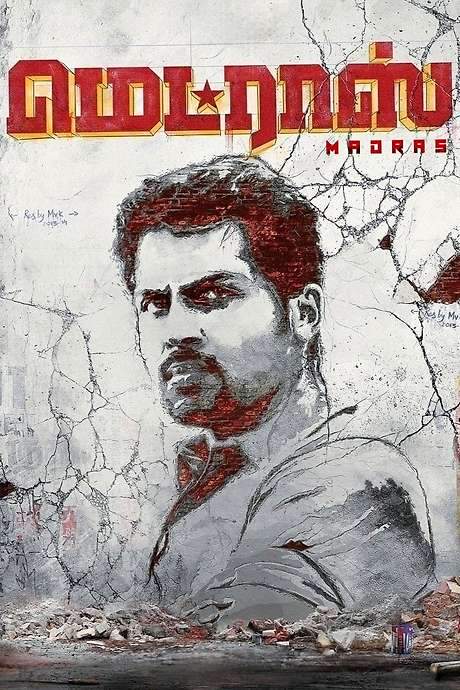
Madras 2014

Directed by

Pa. Ranjith
Made by

Studio Green
Where to Watch Madras
See current US streaming, rental, and purchase options for Madras (2014) via JustWatch.

Amazon Video
SD
Google Play Movies
SD
YouTube
SD Streaming availability powered by 
Madras Plot Summary
Read the complete plot summary and ending explained for Madras (2014). From turning points to emotional moments, uncover what really happened and why it matters.
Kaali is a hot-headed, hard-working man from a tight-knit community in North Chennai who loves football and keeps life balanced between his IT job and his friends in the aging housing blocks of Vyasarpadi. His closest ally is Anbu, a young political hopeful, and together they navigate the everyday tensions of a neighborhood where families, friends, and rival factions collide over a single, contested wall.
Two political factions fight over that wall, a stage for the portraits of their leaders. On one side, Anbu operates under the local guidance of Maari, who aims to claim the wall for their party. On the other, Kannan and his son, Perumal, are determined to keep the rival’s influence at bay. The wall itself bears a long-standing symbol: the portrait of Krishnappan painted there for two decades, marking the deep-rooted feud that shapes everyone’s choices.
As the feud intensifies, Kalaiarasi, a daughter of a politician, captures Kaali’s interest, though she remains emotionally distant at first. In the heat of the election season, Anbu moves to reserve the wall for their party, prompting the opposition to demand that the portrait be left untouched. The tension is fueled by a history of violence—three deaths related to the wall have unsettled the community and hardened nerves on both sides. When Anbu refuses to back down, a goon aligned with Kannan menaces him, and Kaali’s quick temper erupts in a moment that makes Anbu’s plight seem even more perilous in the eyes of their rivals.
The stakes rise as the plan to eliminate Anbu and Kaali takes shape. Kalaiarasi’s confession of love to Kaali adds a personal edge to the looming danger. When the would-be assassins strike, the two friends flee and hide behind a passing van, where they overhear Perumal speaking on the phone and ordering Anbu’s death at any cost. In a brutal moment, Kaali uses a crowbar to strike Perumal down, a decision that spirals their lives toward even darker consequences.
At the courthouse in Kanchipuram, Anbu accepts responsibility for the crime in a bid to secure a lighter fate, but the plan backfires as Kannan’s henchmen attack him in the corridor, leaving Kaali gravely wounded and Anbu dead. The loss drives Kaali into a deep guilt-ridden funk, and with his parents and Maari urging him to rebuild his life, he begins to seek a new path. Maari promises revenge, and Kalaiarasi stands by Kaali as the two of them work to pick up the pieces of their lives. Soon after, they marry, choosing to forge ahead together.
A startling turn comes when, during a restaurant encounter, Kaali spots one of Maari’s henchmen and learns the truth: Maari had secretly allied with the rival party to become MLA of RK Nagar and was orchestrating Anbu’s assassination. Kalaiarasi supports Kaali’s decision to pursue justice, and at a public gathering where Maari is being honored, Kaali exposes the conspiracy, prompting a crowd to turn against Maari. The wall itself becomes a canvas for the public’s reaction, as Kaali splashes new paint and reshapes the symbol on the wall, drawing the community toward a shared act of defiance.
Maari retaliates with a new plan, but his bid to kill Kaali is foiled by a betrayal from within the rival camp. In a final confrontation, Kaali defeats the henchmen and leaves Maari grievously injured; Maari dies, removed from the power struggle that once defined the neighborhood.
In the aftermath, Kaali and Kalaiarasi redirect their energies toward education and community healing. They teach in the very building that once sparked the violent feud, transforming the wall into a mural celebrating children’s education and hopeful futures. Yet the legacy of the wall lingers—the stubborn desire of Kannan to hang his father’s portrait on that same wall remains a lingering thread in the story’s closing image.
Madras Timeline
Follow the complete movie timeline of Madras (2014) with every major event in chronological order. Great for understanding complex plots and story progression.
Kaali and Anbu in Vyasarpadi
Kaali, a quick-tempered IT worker, lives in dilapidated flats in Vyasarpadi with his best friend Anbu, a young political aspirant. They move through a tight-knit but volatile community where the wall feud looms as a constant backdrop. The film introduces their friendship and the looming clash between rival factions over the contested wall.
Decades-old wall feud
Two political factions claim a single wall to display their leaders' portraits. The portrait of Krishnappan has hung there for two decades, fueling a blood-stained rivalry that bleeds into everyday life. The wall becomes a symbol of power and identity for both sides.
Anbu claims the wall for their party
In the lead-up to elections, Anbu reserves the wall for Maari's faction, hoping to leverage its influence. The opposition demands that the wall be given up since their patriarch's portrait has long occupied it. People also fear the wall's history of deaths, turning it into a bad omen.
A confrontation sparks violence
When Anbu refuses to yield, a goon of Kannan insults him and Kaali intervenes, escalating the tension. Kannan sees Anbu as the reason for Maari's resurgence and orders his gang to eliminate both Anbu and Kaali. The plan to kill them is set in motion.
Perumal slain by Kaali
During the attempted hit on Anbu and Kaali, Kaali lashes out with a crowbar, killing Perumal, Kannan's son, in a brutal head strike. The henchmen close in, but Kaali and Anbu manage to slip away and hide behind a parked van. The violent confrontation marks a turning point in their feud.
Surrender and Anbu's murder
Maari urges Kaali and Anbu to surrender at the Kanchipuram district court to avoid a bloodbath. The FIR, however, names Anbu, tying him to the murder in the eyes of the authorities. Anbu takes responsibility for the act, hoping for release, but outside the court he is hacked to death by Kannan's henchmen, badly wounding Kaali.
Guilt, grief, and a vow for revenge
Kaali sinks into guilt and despair after Anbu's death, swearing to avenge him. His parents and Maari urge him to rebuild his life and not be consumed by anger. Maari promises that Anbu's death will be avenged, and Kaali reluctantly begins to regroup.
Kalaiarasi supports and they wed
Kalaiarasi comforts Kaali through his turmoil, and the two grow close, eventually marrying. The relationship offers Kaali a personal lifeline away from the political bloodshed. Their wedding marks a shift from street-level feuds to a personal new chapter.
Revelation at the restaurant
After the marriage, Kaali and Kalaiarasi dine at a restaurant where Kaali spots a Maari henchman. The henchman flees, but Kaali captures him and learns that Maari has allied with the opposing party to become MLA of RK Nagar and orchestrated Anbu's assassination. The revelation fuels Kaali's resolve for vengeance.
Public exposure and vandalism
At a local meeting, Kaali exposes Maari's betrayal, driving Maari from the stage. In protest, he splashes paint on the wall, destroying the old portrait and sparking a mass shift as others join in. The wall gradually becomes a canvas celebrating children's education.
Showdown and Maari's fall
Maari tries to kill Kaali, but is betrayed by the successor of the opposing party. In the final confrontation, Kaali overpowers the henchmen and fatally injures Maari, ending the two-decade feud's central figure. An air of revenge settles over the community as Maari dies.
A new purpose for the wall
Kaali and Kalaiarasi begin teaching in the building where the wall stood, giving the community a fresh sense of hope. The wall is painted with a theme of children's education, shifting from political symbolism to social progress. Kannan continues to want his father's portrait hung on the wall, leaving a remaining tension.
Madras Characters
Explore all characters from Madras (2014). Get detailed profiles with their roles, arcs, and key relationships explained.
Kaali (Karthi)
An impulsive, short-tempered working-class man who works in an IT company and spends his free time playing football. He falls in love with Kalaiarasi, becomes embroiled in the violent wall feud, and his quest for vengeance drives the narrative after Anbu’s death. His struggle to control his temper and protect those he loves reveals a deeper longing for belonging and change.
Anbu (Kalaiyarasan)
Kaali’s best friend and a young political aspirant who fights to claim the wall for their party. He embodies loyalty to his cause and the local power structure, but ultimately sacrifices himself in the violent power struggle. His attempt to shoulder responsibility for murder shows a desire for politics to redeem itself, even as he becomes a casualty of the feud.
Kalaiarasi (Catherine Tresa)
Daughter of a politician who is initially distant but slowly becomes Kaali’s ally and later his wife. She navigates the dangerous political landscape with a calm, supportive presence and ultimately shares in Kaali’s vow for change. Her evolving relationship with Kaali anchors the human stakes of the feud.
Maari (Charles Vinoth)
A powerful political broker who manipulates alliances to influence elections and maintain control. He orchestrates violence around the wall and embodies the corrupt logic of local politics. His eventual downfall comes as his schemes unravel under Kaali’s determined pursuit of justice.
Perumal (Mime Gopi)
Maari’s ruthless henchman who issues orders to kill and keeps the violence flowing. He is a symbol of the mechanized brutality behind the political feuds and meets a violent end when Kaali turns the tables. His presence underscores the price of unchecked aggression on both sides.
Kannan (Poster Nandakumar)
The head of the rival party and a central antagonist who commits to silencing Anbu and Kaali. He embodies the relentless drive to protect his faction’s legacy, often at the cost of collateral damage. His plans fuel the dangerous escalation that culminates in a deadly confrontation.
Krishnappan (V. I. S. Jayapalan)
The patriarch whose portrait has loomed on the wall for two decades, symbolizing the feud’s long memory and the weight of lineage in local politics. His image serves as a focal point around which rivalries coalesce and persist. He stands as a reminder of how history can entrench conflict across generations.
Madras Settings
Learn where and when Madras (2014) takes place. Explore the film’s settings, era, and how they shape the narrative.
Time period
2010s
The events are set in contemporary Chennai, where modern IT workspaces sit alongside aging slums and public walls used for political propaganda. Elections and factional rivalries drive the plot, amplifying clashes between communities and leaders. The era emphasizes urban grit, political ambition, and a quick-moving, media-influenced public sphere.
Location
Vyasarpadi, North Chennai, RK Nagar, Kanchipuram district
The story unfolds in the crowded, aging flats of Vyasarpadi in North Chennai, where a decaying housing board dominates daily life. A contested wall becomes a symbol and battleground for rival political factions, shaping neighborhoods and loyalties. Public spaces near the wall—restaurants, courthouses, and community areas—serve as stages for both romance and violence within a tight-knit, working-class community.
Madras Themes
Discover the main themes in Madras (2014). Analyze the deeper meanings, emotional layers, and social commentary behind the film.
⚔️
Power & Violence
The film shows how political factions wield violence to assert control over a shared space and to intimidate rivals. Leaders manipulate communities and youth to safeguard influence, turning a neighborhood into a constant pressure cooker. The cost of this power struggle is paid by families, friendships, and the social fabric of the area. The wall itself becomes a tangible reminder that power is enforced through force.
🗡️
Revenge & Justice
Kaali’s impulsive nature and sense of loyalty thrust him into a brutal cycle of retaliation after Anbu’s murder. The pursuit of vengeance promises closure but deepens trauma and moral ambiguity. The film questions whether personal revenge can truly restore balance, highlighting the heavy price paid by those who choose the path of vengeance. True justice emerges only when accountability shifts beyond individual vendettas.
📚
Education & Reconciliation
In the aftermath of violence, the community redirects energy from propaganda to learning, repainting the wall as a symbol of children’s education. This shift marks a move from intimidation to possibility, offering a path toward rebuilding trust in a fractured neighborhood. The final emphasis on teaching within the building signals collective healing and hope for a better future.

Coming soon on iOS and Android
The Plot Explained Mobile App
From blockbusters to hidden gems — dive into movie stories anytime, anywhere. Save your favorites, discover plots faster, and never miss a twist again.
Sign up to be the first to know when we launch. Your email stays private — always.
Explore the mobile appMadras Spoiler-Free Summary
Discover the spoiler-free summary of Madras (2014). Get a concise overview without any spoilers.
In the bustling arteries of North Madras, tightly‑packed housing blocks and narrow lanes form a world where daily life is inseparable from the pulse of local politics. The neighborhood is a mosaic of families, street‑side vendors, and football‑loving youths, all navigating a rhythm that is constantly reshaped by election season promises and the ever‑present whisper of power struggles. The atmosphere feels both gritty and intimate, a realistic portrait of a community that endures, hopes, and fights for its small but meaningful spaces.
At the heart of this landscape is Kaali, a hot‑tempered yet diligent young man juggling an IT job with a love for football and a deep sense of loyalty to his close‑knit community. His days are a balancing act between work, sport, and the informal networks that keep the neighborhood alive. Kaali carries the weight of a generation that has learned to survive within the confines of the slums while yearning for something beyond the endless cycle of political rhetoric.
His world intertwines with Anbu, an eager political aspirant who sees the local power dynamics as both a challenge and an opportunity, and Kalaiarasi, a politician’s daughter whose presence adds a layer of complexity to personal and communal ties. Around them, a weathered wall—painted with the portrait of an old local figure—acts as a silent witness to competing factions, each hoping to claim it as their own emblem. The wall’s symbolism reflects the broader tug‑of‑war that defines the area, hinting at deeper currents without revealing outcomes.
The film’s tone is a blend of raw realism and understated hope, capturing the everyday struggles and fleeting moments of joy that color life in the slums. Through its vivid setting and tightly drawn characters, the story invites viewers to feel the pulse of a community caught between the promise of change and the stubborn permanence of its own history.
Featured on this page

What's After the Movie?
Not sure whether to stay after the credits? Find out!
Check out our other apps:

SAT Sphere
Build confidence for the Digital SAT.

Mori Atlas
Discover wild places worth protecting.

Luntero
Search smarter for a home in Amsterdam.

Plot Explained
Unravel movie endings and hidden clues.

Pokechamp
Dive into Pokémon data and battle logic.

Driving Theory
Get ready for your European theory test.

Movie Dust
Plan your next cinema trip with ease.

Musemap
Find art and culture as you travel.

Selkobase
Compare credentials before committing.

Local Manual
Turn an unfamiliar country into practical next steps.

Lernavi
Compare school systems before your next move.

GymRoam
Find a workout stop wherever your plans take you.
Explore Our Movie Platform
New Movie Releases (2026)
Famous Movie Actors
Top Film Production Studios
Movie Plot Summaries & Endings
Major Movie Awards & Winners
Best Concert Films & Music Documentaries
Movie Collections and Curated Lists
© 2026 What's After the Movie. All rights reserved.
Privacy Policy