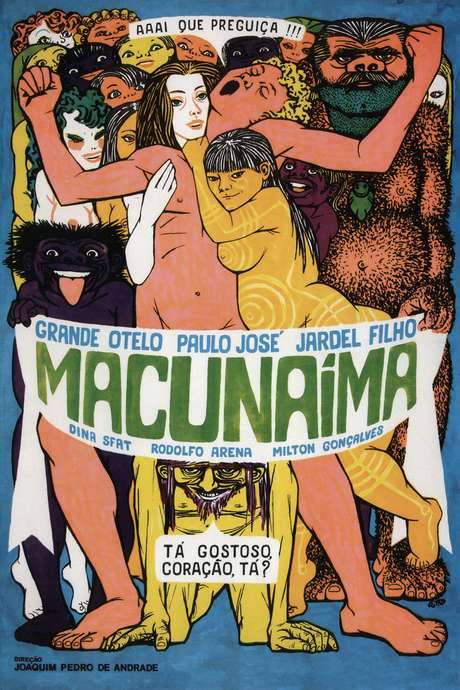


Where to Watch Macunaima
See current US streaming, rental, and purchase options for Macunaima (1969) via JustWatch.







Macunaima Plot Summary
Read the complete plot summary and ending explained for Macunaima (1969). From turning points to emotional moments, uncover what really happened and why it matters.
Based on Mário de Andrade’s 1928 book, this modern-day parable follows the misadventures of a Black Macunaíma, Grande Otelo, born to an old woman, Paulo José, who is said to belong to Brazil’s Indigenous peoples in the Amazon. Though he arrives fully grown, he carries the heart of a playful child, mixing wit, charm, and a stubborn curiosity about the world around him. His early life in the jungle is marked by a blend of humor and mischief, as if the world itself is testing a spirit that refuses to be neatly categorized.
After the death of his mother, a spring appears and turns him white, an improbable transformation that propels him toward a new life beyond the forest. With this change, he and his two brothers set out for Rio de Janeiro, only to be met with suspicion and interrogation by street criminals and other forces of urban life as soon as they arrive. The city’s rough edges contrast sharply with the wild freedom of the Amazon, and the journey becomes a crucible where identity, luck, and circumstance collide.
The tale then threads in a romance that complicates his identity: an affair with Ci, the guerrilla killer played by Dina Sfat, and a union that yields a black boy. The drama of Ci’s presence and the birth of the child deepen Macunaíma’s wanderings, as he navigates love, loyalty, and the unpredictable turns of fate. When Ci and the child die, the hero is left to carry on with a new sense of purpose, venturing onward in search of a magical stone that he believes can change his fate. This quest drives him further into a world where magic, luck, and danger mingle in equal measure.
Throughout the odyssey, the film uses Macunaíma to dramatize a broader cultural conversation. The story frames an essentialist myth of the three Brazilian races—White, Black, and Indigenous—through the protagonist, his brothers, and his mother, turning personal exploits into a symbolic map of national identity. The tone remains steeped in satire and surreal humor, inviting viewers to read Brazil’s social fabric through the lens of a trickster figure who refuses to be pinned down by simple labels. As the adventures unfold, Macunaíma learns hard truths about Brazilian life and society, using his evolving identity to mirror the country’s contradictions, hopes, and upheavals.
In the end, the film presents a nuanced portrait of a nation in flux. It treats identity as a living, shifting mosaic rather than a fixed category, all while offering a cutting, lyrical commentary on the political tremors that followed Brazil’s military coup. The result is a saga that is as much about cultural memory and myth as it is about individual wanderings, inviting audiences to ponder how history, myth, and personal choice shape a country’s path.
Macunaima Timeline
Follow the complete movie timeline of Macunaima (1969) with every major event in chronological order. Great for understanding complex plots and story progression.
Miraculous birth in the Amazon
Macunaíma is born to an old indigenous mother deep in the Amazon, arriving as a fully grown man with the heart of a playful child. The birth sets up a paradox that will shape his later identity and misadventures. Soon after, his mother dies, leaving him to navigate a world that will test him at every turn.
The spring that turns him white
A magical spring in the jungle changes his skin color to white, complicating how others perceive him. The transformation makes him a spectacle in the social hierarchy and foreshadows the race-based conflicts he will confront. He retains the childlike spirit that drives his curiosity and mischief.
Journey with his brothers toward Rio
With his two brothers, Macunaíma leaves the Amazon in search of a better life in the city. They cross forests, rivers, and landscapes, encountering strangers and dangers along the way. The journey marks the shift from mythic wilderness to urban Brazilian culture.
Arrival in Rio and hostile welcome
The brothers reach Rio de Janeiro, where they are promptly interrogated and harassed by street terrorists who challenge their origins. The encounter exposes the precariousness of safety for newcomers and unveils the social violence present in the city. It forces Macunaíma to improvise and survive through wit and luck.
Affair with Ci, the white guerrilla
Macunaíma becomes involved with Ci, a white woman who embodies the era's political and sexual tensions. The liaison blends romance, danger, and social critique, highlighting Brazil's mixed-race fantasies and power dynamics. The affair propels him toward further adventures rather than domestic happiness.
Birth of a black son
From the affair, Ci bears a black child fathered by Macunaíma, intensifying the film's race allegory. This event complicates his identity and the expectations placed on him by various communities. The mother and child’s presence anchors his ties to both the indigenous and urban worlds.
Death of Ci and the child
Ci and their son die, leaving Macunaíma to face loss and responsibility alone. The double tragedy becomes a catalyst for his next quest across Brazil. The event also underscores the fragility of life amid cultural and political upheaval.
Quest for the magical stone begins
Grieving and restless, Macunaíma undertakes a mission to recover a magical stone owned by a wealthy city dweller. The stone symbolizes power, prestige, and the ability to navigate Brazil's social order. His journey spans urban centers and rural backwaters as he pursues this elusive artifact.
Lessons about Brazilian life and society
Along the road, he confronts stereotypes, class disparities, and racial myths that color Brazilian life. The misadventures blend humor with social critique, teaching him about the nation's complexities. These lessons gradually shape his understanding of himself and his homeland.
The three Brazilian races as myth
The film frames the white, black, and indigenous Brazilians as an essentialist trilogy through Macunaíma, his brothers, and his mother. The allegory is woven into encounters across different communities and landscapes. It critiques the simplistic idea of racial purity while highlighting national contradictions.
Reflection of political turmoil
Macunaíma’s escapades are read as an allegory for the turbulence of Brazil's military coup era. The character's rapid shifts and transformations echo the period's political volatility. The film uses myth to comment on national history and social change.
Endings and what the stone reveals
The quest for the magical stone culminates with outcomes that reveal how power, race, and identity are constructed in Brazilian culture. The ending invites viewers to reflect on myth versus reality in a nation still wrestling with its roots. The journey remains an open commentary on Brazil's future.
Macunaima Characters
Explore all characters from Macunaima (1969). Get detailed profiles with their roles, arcs, and key relationships explained.
Macunaíma (Grande Otelo)
The adventurous antihero embodies the trickster archetype. Born in the Amazon with the heart of a playful child, he travels to Rio after a magical transformation that changes his skin color. His wily, irreverent view of social norms drives the misadventures that critique Brazilian society. He negotiates identity, class, and desire within a satirical frame.
Jiguê (Milton Gonçalves)
A cunning, loyal brother figure who navigates the perilous urban landscape alongside Macunaíma. He embodies resilience and street-smart pragmatism, often grounding the hero’s wilder schemes. Through his perspective, the film exposes class tensions and the complexities of Black Brazilian identity in the city.
Sofara (Joana Fomm)
A central female figure who complicates Macunaíma’s journey with love, agency, and social tension. Her presence destabilizes assumptions about gender roles within the film’s satirical universe. She helps drive the plot while highlighting the era’s cultural and erotic politics.
Ci (Dina Sfat)
A guerrilla fighter whose affair with Macunaíma (the white variant) anchors the film’s political edge. She embodies resistance and danger, complicating the hero’s path and challenging power structures. Her presence sharpens the critique of violence and political allegory in the story.
White Macunaíma (Paulo José)
The white version of the hero, created by a magical spring, whose identity oscillates between two cultural selves. His transformation serves as a pointed satire of racial pretensions and social performance. He traverses both Indian mythic roots and urban modernity to expose hypocrisy in national identity.
Venceslau Pietro Pietra (Jardel Filho)
A wealthy patriarch representing elite power and capital, symbolizing the material forces behind cultural manipulation. He embodies the city’s economic and political upper crust, a target of the film’s satire on class and privilege. His interactions with other characters reveal the tensions between wealth, influence, and national myths.
Macunaima Settings
Learn where and when Macunaima (1969) takes place. Explore the film’s settings, era, and how they shape the narrative.
Time period
1960s Brazil
Set against the contemporary backdrop of 1960s Brazil, the narrative unfolds amid modernization and political upheaval following the 1964 coup. The urban journey mirrors the country’s social tensions, mobility, and class divisions of the era. The timing grounds the film’s allegory about race, culture, and national identity in a period of significant change.
Location
Amazon rainforest, Rio de Janeiro
From the lush Amazon rainforest where the story begins, the setting foregrounds myth and play. The action then shifts to the bustling streets of Rio de Janeiro, showcasing a clash between indigenous myth and urban modernity. These locations anchor the film’s satirical look at Brazilian society and its racial dynamics.
Macunaima Themes
Discover the main themes in Macunaima (1969). Analyze the deeper meanings, emotional layers, and social commentary behind the film.
🗺️
Identity
The film uses the myth of Brazil’s three races to probe how national identity is constructed and contested. Macunaíma’s transformations become a satirical lens on how race, class, and culture are navigated in modern Brazil. The narrative moves between the Amazon and the city to show how identity is performative and fluid. Through humor and allegory, it questions essentialist notions of what it means to be Brazilian.
✨
Magic Realism
Folklore, miracles, and fantastical events are woven into a sharp social critique. The ‘spring turning him white’ and the quest for a magical stone insert myth into everyday life, lampooning both rural legends and urban pretensions. This magical layer exposes the contradictions of Brazilian modernity and power structures. The film uses fantasy to reveal uncomfortable truths about society.
🪖
Politics
The work functions as an allegory of Brazil’s coup-era turmoil, using outrageous adventures to critique power, authority, and social order. It treats state violence and elite culture as elements of a broader cultural struggle. By lampooning nationalism and racial myths, it questions who benefits from such narratives. The journey from jungle to metropolis mirrors Brazil’s political awakening and resistance.

Coming soon on iOS and Android
The Plot Explained Mobile App
From blockbusters to hidden gems — dive into movie stories anytime, anywhere. Save your favorites, discover plots faster, and never miss a twist again.
Sign up to be the first to know when we launch. Your email stays private — always.
Explore the mobile appMacunaima Spoiler-Free Summary
Discover the spoiler-free summary of Macunaima (1969). Get a concise overview without any spoilers.
In the heart of an untamed Amazon village, a newborn arrives already an adult, his skin the color of midnight and his spirit bright with child‑like wonder. Known as Macunaíma, he is raised by an enigmatic old matriarch whose lineage whispers of the Indigenous peoples that have long called the forest home. A sudden, mystical spring erupts at his mother’s passing, bathing him in light and turning his skin white—a transformation that feels both blessing and curse, propelling him onto a road that leads far beyond the jungle’s canopy.
The journey carries him to the sprawling, feverish streets of São Paulo, a city that throbs with music, traffic, and a chaotic mix of modernity and myth. Here, Macunaíma adopts the guise of a flamboyant dandy, navigating cafés, tangoing with bureaucrats, and slipping into the orbit of Ci, a charismatic revolutionary whose fire matches his own restless curiosity. Their connection is charged with the electric tension of a nation on the brink, and the city’s surreal, satirical atmosphere frames every encounter as both comedy and critique, inviting the audience to see Brazil through a kaleidoscope of humor and absurdity.
Beyond the personal odyssey, the film paints a broader portrait of Brazil’s tangled identity, using the protagonist and his family as living symbols of the country’s three racial veins—White, Black, and Indigenous. The tone is richly layered, blending magical realism with sharp satire, making every scene feel like a folk tale told in neon. As Macunaíma amasses strange knowledge and unexpected riches amid his urban wanderings, a lingering question hovers: how far can the lessons of the jungle survive in a world that constantly reshapes itself? The story promises a mesmerizing exploration of self, myth, and the ever‑shifting mosaic of a nation seeking its own reflection.
Movies with Similar Twists and Themes
Uncover films that echo the narrative beats, emotional arcs, or dramatic twists of the one you're exploring. These recommendations are handpicked based on story depth, thematic resonance, and spoiler-worthy moments — perfect for fans who crave more of the same intrigue.
Featured on this page

What's After the Movie?
Not sure whether to stay after the credits? Find out!
Check out our other apps:

SAT Sphere
Build confidence for the Digital SAT.

Mori Atlas
Discover wild places worth protecting.

Luntero
Search smarter for a home in Amsterdam.

Plot Explained
Unravel movie endings and hidden clues.

Pokechamp
Dive into Pokémon data and battle logic.

Driving Theory
Get ready for your European theory test.

Movie Dust
Plan your next cinema trip with ease.

Musemap
Find art and culture as you travel.

Selkobase
Compare credentials before committing.

Local Manual
Turn an unfamiliar country into practical next steps.

Lernavi
Compare school systems before your next move.

GymRoam
Find a workout stop wherever your plans take you.
Explore Our Movie Platform
New Movie Releases (2026)
Famous Movie Actors
Top Film Production Studios
Movie Plot Summaries & Endings
Major Movie Awards & Winners
Best Concert Films & Music Documentaries
Movie Collections and Curated Lists
© 2026 What's After the Movie. All rights reserved.
Privacy Policy