
King of Hearts 1966

Directed by

Philippe de Broca
Made by

Fildebroc
Where to Watch King of Hearts
See current US streaming, rental, and purchase options for King of Hearts (1966) via JustWatch.

Streaming availability powered by 
King of Hearts Plot Summary
Read the complete plot summary and ending explained for King of Hearts (1966). From turning points to emotional moments, uncover what really happened and why it matters.
In October 1918, as World War I edges toward its end, a small French village braces for liberation while a bold, calculated danger looms in the town square. The retreating German forces rig an automaton clock to trigger a devastating explosion: when the clock’s mechanical knight strikes the bell at midnight, the ammunition magazine blows, potentially annihilating the entire town. A barber who doubles as an Allied agent overhears the plan and passes the warning to the approaching liberators, but the residents, in a rapid exodus, abandon homes, shops, and even the nearby insane asylum. The barber is killed while transmitting the crucial message, but not before he can relay one chilling detail: the magazine will detonate when “the knight strikes at midnight.”
Signaller Charles Plumpick, a man whose wartime specialty lies in tending pigeons rather than disarming bombs, is dispatched by his colonel to prevent catastrophe. His mission hinges on deciphering a cryptic phrase: “the knight strikes at midnight.” He arrives in the besieged town with two carrier pigeons, ready to face patrols and peril, and the clockwork countdown begins to weave a more surreal fate than any ordinary battlefield.
Plumpick slips into the town’s asylum, where the inmates have already begun to rewrite life under siege. The inmates introduce themselves with grand flourishes, taking on roles as the town’s most familiar figures: a world of pageantry where the barber, the bishop, the brothel madame, the prostitutes, the circus manager, and the soldiers mingle with the circus troupe and the duchy’s aristocracy. The newcomers’ impromptu leadership and theatrical presence blur the lines between sanity and fantasy, leaving the real danger of the approaching explosion to fade into the background of their improvised republic. When Plumpick awakens after a fall from a toppled pole, he finds the asylum’s temporary rulers have overtaken the town, and the Germans overlook him, enchanted—or perhaps bemused—by the inmates’ bold masquerade.
In this new, exuberant chaos, the password phrases shape interactions and misdirections. The password that should unlock critical information, “the whiting likes to fly,” proves difficult to verify, and the barber who was meant to guide him fails to recognize it. Meanwhile, a stray message from one pigeon is misread by the Germans, who conclude the magazine has been dismantled, further complicating Plumpick’s task. With no clear lead to the magazine, he becomes the unlikeliest focal point of a floating carnival: the inmates crown him the “King of Hearts” as they sway between mischief and mercy, treating him as both guardian and guest within their playfully perilous world.
A key moment unfolds as the town’s defiant joy collides with the looming clock. Plumpick warns the villagers of an imminent explosion at midnight, but the mood remains buoyant and defiant; they choose to live fully in the present, even as the clock’s hands creep toward danger. With only three minutes to midnight, he and a girl named Poppy stand vigil beside the clocktower, the room for error narrowing with every second. Plumpick climbs the tower, intent on stopping the knight from striking the bell, and the struggle culminates in a painful twist: the knight strikes, but not the bell—plunging his own head into the blow instead and retreating, leaving the town intact for the moment.
As dawn breaks, German troops advance, but the British colonel orders formation, and Plumpick finds himself marching alongside soldiers whose fates are suddenly bound to the same fragile frontier between safety and ruin. The women and the inmates pull him from the ranks, lifting him to a balcony above the square where the two forces face off. In a stark reversal of the usual wartime drama, Plumpick is spared the firing line and becomes a symbol of the town’s fragile peace, a living reminder of how human hearts can outwit machinery and steel.
The Germans and the liberators converge toward the square; the moment of reckoning comes, but it ends in a devastating stalemate as the two sides shoot each other down. Plumpick survives as the lone soldier in the wake of the clash, a humble witness to the absurd and brutal arithmetic of war. Soon a lookout reports a flood of “liberators” approaching from every direction, and the inmates, choosing their own form of sanctuary, decide to retreat back into the asylum’s embrace. The town’s fate remains a question, but for Plumpick the answer lies not in conquest but in the act of returning to the place that has become his unlikely world.
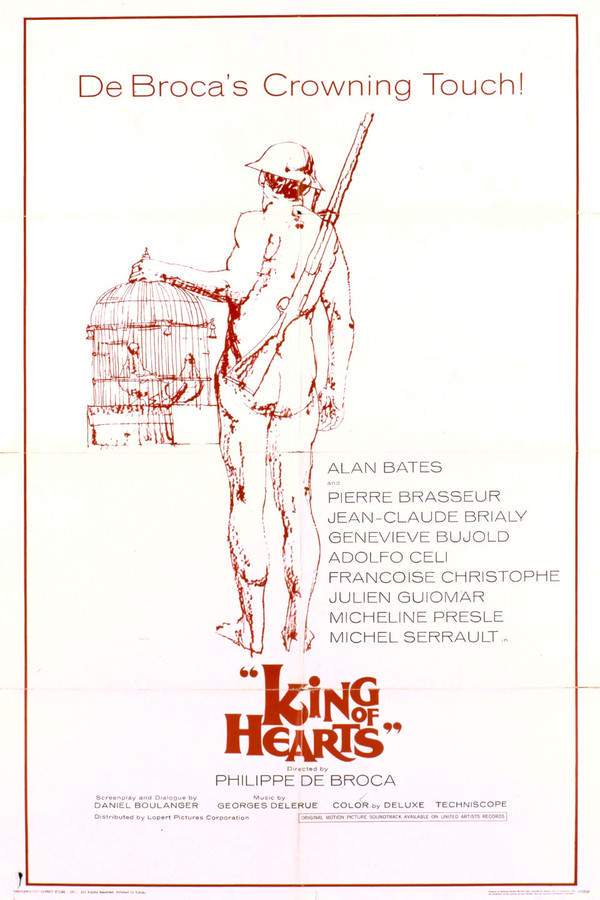
For his part, the rhetoric of survival and service earns Plumpick a ceremonial reward: medals for his role in safeguarding the town and its people. Yet the final act redefines heroism in a striking, human way. While being escorted with the troops past the asylum, Plumpick discards his rifle and uniform, then leaps from the truck, stark naked except for the pigeon’s cage he carries. He approaches the asylum’s gate, and the inmates erupt in joyful acceptance, welcoming their “King of Hearts” back into their world. They declare that he will never leave them again, a vow that transcends the battlefield’s logic and underscores a central question the film persistently raises: Who is truly crazy—the inmates who imagine a different life, or the soldiers who believe war is a guaranteed order of things?
This fable, set against the twilight of a war-torn Europe, uses surreal humor and dreamlike transformation to explore responsibility, courage, and the ambiguous line between sanity and madness. It invites audiences to ponder how communities create meaning in a moment when the old certainties crumble and a clock’s strike at midnight might reset more than just a town’s fate. The closing vision—Plumpick, with only a pigeon for company, escorted by the inmates who celebrate his return—leaves viewers with a haunting, bittersweet question about power, belonging, and the fragile chemistry that holds together even the most unlikely alliances. The film ultimately asks: in a world where reason and chaos clash, who truly dictates what counts as victory, and who decides what it means to be free?
King of Hearts Timeline
Follow the complete movie timeline of King of Hearts (1966) with every major event in chronological order. Great for understanding complex plots and story progression.
Bomb plan set in motion
In October 1918, the German occupiers rig the town's automaton clock to detonate the ammunition magazine at midnight when the knight strikes the bell. The barber overhears the plan and races to warn the Allies, even as the town begins to evacuate. He is killed during the transmission, but the warning confirms the deadline.
Plumpick chosen to disarm the bomb
Signaller Charles Plumpick, a veteran of caring for war pigeons rather than explosives, is ordered by his colonel to disarm the bomb and decipher the phrase 'the knight strikes at midnight.' He must interpret the clue and locate the trigger before disaster strikes. Despite his lack of weapons expertise, he is sent to save the town.
Plumpick arrives under cover with pigeons
Plumpick reaches the town carrying two carrier pigeons and must slip past wary German soldiers. He avoids detection as he travels through streets that are tense with war outside. The town's strange calm is a prelude to the farce that will soon unfold.
Inmates welcome Plumpick as King of Hearts
Inside the asylum, Plumpick puts on pajamas and blends with inmates who introduce themselves as The Duke of Clubs and Monsignor Daisy. When he proclaims himself 'King of Hearts,' the inmates greet him with deference and the Germans overlook him. The surreal disguise allows him to operate while the true danger remains unseen.
The town is occupied by the lunatics
Plumpick regains consciousness to discover the asylum inmates have left and taken over the town, adopting the roles of the town's people. They perform a playful, theatrical life at odds with wartime fear. He must reckon with a new reality where danger is present but disguised as whimsy.
Password confusion and missing directions
The barber fails to recognize the password 'the whiting likes to fly,' leaving him unhelpful to Plumpick's mission. General Geranium cannot direct him toward the ammunition magazine, so the trail goes cold. The lack of reliable guidance deepens Plumpick's isolation.
Pigeon message misinterpreted by Germans
One of Plumpick's pigeons is shot down by the Germans, who misinterpret its message as proof that the magazine has been dismantled. The miscommunication robs Plumpick of a quick lead on the bomb. The imminent explosion still hangs over the town.
Plumpick realizes the town is occupied
Returning to the town, Plumpick discovers the asylum empty and realizes the lunatics are occupying the streets. They crown him 'King of Hearts' with irony-filled pageantry as the madame introduces him to Poppy, a young girl eager to help forget the war. The scene marks a radical shift from grim wartime to carnival-like misrule.
Poppy warns but others dismiss the danger
Poppy and the inmates urge a warning about midnight, but the townsfolk shrug it off as superstition. Plumpick persists in sounding the alarm, but the others treat it as a trivial concern. The countdown to disaster continues amid merriment.
Leading the inmates toward safety
As 'king,' Plumpick tries to shepherd the inmates toward safety at the edge of town. They follow him partway, but refuse to go into the dangerous unknown beyond. The group faces an uncertain journey that could be their salvation or their doom.
Midnight countdown and clocktower climb
Three minutes to midnight, Plumpick stands atop the clocktower with Poppy, awaiting the knight's fate. She insists the clockwork warrior will come out at midnight, and he finally understands the mechanism's danger. He climbs to stop the knight from striking the bell.
The knight strikes and the town is saved
The knight nears; in the struggle, it strikes Plumpick's head instead of the bell and retreats. The explosion is averted and the town is saved for now. Dawn breaks as the unlikely victory settles in and the inmates celebrate their survival.
Morning stand-off and the inmates' retreat
In the morning, German troops advance while British troops line up in opposition. Plumpick joins the formation but is pulled away by Poppy and the women. The two sides clash and Plumpick survives as the only soldier left, while the liberators approach and the inmates decide to return to the asylum.
Medal, disguise, and warm farewell
Plumpick and his surviving pigeon are awarded medals for their mission. As they pass the asylum, he leaps from the convoy, sheds his uniform, and returns to the gate naked except for the pigeon cage. The inmates greet him as 'King of Hearts' and vow he will never leave them again.
King of Hearts Characters
Explore all characters from King of Hearts (1966). Get detailed profiles with their roles, arcs, and key relationships explained.
Charles Plumpick (Alan Bates)
A signaller whose craft is caring for war pigeons rather than explosives. He arrives with two pigeons, seeking to decipher the phrase 'the knight strikes at midnight' and disarm the bomb. Disguised as the 'King of Hearts', he leads the inmates through a surreal town to avert disaster, facing danger with wary courage.
The Duke of Clover (Jean-Claude Brialy)
One inmate who adopts aristocratic airs, orchestrating ritual and order within the improvised town. He participates in the pageantry surrounding the 'King of Hearts' and helps maintain structure among the others as midnight approaches.
Monseigneur Marguerite (Julien Guiomar)
An inmate who projects religious authority as part of the town’s theater. He blends pomp with leadership, guiding others in their performances and injecting moments of solemn ritual amid the chaos.
Madame Eva aka Madame Eglantine (Micheline Presle)
A matronly figure who mentors younger residents and introduces Plumpick to the human side of the asylum’s make-believe world. She embodies warmth and shrewdness within the town’s surreal carnival.
General Geranium (Pierre Brasseur)
An inmate who channels military authority into the town’s makeshift theater. He participates in the group’s impersonations, offering a counterpoint to Plumpick’s civilian mission.
General Vallemat (Daniel Prévost)
Another inmate who commands within the ensemble, translating wartime discipline into performative order. His presence heightens the tension between danger and whimsy in the town.
Duchess (Françoise Christophe)
An inmate who assumes royalty in the town’s pageant. She adds courtly humor and structure to the group as they wait for midnight’s strike.
Schottischer Colonel (Adolfo Celi)
A German commander orchestrating the trap and enforcing the occupation in a tense display of military authority.
King of Hearts Settings
Learn where and when King of Hearts (1966) takes place. Explore the film’s settings, era, and how they shape the narrative.
Time period
October 1918
The action unfolds in October 1918, during the final days of World War I as German forces retreat. The village awaits liberation while a dangerous clockwork trap looms over the town. The countdown to midnight intensifies the tension between imminent destruction and whimsical role-play.
Location
French village
A small village in occupied France serves as the backdrop for the countdown to midnight. The main square centers on an automaton clock wired to a bomb, turning a war-torn town into a ticking stage. The presence of a nearby insane asylum adds a surreal layer, as its inmates repurpose the town into their own theater.
King of Hearts Themes
Discover the main themes in King of Hearts (1966). Analyze the deeper meanings, emotional layers, and social commentary behind the film.
🌀
Madness
The story blurs lines between sanity and performance as inmates inhabit the town like actors in a dream. Plumpick must navigate a world where the sane rules of war no longer apply. The chaos of the asylum and the battlefield asks who is truly sane.
🎭
Masks
Role-playing becomes a survival strategy, with inmates adopting roles from duke to duchess to preserve control and meaning. Plumpick’s ascent to 'King of Hearts' dramatizes how identity can be flexible under pressure. The masquerade exposes how thin the line is between civilization and fantasy.
🕊️
Liberation
Liberation emerges not just as military victory but as a choice to protect each other through artful illusion. The inmates guide Plumpick toward safety, redefining freedom as solidarity within an enchanted sanctuary. The ending questions whether true freedom lies in accepting difference and madness alike.

Coming soon on iOS and Android
The Plot Explained Mobile App
From blockbusters to hidden gems — dive into movie stories anytime, anywhere. Save your favorites, discover plots faster, and never miss a twist again.
Sign up to be the first to know when we launch. Your email stays private — always.
Explore the mobile appKing of Hearts Spoiler-Free Summary
Discover the spoiler-free summary of King of Hearts (1966). Get a concise overview without any spoilers.
In the waning days of World War I, a remote French village clings to the fragile hope of liberation while a whispered danger lingers in its stone squares. The town’s clock tower, an ordinary monument of civic pride, has become the focus of a murmur‑filled rumor: a concealed device set to explode at the stroke of midnight, threatening to erase the community’s hard‑won peace. Around it, the ordinary mingles with the uncanny—cobblestone streets echo with distant artillery, but also with the laughter of those who have learned to survive by turning tragedy into theater.
Enter Charles Plumpick, a quiet ornithologist whose wartime reputation rests on tending carrier pigeons rather than defusing explosives. Mistaken for a specialist in demolition, he is dispatched alone to the village, carrying two birds and a cryptic resistance report that speaks only of “the knight striking at midnight.” His mission is less about firepower and more about unraveling a garbled message, navigating patrols, and making sense of a puzzle that could decide the fate of an entire town.
The film balances stark wartime reality with a surreal, almost dream‑like atmosphere. Nearby, an abandoned asylum houses a colorful chorus of inmates who have fashioned their own improvised society, blurring the lines between sanity and performance. Their presence injects a mischievous, carnival‑like energy into the narrative, turning the town into a stage where ordinary roles are exaggerated and every interaction feels charged with both danger and delight. This mixture of grim stakes and whimsical absurdity creates a tone that is simultaneously tense, humorous, and deeply human.
As Plumpick steps into this world of ticking clocks, cryptic phrases, and eccentric allies, he becomes the unlikely hinge on which the village’s future may turn. His quiet expertise with birds and his outsider’s perspective set the stage for a delicate dance between order and chaos, inviting the audience to wonder whether a simple phrase, a misunderstood signal, or a single act of courage might reshape the destiny of a place caught between the end of war and the beginning of peace.
Movies with Similar Twists and Themes
Uncover films that echo the narrative beats, emotional arcs, or dramatic twists of the one you're exploring. These recommendations are handpicked based on story depth, thematic resonance, and spoiler-worthy moments — perfect for fans who crave more of the same intrigue.


Featured on this page

What's After the Movie?
Not sure whether to stay after the credits? Find out!
Check out our other apps:

SAT Sphere
Build confidence for the Digital SAT.

Mori Atlas
Discover wild places worth protecting.

Luntero
Search smarter for a home in Amsterdam.

Plot Explained
Unravel movie endings and hidden clues.

Pokechamp
Dive into Pokémon data and battle logic.

Driving Theory
Get ready for your European theory test.

Movie Dust
Plan your next cinema trip with ease.

Musemap
Find art and culture as you travel.

Selkobase
Compare credentials before committing.

Local Manual
Turn an unfamiliar country into practical next steps.

Lernavi
Compare school systems before your next move.

GymRoam
Find a workout stop wherever your plans take you.
Explore Our Movie Platform
New Movie Releases (2026)
Famous Movie Actors
Top Film Production Studios
Movie Plot Summaries & Endings
Major Movie Awards & Winners
Best Concert Films & Music Documentaries
Movie Collections and Curated Lists
© 2026 What's After the Movie. All rights reserved.
Privacy Policy