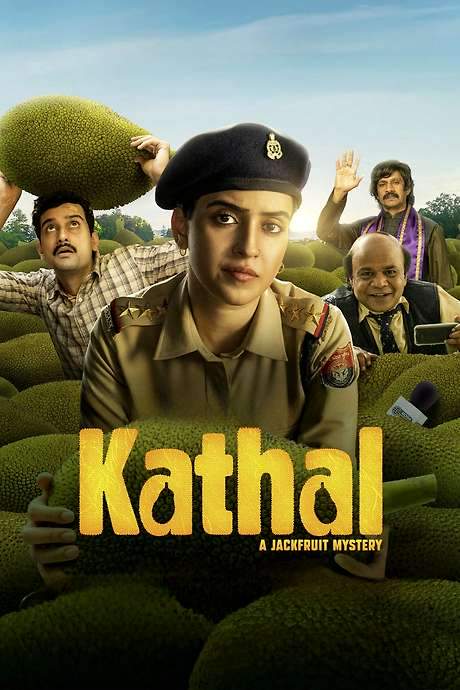
What Is Kathal About?
The premise of Kathal in 301 words, with nothing given away. The full story and the ending follow below.
In the dusty, sun‑baked town of Moba, the ordinary rhythm of daily life is jolted when two prized jackfruits vanish from a local politician’s garden, sparking a mystery that quickly becomes the talk of every street and tehsil. The disappearance is more than a whimsical inconvenience; it pulls the town’s bureaucracy, political theater, and social hierarchies into a tangled dance, hinting that even the smallest oddities can expose deeper cracks in a community’s façade.
At the heart of the investigation is Mahima Basor, an incisive and spirited inspector whose confidence and tenacity set her apart in a male‑dominated force. Though praised for past successes, she constantly grapples with subtle caste‑based slights and institutional inertia, forcing her to balance personal resolve with the need to navigate a system that often overlooks her contributions. Her drive is less about the fruit itself and more about uncovering the truth that hides behind layers of official rhetoric.
She is paired with the earnest constable Saurabh Dwivedi, whose loyalty and quiet competence complement Mahima’s fire. Their partnership is tested by the expectations of their superior, Angrez Singh Randhawa, a senior officer whose focus on hierarchy and political optics creates an ever‑present tension between protocol and principle. Around them, the town’s politicians, gardeners, and ordinary citizens each play a role in a larger, almost theatrical, contest of power and perception.
The film blends sharp satire with heartfelt social commentary, using the seemingly absurd premise of missing jackfruits to explore issues of gender, caste, and corruption. Its tone oscillates between dry humor and earnest drama, inviting the audience to laugh at the absurdity while feeling the weight of the stakes that lie beneath. In this vibrant portrait of a small Indian town, the mystery becomes a mirror reflecting both the quirks and the injustices that shape everyday life.
What Happens in Kathal?
The complete story of Kathal, from the first scene to the last, in 678 words (about 3 minutes). Spoilers throughout.
Spoilers ahead
Inspector Mahima Basor [Sanya Malhotra] takes the lead in an undercover operation that ends with the arrest of a local goon, Veer Singh “Veeru,” setting off a chain of urgent police work in the town of Moba. At the post‑arrest press conference, the official praise lands on SP Angrez Singh Randhawa [Gurpal Singh] rather than on the woman who masterminded the operation, a detail her senior refuses to acknowledge. Mahima’s partner, the earnest Constable Saurabh Dwivedi [Anant Joshi], hints at the omission, but she chooses to let the moment pass, keeping the focus on the case and the pressure mounting from above.
The case shifts gears when two exotic-breed kathals disappear from the garden of MLA Pateria. Mahima is assigned to untangle this odd mystery, a task that becomes political theater as the entire police unit chases an almost absurd deadline—to recover the fruit before it ripens. Throughout the investigation, Mahima endures passive caste‑based discrimination from colleagues, including clashes with Saurabh’s own father, a friction that adds a personal cost to her professional mission. Randhawa promises a promotion to DSP if she can solve the puzzle, but she refuses the quid pro quo and instead pushes for a more equitable change—she asks that Saurabh be promoted instead, a move she hopes will shift the hierarchy within the team.
As Mahima questions the MLA’s family and staff, the trail leads to Birwa Mali [Ambrish Saxena], a recently fired gardener who becomes the prime suspect. Birwa has been trying to file a complaint about his missing daughter Amiya [Apoorva Chaturvedi], yet the constables, including Saurabh, keep turning him away. Mahima lashes out at this neglect but is pressured to present Birwa as the thief at the next day’s press conference. The tension between truth and control intensifies as the team weighs political risk against ethical duty.
At the crucial press conference, Mahima pivots the narrative by declaring that the jackfruits were stolen by Birwa’s daughter Amiya, effectively turning the case into a missing‑person crisis in order to rescue the girl more quickly. She then travels to Birwa’s village to press for answers and discovers that Amiya was likely kidnapped by three thugs in a pink Nano, a vehicle that had been stolen from her subordinate Mishra. The word of this twist travels fast, drawing the attention of a local journalist, Anuj Sanghvi [Rajpal Yadav], who uncovers that Birwa had falsely confessed to his daughter’s involvement under police pressure. In a tense exchange, Mahima bribes him with a file containing the details of 43 teenage girls who had gone missing from Moba, persuading him not to release Birwa’s truth for now.
Armed with intelligence from Saurabh, Mahima and her team pursue the kidnappers to Chhatarpur, Madhya Pradesh, where Amiya is found on the verge of being trafficked to Gulab Seth [Raghubir Yadav], a powerful local businessman. After a spirited, comic clash with the criminals, the officers arrest the traffickers and secure Amiya’s rescue. The courtroom drama that follows centers on the ethics of the investigation itself: Amiya pleads not guilty, while Birwa testifies that his daughter had nothing to do with the missing jackfruits and that Mahima’s press conference pressure swayed the narrative. The prosecution staggers, but Mahima argues with quiet conviction about the irony of a town obsessed with fruit while a missing girl slipped through the cracks. The judge ultimately acquits Amiya for lack of evidence and commends Mahima for her steadfast dedication.
The case closes with concrete career moves that confirm the shift in authority. As promised, Saurabh is promoted to Sub‑Inspector, a recognition that aligns with the original goal of flattening the hierarchy and honoring merit. Mahima herself earns a new mandate, being promoted to DSP and assigned to lead a special cell aimed at combating human trafficking. The arc of the story ends with Amiya being reunited with her friends, while the film cheekily reveals a final, light note: the supposedly stolen jackfruits were actually taken by a group of monkeys, leaving the community to laugh at the long, tangled pursuit that exposed deeper social issues.
Kathal Timeline: Every Key Event in Order
12 key events in the order they happen, from “Undercover arrest of Veer Singh” to “Closing themes and reflections”. 10 events name a place, across 7 locations.
- 1
Undercover arrest of Veer Singh
The undercover operation leads to Veer Singh 'Veeru' being arrested by Inspector Mahima Basore. At a press conference, SP Angrez Singh Randhawa announces the arrest, but Mahima's role stays unacknowledged by her senior. Saurabh points out the omission, but Mahima ignores him.
When:Press conference
- 2
Jackfruits go missing, case escalates under pressure
Two exotic-breed jackfruits disappear from MLA Pateria's garden in Moba, triggering Mahima's assignment. The police unit is pressured to recover the fruit before it ripens, while Mahima faces caste-based discrimination from subordinates. SP Randhawa promises a promotion to DSP if she solves the case, but she refuses and suggests promoting Saurabh instead.
When:Early investigation Where:Moba
- 3
Birwa becomes primary suspect
After questioning the MLA's family and staff, Mahima narrows the suspects to Birwa, the recently fired gardener. Birwa had tried to file a police complaint for his missing daughter Amiya but was repeatedly turned away by constables, including Saurabh. The pressure to present Birwa as thief at the next day's press conference grows.
When:Investigation phase Where:MLA Pateria's estate, Moba
- 4
Mahima reframes the case at the press conference
At the press conference, Mahima declares that Amiya, Birwa's daughter, was responsible for the theft, turning the case into a missing-person matter to rescue Amiya. She travels to Birwa's village to question him and discovers Amiya was likely kidnapped by three thugs in a pink Nano, a vehicle stolen from Mishra. The focus shifts from jackfruits to the missing girl.
When:After the press conference Where:Birwa's village
- 5
Journalist uncovers the confession's coercion
Local journalist Anuj discovers Birwa had falsely confessed under police pressure. Mahima bribes him with a file containing the details of 43 missing teenage girls to suppress the truth.
When:Investigation phase Where:Moba
- 6
Chhatarpur pursuit and Amiya's fate
Relying on intelligence from Saurabh, Mahima's team tracks the kidnappers to Chhatarpur, Madhya Pradesh. There they find Amiya on the cusp of being trafficked to Gulab Seth.
When:Pursuit and rescue phase Where:Chhatarpur, Madhya Pradesh
- 7
Traffickers arrested and Amiya rescued
A combative confrontation leads to the arrest of the traffickers and Amiya is rescued from imminent trafficking.
When:Raid and rescue Where:Chhatarpur
- 8
Courtroom confrontation begins
In court, Amiya pleads not guilty while Birwa testifies that his daughter had nothing to do with the jackfruits. The prosecution is taken aback as Mahima's deception is revealed and the ethics of the investigation are questioned.
When:Court proceedings Where:Court
- 9
Irony of misaligned priorities
Mahima explains the irony of an entire police force chasing stolen jackfruits while a missing girl case was neglected. The judge considers the broader context, highlighting the need for accountability in policing.
When:During trial Where:Court
- 10
Verdict and promotions
The judge acquits Amiya due to lack of evidence and commends Mahima for her dedication. Randhawa promotes Saurabh to Sub-Inspector and Mahima to DSP, assigning her to lead a special cell to combat human trafficking.
When:Verdict and post-trial promotions Where:Court and Police Headquarters
- 11
Amiya rejoins her friends; monkeys steal the fruits
Amiya rejoins her friends and the case resolves with the humorous revelation that the jackfruits were stolen by a group of monkeys.
When:Ending Where:Moba
- 12
Closing themes and reflections
The film closes by reflecting on gender and caste biases in policing and the need to balance justice for vulnerable cases with sensational ones. It emphasizes accountability and the cost of policing decisions on families and communities.
When:End credits
Who Are the Main Characters in Kathal?
8 characters, among them Inspector Mahima Basor (Sanya Malhotra), Saurabh Dwivedi (Anant Joshi) and Birwa Mali (Ambrish Saxena): who each one is and the part they play in the story. Every profile links to the actor’s page.
-

Inspector Mahima Basor (Sanya Malhotra)
Played by Sanya Malhotra
A sharp and principled police inspector who navigates caste and gender bias within the force. She refuses to use a sensational case to advance her own status and instead redirects focus to the missing girl, Amiya. Her relentless pursuit of truth drives the investigation and culminates in her promotion to DSP and leadership of a human-trafficking cell.
- 👮 Police officer
- 💪 Determined
- 🔍 Investigative
-

Saurabh Dwivedi (Anant Joshi)
Played by Anant Joshi
A supportive constable who balances personal relationships with professional duty. He highlights the unequal treatment within the system and aids in gathering intelligence that advances the case. By the end, his work earns him a promotion to Sub-Inspector.
- 👮 Police officer
- 🧭 Loyal
- 🔎 Investigator
- BM
Birwa Mali (Ambrish Saxena)
Played by Ambrish Saxena
The recently fired gardener and Amiya’s father, coerced into confessing his daughter’s involvement in the jackfruit theft. His testimony is pivotal to uncovering the truth that his daughter was not responsible. He ultimately becomes a figure in the case that exposes police influence over confessions.
- 👨👩👧 Family man
- 💼 Victim
- 🔎 Witness
- A(
Amiya (Apoorva Chaturvedi)
Played by Apoorva Chaturvedi
Amiya is the missing girl whose fate drives the investigation across towns. She is rescued from trafficking and, though she pleads not guilty in court, her case highlights the broader neglect of missing children. Her rescue marks a turning point in the film’s moral arc.
- 🧒 Missing person
- 💖 Survivor
- 🧭 Central figure
- AS
Anuj Sanghvi (Rajpal Yadav)
Played by Rajpal Yadav
A journalist who uncovers that Birwa’s confession was coerced under police influence. He becomes a key conduit for truth-telling, ultimately being bribed by Mahima to withhold the full details of missing girls so Amiya’s case can be prioritized.
- 📰 Journalist
- 🕵️♂️ Investigator
- 💼 Media influence
- GS
Gulab Seth (Raghubir Yadav)
Played by Raghubir Yadav
A local businessman and the trafficking kingpin behind Amiya’s forced fate. His network represents the criminal underbelly that preys on vulnerable girls and leverages money and influence to evade justice.
- 💼 Antagonist
- 🔒 Criminal mastermind
- 🕴️ Power broker
- AS
Angrez Singh Randhawa (Gurpal Singh)
Played by Gurpal Singh
The senior SP who promises a promotion to DSP in exchange for presenting Birwa as the thief. He embodies the pressure and shortcuts often exercised by those in charge, illustrating how authority can skew investigations.
- 🧭 Authority
- ⚖️ Political pressure
- 🗣️ Bureaucrat
- MP
Munnalal Pateria (Vijay Raaz)
Played by Vijay Raaz
The MLA whose garden becomes the site of the jackfruit theft and whose political power frames the investigation’s stakes. He represents the nexus of local politics and criminal rumor that permeates the case.
- 🏛️ Politician
- 🕵️♂️ Power broker
- 🗣️ Public figure
Where and When Is Kathal Set?
Kathal is set in Moba, Chhatarpur, Madhya Pradesh and India. Here is why the place matters to the story.
Where
Moba, Chhatarpur, Madhya Pradesh, India
The story unfolds in the town of Moba and expands to nearby Chhatarpur in Madhya Pradesh, reflecting a regional backdrop of local politics and police work. The setting blends a small-town atmosphere with larger political and criminal networks, providing a grounded stage for the investigation into missing people and jackfruits. This backdrop anchors the film's commentary on governance, law enforcement, and social dynamics in contemporary India.
- 🏙️ Town setting
- 🗺️ Indian state
- 🌾 Rural environment
What Are the Themes of Kathal?
4 ideas the story keeps returning to, among them Gender bias, Trafficking and Justice vs Power.
-
01
Gender bias
Inspector Mahima Basor faces caste-based discrimination from subordinates and superiors, highlighting how gender and social hierarchies influence police work. The narrative centers her resolve to challenge patriarchal norms and demand fair recognition. Bias shapes decisions, testing her commitment to truth over status. The film uses her perspective to critique systemic sexism within law enforcement.
-
02
Trafficking
Amiya's disappearance exposes a human trafficking operation led by Gulab Seth, connecting local politics, policing, and criminal networks. The investigation travels from the MLA's circle to distant towns, revealing gaps in protection for vulnerable girls. The case underscores the reformist drive to curb trafficking and safeguard victims. It also shows how powerful interests attempt to control information.
-
03
Justice vs Power
The film pits pursuit of truth against political and administrative pressure, emphasizing that real justice requires listening to neglected cases (like missing girls) despite convenient sensational stories. Mahima's actions critique how promotions and power can distort investigative priorities. The courtroom moment reinforces the idea that integrity and evidence should prevail over appearances. The conclusion celebrates accountability and systemic change, not just individual victories.
-
04
Comic twist
In a final twist, the film reveals the jackfruits' disappearance was a red herring—monkeys were responsible—underscoring the satirical tone. This ending underscores the absurdities within bureaucratic obsession with trivial cases at the expense of serious harms. It also serves as a punchline about misdirected public attention and the comic relief woven into the drama. The twist reinforces the film’s critique of misplaced priorities.
How Does Kathal End?
The last act of Kathal and what it means, in 258 words. The ending lands as happy. Big spoilers: read the plot summary first if you have not seen it.
The final act, in full
In the final act Mahima — a diligent officer constantly haunted by whispers about her caste — realises that the real emergency isn’t the two missing jackfruits but the disappearance of the gardener’s daughter, Amiya. She convinces the police to treat the fruit theft as a ruse, allowing the investigation to focus on the girl. Tracing a trail of sunglasses‑selling kidnappers to a secluded sweet‑maker’s house, Mahima and her team engage in a chaotic, vegetable‑filled brawl, rescue Amiya and arrest the three men. In court the gardener confesses that he had lied about the fruit theft at Mahima’s urging; she then openly admits she sacrificed the trivial jackfruit case to save a life. The judge scolds the force for squandering resources on a ₹360‑worth fruit, but doesn’t charge Mahima, and Amiya is released. Reporter Anuj, who had been jailed for exposing the missing‑girl story, walks free, taking his brief incarceration as a badge of honor. Mahima is promoted to DSP and put in charge of a new special cell for missing‑girl cases, while Saurabh finally receives the inspector rank he coveted, promising that their new positions won’t hinder their future together.
The film’s cheeky post‑credits scene finally answers the lingering mystery: the jackfruits were never stolen by any human at all — they were pilfered by the monkeys that roam the MLA’s rooftop garden, casually feasting on the prized fruit. This twist underscores the movie’s satire, reminding viewers that while bureaucratic squabbles and caste‑laden politics can obscure the truth, sometimes the simplest answer is hidden in plain sight.
What Kind of Film Is Kathal?
Light in tone, with steady pacing and a moderate story, going by the plot summary.
- Tone
- Light
- Pacing
- Steady
- Story
- Moderate
- Intensity
- Medium
- Ending
- Happy
A quirky, socially-conscious dramedy that balances a lighthearted investigation with serious themes of injustice, creating a hopeful and spirited film that is both entertaining and thought-provoking.
- quirky
- hopeful
- satirical
- earnest
- spirited
- thoughtful
- police investigation
- social satire
- political corruption
- missing persons
Content notes: human trafficking, child endangerment.
Quiz
How well do you remember Kathal? Test yourself on the story.