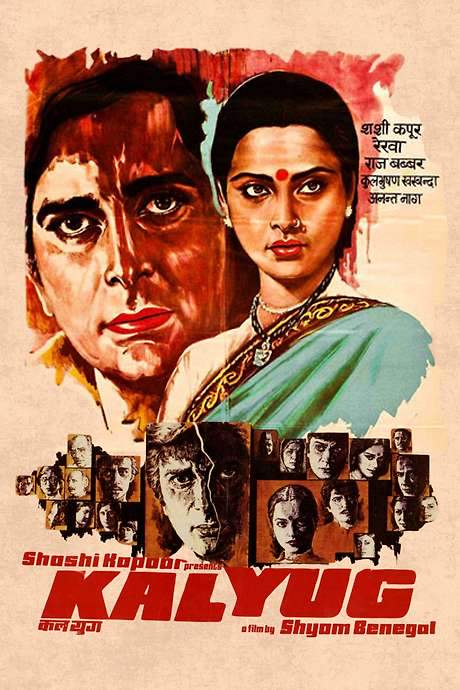


Kalyug Plot Summary
Read the complete plot summary and ending explained for Kalyug (1981). From turning points to emotional moments, uncover what really happened and why it matters.
This is a tale of intrigue, plots and the inevitable war between two families.
Two pioneering brothers in business, Ramchand and A.K. Hangal Bhishamchand, built a thriving enterprise that spans generations. Bhishamchand, a lifelong bachelor, raised Ramchand’s two sons after his demise and gave the family business a firm foundation. Khubchand, the elder son of Ramchand, fathered Dhanraj and Sandeepraj Akash Khurana. Puranchand, Khubchand’s younger brother, had died years earlier, leaving three sons: Dharamraj [Raj Babbar], Balraj [Kulbhushan Kharbanda], and Bharatraj [Anant Nag]. Another pivotal figure is Karan Singh/Karna [Shashi Kapoor], an orphan brought up by Bhishamchand.
A sequence of events reveals a long-hidden feud between the two branches of the family. Despite Bhishamchand’s efforts to mediate and keep the peace, tensions simmer and then flare into violence. Dhanraj’s men strike first by killing Balraj’s young son, a brutal act that deepens the rift and pushes the families toward revenge. In a calculated move of retaliation, Bharatraj murders Karan, widening the chasm and pulling closer those who bear the scars of past loyalties.
As the conflict escalates, long-buried skeletons from the family cupboard come into public view, further poisoning relations and eroding trust. Each revelation adds fuel to the fire, staining memories and complicating choices for everyone involved. The feud spirals beyond reconciliation, culminating in the destruction of both households and underscoring the brittleness of moral values in the face of greed, pride, and retaliation.
In the end, the story offers a stark meditation on how ambition can corrode family bonds and how revenge can hollow out generations. The arc emphasizes the cost of power struggles, the fragility of trust, and the way loyalties are tested when old grievances come to light, leaving little room for redemption in a world where pride and vendetta drive every decision.
Kalyug Timeline
Follow the complete movie timeline of Kalyug (1981) with every major event in chronological order. Great for understanding complex plots and story progression.
Founding the family business
Ramchand and Bhishamchand, two enterprising brothers, lay the foundations of a family business that will shape the fortunes of both clans. Their partnership marks the early rise of both families in the commercial world. The business becomes a central pillar around which family loyalties will turn.
Bhishamchand raises Ramchand's sons
After Ramchand's death, Bhishamchand steps in to raise his brother's two sons. He provides leadership and steers the business through rough waters, ensuring continuity for the next generation. The living arrangement tightens the bond between the two branches of the family.
Khubchand's family tree
Khubchand, Ramchand's elder son, fathers Dhanraj and Sandeepraj. Puranchand, Khubchand's younger brother, has already died, leaving three grandsons: Dharamraj, Balraj, and Bharatraj. The next generation carries the seeds of future conflict amid shared lineage.
Karan the orphan raised by Bhishamchand
Karan, an orphan, is raised by Bhishamchand. He becomes a bridge—yet a flashpoint—between the families, caught in the crosscurrents of loyalty and inheritance. His presence intensifies the sense that kinship is fragile.
Hidden feud surfaces
A long-hidden feud slowly surfaces as old grievances, debts, and ambitions come to light. The two sides re-examine past slights and current power struggles. Tensions begin to calcify into a clear antagonism.
Mediation attempts by Bhishamchand
Bhishamchand attempts to mediate between Ramchand’s and Khubchand’s factions, hoping to avert catastrophe. His negotiations reveal how deep mistrust runs and how fragile any truce would be. The mediation buys only brief respite before conflicts resume.
Tragic first act of violence
Dhanraj's men accidentally kill Balraj's young son, a brutal blow that jolts both families. The tragedy forces Balraj to confront the cost of ancestral feuding. The incident marks a turning point from covert hostility to open grievance.
A vengeful response
Balraj seeks revenge for the killing of his son, setting off a chain reaction. Bharatraj responds by murdering Karan, escalating violence and dragging Bhishamchand deeper into the feud. The cycle of retaliation tightens its grip on everyone involved.
Skeletons from the cupboard
Skeletons from the family cupboard are dragged into the light as past betrayals and secrets come to light. These revelations unsettle both sides and erode any remaining trust. The fallout intensifies the hatred and widens the rift.
The feud erupts into war
The feud erupts into an all-out war between the two families and their business interests. Alliances shift, loyalties fracture, and once-close associates choose sides. The conflict destabilizes the entire household and the broader community.
Destruction and moral fragility
The two families are destroyed as a consequence of the conflict. The violence exposes the brittleness of moral fabric and leaves ruin in its wake. Reflecting on what was sacrificed, the narrative underscores the tragedy of unrestrained vendetta.
Kalyug Characters
Explore all characters from Kalyug (1981). Get detailed profiles with their roles, arcs, and key relationships explained.
Bhisham Chand / Bhishma (A.K. Hangal)
A stern, principled patriarch who tries to mediate the two feuding families but is pulled into the conflict by deep loyalties. His authority and sense of duty anchor the drama, even as his own moral compromises come to light.
Karan Singh / Karna (Shashi Kapoor)
An orphan raised by Bhishamchand, he stands at the center of the feud, torn between loyalty to his guardian and ties to the rival clan by birth. His presence challenges long-held loyalties and triggers revelations about lineage. He embodies the conflict between kinship duty and personal identity.
Dharam Raj / Yudhisthira (Raj Babbar)
The family scion who grapples with duty and honor amidst escalating conflict. His sense of justice is tested as alliances shift and moral choices carry heavy consequences.
Bal Raj / Bhima (Kulbhushan Kharbanda)
A powerful, impulsive presence who defends kin and provokes clashes. His strength amplifies violence and draws lines in the sand between factions.
Bharatraj / Bharat Raj / Arjuna (Anant Nag)
A strategic, perceptive figure whose intellect shapes plans and responses to the feud. He embodies calculation and calculated risk.
Sandeep Raj (Akash Khurana)
The younger ally whose loyalty and political savvy influence the family’s standing. He navigates shifting loyalties and power dynamics with caution.
Draupadi (Rekha)
A central female figure who embodies the ethical tensions within the feud. Her presence catalyzes moral decisions and highlights the personal cost of kin-strife.
Subhadra (Supriya Pathak)
A key female character within the family drama, representing lineage, alliance, and the human stakes of the feud.
Kishan Chand (Amrish Puri)
A powerful business figure driving the family feud and shaping market dynamics with a ruthless, strategic mindset.
Kalyug Settings
Learn where and when Kalyug (1981) takes place. Explore the film’s settings, era, and how they shape the narrative.
Time period
1980s
Set in the late 20th century, the film reflects India's 1980s milieu, a period of rapid urban growth and shifting loyalties. Boardroom plots, power plays, and family honor shape the drama. The era's norms heighten the stakes as private grudges escalate into public catastrophe.
Location
India
Set against India's urban corporate landscape, the story moves through offices, boardrooms, and affluent homes. It captures the pressure of family-owned business and the social codes that govern Indian society. The setting highlights a clash between tradition and modern ambition that fuels the feud.
Kalyug Themes
Discover the main themes in Kalyug (1981). Analyze the deeper meanings, emotional layers, and social commentary behind the film.
⚔️
Power
Power and control drive the two families toward conflict. The struggle for dominance triggers betrayals and strategic gambits. Wealth and authority magnify personal vendettas, eroding trust and amplifying risk.
🪞
Secrets
Skeletons from the family cupboard surface, revealing hidden loyalties and forgotten debts. Revelations shift alliances and redefine who is trusted. Secrecy fuels misinterpretations that escalate tension.
💔
Tragedy
Revenge exacts a heavy toll as innocent lives are drawn into the feud. The narrative underscores the brittleness of moral fabric when honor overruns compassion. The conflict ends in destruction, illustrating the costs of kin-based vendettas.

Coming soon on iOS and Android
The Plot Explained Mobile App
From blockbusters to hidden gems — dive into movie stories anytime, anywhere. Save your favorites, discover plots faster, and never miss a twist again.
Sign up to be the first to know when we launch. Your email stays private — always.
Explore the mobile appKalyug Spoiler-Free Summary
Discover the spoiler-free summary of Kalyug (1981). Get a concise overview without any spoilers.
In a world where commerce and legacy are woven together like tightly‑knit threads, two formidable brothers sit atop a flourishing empire that has shaped generations. Ramchand commands the original spark of the venture, while his elder sibling Bhishamchand—a lifelong bachelor—has become the steady hand that steadied the company after tragedy. Their shared history, built on ambition and mutual respect, casts a long shadow over the sprawling estates and boardrooms that pulse with the rhythm of wealth and expectation.
The family tree that springs from their partnership is a tapestry of rivalries and alliances. Khubchand, the elder son of Ramchand, has fathered the industrious Dhanraj and the contemplative Sandeepraj. Across the hall, Puranchand’s lineage lives on through his three sons—Dharamraj, the pragmatic strategist, Balraj, whose demeanor masks a fierce loyalty, and Bharatraj, a figure of quiet influence. Adding a layer of intrigue, the orphan Karan was raised under Bhishamchand’s roof, his presence a reminder of the bonds forged beyond blood.
Beneath the polished veneer of opulent gatherings and strategic meetings, a subtle current of competition begins to stir. The brothers, once united by a common vision, now find themselves drawn into a delicate dance of power, each seeking to outmaneuver the other without openly betraying the family’s reputation. The sprawling household becomes a chessboard where whispers carry weight, and every gesture hints at deeper motives. The tension is palpable, a lingering note of unease that colors conversations and fuels silent calculations.
The tone of the story is richly atmospheric, blending the grandeur of a dynasty with the intimate tension of a house divided. It invites viewers to linger over the ornate corridors, feel the weight of inherited expectations, and wonder how far ambition will stretch before it reshapes the very foundations of kinship.
Movies with Similar Twists and Themes
Uncover films that echo the narrative beats, emotional arcs, or dramatic twists of the one you're exploring. These recommendations are handpicked based on story depth, thematic resonance, and spoiler-worthy moments — perfect for fans who crave more of the same intrigue.






Featured on this page

What's After the Movie?
Not sure whether to stay after the credits? Find out!
Check out our other apps:

SAT Sphere
Build confidence for the Digital SAT.

Mori Atlas
Discover wild places worth protecting.

Luntero
Search smarter for a home in Amsterdam.

Plot Explained
Unravel movie endings and hidden clues.

Pokechamp
Dive into Pokémon data and battle logic.

Driving Theory
Get ready for your European theory test.

Movie Dust
Plan your next cinema trip with ease.

Musemap
Find art and culture as you travel.

Selkobase
Compare credentials before committing.

Local Manual
Turn an unfamiliar country into practical next steps.

Lernavi
Compare school systems before your next move.

GymRoam
Find a workout stop wherever your plans take you.
Explore Our Movie Platform
New Movie Releases (2026)
Famous Movie Actors
Top Film Production Studios
Movie Plot Summaries & Endings
Major Movie Awards & Winners
Best Concert Films & Music Documentaries
Movie Collections and Curated Lists
© 2026 What's After the Movie. All rights reserved.
Privacy Policy