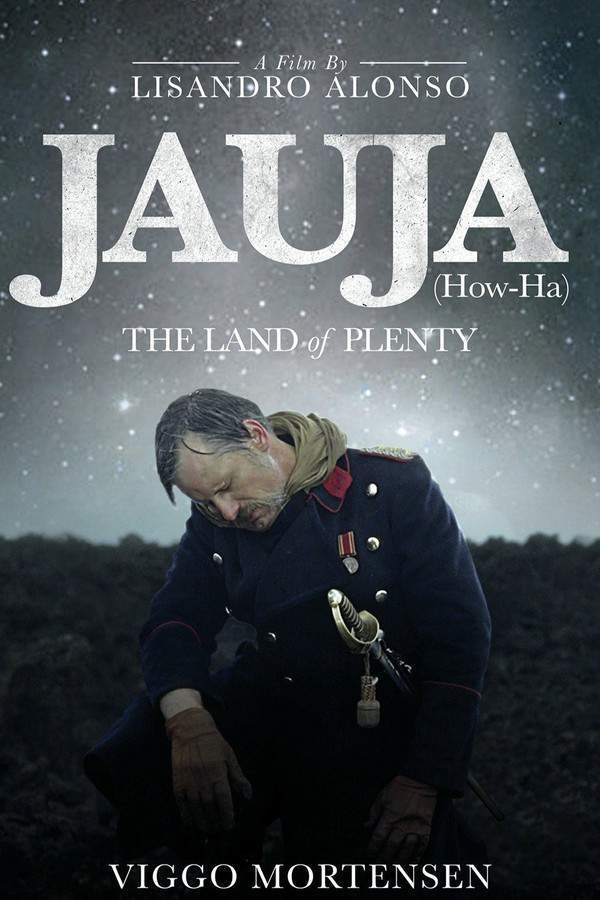
Jauja 2015


Directed by

Lisandro Alonso
Made by

Cinema Guild
Where to Watch Jauja
See current US streaming, rental, and purchase options for Jauja (2015) via JustWatch.








Jauja Plot Summary
Read the complete plot summary and ending explained for Jauja (2015). From turning points to emotional moments, uncover what really happened and why it matters.
In this two-era narrative, the story centers on a Danish captain and his teenage daughter as they move through peril, secrecy, and a puzzling link between worlds. Set in the 1880s, Captain Gunnar Dinesen travels through the Argentine landscape with Ingeborg, a daughter who longs for companionship in the form of a dog that will follow her wherever she goes. The moment is laced with tension when a flirtatious and unseemly proposal arises: Lieutenant Pittaluga asks to take Ingeborg to a dance in exchange for one of the captain’s horses. Dinesen refuses, speaking plainly that Ingeborg is his daughter, and he warns Ingeborg that Pittaluga’s fondness for young girls could bring trouble if she crosses his path. Ingeborg, however, is already drawn toward a young soldier named Corto, and the two young people grow closer under the shadow of the commander’s cautions.
From the outset, the plot threads pull tight around rumors and danger. Corto shares rumors from the desert about Zuluaga, an officer who vanished into the sands and is said to be leading a disruptive group of bandits, even rumored to wear a woman’s dress. The men insist that Corto go into the desert and bring back tangible proof that Zuluaga still lives, a mission that becomes a catalyst for the voyage that will unfold.
One night, Ingeborg and Corto flee together. Pittaluga offers to retrieve Ingeborg, but Dinesen chooses to pursue alone. He ventures into the desert, where the atmosphere thickens with uncertainty and peril. He encounters a mortally wounded man who whispers Zuluaga’s name, a clue that lingers in the air as Dinesen presses on. Not long after, he finds Corto dying, his throat cut, and demands from the young man the whereabouts of his daughter. Dropping his rifle and hat, Dinesen moves toward a suspicious sound in the darkness, a moment that marks a turning point in the ordeal. A native steals his hat and rifle during the confusion, leaving Dinesen to continue on foot through an unforgiving landscape. The relentless search for his daughter drives him onward, his resolve unbroken by the harsh desert and the unsettling aftermath of what he has witnessed.
As the journey persists, a dog appears in the desolate terrain and becomes a guide of sorts. The dog leads Dinesen first to a small toy soldier Corto had given Ingeborg and then to a Dane-speaking elderly woman who lives in a cave. This woman, who speaks of her late husband’s death from a snake bite, becomes a hinge in the narrative. She learns of Dinesen’s quest and, through conversation, reveals a startling truth: she is his daughter. The moment of revelation rests on a fragile, mystifying ambiguity that reconfigures the entire trek in the desert. The woman invites Dinesen to return whenever he wishes, a statement that hints at a complicated fate that will stretch beyond their current encounter as he resumes his trek into the desert.
In the present day, the story shifts to a young girl waking inside a mansion in Denmark and tending to her dogs. The atmosphere here is intimate and domestic, yet it quickly becomes uneasy. One dog shows signs of distress, scratching his fur as if unsettled by prolonged absence and silence. The hound-keeper explains that the dog’s nervous behavior is tied to her owner’s long periods away, creating a sense of disconnect and longing that echoes the past’s urgency. The girl takes the dog for a walk through the woods surrounding her home, turning her attention to a toy soldier lying on the ground. When she picks it up, a ripple of suspense runs through the scene as she senses something amiss. A quiet search follows, and she discovers only ripples spreading across a pond, with no visible sign of the dog. Ingeborg’s action—casting the toy soldier into the pond—suggests a deliberate ritual or symbolic closure that ties the contemporary thread back to the desert journey.
Across both timelines, the narrative navigates the tension between duty and desire, parent and child, pursuit and memory. The desert trek is a crucible in which Dinesen must confront the disappearance of his daughter, the rumors that swirl around Zuluaga, and the possibility that the past and present are more intimately connected than they first appear. The elderly woman’s revelation reframes his search as not only a matter of rescue or reunion but also a reckoning with the nature of family and the ways time can loop back on itself.
The film’s mood is earned through a steady, restrained pace that favors atmosphere over spectacle. The stark landscapes—whether the barren, sun-baked stretches of the desert or the secluded, wooded grounds of a Danish mansion—mirror the internal landscapes of the characters. The dialogue carries weight, and moments of silence carry as much significance as lines spoken aloud. The story’s core rests on the fragile thread linking Ingeborg across centuries to the daughter who appears to be her older self or another facet of the same person, a connection hinted at through shared objects—the toy soldier, the dog, and the unspoken questions that rise whenever a child’s absence becomes a shared memory.
Ultimately, the film invites viewers to consider how longing, obligation, and the mysterious currents of fate intertwine. A father’s relentless search for his daughter in a hostile land parallels a young woman’s quiet, unresolved longing in a safe, daylight-lit dwelling. The mysterious cave-dwelling elder, the rumor-spread deserter, and the enigmatic toy soldier all serve to knit the two eras into a singular, contemplative meditation on lineage, memory, and the elusive nature of reunion. The final image—Ingeborg casting the toy soldier into the pond—leaves a resonant impression of release and continuity, a quiet closing that lingers with the audience long after the desert winds have faded.
Jauja Timeline
Follow the complete movie timeline of Jauja (2015) with every major event in chronological order. Great for understanding complex plots and story progression.
Ingeborg asks her father for a dog in Argentina
In the 1880s, Danish Captain Gunnar Dinesen travels with his teenage daughter Ingeborg in Argentina. Ingeborg asks if she can have a dog that will follow her wherever she goes. The request hints at her longing for companionship on the long, perilous journey ahead.
Pittaluga’s proposition and Dinesen’s refusal
Lieutenant Pittaluga asks for permission to take Ingeborg to a dance in exchange for one of his horses. Dinesen refuses, stating that Ingeborg is his daughter and not a prize. He warns Ingeborg to steer clear of Pittaluga and his predatory offers.
Ingeborg grows close to Corto and rumors emerge about Zuluaga
Ingeborg becomes involved with a young soldier named Corto. Corto shares rumors with Pittaluga and Dinesen that Zuluaga—an officer who disappeared into the desert—now leads bandits and may be disguised as a woman.
Ingeborg and Corto run off; Dinesen pursues alone
That night, Ingeborg and Corto run away together. Pittaluga offers to retrieve Ingeborg, but Dinesen insists on going after them alone into the desert.
Desert hardship: mortally wounded man, Corto’s death, and loss
While searching the desert, Dinesen encounters a mortally wounded man whispering the name Zuluaga. He later finds Corto dying with his throat cut and demands to know where his daughter is. A native steals Dinesen’s hat and rifle, leaving him to continue on foot.
A guide appears: dog leads to toy soldier and a mysterious woman
Driven on, a dog leads Dinesen to a toy soldier Corto gave Ingeborg, then to a Danish-speaking elderly woman living in a cave. The encounter reveals that there is a surprising family connection connected to his past.
The woman reveals she is Dinesen’s daughter
The elderly woman finally confirms that she is Dinesen’s daughter. She tells him to return whenever he likes, and he is left to continue wandering the vast desert with this revelation looming over him.
Present-day Denmark: Ingeborg wakes in a mansion
In the present day, a young girl named Ingeborg wakes up in a grand Danish mansion and goes to check on her dogs. The hound-keeper explains that one dog is nervous and its fur is being scratched away by her long absences.
Ingeborg walks the dogs and discovers a toy soldier
She tends to the dogs and takes one for a walk in the surrounding woods. During the ramble, she finds a toy soldier on the ground, hinting at a connection to her past.
The pond moment: mystery deepens
Hearing a disturbance from her dog, she searches but finds only ripples on a pond and no sign of the dog. In a final gesture, she casts the toy soldier into the pond, sealing the moment with mystery.
Jauja Characters
Explore all characters from Jauja (2015). Get detailed profiles with their roles, arcs, and key relationships explained.
Gunnar Dinesen
A stoic Danish captain who leads a perilous search into the Argentinian desert to find his daughter, showing stubborn resolve and protective authority. He faces hostile terrain, makes hard choices, and ultimately acts decisively, including killing Corto when needed. His journey tests his sense of honor, duty, and the limits of paternal love.
Ingeborg
Dinesen's daughter, a spirited young woman who seeks independence and is drawn into a forbidden relationship with Corto, fueling the dangerous expedition into the desert. Her choices drive the plot and blur the line between memory and present danger. In the present day, the character resurfaces as a young woman in a mansion, hinting at a cyclical fate.
Corto
A young soldier who becomes entangled with Ingeborg and informs others of Zuluaga’s rumored return, catalyzing the expedition. He is ultimately killed in the desert, serving as a warning of danger and a catalyst for Dinesen’s relentless pursuit.
Lieutenant Pittaluga
A lecherous officer who tries to exploit Ingeborg for a dance and a horse, illustrating the era’s power dynamics and the danger the girl faces from men’s predatory behavior.
Zuluaga
An officer rumored to be alive in the desert, wearing a woman's dress and leading a band of bandits; his legend fuels the men’s fear and motivates the desert expedition.
Old Woman (Dinesen's daughter)
A Danish-speaking elder who lives in a cave in the desert and reveals to Dinesen that she is his daughter, creating a connection between the two timelines. Her presence ties into the film’s cyclical structure and hints at lineage continuing beyond death.
Jauja Settings
Learn where and when Jauja (2015) takes place. Explore the film’s settings, era, and how they shape the narrative.
Time period
1880s; Present Day
Two timeframes drive the narrative: the 1880s, when Danish Captain Gunnar Dinesen hunts for his daughter Ingeborg in Argentina, and a present-day sequence in Denmark where a young girl and her dogs hint at a cyclical link to the past. The 1880s frontier era is portrayed with military tension and survival against a harsh desert, while the present-day scenes frame memory as a living thread, implying that the past persists within the present.
Location
Argentina, Denmark
The film unfolds across two stark settings: the arid Argentinian frontier where Captain Gunnar Dinesen searches for his daughter, and a secluded Danish mansion in present-day Denmark where Ingeborg awakens to a life that echoes the past. The desert landscape is merciless and endless, shaping the protagonists' resolve and blurring the line between memory and pursuit. The Danish mansion provides a claustrophobic counterpoint where generations feel the pull of history.
Jauja Themes
Discover the main themes in Jauja (2015). Analyze the deeper meanings, emotional layers, and social commentary behind the film.
🕰️
Time
The film toys with time, moving between the 1880s frontier of Argentina and a present-day Denmark, suggesting that memories and destinies loop back on themselves. The narrative structure blurs chronology, forcing characters to confront echoes of the past in the present. The desert acts as a liminal space where time collapses and choices endure beyond mortality.
🪞
Identity
Characters cross identities across generations, with Ingeborg's presence in both eras complicating lineage and self-perception. The story asks who remains the 'self' when borders of time and place shift, and how memory shapes who we are. The revelation that the elder woman is the captain's daughter underscores the fragility of fixed identities.
🏜️
Pursuit
A relentless pursuit drives the plot: a father chasing his daughter through a merciless desert, echoing in the modern chase for answers in a Danish mansion. The pursuit tests resolve, moral boundaries, and the willingness to face the unknown. Through the chase, the film explores how desire and duty push characters to traverse impossible distances.

Coming soon on iOS and Android
The Plot Explained Mobile App
From blockbusters to hidden gems — dive into movie stories anytime, anywhere. Save your favorites, discover plots faster, and never miss a twist again.
Sign up to be the first to know when we launch. Your email stays private — always.
Explore the mobile appJauja Spoiler-Free Summary
Discover the spoiler-free summary of Jauja (2015). Get a concise overview without any spoilers.
In the stark, sun‑baked expanses of 1880s Argentina, Captain Gunnar Dinesen leads a small detachment across an unforgiving desert, his sense of duty weighed against a father’s fierce love for his teenage daughter. Ingeborg is restless, yearning for companionship and the freedom to choose her own path, while the young soldier Corto offers a glimpse of that coveted independence. Their relationship ignites tension with the disciplined world of the military, especially under the watchful eye of Lieutenant Pittaluga, whose presence hints at the delicate balance between authority and desire. The landscape itself becomes a character, its silence amplifying the unspoken worries that linger between father and child.
Centuries later, a quiet Danish mansion provides a contrasting backdrop of domestic calm. A young girl tends to her dogs, her days marked by the subtle rhythms of home life. An uneasy tension surfaces when one of the hounds reacts to an absence, mirroring the lingering sense of loss that haunts the older narrative. A simple toy soldier, found on a walk through the woods, serves as a fragile bridge between the two eras, suggesting that memory and longing can echo across time without revealing their full meaning.
The film moves with a deliberate, measured pace, favoring atmosphere over action. Its visual language shifts between the arid, windswept desert and the hushed, leafy grounds of the Danish estate, each reflecting the internal landscapes of its characters. Dialogue is sparse, allowing silences to speak volumes about duty, affection, and the mysterious ways the past can intrude upon the present. The story invites viewers to sit with unanswered questions, feeling the pull of an invisible thread that ties a father’s relentless search to a contemporary child’s quiet yearning.
Movies with Similar Twists and Themes
Uncover films that echo the narrative beats, emotional arcs, or dramatic twists of the one you're exploring. These recommendations are handpicked based on story depth, thematic resonance, and spoiler-worthy moments — perfect for fans who crave more of the same intrigue.
Featured on this page

What's After the Movie?
Not sure whether to stay after the credits? Find out!
Check out our other apps:

SAT Sphere
Build confidence for the Digital SAT.

Mori Atlas
Discover wild places worth protecting.

Luntero
Search smarter for a home in Amsterdam.

Plot Explained
Unravel movie endings and hidden clues.

Pokechamp
Dive into Pokémon data and battle logic.

Driving Theory
Get ready for your European theory test.

Movie Dust
Plan your next cinema trip with ease.

Musemap
Find art and culture as you travel.

Selkobase
Compare credentials before committing.

Local Manual
Turn an unfamiliar country into practical next steps.

Lernavi
Compare school systems before your next move.

GymRoam
Find a workout stop wherever your plans take you.
Explore Our Movie Platform
New Movie Releases (2026)
Famous Movie Actors
Top Film Production Studios
Movie Plot Summaries & Endings
Major Movie Awards & Winners
Best Concert Films & Music Documentaries
Movie Collections and Curated Lists
© 2026 What's After the Movie. All rights reserved.
Privacy Policy