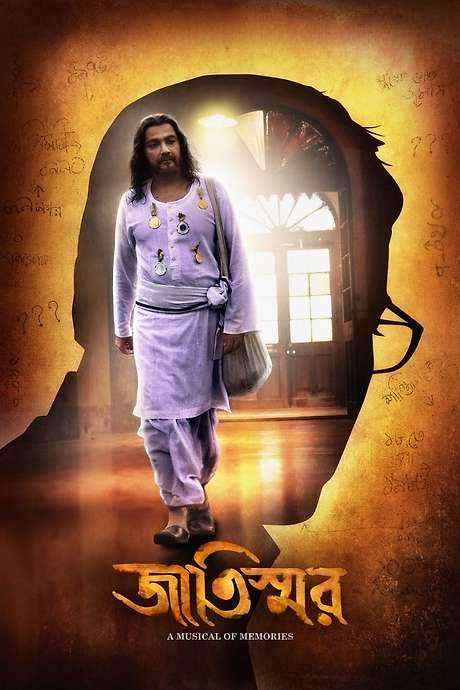

Where to Watch Jaatishwar
See current US streaming, rental, and purchase options for Jaatishwar (2014) via JustWatch.


Streaming availability powered by 
Jaatishwar Plot Summary
Read the complete plot summary and ending explained for Jaatishwar (2014). From turning points to emotional moments, uncover what really happened and why it matters.
Jaatishwar Timeline
Follow the complete movie timeline of Jaatishwar (2014) with every major event in chronological order. Great for understanding complex plots and story progression.
Rohit falls for Mahamaya and accepts her Bengali song challenge
In the present timeline, Rohit Mehta, a Gujarati-born man in Calcutta, falls in love with Mahamaya Bandopadhyay. She tests him by demanding a Bengali song with perfect lyrics and no accent, as a condition for considering a relationship. He agrees and leaves for Portugal to study colonial history, hoping to master Bengali and win her heart.
Two years later in Portugal, Rohit's Bengali improves and he starts a dissertation
Two years pass in Portugal. Mahamaya is now a radio jockey while Rohit continues living abroad, and his Bengali improves with Bodhi's help. He chooses a music course and decides to write a dissertation on the 19th-century folk poet Anthony Firingee, traveling between Calcutta and Chandannagar as part of his research.
Rohit meets Kushal Hajra, the self-proclaimed reincarnation
Back in Calcutta, Rohit meets Kushal Hajra, who claims to be the reincarnation of Anthony. Kushal's visions haunt him daily, threatening his present life. Rohit promises to take Kushal to Calcutta for treatment if Kushal shares Anthony's life history.
Anthony's 19th-century beginnings in Calcutta
The story shifts to the 19th century as Anthony captivates villagers with his musical talent in Calcutta. He saves Soudamini, a young Bengali widow, from sati and marries her, while pursuing mastery of Bengali through Hindu scriptures and folk songs.
Anthony forms a kaviyaal troupe and faces rivals
Anthony learns Bengali poetry and forms his own kaviyaal group. He defeats Joggeshwari, the first female kaviyaal, and goes on to compete with notable poets like Ram Basu and Thakur Singha.
Kushal undergoes psychiatric evaluation in present timeline
Back in the present, Kushal is taken to a psychiatrist, who explains that completing Anthony's life work might quiet the visions. Kushal's visions intensify as he confronts visions from the past while Rohit plans his musical path.
Bandemonium plan forms and Rohit prepares for a Bengali performance
Rohit discovers a way to sing his Bengali composition in front of Mahamaya as Bandemonium—a cross-border competition between West Bengal and Bangladesh—approaches. Bodhi returns to Calcutta with Sidhu to assemble musicians for the show.
Anthony's last kavigaan and the Durga Puja tragedy
Kushal reveals Anthony's final kavigaan, during which the widower planned to perform a Durga Puja alone. The villagers, who see him as a firingee (foreigner), oppose him, forcing him to travel to Calcutta for another kavigaan against Bhola Moira, which he wins despite the opposition.
Bandemonium day; Rohit performs and flashes back to the past
Bandemonium arrives and Rohit takes the stage to perform his Bengali song 'E Tumi Kemon Tumi' while Mahamaya watches with tears. The performance triggers a flashback to Anthony's 19th-century life, including triumphs and losses.
Anthony's return, tragedy, and Soudamini's death
In the flashback, Anthony returns victorious, only to find his home burned and Soudamini dead. He digs graves for his wife and then for himself, his faith shattered by the tragedy and isolation of his life.
Kushal meets Mahamaya and then vanishes
During the show, Bodhi brings Kushal to the auditorium to see Rohit's performance. Kushal meets Mahamaya briefly and leaves abruptly, his visions growing stronger in her presence.
Rohit and Mahamaya confess love; Kushal is missing
After the performance, Rohit and Mahamaya profess their love backstage. Kushal goes missing, and Rohit and Mahamaya rush to Kushal's house in Chandannagar, where they find him delirious and attacking Rohit amid his worsening visions.
Kushal's final act and the end of visions
Kushal, now seemingly beyond cure, recounts Anthony's life and finally apologizes to Soudamini in memory of his lost love. The visions gradually fade, and Kushal is left at peace as the present timeline moves forward.
Reincarnation twist and ending cue
The film reveals that Mahamaya is the reincarnation of Soudamini, though she remembers nothing of her past life. Rohit and Mahamaya's romance remains complex as Kushal's visions come to a close and the two timelines converge through memory and music.
Credits roll with Jaatishwar
Kabir Suman's song Jaatishwar plays in the background as the film ends, underscoring the fusion of love, art, and reincarnation that runs throughout the story. The closing sequence ties together the present and past through melody and memory.
Jaatishwar Characters
Explore all characters from Jaatishwar (2014). Get detailed profiles with their roles, arcs, and key relationships explained.
Rohit Mehta (played by Jisshu Sengupta)
A Gujarati-born, Calcutta-raised man who loves Mahamaya but struggles with Bengali. He travels to Portugal to study colonial history and slowly refines his Bengali with Bodhi, aiming to sing with authentic lyrics and without an accent. Rohit’s journey blends romantic pursuit with a quest for linguistic and artistic mastery across two eras.
Mahamaya Bandhopadhyay
A radio jockey in the present timeline who captivates Rohit with her passion for music. She harbors a profound personal history and is implied to be the reincarnation of Soudamini. Her relationship with Rohit grows as Bandemonium approaches, culminating in a moment of emotional revelation.
Kushal Hajra (Kushal Hazra)
A mysterious figure in the present who claims to be the reincarnation of Anthony and is haunted by visions from a previous life. He is taken to a psychiatrist to address his increasingly intense experiences, and his unraveling becomes central to the film’s twist ending.
Bhola Moyra
A formidable 19th-century kavigyaal who competes with Anthony in the local folk-poetry battles. He embodies the rivalries and passions of the era’s musical dueling culture and helps define Anthony’s rise as a master of Bengali verse.
Joggeshwari
The woman kaviyaal who Anthony defeats in early performances, representing the female voice within the traditional kavigaan tradition. She stands as a key figure in the era’s artistic competition and helps illustrate the social dynamics of the time.
Soudamini
A young Bengali widow saved from sati by Anthony; she becomes his wife in the 19th century. Her death under violent village resistance drives Anthony’s heartbreak and fuels the tragedy that echoes across time.
Ram Basu
A notable 19th-century kaviyaal who competes in the same circles as Anthony, adding to the competitive and collaborative atmosphere of Calcutta’s folk-poetry scene.
Thakur Singho (Thakur Singha)
A senior rival in the 19th-century kavigaan circuit. His clashes with Anthony underscore the era’s social and artistic tensions and help shape the autobiographical arc of Anthony’s character.
Hensman Anthony (Anthony Firingee)
The celebrated 19th-century Bengali poet whose life and work anchor the historical chapters. His pursuit of Bengali language and his dedication to art drive both the era’s music culture and the film’s interwoven narrative about memory and belonging.
Jaatishwar Settings
Learn where and when Jaatishwar (2014) takes place. Explore the film’s settings, era, and how they shape the narrative.
Time period
Present-day and 19th Century
The narrative alternates between contemporary Calcutta—with radio studios and a band competition—and the 19th-century Calcutta where Anthony’s kavigaan culture thrived. The film uses flashbacks to reveal how language, love, and music cross generations. This dual timeline emphasizes how past and present influence each other through memory, art, and fate.
Location
Calcutta (Kolkata), Chandannagar, Farashdanga, Portugal
The present-day action unfolds in Kolkata, a historic cultural hub known for literature, music, and radio. Chandannagar and Farashdanga anchor the 19th-century segments, offering riverside streets and a colonial-era backdrop that shaped Anthony’s world. The story also briefly travels to Portugal as Rohit pursues a history dissertation, linking local Bengali culture to a broader global context.
Jaatishwar Themes
Discover the main themes in Jaatishwar (2014). Analyze the deeper meanings, emotional layers, and social commentary behind the film.
❤️
Romance
A timeless romance unfolds between Rohit and Mahamaya, transcending language barriers and social expectations. The relationship gains depth as Mahamaya’s feelings grow during Bandemonium and through Rohit’s growing mastery of Bengali. The movie also threads in a larger fate-driven romance spanning generations, culminating in a revelation about reincarnation.
🎶
Music
Music is the spine of the story, from Anthony’s kavigaan battles to Rohit’s Bengali song and the Bandemonium contest. The film treats language and melody as vehicles for identity, bridging cultures across time. Kavigaans, lyrical duels, and communal singing illustrate how music binds people and preserves memory.
🗣️
Language Identity
Rohit’s struggle to learn correct Bengali reflects a search for belonging and authenticity. The plot uses linguistic mastery as a test of love and loyalty, showing how language can unlock connections across generations. The 19th-century sections dramatize how Bengali language and poetry elevate everyday life into art.
🔮
Reincarnation
The film builds a thread of fate and rebirth, with Mahamaya revealed as the reincarnation of Soudamini. Visions of the past haunt Kushal, driving the need to resolve a life unfinished in Anthony’s time. The ending tightens the link between lives, memory, and music, suggesting destiny cannot be easily silenced.

Coming soon on iOS and Android
The Plot Explained Mobile App
From blockbusters to hidden gems — dive into movie stories anytime, anywhere. Save your favorites, discover plots faster, and never miss a twist again.
Sign up to be the first to know when we launch. Your email stays private — always.
Explore the mobile appFeatured on this page

What's After the Movie?
Not sure whether to stay after the credits? Find out!
Check out our other apps:

SAT Sphere
Build confidence for the Digital SAT.

Mori Atlas
Discover wild places worth protecting.

Luntero
Search smarter for a home in Amsterdam.

Plot Explained
Unravel movie endings and hidden clues.

Pokechamp
Dive into Pokémon data and battle logic.

Driving Theory
Get ready for your European theory test.

Movie Dust
Plan your next cinema trip with ease.

Musemap
Find art and culture as you travel.

Selkobase
Compare credentials before committing.

Local Manual
Turn an unfamiliar country into practical next steps.

Lernavi
Compare school systems before your next move.

GymRoam
Find a workout stop wherever your plans take you.
Explore Our Movie Platform
New Movie Releases (2026)
Famous Movie Actors
Top Film Production Studios
Movie Plot Summaries & Endings
Major Movie Awards & Winners
Best Concert Films & Music Documentaries
Movie Collections and Curated Lists
© 2026 What's After the Movie. All rights reserved.
Privacy Policy