
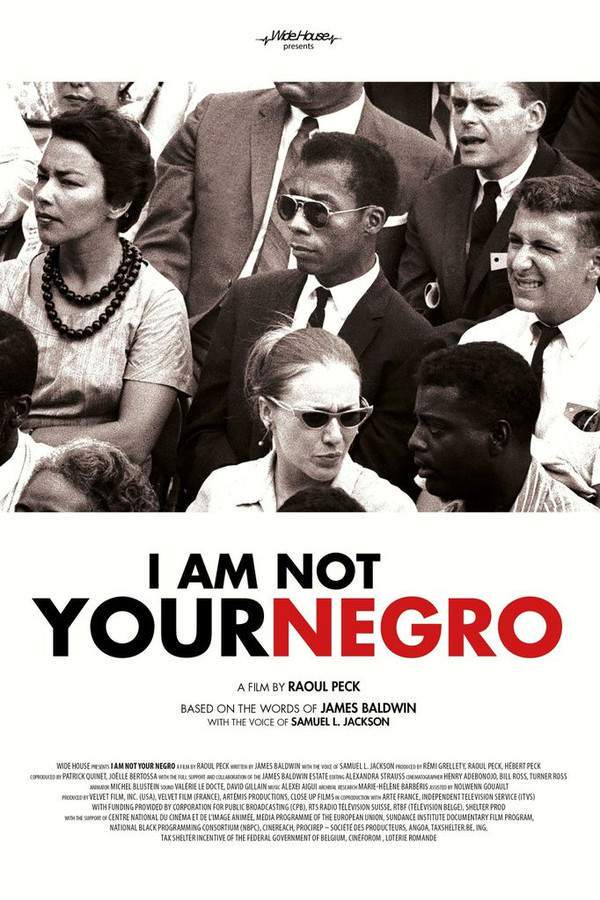
What Happens in I Am Not Your Negro?
The complete story of I Am Not Your Negro, from the first scene to the last, in 1,468 words (about 6 minutes). Spoilers throughout.
Spoilers ahead
The film opens with a 1968 interview on The Dick Cavett Show. Cavett notes that Baldwin is often asked a stubborn question: “Why aren’t the Negroes optimistic?” He says that many people believe the situation to be improving considerably, with Black people now holding positions of influence across society: as mayors, professional athletes, politicians and TV actors. Cavett asks Baldwin, “Is it at once getting much better and still hopeless?”
In response, Baldwin says, “I don’t think there’s much hope for it, as long as people are using this peculiar language. It’s not a question of what happens to the Negro here, [though] that is a very vivid question for me. The real question is what’s going to happen to this country? I have to repeat that.” Baldwin continues to assert throughout the film that the fate of the United States is directly linked to how effectively it addresses the plight of Black Americans. The prospects for the entire country and the prospects for Black Americans are inextricably tied together such that the truth and reckoning for one becomes the same for the other.
The film is divided into five chapters across which Baldwin weaves the assassinations of Medgar Evers, Malcolm X, and Martin Luther King Jr.
Chapter one, “Paying My Dues,” portrays the school integration era of the civil rights movement, emphasizing the fierce resistance to desegregation displayed by many white Americans in an attempt to maintain the status quo of white supremacy. Peck shows both live footage of Leander Perez (supporting segregation) and photographs of 15-year-old Dorothy Counts (a student integrating a North Carolina school). Peck quotes Baldwin’s writings in which he says that while others are addressing civil rights in the U.S., he is across the Atlantic. Baldwin returned to America. Baldwin asserts, “I missed the music, I missed the style… that style possessed by no other people in the world… I missed, in short, my connections, missed the life which had produced me and nourished me and paid for me.”
Chapter two, “Heroes,” highlights how white film protagonists are near-universally portrayed through a romantic, heroic lens when pursuing and protecting their interests, even and especially through the use of violence and rape. Peck uses clips of films and documents as examples. Baldwin’s reaction to the black protagonists who do not take vengeance: “because Uncle Tom refuses to take vengeance in his own hands, he was not a hero for me.” Peck shows examples of how films and other media portray Black Americans as people suspected of crimes or deviant behavior who face the barbaric consequences of those unfounded suspicions. Peck quotes Baldwin, who states that the characters portrayed by Black actors like Stepin Fetchit (Lincoln Theodore Monroe Andrew Perry), Mantan Moreland, and Willie Best “lied about the world [he] knew, and debased it.”
The chapter recognizes the influential impact of the deaths of Martin Luther King Jr and Malcolm X, which caused Baldwin “to discover that the line which separates a witness from an actor” was small, but “nevertheless, the line is real.”
The film shows photographs from the May 1963 meeting between Baldwin, Attorney General Robert F. Kennedy, and playwright Lorraine Hansberry (Baldwin–Kennedy meeting). The narrator describes the meeting as devolving tensely. Hansberry seeks “a moral commitment” from Kennedy in light of “the state of the civilization which produced that photograph of the white cop standing on that Negro woman’s neck in Birmingham.” The film reports that though the conversation does not conclude amicably, it may have contributed to Kennedy’s awakening to the significance and urgency of racial issues across the country. The chapter concludes with Baldwin demanding that America “forget ‘The Negro Problem’” and take responsibility for racial inequality and discrimination as an American problem.”
Chapter three, “Purity,” addresses differing expectations of Black actors and provides quotes from Baldwin and film clips regarding expectations for deference, racial purity, social capital, spending power, the achievement ceiling. Peck quotes Baldwin: “In spite of the fabulous myths proliferating in this country concerning the sexuality of black people, black men are still used, in the popular culture, as though they had no sexual equipment at all.” Baldwin writes that, “though no one dares admit that,” Harry Belafonte and Sidney Poitier were portrayed as sex symbols, as they were robbed of their sexuality autonomy as a way to appeal to white audiences.” The chapter also illustrates how different audiences interpret and preserve films in racially distinct ways. In the 1958 film The Defiant Ones, Sidney Poitier plays Noah Cullen, a Black man who has an opportunity to escape by remaining on a train but chooses to jump with his white companion, John “Joker” Jackson, played by Tony Curtis. Baldwin suggests that “the white liberal people downtown were much relieved and joyful. But when black people saw him jump off the train, they yelled, ‘Get back on the train, you fool!’ The black man jumps off the train in order to reassure white people, to make them know that they are not hated, that though they have made human errors, they done nothing for which to be hated.”
The film uses video from the 1965 debate between Baldwin and conservative commentator William F. Buckley Jr., at the University of Cambridge. In the film, Baldwin quotes ex-Attorney General Robert F. Kennedy: “It’s conceivable that in 40 years in America, we might have a Negro president.” Baldwin responds that Black Americans have “been here for 400 years and now he [Kennedy] tells us that maybe in 40 years, if you’re good, we may let you become president.”
In Chapter four, “Selling the Negro,” Peck discusses the American economy of forced labor and the economy of imprisonment today. He quotes Baldwin: “the harbors and the ports and the railroads of the country, the economy, especially in the southern states, could not conceivably be what it has become if they had not had, and do not still have, indeed, and for so long, so many generations, cheap labor.” In this chapter, Peck quotes Baldwin’s views on whether white Americans have an accurate sense of reality, as there have “never been any genuine confrontation between these two levels of experience” of racial issues and the extent to which film and television reassures rather than criticizes.
In the concluding chapter, “I Am Not A Nigger,” Peck shows photographs of African-Americans, including contemporary photos. The film’s narrator reads quotes from Baldwin about whiteness as a metaphor for power and autonomy. Peck concludes with a video of Baldwin stating: “I can’t be a pessimist because I’m alive, so I’m forced to be an optimist. But the future of the Negro in this country is precisely as bright or as dark as the future of the country. It is entirely up to the American people whether or not they are going to face and deal with and embrace this stranger whom they maligned so long. What white people have to do is try to find out in their own hearts why it was necessary to have a ‘nigger’ in the first place. Because I am not a nigger, I am a man! But if you think I’m a nigger, it means you need him. And the question the white population of this country has got to ask itself—North and South, because it’s one country, and for a Negro there is no difference between the North and the South. It’s just a difference in the way they castrate you, but the fact of the castration is the American fact—If I am not the nigger here, and you the white people invented him, then you’ve got to find out why. And the future of the country depends on that, whether or not it’s able to ask that question.”
Political figures, journalists, and activists who are quoted or portrayed in the documentary include James Baldwin (video of him speaking and also narrator Samuel L. Jackson reading Baldwin quotes), Harry Belafonte, Dick Cavett, Kenneth B. Clark, Dorothy Counts, H. Rap Brown, Medgar Evers, J. Edgar Hoover, Robert F. Kennedy, Martin Luther King Jr., Rodney King, Leander Perez, Sidney Poitier, David Schoenbrun, Paul Weiss, Billy Dee Williams, and Malcolm X.
The film references actors from films and television shows to make claims about portrayals of race. Visuals and mentions include Willie Best in The Monster Walks as Exodus, Joan Crawford in Dance, Fools, Dance as Bonnie Jordan, Gary Cooper in Love in the Afternoon as Frank Flanagan, Tony Curtis in The Defiant Ones as John “Joker” Jackson, Doris Day in Love Come Back, as Carol Templeton, Stepin Fetchit in I Ain’t Gonna Open That Door (1947) as Richard, Mantan Moreland, Clinton Rosemond in They Won’t Forget as Tump Redwine, Rod Steiger in In the Heart of the Night as Chief Bill Gillespie, and Richard Widmark in No Way Out as Ray Biddle.

