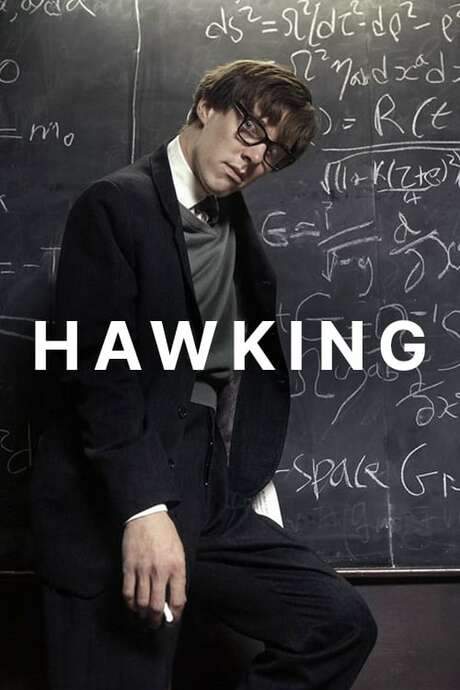



Where to Watch Hawking
See current US streaming, rental, and purchase options for Hawking (2004) via JustWatch.






Hawking Plot Summary
Read the complete plot summary and ending explained for Hawking (2004). From turning points to emotional moments, uncover what really happened and why it matters.
Stephen Hawking’s 21st birthday party becomes the unlikely spark for a profound connection with Jane Wilde, as she is drawn to his vast curiosity about the stars and the universe. The pair share a magnetic pull, but the moment of wonder is brutally interrupted when Stephen suddenly cannot stand, and a hospital visit reshapes the course of their lives. Doctors deliver a devastating diagnosis: Stephen has motor neurone disease, and the prognosis is bleak—doctors don’t expect him to survive more than two years. He returns to Cambridge to face a term that will continue without him, and the looming question of a PhD subjects his mind in a way nothing else can.
Back on campus, Stephen struggles to keep up with the rapid pace of academic life. He finds it impossible to pretend that everything is fine, rejecting the steady hands of his supervisor Dennis Sciama and sinking into a deep, isolating depression. Yet the spark of hope remains, partly sustained by Jane’s unwavering faith in him, which helps him cling to something meaningful as his body weakens. The atmosphere of the time is dominated by the Steady State theory, a bold claim about a universe with no origin, championed by the outspoken Yorkshire professor Fred Hoyle, a public figure of science television who becomes a foil and a focal point of Hawking’s growing skepticism.
One evening Hawking glimpses an early paper by Hoyle and, through careful scrutiny, spots a mistake. He challenges Hoyle after the lecture, and the public fracas rattles the department while also giving him a hard-won rush of confidence. Around this time, a fresh perspective arrives in the form of Roger Penrose, whose topological approach—focusing on shapes rather than equations—opens new doors for Hawking. Penrose’s fascination with the life and death of stars leads to a remarkable idea: the behavior of collapsing stars might reveal something fundamental about the universe itself. Hawking’s mind, pressured by illness yet energized by possibility, begins to see a path toward a radical theory: what if the universe began with a bang rather than simply existing without origin?
With renewed purpose, Stephen embraces Penrose’s insights about singularities and the possibility of tracing the universe’s history backward in time. He harnesses this new lens to forge a brilliant PhD thesis with implications that reverberate through cosmology. Despite his deteriorating health, he writes, studies, and maintains a stubborn resilience, bound to Jane through marriage proposals and a stubborn, almost defiant will to survive. The result is a story of scientific awakening that pairs intimate personal endurance with a leap in understanding the cosmos.
Interwoven with Hawking’s journey is a parallel, real-world arc: in 1978, Arno Allan Penzias and Robert Wilson recount, in Stockholm, how their radio-telescope work uncovered a faint, pervasive signal from space—the leftover glow of the universe’s earliest explosion. This discovery provides crucial empirical support for the big-bang theory Hawking is beginning to articulate, cementing a turning point in how humanity comprehends its origins. As the film threads these two strands together, it paints a portrait of a man who, despite a daunting diagnosis, helps usher in a scientific upheaval that changes the way we understand space, time, and our own place within it.
Today, the consensus in science holds that the universe started with a Big Bang, billions of years ago, and the narrative of two lives—one intimate and fragile, one giant and universal—converges to tell the story of how a young student from Cambridge helped transform our view of reality.
Hawking Timeline
Follow the complete movie timeline of Hawking (2004) with every major event in chronological order. Great for understanding complex plots and story progression.
Hawking meets Jane Wilde at his 21st birthday party
At Stephen Hawking's 21st birthday party, he meets Jane Wilde and there is an immediate attraction. They connect over conversations about stars and the universe. Jane soon realises something is wrong when he suddenly cannot stand up.
Diagnosis of motor neurone disease
A stay in hospital reveals that Stephen Hawking has motor neurone disease. Doctors provide a distressing prognosis, suggesting he might not live beyond two years. The news anchors his future to a long, difficult fight.
Return to Cambridge and PhD struggle
Back in Cambridge, the new term starts but Stephen cannot find a subject for his PhD and drifts away from his supervisor, Dennis Sciama. He sinks into depression as his condition worsens and his academic life stalls. Friends and colleagues remain engaged with their own work, leaving Stephen feeling isolated.
Jane's support sustains him
Jane's visits and faith in his abilities help Stephen hold on during the toughest days. He leans on their relationship as a source of hope and purpose. This support begins to pull him back from the edge of withdrawal.
Hoyle paper confrontation
Hawking gets an early glimpse of a paper by Fred Hoyle to be presented at a Royal Society lecture. He works through the calculations, spots a mistake, and publicly confronts Hoyle after the talk. The clash sparks interest in his own independent research.
Penrose introduces topology
Around the same time, Roger Penrose introduces Hawking to topology, a way of thinking about the universe through shapes rather than equations. The new approach gives Stephen a practical method to cope with writing and to frame his ideas.
Penrose and the singularity concept
Penrose explains how the collapse of dying stars suggests singularities at their cores, a concept that excites Stephen's imagination about the origins of the universe. He begins to see a path toward a cosmology that could include a beginning.
Thinking backwards: the Big Bang idea
Stephen asks what would happen if Penrose's math were applied backwards to the universe as a whole. The answer hints that nothingness could explode into something, implying the universe could have originated with a Big Bang.
PhD breakthrough and renewed focus
With renewed energy, Hawking dives into his research and produces a PhD that combines Penrose's theorems with cosmological questions. The results are brilliant and have profound implications for cosmology.
Marriage proposal and commitment to survival
Despite his deteriorating health, Stephen commits to Jane, asking her to marry him. Their engagement becomes a source of resolve and a personal victory in his fight to survive.
Two-year milestone and impact
Two years after the initial diagnosis, Hawking is still alive and has helped spark a major scientific breakthrough that reshapes how people view the universe. He demonstrates that ambition and intellect can persist beyond a grim prognosis.
Penzias and Wilson and the evidence for the Big Bang
Unbeknownst to Hawking, two American scientists, Arno Penzias and Robert Wilson, are interviewed in Stockholm in 1978 on the eve of receiving the Nobel Prize. They recount how they discovered a faint signal from space that would become evidence for the Big Bang.
Cosmic microwave background discovered
They describe scanning the skies from a radio telescope in the hills above New Jersey, where they detected the leftover heat of the first explosion. This signal would later be recognized as physical proof of the Big Bang.
Legacy: Big Bang confirmed
By the film's end, the cosmological consensus is that the universe started with a Big Bang, marking a fundamental shift in how humanity understands space and time.
Hawking Characters
Explore all characters from Hawking (2004). Get detailed profiles with their roles, arcs, and key relationships explained.
Stephen Hawking (Benedict Cumberbatch)
Brilliant physicist who endures a devastating motor neuron disease diagnosis while maintaining a fierce curiosity about the universe. He grapples with physical decline but remains relentlessly driven to understand cosmology. His perseverance and relationship with Jane drive both his personal and scientific breakthroughs.
Jane Wilde
Stephen's partner who believes in him and provides essential emotional support. Her faith and commitment help him confront his diagnosis and continue his work. She anchors his personal life amid academic pressures and public scrutiny.
Dennis Sciama
Hawking's supervisor who is skeptical at first but ultimately supportive, encouraging him to pursue new ideas. He serves as a mentor who helps Hawking reconnect with his academic path. His belief in the student plays a key role in Hawking's return to productive work.
Sir Fred Hoyle
Prominent cosmologist known for the Steady State theory, whose blunt, outspoken nature creates high-profile debates with Hawking. He embodies the established scientific establishment Hawking must contend with. The clashes with Hawking underscore the film's central tension between old and new cosmological ideas.
Roger Penrose
Theoretical physicist who introduces topology and the concept of singularities, guiding Hawking toward the idea of a universe with a beginning. His collaborative dynamic with Hawking pushes the boundaries of cosmological thinking. He provides a crucial intellectual bridge between mathematics and cosmology.
Arno Penzias
One of the real-world scientists whose discovery of the cosmic microwave background radiation provides empirical support for Hawking's theoretical work. His work in radio astronomy becomes a landmark in proving the Big Bang model. The film depicts the moment as a parallel scientific quest to Hawking's theoretical breakthroughs.
Robert Wilson
Co-discoverer of the cosmic microwave background radiation, whose interview-style recounting frames the Nobel Prize narrative. He represents the empirical validation that accompanies theoretical advances in cosmology. His collaboration with Penzias anchors the film's scientific arc in real-world discovery.
Hawking Settings
Learn where and when Hawking (2004) takes place. Explore the film’s settings, era, and how they shape the narrative.
Time period
1960s–1978
The film follows Stephen Hawking from his 1963 diagnosis through the late 1970s, tracing his transformation from a student with a bleak prognosis to a groundbreaking physicist. The era is marked by debates over cosmology, the rise of Big Bang theory, and public science figures who shape public understanding. It also portrays the shifting medical and personal challenges Hawking faces as his condition progresses.
Location
Cambridge, United Kingdom, London, United Kingdom, Stockholm, Sweden, New Jersey, United States
The story centers in Cambridge, a historic university town known for its scientific heritage. It also spans Royal Society events in London and Stockholm during the Nobel Prize interviews, as well as the hills of New Jersey where the cosmic background radiation was detected.
Hawking Themes
Discover the main themes in Hawking (2004). Analyze the deeper meanings, emotional layers, and social commentary behind the film.
🔬
Scientific Breakthrough
The movie charts the turn from established ideas to revolutionary concepts, highlighting Hawking's collaboration with Penrose and the pivot toward the Big Bang. It shows how a single insight can redefine a field and how perseverance in the face of illness can drive scientific progress. Theoretical breakthroughs are framed as fragile yet transformative moments that alter how humanity understands the cosmos.
❤️
Love and Support
Jane Wilde's faith in Stephen sustains him during his darkest hours, illustrating how personal relationships fuel scientific pursuit. The film portrays love as a grounding force that helps Hawking retain humanity amid professional isolation and decline. Their bond becomes a catalyst for resilience and continued work.
⚔️
Conflict and Breakthrough
Hawking openly challenges Hoyle's steady-state view, highlighting the struggle between established authority and new ideas. The narrative emphasizes mentorship, rivalry, and intellectual risk as necessary ingredients for major discoveries. This clash ultimately leads to a broader acceptance of a universe with a beginning.
🌌
Origins of the Universe
The film centers on the question of whether the universe began with a bang or has always existed. Penrose's topology and the concept of singularities steer Hawking toward a model where time and space emerge from a cosmic origin. The ultimate implication is a paradigm shift in cosmology that redefines humanity's place in the cosmos.

Coming soon on iOS and Android
The Plot Explained Mobile App
From blockbusters to hidden gems — dive into movie stories anytime, anywhere. Save your favorites, discover plots faster, and never miss a twist again.
Sign up to be the first to know when we launch. Your email stays private — always.
Explore the mobile appHawking Spoiler-Free Summary
Discover the spoiler-free summary of Hawking (2004). Get a concise overview without any spoilers.
In the crisp, scholarly corridors of 1960s Cambridge, a young brilliant mind named Stephen Hawking celebrates his 21st birthday surrounded by a circle of friends whose conversations orbit the mysteries of the night sky. Among them, the captivating Jane Wilde is drawn not only to his daring curiosity about the cosmos but also to the quiet intensity that sets him apart. Their shared fascination creates an electric, unspoken connection that feels as limitless as the stars they discuss, setting the tone for a story that balances intimate romance with the grandeur of scientific wonder.
The film paints a world where the pursuit of knowledge is both a refuge and a battlefield, with towering figures like Dennis Sciama, Fred Hoyle and Roger Penrose embodying the era’s fierce debates over the nature of the universe. The academic atmosphere is charged with intellectual vigor, yet beneath the chalk‑dust and lecture halls lies an unexpected fragility. A sudden collapse at Stephen’s birthday party reveals a looming health challenge, casting a shadow over his bright future and prompting a profound reevaluation of purpose, ambition, and love.
Parallel to Stephen’s personal journey, the narrative hints at the larger scientific tapestry of the time, evoking the work of astronomers such as Arno Allan Penzias and Robert Wilson whose discoveries will later echo the very questions Stephen and his peers wrestle with. The tone remains simultaneously hopeful and contemplative, inviting the audience to feel the weight of impending uncertainty while celebrating the relentless human drive to decipher the cosmos. In this melding of personal and universal quests, the film offers a richly textured portrait of a young scholar whose life, relationships, and aspirations are poised on the brink of extraordinary transformation.
Featured on this page

What's After the Movie?
Not sure whether to stay after the credits? Find out!
Check out our other apps:

SAT Sphere
Build confidence for the Digital SAT.

Mori Atlas
Discover wild places worth protecting.

Luntero
Search smarter for a home in Amsterdam.

Plot Explained
Unravel movie endings and hidden clues.

Pokechamp
Dive into Pokémon data and battle logic.

Driving Theory
Get ready for your European theory test.

Movie Dust
Plan your next cinema trip with ease.

Musemap
Find art and culture as you travel.

Selkobase
Compare credentials before committing.

Local Manual
Turn an unfamiliar country into practical next steps.

Lernavi
Compare school systems before your next move.

GymRoam
Find a workout stop wherever your plans take you.
Explore Our Movie Platform
New Movie Releases (2026)
Famous Movie Actors
Top Film Production Studios
Movie Plot Summaries & Endings
Major Movie Awards & Winners
Best Concert Films & Music Documentaries
Movie Collections and Curated Lists
© 2026 What's After the Movie. All rights reserved.
Privacy Policy