
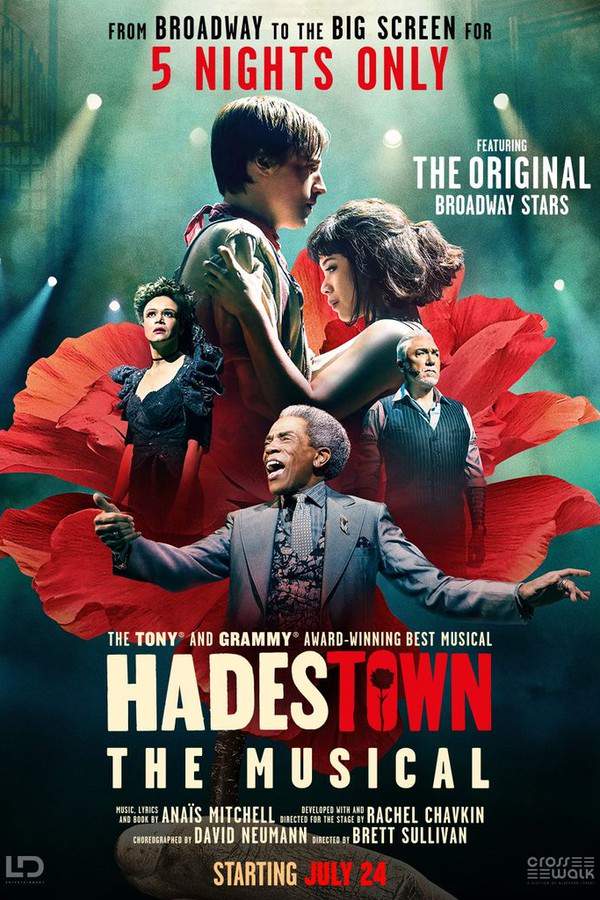
What Is Hadestown: The Musical About?
The premise of Hadestown: The Musical in 310 words, with nothing given away. The full story follows below.
Set against a bare stage where the band sits in full view and a single set piece hints at both a railway and a mythic underworld, Hadestown reimagines an ancient tale through the warm grit of modern American folk and the smoky pulse of New Orleans‑style jazz. This filmed Broadway recording captures the original company in full voice, weaving a story that feels both ritualistically old and urgently contemporary, where every lyric carries the weight of a long‑told legend being sung anew.
Hermes steps forward as the storyteller, his voice threading through the narrative like a sly guide, introducing two intertwined worlds: the sunlit realm above and the industrial, factory‑lit gloom below, ruled over by Hades and shadowed by Persephone’s fleeting returns to the warmth. Watching from the edges are the Fates, three women who dress alike and keep a quiet vigil over every twist of the tale. The stage hums with the sense of a place where seasons and labor are locked in constant, uneasy negotiation.
Into this world stumble Eurydice, hungry and wary after a life of hardship, and Orpheus, a young musician whose hopeful songs promise to turn even the grayest days into something luminous. Their first meeting glows with reckless tenderness — a paper bouquet, a whispered vow, a fragile dream of building a life together when the world offers little shelter. Their love is set against a backdrop of gathering shadows, as Persephone’s time above gives way to colder winds and the underground city’s rhythm tightens around those caught in its current.
The musical’s power lies in its atmosphere: a genre‑defying soundscape that turns mythology into something visceral and modern, where ancient sorrow and stubborn, radiant defiance share the same breath. With the band as heartbeat and the chorus moving like a tide, the stage becomes a place where hope, hunger, and haunting melody collide.
What Happens in Hadestown: The Musical?
The complete story of Hadestown: The Musical, from the first scene to the last, in 1,146 words (about 5 minutes). Spoilers throughout. Names in the text link to 1 cast member page.
Spoilers ahead
Hadestown unfolds with the whole company gathered on a bare stage, the band in full view, and the set hinting at both a railway and a mythic underworld. Hermes, André De Shields stepping forward, convinces the musicians to start the throbbing beat of the song Road to Hell and dances as he sings, weaving a storyteller’s thread through an ancient tale that feels newly urgent. He introduces the three women who loom at the back of the mind—the Fates [Bella Brown], [Allie Daniel], and [Madeline Charlemagne]—who dress alike and keep a quiet watch over every twist of fate.
From the underworld’s gloom emerges Persephone, [Amber Gray], returning from a bright break in the above world and eager for the warmth that fleeting freedom brings. Hermes reminds the audience that this is Orpheus and Eurydice’s story, a tale many know to be sad, yet the singers lean into it anyway with a listening heart and bright, stubborn resolve. Eurydice, a penniless young woman, makes a first, aching entrance, singing Any Way the Wind Blows, her voice a plea for connection amid the hardship of hunger and isolation. It’s in this moment that Orpheus, [Reeve Carney], spots her and fashions a newspaper into a makeshift bouquet, declaring in song that he will “Come Home With Me,” a vow that feels both reckless and radiant.
Orpheus is a gifted lyre-player who believes his music can turn a harsh, gray world into something luminous. Eurydice answers this vow with a wary tenderness, and the scene shifts to their budding love as she wonders, in the tender ache of Wedding Song, how they can make a life together when money is scarce and the future seems so fragile. Orpheus promises that his song will provide everything they need, whispering of blossoms blooming despite the grime and of wedding bands forged from the same hopeful melody.
Hermes returns with a sly note of familiarity, hinting that he’s heard this melody before. Orpheus confirms he knows the old tale well, and the story of Hades and Persephone unfolds through the visionary number Epic I: Hades, king of the underworld, falls for Persephone, a bright soul from above who gathers flowers in a sunlit field. When Persephone returns to the upper world, the balance of seasons changes as the cycles of life resume, and the stage fills with the sense of a world that depends on two forces in constant negotiation. Persephone, delighted by the return to light, sings Livin’ It Up on Top, relishing time above ground and the chance to celebrate. The townspeople toast her homecoming as Orpheus raises a glass to the couple, a moment of shared optimism.
Eurydice and Orpheus draw closer as they sing a duet that grows into a kiss, a moment of pure, reckless hope. Eurydice confesses that she has known only survival until now, and the two find shelter in each other’s arms as they sing All I’ve Ever Known. Yet the Fates arrive with a sobering reminder that Persephone’s time above ground is finite. Hermes guides us toward Hadestown’s shadowed railroad, and the narrative barrels toward a darker turn as Hades, [Patrick Page], descends to claim Persephone and to impose his own brutal order. The underground world is cast in cold metallic light as Way Down Hadestown is performed, tracing a factory-like chain of wages and toil that binds the workers to a harsh rhythm of labor and fear.
With Persephone back in Hadestown, Eurydice’s fear grows into the stark choice that defines the second act. She confronts the brutal reality of A Gathering Storm as the cold begins to bite and Orpheus’s hopeful song, Epic II, struggles against a cruel system. The couple’s world tightens around Eurydice’s decision to accept Hades’s offer, a moment written in the stark, bleak music of “Hey Little Songbird” as Eurydice contemplates a life where care is guaranteed, even if it means surrendering her freedom. The Fates weigh in with When the Chips Are Down, pressing her to protect herself, and Eurydice, driven by hunger, surrenders to the only option that seems to sustain life.
Orpheus, now alone, searches for Eurydice while Hermes offers a possible path through a long, arduous journey instead of a quick, doomed ride with the train. He sings Wait for Me, pouring everything he has into following the not-yet-cemented path to rescue her. In Hadestown, the city’s heartbeat—guided by Hades and Persephone—keeps a steady tempo as the workers’ chorus embraces the system’s decree in Chant. Eurydice arrives at the office, signing her contract to become a Hadestown worker, and the curtain falls on Act One with a sense of chained possibility.
Act Two opens with Persephone’s secret speakeasy, a hidden beacon beneath the surface of the factory’s grim reality, where she tends to the exhausted souls of Hadestown and sings Our Lady of Underground. Eurydice’s life among the workers deepens, and the reprise of Way Down Hadestown (Reprise) makes it clear she’s not free, despite the comfort some promises offer. She admits, in the bleakly beautiful Flowers, that the memory of real flowers—of a world beyond this place—will haunt her forever. Then Orpheus returns, tears and hope warring in his voice as he pleads, in Come Home With Me (Reprise), for Eurydice to come home and marry him.
But the Fates reveal the price of Orpheus’s request: Eurydice belongs to Hadestown now, bound by a contract. The court-like tension rises as Hades, confident in his control, declares in Papers that Eurydice’s fate rests in his hands. The workers tighten their grip, and Orpheus is dragged from the scene, blasted by a sense of injustice in a brutal, physical sense—“If it’s true,” he sings in despair, wondering if any change is possible. Persephone’s mercy prompts a bold intervention in How Long?, as she pleads with Hades to release Eurydice, to let them try the road of love again.
Back in the underworld’s heart, Orpheus’s hope is renewed for a moment as he is persuaded to try the exit route, and the chorus lifts with Wait for Me (Reprise). The long road out becomes a shared trial for the lovers, with the Fates whispering doubt as the couple advances. As they near the surface, Orpheus teeters on the verge of looking back, a fatal mistake that shatters their chance at triumph. Eurydice slips away, lowered back to Hadestown, and Orpheus is left in ruin, his heartbreak vocalized in a final, aching cry.
The world returns to its opening posture—Hermes, the band, and the entire company gradually resettle into their original positions, and the story folds back into its opening cadence, suggesting the tale’s ritual repetition rather than a neat resolution. Yet the evening closes with Persephone leading one last, hopeful chorus, We Raise Our Cups, a toast to Orpheus and to the enduring power of song to carry his memory, even when the world breaks apart.
Hadestown: The Musical Timeline: Every Key Event in Order
15 key events in the order they happen, from “Hermes opens the tale on stage” to “Final chorus and toast”. 15 events name a place, across 14 locations.
- 1
Hermes opens the tale on stage
Hermes steps out from the band and launches the audience into an old-time tale. He explains there’s a railroad track to hell and introduces the Fates watching from behind the mind. The mood is set for the gods, mortals, and a fateful love story to unfold on the Hadestown stage.
When:Opening, Act I Where:Stage
- 2
Eurydice is introduced as a struggling young woman
Eurydice is introduced as a woman who struggles to eat and survive in poverty. She sings of loneliness and hardship, while Orpheus arrives, fashions a bouquet from a newspaper, and captures her attention. He declares he will marry Eurydice and use his music to transform their world.
When:Act I Where:Street Eatery
- 3
Orpheus vows to marry Eurydice
Orpheus vows to marry her, promising a life made real by his lyre and song. He insists he can turn the grim world into a beautiful place. Eurydice worries about money, but hope flickers as their plan begins.
When:Act I Where:Eatery
- 4
Epic I: Hades and Persephone's love story
Hermes asks Orpheus to recount the old tale, and Orpheus sings Epic I about Hades falling for Persephone. He explains Persephone’s time above ground as the source of the seasons. Persephone herself then appears, reentering the world above after her time in the underworld.
When:Act I Where:On Stage / Flashback
- 5
Persephone returns and above-ground life begins
Persephone arrives happy to be free for a while and celebrates the above world. She sings Livin' It Up On Top and the townspeople join in with dancing. Orpheus makes a toast to her return, and Eurydice watches with a mix of awe and longing.
When:Act I Where:Town Square / Above Ground
- 6
Orpheus and Eurydice fall in love
Eurydice sings All I’ve Ever Known, admitting she’s known only survival. Orpheus joins and they realize their love is real, ending in a kiss. The moment changes Eurydice’s outlook on life and hope.
When:Act I Where:Alone with Orpheus
- 7
Persephone's departure and the Hadestown train
The Fates tell Persephone her time is up and she must return to the underworld. Hades arrives to claim her, and they descend as Way Down Hadestown chronicles the brutal factory and the cold economy. Eurydice becomes aware of the cold consequences of the world she’s now drawn into.
When:Act I Where:Hadestown / Underworld
- 8
Eurydice faces a life-altering choice
In the snow and hunger, Eurydice is enticed by Hades's offer—work in Hadestown in exchange for care. The Fates weigh in, urging her to secure her own safety. She ultimately signs away her freedom with Gone I’m Gone.
When:Act I Where:Hadestown – outside Hades's office
- 9
Orpheus learns a longer route to Hadestown
Hermes reveals a longer, harder path to reach Eurydice in Hadestown. Orpheus sings Wait For Me as he begins the dangerous journey to find her. A glimmer of hope returns as he accepts the new plan.
When:Act I Where:The road below
- 10
Eurydice arrives in Hadestown and signs a contract
Eurydice reaches Hadestown and signs the contract to become a worker in the underground city. She discovers the new, oppressive reality of the underworld economy. The act closes with this grim setup.
When:End of Act I Where:Hadestown—Hades's office / entrance
Show the other 5 events of Hadestown: The Musical Hide the last 5 events
- 11
Act II opens: Persephone's Our Lady of Underground
Persephone runs a hidden speakeasy for Hadestown’s exhausted citizens. The new underground life is visible, and the workers are depicted as tired yet determined. Eurydice begins to toil in the factory, joining a chorus of the Hadestown workers.
When:Act II Where:Hadestown – Our Lady of Underground / factory floor
- 12
Orpheus reunites with Eurydice and challenges fate
Orpheus arrives in Hadestown and finds Eurydice, promising to bring her home. The Fates remind him of the contract and warn that nothing changes. Persephone’s subtle intervention adds a glimmer of hope to their plan.
When:Act II Where:Hadestown
- 13
Papers and the conditional escape
Hades reveals Eurydice’s signed contract in the song Papers, making Orpheus’s plan to leave with her seem impossible. He is warned that attempting an escape could backfire and spark a workers’ rebellion. The Fates press him with the line Nothing Changes, casting doubt on their hope.
When:Act II Where:Hades's office / Hadestown
- 14
The escape and its tragic turn
Orpheus must lead Eurydice out with him in front and not look back at her. They begin the long walk toward the light as suspense builds and Hermes guides their path. In the final moments, Orpheus looks back and Eurydice slips away back into Hadestown.
When:Act II climax Where:The road out of Hadestown
- 15
Final chorus and toast
The troupe returns to their places and the story loops back toward the start, a reminder that the tale repeats. Persephone leads a final song, We Raise Our Cups, toasting Orpheus and offering a small note of hope within tragedy. The audience is left with the cycle renewed.
When:Ending Where:Stage
Who Are the Main Characters in Hadestown: The Musical?
9 characters, among them Orpheus (Reeve Carney), Eurydice (Eva Noblezada) and Hermes (André De Shields): who each one is and the part they play in the story. Every profile links to the actor’s page.
-

Orpheus (Reeve Carney)
Played by Reeve Carney
A gifted, hopeful musician who believes his lyre can transform the world. He falls in love with Eurydice and promises to bring her home, using song to try to overcome poverty and despair. He must navigate doubt and danger as he follows a treacherous path to rescue Eurydice.
- 🎵 Musician
- 💫 Hopeful
- 🗝️ Determined
- E(
Eurydice (Eva Noblezada)
Played by Eva Noblezada
A young woman struggling to survive in poverty who finds herself falling for Orpheus. She longs for a better life but is forced to weigh love against hunger. Her decision to sign with Hades reveals the brutal trade-offs between security and freedom.
- 🌹 Survivor
- 💬 Cautious
- 🎭 Complex
- H(
Hermes (André De Shields)
Played by André De Shields
Messenger of the gods and narrator guiding the story, offering sly commentary and bridging mortal and divine perspectives. He introduces the tale and hints at the cyclical nature of Hadestown. His presence keeps the audience aware that the tale is both ancient and ongoing.
- 🗣️ Narrator
- 🎩 Trickster
- 🧭 Guide
- H(
Hades (Patrick Page)
Played by Patrick Page
Ruler of the underworld, stern and calculating. He maintains Hadestown through power, enforcing obedience with a ruthless sense of order. His contract with Eurydice and the threat he poses underline the limits of resistance against a system built on control.
- 👁️ Authority
- ⚖️ Control
- 💰 Power
- P(
Persephone (Amber Gray)
Played by Amber Gray
Goddess of spring who alternates between the above world and the underworld. Her return brings light and a fragile sense of renewal, while her secret speakeasy in Hadestown reveals a hidden kind of resistance. Her relationship with Hades shapes the seasonal cycle that drives the plot.
- 🌼 Seasons
- 🗝️ Secrets
- 🎭 Complexity
- FI
Fate I (Bella Brown)
Played by Bella Brown
One of the three Fates who appear as a chorus of destiny, watching and steering the events of the story. They manipulate outcomes with a knowing tone, blurring the line between fate and human choice. Their presence underscores how individual actions fit into a larger web of inevitability.
- 🧭 Destiny
- 🎭 Chorus
- 🗝️ Fate
- FI
Fate II (Madeline Charlemagne)
Played by Madeline Charlemagne
Another Fate weaving threads of destiny with a calm, observant stance. She helps set the stage for pivotal decisions while reminding the audience that outcomes are influenced by chance as much as by intention. Her reflections deepen the sense that the world is guided by unseen forces.
- 🧭 Destiny
- 🎭 Chorus
- 🗝️ Fate
- FI
Fate III (Allie Daniel)
Played by Allie Daniel
The third Fate who completes the trio of destinies, signaling the omnipresence of fate in every choice. She participates in the commentary on risk, hope, and consequence, and reinforces the idea that the future is shaped by small acts.
- 🧭 Destiny
- 🎭 Chorus
- 🗝️ Fate
- W(
Worker (Christopher Short)
Played by Christopher Short
A representative of Hadestown's working class, one of many unnamed laborers who endure brutal conditions. The Worker embodies resilience and the collective struggle of those who keep the machine running. He reflects the human cost behind the city’s gleaming surface.
- 🏭 Worker
- 🧭 Collective
- 🎭 Ensemble
Where and When Is Hadestown: The Musical Set?
Hadestown: The Musical is set in Hadestown and Above World. Here is why the place matters to the story.
When
The story unfolds in a timeless, mythic present that reimagines the Orpheus and Eurydice tale. It cycles between the underground Hadestown and the brighter above world, tied to Persephone's seasonal movements. The narrative uses a looping structure that suggests the tragedy might unfold differently if someone chooses differently.
Where
Hadestown, Above World
Hadestown is an underworld city ruled by Hades where workers toil in a sunless factory. The above world exists as a bright counterpoint, with Persephone's seasonal return bringing light and life. The setting blends ancient myth with a modern stage aesthetic, highlighting the tension between dream and harsh reality.
- 🌍 Dual Worlds
- 🏭 Industrial Hadestown
- 🎭 Mythic Setting
- 🎶 Musical Theater Locale
What Are the Themes of Hadestown: The Musical?
3 ideas the story keeps returning to, among them Love, Oppression and Music.
-
01
Love
Orpheus and Eurydice's romance drives the plot and motivates the characters' choices. Their bond offers hope in a brutal world, showing how love can inspire risk and resilience. Yet trust and sacrifice collide with fate and necessity, testing whether love can overcome systemic power and hunger.
-
02
Oppression
Hadestown portrays a harsh underworld where workers are exploited to sustain the surface world. The factory setting and songs like 'Why We Build the Wall' illustrate control, inequality, and the costs of obedience. The Fates emphasize how power can shape destinies at the expense of human agency.
-
03
Music
Music is the narrative engine, turning songs into both storytelling and resistance. Orpheus's lyre and Persephone's songs awaken hope and challenge oppression. The musical form foregrounds emotional arcs while signaling high-stakes political consequences, making song a weapon against despair.
What Kind of Film Is Hadestown: The Musical?
Bittersweet in tone, with variable pacing and a moderate story, going by the plot summary.
- Tone
- Bittersweet
- Pacing
- Variable
- Story
- Moderate
- Intensity
- High
- Ending
- Bittersweet
A sweeping folk and jazz musical retelling of the Orpheus myth that moves from radiant hope to devastating loss, blending warm celebration with cold industrial shadows in a deeply emotional theatrical experience.
- mythic
- melancholic
- folk infused
- ritualistic
- industrial
- romantic tragedy
- greek mythology
- love and loss
- poverty
- industrialization
Content notes: poverty, forced labor themes, inescapable fate, emotional manipulation, loss of loved one.
Quiz
How well do you remember Hadestown: The Musical? Test yourself on the story.
