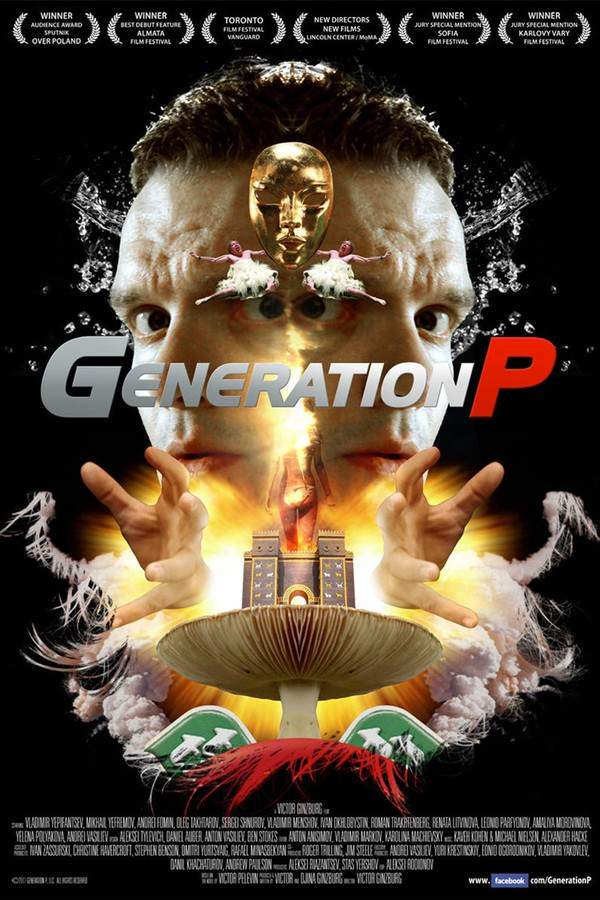
Generation P 2012

Directed by

Victor Ginzburg
Made by

New World Distribution
Where to Watch Generation P
See current US streaming, rental, and purchase options for Generation P (2012) via JustWatch.

Fawesome
HD
Tubi TV
SD
Amazon Video
SD
Google Play Movies
SD
YouTube
SD Streaming availability powered by 
Generation P Plot Summary
Read the complete plot summary and ending explained for Generation P (2012). From turning points to emotional moments, uncover what really happened and why it matters.
The narrative unfolds in the chaotic backdrop of Moscow during the Yeltsin era in the early 1990s, a time characterized by overwhelming disorder and corruption. The story revolves around Babylen Tatarsky, a graduate student and aspiring poet, who finds himself homeless following the collapse of the Soviet Union. Faced with this new reality, he discovers his unexpected vocation in creating Russian versions of Western advertisements. While his career as a copywriter flourishes, Tatarsky grapples with the increasing materialism and self-indulgence that defines contemporary culture. His journey is not merely about professional success; it is a profound quest for meaning in a society that seems to have lost its way.
As he delves deeper into this new world, Tatarsky begins to notice unusual coincidences that point to patterns, suggesting a deeper significance amidst the confusion of modern life. His intrigue leads him to explore historical contexts, where he finds initial insights through the lens of Mesopotamian religious practices. Enhanced by the use of hallucinogenic substances such as mushrooms, cocaine, and vodka, his search for answers takes on a surreal dimension. Moreover, Tatarsky’s discovery journey is intriguingly embellished when he uses a ouija board, allegedly channeling Che Guevara, who comments on various themes including identity, consumerism, and the pervasive influence of television.
In his pursuit of understanding, Tatarsky begins to uncover profound revelations, such as the realization that much of what is presented as reality on television and in politics is merely a fabrication. However, the ultimate truth behind these constructs eludes him. As he ascends to the pinnacle of the advertising world, he learns that his colleagues serve an enigmatic entity: the goddess Ishtar, whose existence is intertwined with the vast array of advertising imagery. The principal task of their firm is to maintain vigilance against Ishtar’s adversary, the dog Phukkup, whose awakening threatens to unleash chaos and turmoil.
After a significant ritual sacrifice, Tatarsky inadvertently becomes Ishtar’s new regent, assuming the role of her 3-D counterpart and bridegroom. The summation of Tatarsky’s transformation is poignant; in the final chapter, his digital double manifests as a dominant force on Russian television. Ironically, Tatarsky—who initially sought to pierce through the veil of falsehoods perpetuated by media to find a genuine reality—ultimately metamorphoses into an illusion himself.
In the epilogue, it is revealed that the “P” in Generation P signifies “Generation Pizdets,” a term that translates roughly to “Generation Screwed,” encapsulating the disillusionment of a generation caught in the grip of commercialism and disarray.
Generation P Timeline
Follow the complete movie timeline of Generation P (2012) with every major event in chronological order. Great for understanding complex plots and story progression.
Babylen's Transformation
Following the fall of the Soviet Union, Babylen Tatarsky, a graduate student and poet, finds himself homeless on the streets of Moscow. This drastic change in his life sets him on a journey of self-discovery and adaptation in a chaotic post-Soviet society.
The Rise of a Copywriter
As Tatarsky navigates his new reality, he discovers his talent for creating Russian versions of Western advertisements. His success as a copywriter marks a turning point, introducing him to a world defined by consumerism and materialism.
Seeking Meaning
Despite his professional achievements, Tatarsky grapples with existential questions about meaning in a culture overwhelmed by self-indulgence. He begins to explore the underlying forces that shape desires and beliefs within this new societal framework.
Patterns in Chaos
During his quest for understanding, Tatarsky becomes attuned to coincidences that hint at hidden patterns in life. This realization prompts him to search for a deeper truth within the chaos surrounding him.
Influence of Mesopotamian Practices
Tatarsky's journey takes an intriguing turn when he reads about Mesopotamian religious practices, leading him to contemplate the connection between ancient beliefs and contemporary life. This newfound knowledge shifts his perspective on spirituality and existence.
Altered States of Consciousness
Tatarsky enhances his quest with the consumption of hallucinogenic mushrooms, cocaine, and vodka. This indulgence helps him access altered states of consciousness, further fueling his search for meaning in a fractured reality.
Messages from the Beyond
Using a ouija board, Tatarsky channels messages from Che Guevara, who pens a treatise on identity, consumerism, and the impact of television. This supernatural encounter deepens Tatarsky's understanding of the forces at play in modern society.
Revelations about Politics
As Tatarsky delves deeper into the world of advertising and media, he uncovers unsettling truths about politics and reality. He realizes that the events portrayed on television are fabrications designed to manipulate public perception.
Corporate Pyramid Climb
Tatarsky ascends to the pinnacle of the advertising industry, only to discover the shocking connection between his firm and the goddess Ishtar. This revelation reveals the eerie underbelly of the corporate world steeped in myth and power.
Confronting Phukkup
In a dramatic turn of events, Tatarsky learns that his firm's primary aim is to prevent the awakening of Ishtar's enemy, the canine Phukkup. The potential chaos and destruction that could ensue fuels his inner conflict regarding his role in this dark narrative.
Ritual Sacrifice
Tatarsky ultimately participates in a ritual sacrifice, solidifying his position within the mythology of advertising. This event seals his fate as he becomes intertwined with Ishtar's realm, blurring the lines between reality and illusion.
Becoming Ishtar's Regent
After the ritual, Tatarsky is elevated to the role of Ishtar's regent, embodying her presence in a digital form. This transformation signifies his complete immersion into the world of advertising and illusion, stepping away from his authentic self.
Ubiquitous Television Presence
In the concluding chapter, Tatarsky's electronic double permeates Russian television, symbolizing the persistent influence of media on public consciousness. This shift marks a poignant irony as he had once sought the unmediated reality beyond the illusion.
Understanding Generation P
The epilogue reveals that the 'P' in Generation P signifies 'Generation Pizdets,' highlighting the disillusionment felt by many in the post-Soviet era. This commentary underscores the film's critique of modern societal values and the impact of consumer culture.
Generation P Characters
Explore all characters from Generation P (2012). Get detailed profiles with their roles, arcs, and key relationships explained.
Babylen Tatarsky
Babylen Tatarsky is a graduate student and poet who becomes a copywriter amid the chaos of post-Soviet Moscow. His character embodies the struggle to find meaning in a society overwhelmed by materialism and superficiality, often resorting to escapism through drugs and mystical practices. Tatarsky's journey reflects his quest for clarity and truth in a landscape where reality blurs with illusion.
Generation P Settings
Learn where and when Generation P (2012) takes place. Explore the film’s settings, era, and how they shape the narrative.
Time period
early 1990s
The early 1990s in Russia were characterized by a tumultuous upheaval following the dissolution of the Soviet Union. This period saw rapid political and economic changes, resulting in widespread uncertainty and a search for identity among the populace. The era was notably marked by rampant consumerism and a shift towards materialism, which deeply influenced individual and collective consciousness.
Location
Moscow
Moscow, the capital city of Russia, is a vibrant metropolis known for its rich history and cultural significance. During the Yeltsin years in the early 1990s, it was a bustling hub of change, marked by the transition from communism to a market economy. The city's landscape captured the chaos and corruption of the time, providing a backdrop for the protagonist's transformative journey.
Generation P Themes
Discover the main themes in Generation P (2012). Analyze the deeper meanings, emotional layers, and social commentary behind the film.
💭
Identity
The search for identity is a central theme in 'Generation P,' as the protagonist grapples with the implications of a rapidly changing society. This exploration is heightened by the contrast between personal aspiration and the influence of external forces like media and advertising. The quest for meaning amid chaos reflects a broader commentary on self-identity in the post-Soviet landscape.
🛒
Consumerism
Consumerism underpins the narrative of 'Generation P,' highlighting how the newfound freedom in post-Soviet Russia led to an overwhelming focus on material possessions. The protagonist's journey into the world of advertising sheds light on how these values shape societal interactions and beliefs. This theme critiques the illusion of choice in a commercialized culture driven by profit and superficiality.
🌌
Illusion vs Reality
The dichotomy of illusion versus reality emerges as a significant theme, as the protagonist strives to uncover deeper truths in a world dominated by fabricated images. The transition from seeking authentic experiences to becoming a product of the very system he critiques illustrates the pervasive nature of deception in society. The conclusion raises questions about the nature of existence in a media-saturated environment.

Coming soon on iOS and Android
The Plot Explained Mobile App
From blockbusters to hidden gems — dive into movie stories anytime, anywhere. Save your favorites, discover plots faster, and never miss a twist again.
Sign up to be the first to know when we launch. Your email stays private — always.
Explore the mobile appGeneration P Spoiler-Free Summary
Discover the spoiler-free summary of Generation P (2012). Get a concise overview without any spoilers.
In the fever‑dream swirl of early‑1990s Moscow, a city still reeling from the collapse of an empire, the world of Babylen Tatarsky feels both wildly liberated and terrifyingly uncertain. Neon billboards clash with crumbling Soviet architecture, while street‑level barter and booming consumerism fight for dominance. The film captures this volatile backdrop with a tone that is simultaneously sardonic and melancholy, painting a portrait of a society that has swapped ideology for excess, and where every advertisement becomes a new prayer to an unknown god of profit.
Babylen Tatarsky arrives on the scene as a disillusioned poetry graduate, drifting through the streets with his verses as his only compass. When the desperate need for survival pushes him into the burgeoning advertising agencies sprouting across the city, his talent for language finds an unexpected outlet. The narrative follows his tentative steps into a world where slogans replace sonnets, and the line between artistic expression and commercial manipulation blurs into a darkly comic dance. His internal conflict—seeking meaning amid the glittering façades of consumer culture—drives the film’s exploration of ambition and identity.
The movie’s style is a kaleidoscopic blend of gritty realism and surreal hyperbole, mirroring the chaotic energy of a nation reinventing itself. With sharp humor laced through every scene and a lingering sense of tragedy beneath the surface, the story invites viewers to question what is genuine in a landscape built on illusion. As Tatarsky rises through the ranks of advertising, he encounters a cast of eccentric colleagues and mentors, each embodying the shifting values of a generation caught between the old world’s decay and the seductive promise of a brand‑driven future. The atmosphere remains charged with curiosity, hinting at deeper mysteries without revealing their outcomes, leaving the audience eager to see how this poet‑turned‑copywriter will navigate the ever‑changing tapestry of post‑Soviet Russia.
Movies with Similar Twists and Themes
Uncover films that echo the narrative beats, emotional arcs, or dramatic twists of the one you're exploring. These recommendations are handpicked based on story depth, thematic resonance, and spoiler-worthy moments — perfect for fans who crave more of the same intrigue.



Featured on this page

What's After the Movie?
Not sure whether to stay after the credits? Find out!
Check out our other apps:

SAT Sphere
Build confidence for the Digital SAT.

Mori Atlas
Discover wild places worth protecting.

Luntero
Search smarter for a home in Amsterdam.

Plot Explained
Unravel movie endings and hidden clues.

Pokechamp
Dive into Pokémon data and battle logic.

Driving Theory
Get ready for your European theory test.

Movie Dust
Plan your next cinema trip with ease.

Musemap
Find art and culture as you travel.

Selkobase
Compare credentials before committing.

Local Manual
Turn an unfamiliar country into practical next steps.

Lernavi
Compare school systems before your next move.

GymRoam
Find a workout stop wherever your plans take you.
Explore Our Movie Platform
New Movie Releases (2026)
Famous Movie Actors
Top Film Production Studios
Movie Plot Summaries & Endings
Major Movie Awards & Winners
Best Concert Films & Music Documentaries
Movie Collections and Curated Lists
© 2026 What's After the Movie. All rights reserved.
Privacy Policy