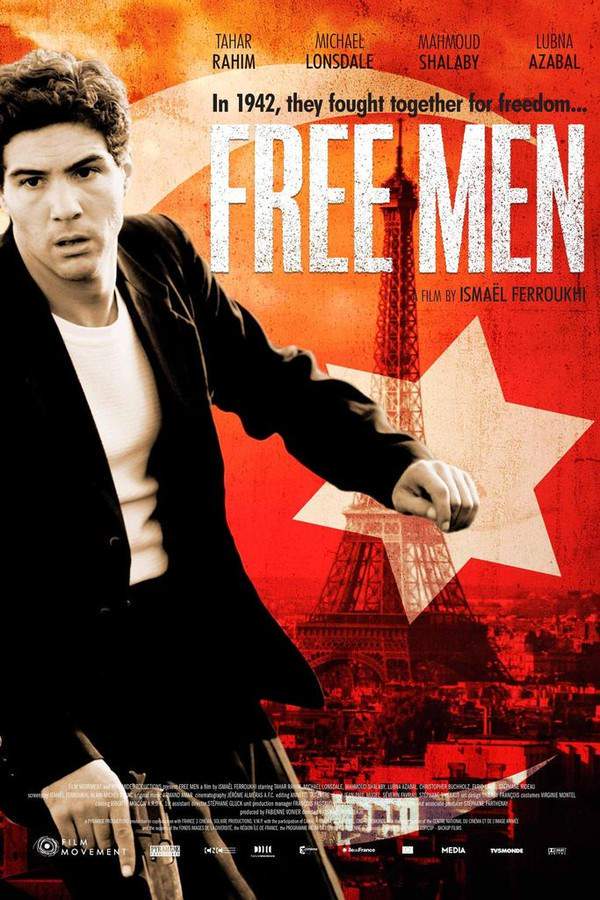
Free Men 2012


Directed by

Ismaël Ferroukhi
Made by

Film Movement
Where to Watch Free Men
See current US streaming, rental, and purchase options for Free Men (2012) via JustWatch.












Free Men Plot Summary
Read the complete plot summary and ending explained for Free Men (2012). From turning points to emotional moments, uncover what really happened and why it matters.
In occupied Paris, a young unemployed Algerian named Younes Ben Daoud scrapes by on the black market, navigating a city gripped by fear and scarcity. His precarious life is upended when he is arrested by the police, and to dodge prison he agrees to spy on the Paris Mosque. The authorities whisper that the mosque’s leadership, including its rector Si Kaddour Benghabrit, may be aiding resistance fighters and protecting North African Jews by issuing Muslim birth certificates, a charge that places Younes at a dangerous crossroads between survival and conscience.
Inside the mosque, Younes forms an unexpected bond with the Algerian singer Salim Halali. What begins as a tense arrangement slowly deepens into a genuine friendship, built on shared history, culture, and trust. As Younes grows closer to Salim, he discovers that Salim is Jewish, and he witnesses the compassionate work carried out by the mosque community. This realization becomes a catalyst for change: Younes chooses to stop feeding information to the police and starts to see the people around him in a new light. The mosque, far from being a mere religious space, becomes a shelter for European Jews seeking refuge in Paris, offering safety at a time when Nazi roundups threaten their lives.
With the truth dawning more clearly, Younes is drawn into the broader network of Algerians who are part of the French Resistance. They are quietly organizing, planning, and preparing for a future that will see Algerians claim their own independence from French colonial rule after the war. Through these clandestine connections, he is pushed to confront hard truths about loyalty, courage, and the cost of resistance. The journey reshapes him from a politically indifferent immigrant into someone capable of decisive action, driven by solidarity and a growing commitment to justice.
As the narrative unfolds, the threads of personal transformation and collective struggle intertwine, painting a portrait of a man who chooses to risk everything for a cause larger than himself. Younes’s evolution—from a man trying to survive to a fighter for freedom—embodies themes of awakening, humanity, and the profound impact of communities that stand together in the darkest hours. The story underscores how acts of quiet courage within intimate spaces can ripple outward, challenging oppression and helping to bend the arc of history toward hope.
Free Men Timeline
Follow the complete movie timeline of Free Men (2012) with every major event in chronological order. Great for understanding complex plots and story progression.
Younes enters the shadow economy in occupied Paris
In occupied Paris, Younes Ben Daoud, an unemployed Algerian, makes a living on the black market. His activities eventually draw police attention, and he is arrested. To avoid prison, he agrees to spy on the Paris Mosque for the authorities.
Undercover assignment begins at the Paris Mosque
Under orders to surveil the mosque, Younes starts observing its daily operations and people. He gathers information while trying to remain inconspicuous. The assignment exposes him to a hidden world inside the religious sanctuary.
Police suspect the mosque is aiding fighters and protecting Jews
The police believe the mosque leadership, including its rector Si Kaddour Benghabrit, is helping resistance fighters and protecting North African Jews. They suspect the issuance of Muslim birth certificates to Jewish refugees. This tension makes the mosque a focal point of suspicion and danger.
Younes befriends Salim Halali at the mosque
While at the mosque, Younes meets Salim Halali, an Algerian singer who is secretly Jewish. They strike up a friendship that begins to transcend their differences. Salim's presence broadens Younes's view of who the mosque serves and whom it protects.
Discovery of Salim's Jewish identity and reassessment
Younes discovers Salim's Jewish identity and witnesses the mosque's humanitarian work firsthand. This revelation challenges his collaboration with the police. He begins to rethink his loyalties and the value of protecting vulnerable people.
Mosque shelters European Jews during Nazi roundups
The mosque opens its doors to shelter European Jews seeking refuge in Paris, providing a safe haven during the Nazi roundups. Its courtyards, rooms, and networks become a living shield for vulnerable people. The acts of protection reveal the mosque's quiet resistance to oppression.
Younes joins Algerian resistance circles
Younes becomes involved with Algerians who are part of the French Resistance, aligning with their cause. He starts contributing to clandestine activities and information sharing. The experience marks a turning point in his political awareness.
Move toward independence after the war
Beyond immediate shelter and defense, the Algerian resistance group Younes associates with begins planning for independence after the war. He sees a new horizon where colonial rule might end. The fighting mindset expands from wartime defense to national self-determination.
Leadership of Si Kaddour Benghabrit and the mosque
The mosque leadership, including rector Si Kaddour Benghabrit, plays a central role in sheltering refugees and protecting people. The film portrays their courage and moral resolve under occupation. Their leadership becomes a symbol of principled resistance.
Birth certificates as a tool of protection
As part of its protective work, the mosque helps issue Muslim birth certificates to North African Jews, easing their identification under oppressive regimes. This bureaucratic shield allows some to avoid persecution and find refuge. The document network illustrates the quiet ingenuity of resistance.
Cross-cultural bonds strengthen the resistance
Younes's growing bond with Salim and his collaboration with resistance members demonstrates how alliances across cultural lines can strengthen a common cause. He learns empathy and strategic restraint through these relationships. The mosque acts as a bridge between oppressed communities.
Younes fully joins the resistance
Gradually Younes morphs from a politically ignorant immigrant into a fully fledged resistance fighter. He commits to armed and strategic resistance against colonial rule and Nazi oppression. The transformation culminates in a new sense of purpose tied to liberation.
Free Men Characters
Explore all characters from Free Men (2012). Get detailed profiles with their roles, arcs, and key relationships explained.
Younes Ben Daoud
A young unemployed Algerian in occupied Paris who starts on the wrong side of the law through black-market activity and police recruitment. He is politically ignorant at first, but his experiences at the mosque and with its inhabitants push him toward the resistance. He discovers Salim is Jewish and, witnessing the mosque’s protection of Jews and fighters, he abandons collaboration and becomes a resistance fighter.
Si Kaddour Benghabrit
The rector of the Paris Mosque who leads with a quiet, strategic leadership; He extends hospitality to shelter European Jews and supports resistance fighters. He embodies leadership, strategy, and quiet courage, using the mosque’s resources to protect vulnerable communities and aid the resistance.
Salim Halali
An Algerian singer who becomes a friend to Younes. He is revealed to be Jewish, and his presence highlights the diverse, cross-community solidarity that underpins the sanctuary network. His identity and music symbolize cultural bridges amid oppression.
Free Men Settings
Learn where and when Free Men (2012) takes place. Explore the film’s settings, era, and how they shape the narrative.
Time period
1940s
The film unfolds in the 1940s during the German occupation of Paris, when fear, curfews, and police raids shape daily life. The narrative shows how residents improvise shelter and solidarity in the face of roundups. It hints at the postwar rise of anti-colonial movements, including the Algerian struggle that follows the war.
Location
Paris, France, Great Mosque of Paris
Occupied Paris forms the backdrop during the German occupation. The Great Mosque of Paris serves as a covert sanctuary sheltering European Jews and supporting resistance activities. The city’s streets and the mosque become a clandestine hub where allies from different communities converge.
Free Men Themes
Discover the main themes in Free Men (2012). Analyze the deeper meanings, emotional layers, and social commentary behind the film.
🗡️
Resistance
The story tracks a shift from political ignorance to active defiance. Younes is drawn into the resistance through his work around the mosque and his growing awareness of the occupation's human cost. Small, risky acts of courage reveal the power of solidarity and personal commitment against oppression. The mosque's protection of fighters and refugees becomes a catalyst for his transformation.
🤝
Identity
Identity is tested as communities collide and collaborate under threat. Younes’s alliance with Algerians and his discovery of Salim’s Jewish background force him to reconsider loyalties. The film shows how shared danger can forge unlikely bonds and redefine belonging.
🕌
Refuge
The mosque is depicted as a beacon of shelter amid persecution. Its doors, birth certificates, and resources demonstrate humanitarian courage that transcends borders. Through this sanctuary, diverse communities unite in defense of life and dignity.

Coming soon on iOS and Android
The Plot Explained Mobile App
From blockbusters to hidden gems — dive into movie stories anytime, anywhere. Save your favorites, discover plots faster, and never miss a twist again.
Sign up to be the first to know when we launch. Your email stays private — always.
Explore the mobile appFree Men Spoiler-Free Summary
Discover the spoiler-free summary of Free Men (2012). Get a concise overview without any spoilers.
In the winter of 1942, Paris lives under a suffocating shadow, its grand boulevards layered with the quiet menace of occupation. The city hums with whispered deals on dimly lit streets, while the ever‑present gaze of the authorities turns even ordinary survival into an act of quiet defiance. Amidst this tense backdrop, cultural neighborhoods pulse with a mix of hope and apprehension, their narrow alleys echoing with languages and prayers that refuse to be silenced.
Younes Ben Daoud, a young Algerian thrust into the margins of the capital, ekes out a living on the black market. His precarious existence is shattered when he is apprehended by the police, and a stark bargain is laid before him: monitor the Paris Mosque, long rumored to be a sanctuary for resistance, or endure imprisonment. The offer pulls him into a world where loyalty is measured not only by survival but also by the secrets one is asked to keep.
Within the marble‑lined walls of the mosque, Salim Halali captivates patrons with a voice that seems to lift the very air. Their friendship blossoms, rooted in shared exile and the longing for belonging, while the mosque’s rector, Si Kaddour Benghabrit, presides over a space that seems to hold more than prayers. The atmosphere glitters with quiet bravery, and the subtle exchange between Younes and Salim hints at connections that cross faith and heritage, suggesting alliances that could reshape destinies.
The film balances gritty realism with lyrical moments, letting the oppressive reality of occupied Paris coexist with fleeting instances of beauty and solidarity. As Younes navigates the delicate line between collaboration and conscience, the story invites viewers to wonder how far a man will go when the lines between survival, identity, and resistance begin to blur.
Movies with Similar Twists and Themes
Uncover films that echo the narrative beats, emotional arcs, or dramatic twists of the one you're exploring. These recommendations are handpicked based on story depth, thematic resonance, and spoiler-worthy moments — perfect for fans who crave more of the same intrigue.



Featured on this page

What's After the Movie?
Not sure whether to stay after the credits? Find out!
Check out our other apps:

SAT Sphere
Build confidence for the Digital SAT.

Mori Atlas
Discover wild places worth protecting.

Luntero
Search smarter for a home in Amsterdam.

Plot Explained
Unravel movie endings and hidden clues.

Pokechamp
Dive into Pokémon data and battle logic.

Driving Theory
Get ready for your European theory test.

Movie Dust
Plan your next cinema trip with ease.

Musemap
Find art and culture as you travel.

Selkobase
Compare credentials before committing.

Local Manual
Turn an unfamiliar country into practical next steps.

Lernavi
Compare school systems before your next move.

GymRoam
Find a workout stop wherever your plans take you.
Explore Our Movie Platform
New Movie Releases (2026)
Famous Movie Actors
Top Film Production Studios
Movie Plot Summaries & Endings
Major Movie Awards & Winners
Best Concert Films & Music Documentaries
Movie Collections and Curated Lists
© 2026 What's After the Movie. All rights reserved.
Privacy Policy