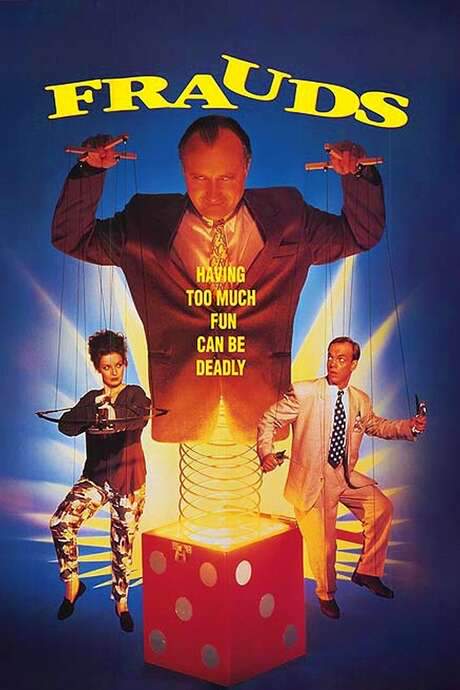
Frauds 1993

Directed by

Stephan Elliott

Frauds Plot Summary
Read the complete plot summary and ending explained for Frauds (1993). From turning points to emotional moments, uncover what really happened and why it matters.
Roland Copping, Phil Collins, is a boy who greets his eighth birthday with a small, hopeful ceremony. His mother gives him a pair of dice once belonging to his father, tokens of luck and memory that will come to drive his life. Roland and his brother Matthew craft a makeshift raft, and Roland, after rolling the dice, urges Matthew to climb aboard. They push the raft into the river, and the journey ends in tragedy as Matthew leaps onto an overhead crane, the raft careening toward danger. Their mother rushes to intervene, but in a fateful moment she reaches too late, and Matthew slips from her grasp, vanishing down the river over the waterfall.
Years pass, and Roland has grown into a wily insurance investigator and a relentless practical joker in the town of Andreas. Jonathan Wheats, Hugo Weaving, and his wife Beth Wheats, Josephine Byrnes, a kindergarten teacher, host a lively party with their friends Margaret, Helen O’Connor, and Michael. As a gift, Michael Allen, Peter Mochrie, passes along two tickets to La Bohème, a gesture that seems harmless enough at first.
The following evening, Jonathan is away at the opera house while Beth returns home to a scene of chaos: the house has been ransacked, silver Georgian cutlery missing, and a burglar fleeing with a knife in hand. In a frightening moment of self-defense, Beth fires a crossbow, striking and killing the intruder. When the mask comes off, the dead man is revealed to be Michael, who was attempting a prank gone wrong. In the courtroom, the judge, Vincent Ball, rules the death an accident, and Beth is acquitted for self-defense.
Six months later, the Wheats file a phony compensation claim for their stolen cutlery, hoping to cash in on the tragedy. Roland visits the Wheats’ home to question Jonathan about Michael’s death, and the truth begins to surface: Michael had an accomplice waiting in a getaway car, and when Michael died, the accomplice fled. As Roland leaves, Jonathan asks if they will see him again, and Roland flips one of the dice to imply that their paths will cross again. He even pulls back a curtain to reveal Roland standing across the street, still flipping the dice and watching.
A month later, Roland returns to interview Beth during a game of Twister, his constant rolling of the dice proving a distracting, unnerving presence. He explains the dice belong to his war-hero father and hint at a special, almost magical quality. When Jonathan presses him for relevance to the case, Roland again flips the dice and chooses to continue the conversation tomorrow. Before leaving, he returns a portion of the stolen cutlery and vows to resume the inquiry “tomorrow,” insisting that new evidence requires a fresh search.
The next morning, Roland inspects the claim and, in a chilling reveal, accuses Jonathan of being his partner. The Wheats throw him out in a blaze of anger, but Roland hurls a fork as evidence that the hiding spot—behind a Battle of Austerlitz model in a shed—contains the truth. The fork seems to vanish from sight, prompting Jonathan and Beth to search deeper. When they finally pry open the back of the closet door, a hidden safe containing the stolen cutlery is revealed.
Jonathan confesses he stole the cutlery because Beth has spent much of her life overwhelmed by bills and debt, and the couple decides to pay Roland to stay quiet. But Roland turns the tables with a new form of blackmail, subjecting them to childish pranks designed to humiliate and destabilize them—sending an insurance agent to inspect their car, mailing the crossbow, and decorating their Christmas tree with the stolen utensils and the words “steal me.” The prank escalates to the point where Beth collapses with disgust as an onlooker gapes at the chaos.
Meanwhile, Jonathan locates Roland’s secret hideout, a hidden funhouse-like lair reached through a concealed passage. Traps and a rogue goose named Cesar emerge as Jonathan tries to escape, and he eventually breaks free to pursue Roland to Glendale Clinic, a mental asylum where his brother Matthew has somehow survived the waterfall but is left vegetative and quadriplegic.
Seeing a new opportunity to break the siege, Jonathan asks for two days to win Roland at his game. Beth, worn down, is ready to call the police, but Roland’s latest demand leads them to offer him their car in exchange for silence. At Roland’s birthday party, Beth finally surrenders everything she owns to keep Roland away, but she secretly steals his dice. As she phones Jonathan from a public booth, Roland kidnaps Beth’s ally, and the chase intensifies.
Roland arranges a final confrontation at his own home. He phones Jonathan to lure him in, threatening to plunge Beth down a slide toward a spinning sawblade if he dares to intervene. Jonathan counteracts by revealing a grim gambit: he has kidnapped Matthew and tied him above a pool; if Jonathan dials a certain number, Matthew will be dropped into the water. The revelation shocks Roland, who retorts that his brother is a vulnerable, silent passenger in a life of danger. But Jonathan reveals that Matthew is not vegetative after all—that he can speak and has revealed the truth about their father’s rejection and the injuries Roland inflicted in an attempt to entertain his brother.
Roland gambles that a roll of the dice can set them free, and he rolls. The die lands on one of the “half” numbers, and the balance of power shifts. A brutal fight ensues as Roland activates the final device, sending Beth down the slide, while the sawblade retracts just in time to spare her. In a last attempt to control the situation, he lowers Matthew into the pool, but the plan backfires: the ducky-like display ends with Roland leaping into the pool to rescue Matthew, only to discover that Matthew’s head, when removed, is revealed to be a convincing replica. Roland screams in fury, his triumph undone.
Beth, desperate and finally resolute, calls the police while Jonathan helps Roland from the deadly waters. As they stand by the pool, the sight of “Matthew’s” floating head ignites a bizarre, unsettling laughter that spreads to Beth and Jonathan. The sirens grow louder in the distance, signaling the end of Roland’s game and the beginning of consequences for the man who turned a family’s tragedy into a dangerous, relentless chase.
Frauds Timeline
Follow the complete movie timeline of Frauds (1993) with every major event in chronological order. Great for understanding complex plots and story progression.
Roland's 8th Birthday and the Fateful Dice
On his eighth birthday, Roland receives a pair of dice from his war-hero father. He and his brother Matthew build a raft and send it down the river, but danger arrives when the raft approaches a waterfall. Roland's mother tries to intervene as Matthew climbs an overhead crane and slips, vanishing into the raging water.
Years Later: Roland in Andreas
Years after the childhood tragedy, Roland has become an insurance investigator and a practical joker in the fictional town of Andreas. He uses his wit and the dice superstition to manipulate situations as he moves between cases and pranks.
La Bohème Tickets and a Party
Jonathan and Beth host a party at their home, and Michael gifts them two tickets to La Bohème. The gift foreshadows a night of refined culture that will soon give way to a dangerous game of deceit.
The Burglary and the Crossbow Death
That night, Beth returns home to a trashed house and a burglar in the act. In defense, she fires a crossbow, impaling him through the heart. When the burglar lowers his mask, he is revealed to be Michael in disguise.
Trial and Acquittal
Beth is put on trial for Michael's death, but the judge rules it an accident and acquits her for self-defense. The verdict lingers as Beth tries to resume a semblance of normal life while the strange case continues to loom.
Six Months Later: Fake Claim Begins
Six months later, Beth and Jonathan file a phony compensation claim for their stolen cutlery. Roland visits to interview Jonathan about Michael's death and reveals that Michael had an accomplice waiting in a getaway car, hinting at a longer scheme behind the scenes.
First Interview and the Dice's Hint
During Roland's visit, he interviews Beth and interrupts a Twister game, constantly rolling his dice to emphasize his claimed magic. He explains the dice belonged to his father and uses them to decide whether to continue the conversation. After the exchange, he leaves a taunting clue about 'new evidence' and a piece of the stolen forks.
Morning After: The Accomplice Is Exposed
The next morning, Roland returns to approve the compensation claim and reveals that Jonathan is the accomplice. He exposes a forgery of the forks and shows that the real cutlery is hidden elsewhere. The chase intensifies as they discover a hidden safe behind a Battle of Austerlitz model.
Jonathan's Confession and Roland's Demands
Jonathan confesses that he stole the cutlery to cover Beth's mounting debts. They call Roland to meet, and he demands money in exchange for his silence. The couple pays him, choosing to avoid police rather than expose the fraud.
Roland's Pranks Instead of Justice
Rather than involving the police, Roland begins a spree of petty terror: stealing back the cutlery, sending an inspector to their car, mailing the crossbow, and decking the house with stolen silver to taunt them. The family is horrified as the pranks escalate, blurring lines between game and danger.
The Secret Hideout and Glendale Clinic
Jonathan locates Roland's house and falls through a secret passage into a game-room-style hideout, triggering traps including a goose release. He escapes and trails Roland to Glendale Clinic, where Matthew—Roland's supposed victim—surfaces as alive, but is revealed to be vegetative and quadraplegic.
Final Showdown: Birthday Trap and the Matthew Head
At Roland's birthday party, Beth pretends to concede but secretly steals his dice. Roland abducts Beth and triggers a deadly slide-to-saw trap, which the blade retracts as she slides. Jonathan calls with a stark reveal: Matthew is alive but not the powerless figure he claimed, and the plan pivots toward a final gambit involving a drowned outcome and a shocking head in the pool. The moment culminates with the appearance of Matthew's floating head and police sirens approaching as the trio reacts with relieved, uneasy laughter.
Frauds Characters
Explore all characters from Frauds (1993). Get detailed profiles with their roles, arcs, and key relationships explained.
Roland Copping (Phil Collins)
Roland Copping is an unscrupulous insurance investigator and master of pranks who hunts the Wheats with a chilling, methodical patience. He weaponizes fear and 'new evidence' to bend others to his will, showing no hesitation to escalate the game's stakes. His charm masks a ruthless hunger for control and money, making him the architect of the film's ethical collapse. He operates with a perverse sense of fate, treating people's vulnerabilities as tools to manipulate.
Jonathan Wheats
Jonathan Wheats is the Wheats' husband, a resourceful man who becomes entangled in Roland's deadly game. He pushes moral boundaries to protect his family and outsmart his foe, even as the plot reveals his own complicity. His quick thinking and willingness to gamble with the truth drive the film's twists and eventual confrontation. Ultimately, his actions contribute to the fraud, complicating his moral stance.
Beth Wheats
Beth is a kindergarten teacher who survives a brutal self-defense incident and becomes entangled in an insurance fraud scheme. Her resilience grows as she navigates the consequences of Roland's manipulation and their own questionable choices. Her decisions anchor the emotional core of the story, highlighting the cost of desperation.
Michael Allen
Michael Allen is the burglar whose death triggers the investigation, only to be revealed as part of a larger deception. His role exposes the fragility of appearances and the way pranks can spiral into crime. Even in death, his character serves as a catalyst for the truth to emerge.
Matthew Copping
Matthew Copping is Roland's brother who survived the waterfall but became vegetative and quadraplegic. In the climax, it is revealed that he can speak, turning the tables on Roland and reframing the brothers' past. His condition and hidden vitality become a focal point of the final confrontation, illustrating the personal costs of Roland's games.
Frauds Settings
Learn where and when Frauds (1993) takes place. Explore the film’s settings, era, and how they shape the narrative.
Location
Andreas, Glendale Clinic, Wheats' residence, La Bohème opera house
The story unfolds in the fictional town of Andreas, a close-knit community where the central characters' schemes take shape. Key locations include the Wheats' home, a grand opera house where a party ends in murder, and the Glendale Clinic where secrets surface. The settings blend ordinary suburban life with ominous, trap-filled spaces that mirror the game-like battles between characters.
Frauds Themes
Discover the main themes in Frauds (1993). Analyze the deeper meanings, emotional layers, and social commentary behind the film.
🎭
Deception
Deception drives the plot as Roland manipulates the Wheats and crafts a web of lies that upend trust. The dice motif emphasizes chance as a weapon in his scheme. The story probes how truth becomes negotiable when money, pride, and fear are at stake. Characters continuously test boundaries between honesty and fraud.
💰
Fraud
Insurance claims, forged evidence, and a staged disappearance push the couple toward criminal complicity. Roland monetizes others' fear and vulnerability, revealing the corrosive power of greed. The revelation that nearly every trophy in the house has a hidden purpose underscores the scale of the fraud. The film critiques social pressures to present a perfect life.
🧠
Power games
The narrative centers on control, manipulation, and psychological gamesmanship. Each confrontation tests who truly holds power in a precarious, secretive world. The asylum, traps, and booby-trapped spaces symbolize the fragility of autonomy under coercion. Characters reveal how far they will go to maintain influence.

Coming soon on iOS and Android
The Plot Explained Mobile App
From blockbusters to hidden gems — dive into movie stories anytime, anywhere. Save your favorites, discover plots faster, and never miss a twist again.
Sign up to be the first to know when we launch. Your email stays private — always.
Explore the mobile appFrauds Spoiler-Free Summary
Discover the spoiler-free summary of Frauds (1993). Get a concise overview without any spoilers.
Roland Copping is an insurance investigator who treats every case as a stage for his elaborate games. In the sleepy town of Andreas, his reputation for turning routine inquiries into theatrical spectacles precedes him, and his quirks—dice that seem to carry a lingering echo of his past—set a tone of dark, almost whimsical manipulation. He prowls the streets with a mischievous grin, slipping puzzles into the lives of strangers as if testing the limits of fate itself.
When a seemingly ordinary claim draws the attention of a married couple, Jonathan Wheats and Beth Wheats, Roland’s penchant for meddling takes on a sharper edge. The couple, caught in the mundane rhythms of their small‑town existence, become unwilling participants in his orchestrated antics. Their interactions with Roland crackle with a blend of curiosity, irritation, and an unspoken awareness that the stakes may be higher than the paperwork on their desks.
The film unfolds in a world where humor and tension coexist in a tightrope walk; everyday settings are laced with a subtle menace, and ordinary objects acquire a portentous sheen under Roland’s watchful eye. The tonal palette shifts fluidly between sly comedy and an undercurrent of anxiety, inviting the audience to wonder how far one man will push his games before the consequences become unavoidable. As Roland’s elaborate schemes intersect with the couple’s lives, the atmosphere thickens with a sense of impending rivalry, hinting at a conflict that is as psychological as it is personal.
Movies with Similar Twists and Themes
Uncover films that echo the narrative beats, emotional arcs, or dramatic twists of the one you're exploring. These recommendations are handpicked based on story depth, thematic resonance, and spoiler-worthy moments — perfect for fans who crave more of the same intrigue.


Featured on this page

What's After the Movie?
Not sure whether to stay after the credits? Find out!
Check out our other apps:

SAT Sphere
Build confidence for the Digital SAT.

Mori Atlas
Discover wild places worth protecting.

Luntero
Search smarter for a home in Amsterdam.

Plot Explained
Unravel movie endings and hidden clues.

Pokechamp
Dive into Pokémon data and battle logic.

Driving Theory
Get ready for your European theory test.

Movie Dust
Plan your next cinema trip with ease.

Musemap
Find art and culture as you travel.

Selkobase
Compare credentials before committing.

Local Manual
Turn an unfamiliar country into practical next steps.

Lernavi
Compare school systems before your next move.

GymRoam
Find a workout stop wherever your plans take you.
Explore Our Movie Platform
New Movie Releases (2026)
Famous Movie Actors
Top Film Production Studios
Movie Plot Summaries & Endings
Major Movie Awards & Winners
Best Concert Films & Music Documentaries
Movie Collections and Curated Lists
© 2026 What's After the Movie. All rights reserved.
Privacy Policy