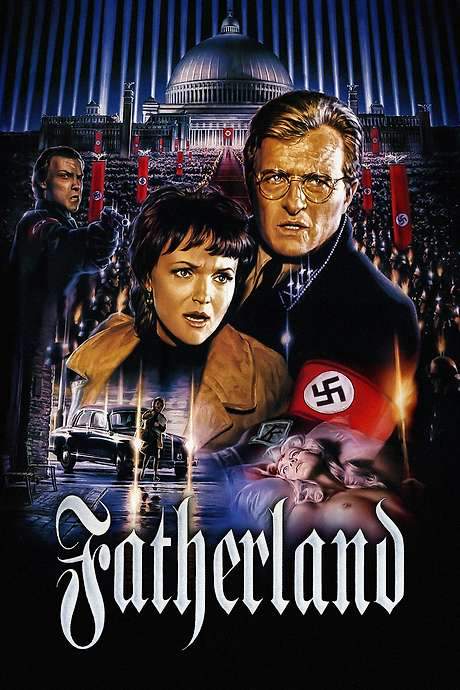
Fatherland 1994

Directed by

Christopher Menaul
Made by

HBO
Fatherland Plot Summary
Read the complete plot summary and ending explained for Fatherland (1994). From turning points to emotional moments, uncover what really happened and why it matters.
In an alternate timeline, history takes a sharp turn from the very start. The Normandy invasion fails, and the United States withdraws from the European theater of World War II, leaving General Dwight D. Eisenhower to retire in disgrace. The U.S. concentrates its might in the Pacific, where General Douglas MacArthur leads the effort against Japan, reportedly using atomic bombs to seal victory. Back in Europe, Nazi Germany achieves a successful invasion of the United Kingdom, forcing King George VI and his family to flee to Canada while continuing to rule the empire from exile. In a further twist, Edward VIII returns to the throne in 1947, with Wallis Simpson as queen, and Winston Churchill likewise goes into exile in Canada, living there until his death in 1953. Germany consolidates control over most of Europe, save for neutral Switzerland and the Vatican, creating a state system known publicly as Germania, and the SS is reorganized into an elite peacetime police force.
Against this backdrop of a reimagined world, the long-simmering war with the Soviet Union persists, with Joseph Stalin aged well into the 1960s still guiding a vast anti-fascist front. In the United States, the 1960 presidential election brings Joseph Kennedy to power, a leader whose openly anti-Semitic stance shapes a controversial détente with the Nazi regime and its allies in Latin America. As 1964 approaches, Kennedy travels to a summit in a Germany that now openly welcomes a media presence from the Americas, even as borders are opened in unsettling ways.
The core mystery begins when a body is discovered on a lake near Berlin by an SS cadet in training. The case lands in the hands of Xavier March, a Berlin police detective and high-ranking SS officer, who begins to question the official explanation. The corpse is identified as Josef Bühler, a retired Nazi official who once managed the “resettlement” program for Jews in Eastern Europe, and the Gestapo takes over the investigation in the name of “state security.” As the inquiries unfold, March finds himself pressed to stay within his allotted boundaries, while his superior, Arthur Nebe, warns him against pushing too far.
Meanwhile, a visiting American journalist, Charlie Maguire, receives an enigmatic envelope containing a photograph of a group of high-ranking Nazi officials gathered outside a villa. A note on the photo leads her into a dangerous chase that also draws March into the mystery. The clues point toward the Wannsee Conference, where the high-ranking men who attended the gathering emerge as suspects, all dead under suspicious circumstances except for one survivor: Franz Luther, the elderly man who first handed the photograph to Maguire.
As March and Maguire dig deeper, Luther contacts Maguire from a train and asks for safe passage to the United States in exchange for the truth he bears about “the biggest secret of the war.” Luther’s request sets off a perilous sequence of escapes and interrogations, with Luther murdered by Gestapo agents before he can be fully heard, and March risking everything to protect Maguire. March’s resourcefulness leads him to obtain Luther’s papers and to uncover a chilling revelation: the Jews were not merely resettled but exterminated, a plan that was enacted on a massive scale and concealed for decades.
This discovery shatters March’s worldview. He becomes determined to escape Germany with his young son, Pili, and to reveal the truth beyond the regime’s reach. The mission is complicated by internal betrayals: Pili is coaxed to betray his father, and a trap is laid by Globus to take March down. In a tense confrontation, March shoots a Gestapo agent and is mortally wounded, managing to reach a phone booth and call Pili for a final, desperate goodbye before he dies.
As Kennedy arrives at Berlin’s Great Hall for a scheduled address, Maguire seizes a moment to pass the incriminating documents to a trusted journalist, allowing a pivotal disclosure to reach the U.S. ambassador and, ultimately, Kennedy. The plan alters the course of history: Kennedy cancels the anticipated meeting with Hitler and returns to the United States with the truth in hand.
In the epilogue, the narrator reveals himself as a grown Pili, reflecting on the consequences of exposing the genocide. The exposure derails any possibility of a strategic alliance between the Nazi leadership and the United States. The Nazi regime bears the strain of ongoing resistance and economic exhaustion, leading to revolutions across Europe and the eventual collapse of the Reich.
- As the mystery unfolds, the consequences of truth, loyalty, and the costs of alliance echo through every choice, painting a world where history could have gone another direction, but the terrible clarity of the past cannot be hidden forever.
Fatherland Timeline
Follow the complete movie timeline of Fatherland (1994) with every major event in chronological order. Great for understanding complex plots and story progression.
Body found in a Berlin-area lake
A body is discovered floating in a lake near Berlin by SS cadet Hermann Jost. The deceased is Josef Bühler, a former Nazi official connected to the Jewish resettlement program. The discovery triggers a high-stakes inquiry and hints at a cover-up that reaches into the regime's inner circle.
Gestapo takes over the case and Jost dies
The Gestapo seizes the investigation for reasons of state security, shutting down normal channels of inquiry. Jost dies in an apparent training accident, fueling rumors of a deeper conspiracy. March and other investigators sense that powerful figures are protecting dark secrets.
Maguire receives an incriminating photograph
Charlotte Maguire, a visiting American journalist, is handed an envelope containing a photo of several high-ranking Nazi officials outside a villa. A note points her toward Wilhelm Stuckart, a retired party official, who is later found dead in his apartment. The trail intensifies as connections to Wannsee attendees begin to surface.
March is reassigned; Gestapo blocks investigation
March is reassigned to the Stuckart case, but the Gestapo asserts jurisdiction and warns him against pursuing further investigations. The case hints at a top-level plot that dwarfs a single murder. The danger grows as March presses for answers.
Wannsee visit reveals the conference attendees are dead
March and Maguire trace the photo to Wannsee, uncovering that all attendees of the Wannsee Conference have died under suspicious circumstances. Only one survivor remains: Franz Luther. The discovery deepens the intrigue and confirms a calculated cover-up.
Franz Luther seeks safe passage through Maguire
Franz Luther contacts Maguire and asks to arrange safe passage to the United States in exchange for what he knows about 'the biggest secret of the war.' March cautions that Luther cannot be trusted, but Maguire decides to pursue the lead anyway. The two set up plans that move toward a dangerous train meeting.
Luther is killed; March saves Maguire
SS troops corner Luther and kill him on the way to secure his information, but March intervenes and rescues Maguire. The botched capture reveals the depth of the regime's reach and willingness to silence witnesses. The escape attempt marks a turning point in their investigation.
Maguire exposes Luther's papers; Hagen reveals truth
Maguire, posing as an American embassy official to process Luther's safe passage, visits Anna von Hagen. Hagen reveals that Jews were not merely resettled but exterminated during the war, as discussed at Wannsee. The revelation shocks March and confirms the truth the regime has tried to bury.
March decides to escape with his son Pili
Haunted by the documents, March agrees to escape Germany with his son Pili and leave the country with Maguire. The Gestapo has already manipulated Pili to betray his father, creating a trap that follows him into the escape attempt. March fights his way toward freedom, but is gravely wounded.
Final confrontation and March's death
During the escape, March kills a Gestapo agent but is mortally wounded himself. He manages to reach a phone booth and give Pili a final call, entrusting him with their fate. He dies knowing the truth has begun to reverberate beyond Berlin.
Kennedy arrives at the Great Hall; documents reach US
As Kennedy arrives at Berlin's Great Hall, a journalist assists Maguire in slipping the documents to the US ambassador. Kennedy reads the materials and immediately cancels the planned meeting with Hitler, returning to the United States. The moment hints at a potential detente being broken and the regime losing leverage.
Epilogue: Pili's narration and regime collapse
In the epilogue, Pili, now grown, narrates the story and notes that Maguire was ultimately arrested by the Gestapo. The exposure of the Jewish extermination derails any prospect of a strategic alliance with the United States, and revolutions flare across Europe. The Nazi regime collapses as its war-weariness and internal turmoil overwhelm its control.
Fatherland Characters
Explore all characters from Fatherland (1994). Get detailed profiles with their roles, arcs, and key relationships explained.
Xavier March (Rutger Hauer)
A Berlin police detective in a regime where the SS claims jurisdiction, March is principled, persistent, and wary of the cover-up. He navigates dangerous loyalties as he assembles the truth about the wartime atrocities. His pursuit of justice comes at the cost of danger to himself and his son Pili, culminating in a fatal confrontation.
Charlie Maguire (Miranda Richardson)
An American journalist visiting Berlin who is drawn into a dangerous investigation. She pieces together the conspiracy, uses subterfuge to access Luther's papers, and bridges the gap between journalism and truth-telling. Her actions drive the revelation of the regime's crimes.
General Globus (John Shrapnel)
Odilo Globočnik-inspired Gestapo leader who presides over the cover-up and maintains order through the threat of state security. He embodies the regime's ruthless efficiency and willingness to sacrifice individuals for the illusion of control.
Anna von Hagen (Jean Marsh)
Former stage actress and Luther's mistress who becomes a conduit of hidden information. She helps Maguire access Luther's papers and reveals the truth behind the so-called 'resettlement' of Jews. Her role highlights personal risk in service of disclosure.
Franz Luther
A retired Nazi Party official who provides the crucial papers that expose the extermination program. His willingness to share what he knows triggers the investigation and the final confrontation with the regime.
Pili (Rory Jennings)
March's young son, drawn into the danger surrounding his father's investigation. He is manipulated by the regime but survives to narrate the epilogue, underscoring the personal costs of uncovering truth.
Fatherland Settings
Learn where and when Fatherland (1994) takes place. Explore the film’s settings, era, and how they shape the narrative.
Time period
Mid-1960s
The story takes place in an alternate 1960s in which Nazi Germany dominates most of Europe. The plot references a 1964 summit in Germany and a renewed Cold War tension framed by Kennedy's diplomacy. It presents a world still shaped by war and political maneuvering, where history has taken a darkly different turn.
Location
Berlin, Germany, Wannsee
The narrative centers on Berlin under Germania, with key action unfolding in government districts, police precincts, and the Wannsee villa. The city is portrayed as a tightly controlled capital where the Gestapo and SS enforce a new, orderly regime. Iconic locations like the Wannsee Conference era sites and Berlin's corridors of power serve as backdrops for the investigation and revelation.
Fatherland Themes
Discover the main themes in Fatherland (1994). Analyze the deeper meanings, emotional layers, and social commentary behind the film.
🔎
Truth vs. Cover-Up
A journalist and a detective uncover a deliberate conspiracy to hide war crimes, exposing how the state uses secrecy to preserve its legitimacy. The search for verifiable evidence pits personal risk against institutional power. The story treats truth as a catalyst that could destabilize or even topple a regime.
⚖️
Power and Consequences
The regime relies on surveillance, intimidation, and legal pretenses to maintain control. Characters weigh loyalty to duty against the moral cost of protecting a system built on atrocity. The narrative shows that political expedience often sacrifices justice.
🕯️
Memory and Reckoning
The revelation of the Holocaust crimes redefines the present, challenging alliances and forcing societies to confront a painful past. Personal memories intersect with state narratives as individuals decide whether to speak out. The climax links individual courage with broader historical reckoning.

Coming soon on iOS and Android
The Plot Explained Mobile App
From blockbusters to hidden gems — dive into movie stories anytime, anywhere. Save your favorites, discover plots faster, and never miss a twist again.
Sign up to be the first to know when we launch. Your email stays private — always.
Explore the mobile appFatherland Spoiler-Free Summary
Discover the spoiler-free summary of Fatherland (1994). Get a concise overview without any spoilers.
In an unsettling re‑imagining of the 1960s, the world has been reshaped by a Nazi victory that turned Europe into an authoritarian empire and left the United States cautiously engaged in a precarious détente. The continent moves under the shadow of a regime intent on rewriting its own history, and a high‑profile peace summit between the American president and Adolf Hitler looms as
Movies with Similar Twists and Themes
Uncover films that echo the narrative beats, emotional arcs, or dramatic twists of the one you're exploring. These recommendations are handpicked based on story depth, thematic resonance, and spoiler-worthy moments — perfect for fans who crave more of the same intrigue.



Featured on this page

What's After the Movie?
Not sure whether to stay after the credits? Find out!
Check out our other apps:

SAT Sphere
Build confidence for the Digital SAT.

Mori Atlas
Discover wild places worth protecting.

Luntero
Search smarter for a home in Amsterdam.

Plot Explained
Unravel movie endings and hidden clues.

Pokechamp
Dive into Pokémon data and battle logic.

Driving Theory
Get ready for your European theory test.

Movie Dust
Plan your next cinema trip with ease.

Musemap
Find art and culture as you travel.

Selkobase
Compare credentials before committing.

Local Manual
Turn an unfamiliar country into practical next steps.

Lernavi
Compare school systems before your next move.

GymRoam
Find a workout stop wherever your plans take you.
Explore Our Movie Platform
New Movie Releases (2026)
Famous Movie Actors
Top Film Production Studios
Movie Plot Summaries & Endings
Major Movie Awards & Winners
Best Concert Films & Music Documentaries
Movie Collections and Curated Lists
© 2026 What's After the Movie. All rights reserved.
Privacy Policy