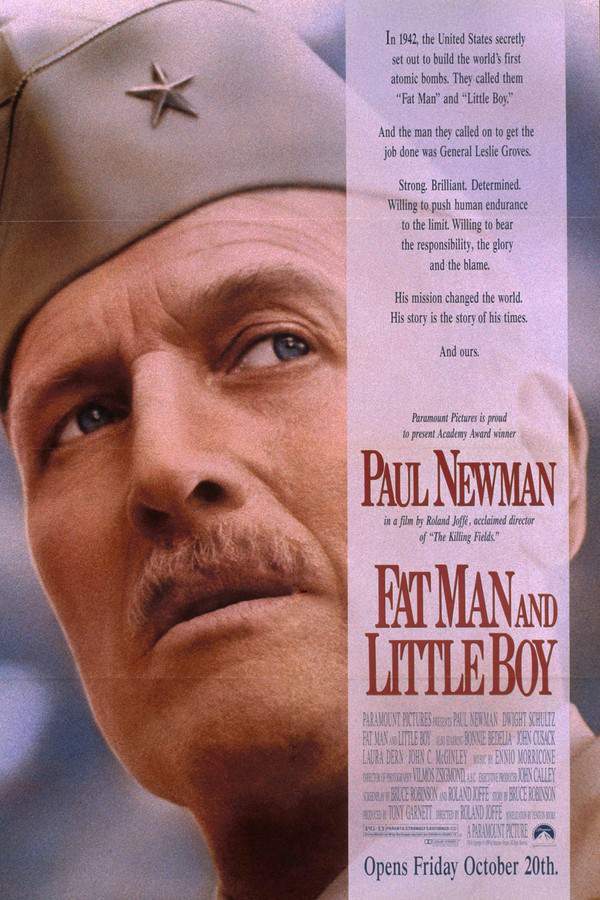
Fat Man and Little Boy 1989

Directed by
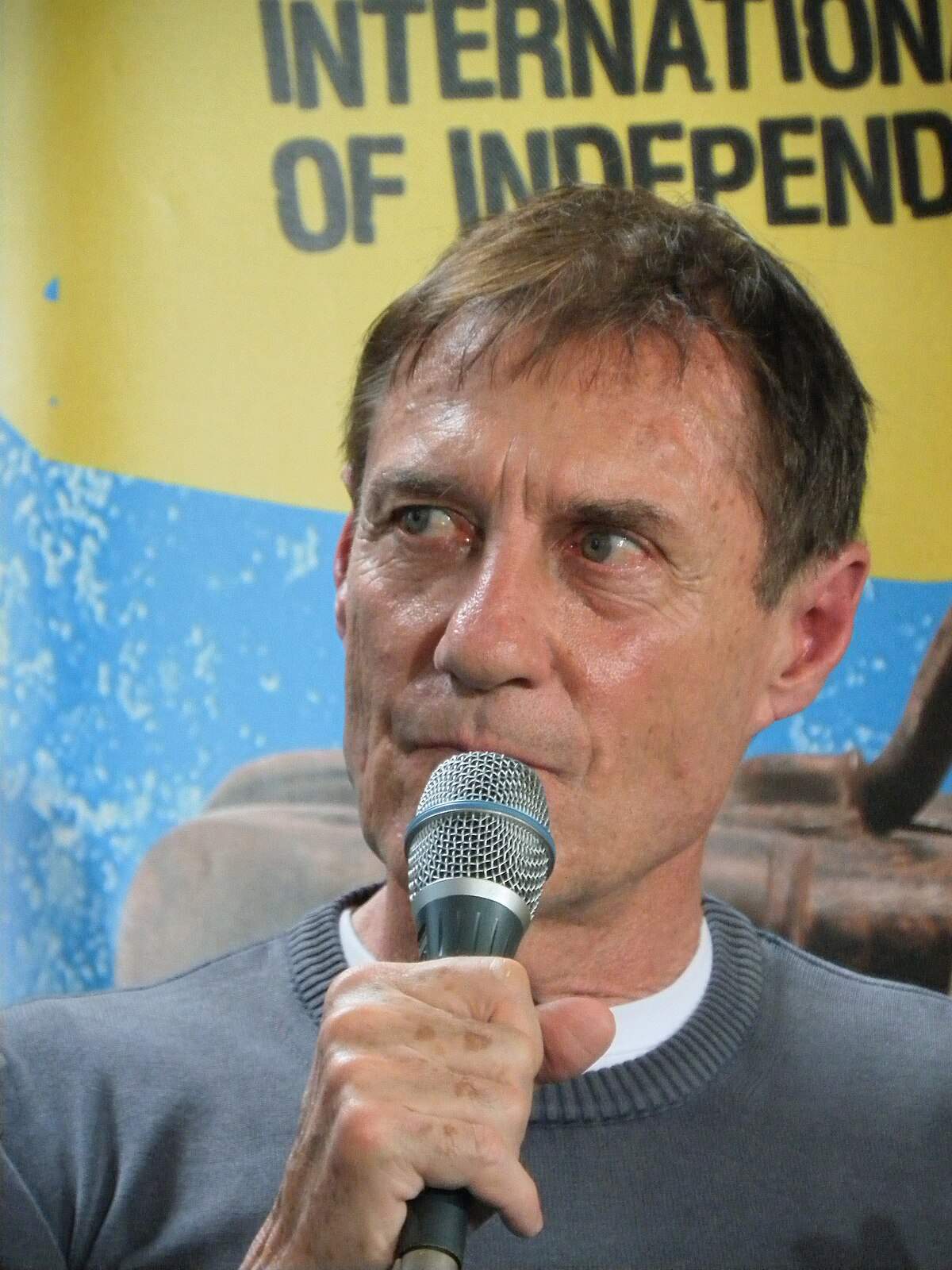
Roland Joffé
Made by

Paramount Pictures
Where to Watch Fat Man and Little Boy
See current US streaming, rental, and purchase options for Fat Man and Little Boy (1989) via JustWatch.






Fat Man and Little Boy Plot Summary
Read the complete plot summary and ending explained for Fat Man and Little Boy (1989). From turning points to emotional moments, uncover what really happened and why it matters.
In September 1942, the ultra-secret Manhattan Project lands in the hands of Colonel Leslie Groves, a no-nonsense military man who has already earned a reputation for overseeing the construction of the Pentagon. His mission is to outpace Germany in the race to build an atomic weapon, a task that feels almost impossible given the scale and secrecy involved. Groves picks J. Robert Oppenheimer, a brilliant and somewhat enigmatic physicist, to lead the scientific effort. Oppenheimer is drawn to the stark, remote landscape of northern New Mexico, where his family once owned a cabin, and he envisions a research facility that sits atop a mesa near Los Alamos Canyon, northwest of Santa Fe.
From the start, the relationship between Groves and Oppenheimer is defined by clash and compromise. Groves brings order, discipline, and a ruthless focus on schedules, while Oppenheimer, surrounded by a diverse group of scientists, wrestles with the moral and philosophical implications of their work. The scientists debate whether their personal consciences should guide their science or if they must suppress emotion to fulfill a national goal. The project becomes a crucible where professional ambition, ethical concerns, and personal loyalties pull in different directions, and the strain of leadership is felt as much in the offices and laboratories as it is in the field.
Within this high-stakes pressure cooker, individuals grapple with dangerous breakthroughs and the human costs of progress. Nurse Kathleen Robinson and young physicist Michael Merriman become aware that their work may come with consequences that extend far beyond equations and experiments. An accident during a high-risk experiment—an event dubbed Tickling the Dragon’s Tail—leads to a catastrophic exposure for Merriman, who develops grotesque swelling and deformity before his death. The tragedy lays bare the risks of radiation, the fragility of the human body, and the emotional toll on those left behind in the hospital and laboratories.
As the project expands across multiple sites across the United States, security concerns take center stage. Investigations probe possible foreign espionage and internal sympathies, including connections to socialist organizations, heightening paranoia and tension. The scrutiny also touches Oppenheimer personally, revealing that he has had a complicated relationship with Jean Tatlock, who becomes a source of personal and political trouble. Groves orders Oppenheimer to end their relationship, but Oppenheimer’s need to protect secrecy prevents him from fully explaining the reasons, leaving Tatlock to confront heartbreak and a solitary fate.
With the operation sprawling and the clock ticking, the scientists explore two parallel designs to avert a single point of failure. One design targets a large, heavy plutonium bomb that would explode via implosion using shaped charges, known as the “Fat Man.” The other is a leaner, lighter uranium bomb that would be fired in a shotgun-style configuration, nicknamed “Little Boy.” The project moves through technical breakthroughs and stubborn setbacks, testing the limits of engineering, physics, and human resilience.
The narrative culminates at the Trinity Site in the Alamogordo Desert of south-central New Mexico, on a clear July day in 1945. At the moment of detonation, a mushroom cloud rises and the winds roar across the desert as observers feel the profound and humbling awe of witnessing the first atomic explosion. The successful tests of Fat Man and Little Boy propel humanity into a new era—the Atomic Age—while leaving behind a lasting legacy of scientific triumph shadowed by ethical questions, personal losses, and the enduring complexity of discovery under the weight of enormous responsibility.
Fat Man and Little Boy Timeline
Follow the complete movie timeline of Fat Man and Little Boy (1989) with every major event in chronological order. Great for understanding complex plots and story progression.
Groves is appointed to lead the Manhattan Project
In September 1942, U.S. Army Corps of Engineers Colonel Leslie Groves is assigned to head the ultra-secret Manhattan Project, aiming to beat the German nuclear program. He brings military organization and discipline to a top-secret effort, previously focused on other national projects like the Pentagon. The assignment sets the stage for a massive, cross-country scientific undertaking.
Oppenheimer recruited to lead the scientific team
Groves selects J. Robert Oppenheimer, a Berkeley physicist, to head the project team. Oppenheimer's charisma and intellect make him a natural leader for a diverse group of scientists. The recruitment marks a pivotal shift from military oversight to scientific leadership.
Remote Los Alamos site chosen for the research facility
Oppenheimer chooses a remote mesa near Los Alamos Canyon to house the new research facility, keeping the team insulated from external pressures. The secluded site is intended to protect sensitive work and foster focused collaboration. This setting would become the cradle of the Manhattan Project’s most famous work.
Tensions between Groves and the scientists over conscience
As the project advances, military demands and scientific ideals clash. Groves pushes for rapid progress, while Oppenheimer and the team wrestle with whether personal ethics should influence their work. The result is ongoing friction as components move toward a critical, time-sensitive completion.
Tickling the Dragon's Tail accident and radiation injury
During a high-risk experiment nicknamed Tickling the Dragon's Tail, a reactor component is dropped and recovered by hand to prevent a disaster. The handler is exposed to a lethal dose of radiation and dies days later after a painful battle with swelling and deformation. Kathleen Robinson, a nurse, witnesses the tragedy in the base hospital.
Espionage investigations begin amid fears of foreign influence
As the project expands, investigators scrutinize potential espionage and communist sympathizers within the broader scientific community. The scrutiny creates anxiety and distrust among staff, threatening the unity needed for a project of this scale. The atmosphere grows tenser as leaks or suspected leaks become a daily concern.
Oppenheimer's relationship with Jean Tatlock is found and ordered to end
Groves orders Oppenheimer to sever his relationship with Jean Tatlock after spying concerns surface about her. Oppenheimer breaks off the affair, unable to fully explain the reasons to her, and the personal tension bleeds into his professional life. The rift compounds the emotional strain surrounding the project’s secrecy.
Tatlock's suicide follows the breakup
Tatlock, unable to cope with the heartbreak and isolation caused by the project’s secrecy, is later found dead, apparently by suicide. The tragedy haunts Oppenheimer and underscores the collateral human costs of the project. The incident feeds the moral questions the scientists grapple with throughout development.
Parallel bomb designs chosen to avoid single point of failure
To mitigate the risk of a single point of failure, the project pursues two different bomb concepts: Fat Man, a plutonium implosion design, and Little Boy, a uranium gun-type design. The scientists and engineers work on simultaneous development across multiple sites to diversify the project’s prospects. The dual paths exemplify the tension between competing scientific approaches.
Fat Man and Little Boy design converge toward final solutions
Across facilities, the two designs advance toward practical prototypes. The plutonium implosion method for Fat Man and the uranium gun-type method for Little Boy represent radically different engineering challenges. The project races toward a dramatic test and eventual deployment.
Trinity test marks the first nuclear detonation
The Trinity test, conducted at the Trinity Site in the Alamogordo Desert, detonates the first nuclear device in history. At 05:29:45 on July 16, 1945, a massive mushroom cloud rises as companions miles away feel the blast and the winds roar across the desert. The test confirms the weapon’s viability and accelerates the coming atomic age.
Fat Man and Little Boy achieve success, ushering in atomic age
Following the Trinity test, the Fat Man and Little Boy weapons are deemed successful, bringing the Atomic Age into reality. The successful demonstration and production enable deployment during World War II and reshape global power dynamics. The project ends its long arc, having achieved its strategic aims but at great human and moral cost.
Fat Man and Little Boy Characters
Explore all characters from Fat Man and Little Boy (1989). Get detailed profiles with their roles, arcs, and key relationships explained.
Colonel Leslie Groves (Paul Newman)
A methodical, blunt military administrator who runs the Manhattan Project with a focus on speed, security, and efficiency. He pushes scientists to deliver results, often clashing with theoretical viewpoints. His wartime pragmatism underpins the project as it expands across the country.
J. Robert Oppenheimer
A brilliant physicist who leads the scientific team with a vision that blends theory and moral consideration. He is deeply introspective and frequently torn between scientific exploration and the ethical implications of his work. His relationships with colleagues reflect the ideological tensions within the project.
Kathleen Robinson
A nurse who witnesses the human cost of the project and provides a ground-level perspective on radiation risks and patient care. Her presence highlights the personal toll behind the scientific achievement. Her stance helps frame the moral questions raised by the mission.
Michael Merriman
A young physicist who embodies the scientific drive but pays a high price for risky experimentation. His daring act during a crucial experiment underlines the dangers of handling dangerous components without full protection. His fate underscores the human cost of technical ambition.
Jean Tatlock
A figure from Oppenheimer's personal life whose relationship introduces emotional complication and tension within the project. Her story contributes to the film's exploration of the costs of secrecy and sacrifices made for the greater goal.
Fat Man and Little Boy Settings
Learn where and when Fat Man and Little Boy (1989) takes place. Explore the film’s settings, era, and how they shape the narrative.
Time period
1942–1945
Set during World War II, the Manhattan Project accelerates from recruitment and research in 1942 to the catastrophic demonstration of power in 1945. The timeline follows laboratory work, security measures against espionage, and personal relationships shaped by wartime secrecy. By 1945, the project consolidates at multiple sites, leading to the first nuclear detonation.
Location
Berkeley (California), Los Alamos Canyon (New Mexico), Santa Fe region (New Mexico), Trinity Site, Alamogordo Desert (New Mexico)
The film traverses multiple sites in the American Southwest and California. The primary research hub sits at Berkeley for early theory work, while a remote mesa overlooking Los Alamos Canyon hosts the secret project, northwest of Santa Fe. The narrative culminates at the Trinity Site in the Alamogordo Desert, the first test of the atomic bomb.
Fat Man and Little Boy Themes
Discover the main themes in Fat Man and Little Boy (1989). Analyze the deeper meanings, emotional layers, and social commentary behind the film.
⚖️
Ethics
The project raises profound moral questions about scientific responsibility and the impact of discovery on human lives. Scientists debate whether personal conscience should steer research or whether pure curiosity justifies the means. Personal relationships, such as the affair and the heartbreak, underscore the human costs of monumental decisions. The result is a tension between duty to country and duty to humanity.
🔬
Science
The film centers on the clash between theoretical physics and practical engineering, showing how ideas must be translated into weapons. It highlights collaboration among diverse experts, bureaucratic pressures, and the race against time. It also portrays the risks of radiation exposure and the ethical limits of experimentation. The pursuit of knowledge becomes inseparable from its potential for destruction.
💥
Power
The project culminates in the detonation at Trinity, revealing the sheer scale of human invention. The film presents the awe and fear surrounding the birth of the Atomic Age. It also questions who wields such power and under what oversight. The narrative suggests that power, once unleashed, reshapes politics, science, and personal destinies.

Coming soon on iOS and Android
The Plot Explained Mobile App
From blockbusters to hidden gems — dive into movie stories anytime, anywhere. Save your favorites, discover plots faster, and never miss a twist again.
Sign up to be the first to know when we launch. Your email stays private — always.
Explore the mobile appFat Man and Little Boy Spoiler-Free Summary
Discover the spoiler-free summary of Fat Man and Little Boy (1989). Get a concise overview without any spoilers.
In the shadow of World War II, a covert scientific effort is launched to shape the future of warfare. Deep in the isolated mesas of northern New Mexico, a network of laboratories and production sites hums with the quiet urgency of a race against an unseen enemy. The landscape is both stark and beautiful, a desert canvas on which the most advanced physics of the era is quietly unfolded, while the ever‑present weight of secrecy presses on every door and corridor.
Leslie Groves, a disciplined military commander known for his no‑nonsense approach, is tasked with turning this ambitious venture into a workable reality. To give it intellectual life, he recruits J. Robert Oppenheimer, a brilliant yet enigmatic physicist whose curiosity and depth of insight draw him to the remote wilderness. Their partnership is a study in contrast: Groves enforces strict schedules and pragmatic logistics, while Oppenheimer navigates a world of abstract theory and moral reflection. The friction between order and imagination fuels both tension and progress.
Against this backdrop, the project’s goal—to forge two groundbreaking atomic devices, famously nicknamed “Fat Man” and “Little Boy”—casts an almost mythic aura over the daily grind. The tone is a blend of relentless urgency and quiet contemplation, where every calculation hints at unprecedented power and every decision carries a lingering ethical weight. The story invites viewers to feel the pull of duty, the spark of intellectual rivalry, and the uneasy wonder of pushing humanity into an unknown age.
Featured on this page

What's After the Movie?
Not sure whether to stay after the credits? Find out!
Check out our other apps:

SAT Sphere
Build confidence for the Digital SAT.

Mori Atlas
Discover wild places worth protecting.

Luntero
Search smarter for a home in Amsterdam.

Plot Explained
Unravel movie endings and hidden clues.

Pokechamp
Dive into Pokémon data and battle logic.

Driving Theory
Get ready for your European theory test.

Movie Dust
Plan your next cinema trip with ease.

Musemap
Find art and culture as you travel.

Selkobase
Compare credentials before committing.

Local Manual
Turn an unfamiliar country into practical next steps.

Lernavi
Compare school systems before your next move.

GymRoam
Find a workout stop wherever your plans take you.
Explore Our Movie Platform
New Movie Releases (2026)
Famous Movie Actors
Top Film Production Studios
Movie Plot Summaries & Endings
Major Movie Awards & Winners
Best Concert Films & Music Documentaries
Movie Collections and Curated Lists
© 2026 What's After the Movie. All rights reserved.
Privacy Policy