
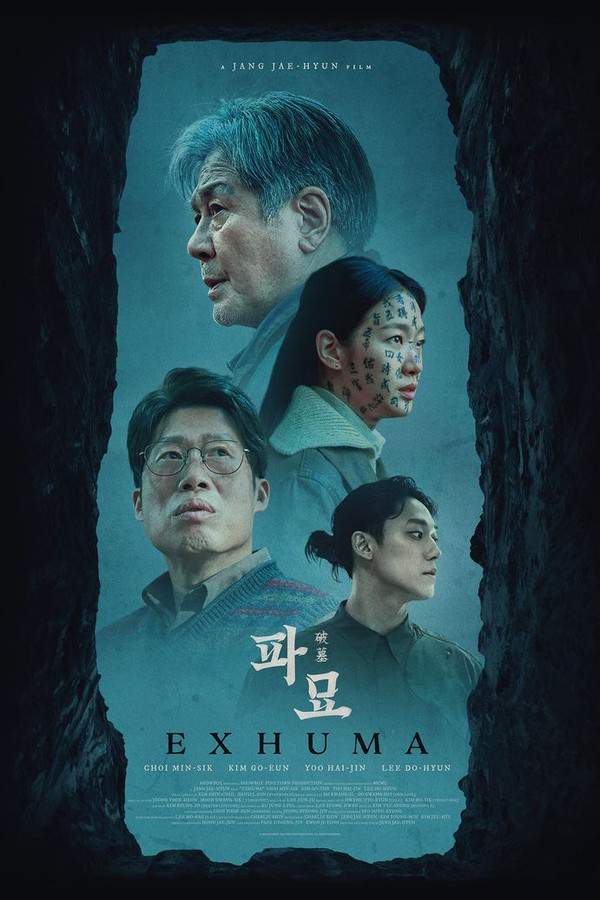
What Is Exhuma About?
The premise of Exhuma in 323 words, with nothing given away. The full story and the ending follow below.
In a mist‑laden corner of the Korean‑American diaspora, a family’s cherished lineage is threatened by a series of inexplicable maladies that strike each firstborn son. The affluent Park household, desperate to protect their future, turns to the arcane world for answers, calling upon a renowned shaman and her eager apprentice. Hwa‑rim, steeped in tradition and ritual, brings a calm authority, while Bong‑gil, still learning the delicate balance between the living and the unseen, offers fresh curiosity and a restless energy that fuels their investigation.
Recognizing that the mystery may run deeper than a single household, the pair enlists the expertise of a pragmatic mortician and a master of earth’s hidden currents. Yeong‑geun provides a grounded perspective on death’s physical rites, his steady demeanor anchoring the group when the supernatural threatens to overwhelm. Beside him, Kim Sang‑deok, a geomancer whose keen sense of spatial harmony borders on the mystical, maps the invisible forces that bind the family’s home to the land it occupies. Together, this unlikely quartet forms a delicate alliance, each bringing a unique lens to the unfolding enigma.
The film’s atmosphere is a quiet, brooding blend of rural Korean folklore and modern diaspora anxieties, where the natural world—rain‑soaked hills, ancient burial sites, and wind‑whistled temples—feels both a sanctuary and a source of unease. Light filters through fogged windows, incense curls in dim chambers, and distant thunder underscores the sense that the past is restless, waiting to be heard. The tone remains haunting yet reverent, inviting viewers to linger on the weight of inherited memory and the uneasy peace that rituals attempt to secure.
At its core, the story follows Hwa‑rim and Bong‑gil as they navigate the fragile boundary between belief and skepticism, guided by Yeong‑geun’s practicality and Kim Sang‑deok’s intuition. Their collaboration hints at deeper, intergenerational secrets hidden beneath the surface, promising a journey where every whispered legend may hold a key to breaking the silent curse that haunts the family’s future.
What Happens in Exhuma?
The complete story of Exhuma, from the first scene to the last, in 737 words (about 3 minutes). Spoilers throughout. Names in the text link to 5 cast member pages.
Spoilers ahead
In this haunting narrative of familial revenge, celebrated shaman Hwa-rim and her devoted apprentice Bong-gil are called upon by an affluent Korean American family to decode the mysteries surrounding their infant son’s bizarre illness. Together, they uncover a sinister phenomenon known as the “Grave’s Call,” a curse stemming from the restless spirit of a vengeful ancestor that has plagued the family for generations.
The family’s patriarch, Park Ji-Yong, places his trust in Hwa-rim and Bong-gil, urging them to relocate the grave in a bid to appease the ancestral spirits and eliminate the dark energy threatening his lineage. To assist them in this daunting task, they enlist the guidance of feng shui master Kim Sang-deok and the mortician Yeong-geun.
As their investigation unfolds, Sang-deok becomes alarmed when Ji-yong expresses his intention to cremate the grave located in a secluded mountainous area near the North Korean border. His intuition warns of looming disaster, but Hwa-rim reassures him that she has the skill to perform a ritual that would alleviate the curse, even while the grave is exhumed.
During the excavation process, Ji-yong shares the legend of Gisune, a wise monk who once indicated the grave’s location to protect his grandfather from grave robbers. Hwa-rim and Bong-gil carry out the ritual, ensuring everything proceeds smoothly. However, as the cleanup begins, a gravedigger inadvertently beheads a serpentine creature, unleashing a cascade of foreboding events that lead to fierce rainstorms.
The funeral director, Yeong-geun, insists that the coffin must be cremated once the storms pass, leading them to store it in a nearby ward. Unbeknownst to them, the town custodian, lured by rumors of hidden treasures within the grave, foolishly opens the coffin, thus releasing the wrathful spirit of Ji-yong’s grandfather, who had suffered from a bungled burial for years.
As the curse takes its toll, Ji-yong and his parents become victims of their ancestors’ vengeance. In a climactic moment, Sang-deok manages to cremate the coffin just before the spirit could claim another life, lifting the curse and liberating the family from its ominous grip.
With days passing, Yeong-geun reveals a disturbing tale to Sang-deok: a gravedigger who goes mad after committing an unthinkable act against a serpent. This horrific account prompts Sang-deok to revisit the gravesite, where he encounters the chilling sight of a serpent head and an exceptionally large, seven-foot-long coffin. Driven by a mix of curiosity and moral duty, Sang-deok recruits the help of Hwa-rim, Bong-gil, and Yeong-geun to dispose of this unsettling relic, leading them to a temporary sanctuary at a nearby temple.
Within the temple walls, Hwa-rim unveils the legend of Gisune, a formidable Japanese shaman dubbed The Fox, whose supernatural abilities wield dire repercussions. As night falls, Bong-gil witnesses a gruesome scene where a vengeful entity, revealed to be a samurai, mercilessly slaughters the temple’s priest alongside a local pig farmer and his herd.
Amidst the carnage, Hwa-rim and Bong-gil discover the violated coffin, its contents in disarray. In an unexpected clash, Hwa-rim is assaulted by the ominous samurai, who transforms into a blazing orb of fire and retreats to the mountains, leaving the trio in shock.
As the enigma thickens, Hwa-rim investigates the ghoul’s origins through the visions of her possessed ally, Bong-gil. Sang-deok returns to the grave site, only to uncover the dormant samurai, intrinsically linked to the coordinates on his grandfather’s tombstone. This discovery exposes a tangled history of subterfuge, revealing that what was presumed to be grave robbers were in fact Korean patriots attempting to unearth a piece of Japan’s martial history in Korea.
With escalating stakes, Sang-deok, Hwa-rim, and Yeong-geun strategize to exhume this long-concealed relic, set to awaken from its slumber at midnight. Hwa-rim takes up the charge as a diversion, while the others direct their efforts at the grave. A prophetic vision unveils The Fox’s malevolent role in endowing the decapitated samurai with a katana, transforming it into the vengeful spirit now haunting their every step.
Sang-deok ultimately connects the dots: the relic is buried beneath his grandfather’s grave, cleverly disguised to conceal its presence. Confronting the samurai, he employs his feng shui mastery to defeat the creature, only to later succumb to extreme fatigue.
The story shifts forward in time as Sang-deok regains consciousness in a hospital, flanked by Hwa-rim and Yeong-geun. Their harrowing adventure has finally reached its conclusion, paving the way for a celebratory moment: Ji-yong’s wedding day arrives, marking the joyful culmination of their tribulations.
Exhuma Timeline: Every Key Event in Order
15 key events in the order they happen, from “The Call for Help” to “Resolution and Celebration”. 2 events name a place, across 2 locations.
- 1
The Call for Help
An affluent Korean American family reaches out to celebrated shaman Hwa-rim and her apprentice Bong-gil. They seek to understand the mysterious illness affecting their infant son, which has baffled conventional medical professionals.
- 2
Unraveling the Curse
Hwa-rim and Bong-gil begin their investigation into the family's dark history. They discover a sinister phenomenon known as the 'Grave's Call,' which is rooted in a generational curse brought on by the family's restless ancestral spirit.
- 3
Relocating the Grave
The family's patriarch, Park Ji-Yong, trusts Hwa-rim and Bong-gil with the task of relocating his ancestor's grave. He believes that this act could appease the vengeful spirits and rid his family of the curse that grips them.
- 4
Guidance from Masters
To bolster their efforts, Hwa-rim and Bong-gil enlist the help of feng shui master Kim Sang-deok and mortician Yeong-geun. Together, they prepare for the grave relocation that they hope will end the family's suffering.
- 5
Warning Signs
As the team prepares to cremate the grave, Sang-deok expresses concern about Ji-yong's decision, sensing impending doom. Hwa-rim reassures him, claiming that she can perform a ritual to relieve the curse, even during the grave's exhumation.
Where:Secluded mountainous area near the North Korean border
- 6
The Ritual Begins
During the excavation, Ji-yong shares the legend of Gisune, a wise monk who protected his grandfather's grave. Hwa-rim and Bong-gil commence the ritual as planned, hoping to ensure a smooth process for appeasing the spirits.
- 7
Unleashing the Curse
An unexpected accident occurs when a gravedigger accidentally beheads a serpentine creature during cleanup, triggering violent rainstorms. This incident signifies a disturbance in the spirit realm, raising the stakes for the family.
- 8
The Coffin's Fury
Funeral director Yeong-geun insists that the disturbed coffin be cremated once the storms subside. However, a town custodian unable to resist tales of hidden treasures foolishly opens the coffin, unleashing the wrathful spirit of Ji-yong's grandfather.
- 9
Consequences of the Curse
The curse takes hold as Ji-yong and his family start experiencing terrifying manifestations of their ancestors' vengeance. They become desperate as the family members begin to suffer dire consequences of their actions.
- 10
A Narrow Escape
In a tense climax, Sang-deok manages to cremate the aggrieved coffin before the spirit can strike again. This act temporarily alleviates the family's plight, lifting the malevolence that had threatened their very existence.
Show the other 5 events of Exhuma Hide the last 5 events
- 11
A Gravedigger's Tale
Days later, Yeong-geun recounts a disturbing story of a gravedigger who went mad after a horrific encounter with a serpent. This prompts Sang-deok to revisit the grave site and uncover unsettling truths that intertwine with their recent ordeal.
- 12
Discovering Horrors
Upon returning to the gravesite, Sang-deok discovers the head of the serpent and an unusually large coffin. The presence of these relics leads to renewed fears as the team realizes the depths of the curse they are dealing with.
- 13
The Vengeful Samurai
Night descends, and Bong-gil witnesses a horrifying scene in the temple where a samurai spirit brutally slaughters those present. This act of vengeance intensifies their urgency to quell the ensuing chaos.
When:Night Where:Temple
- 14
Confronting the Past
As the mystery unfolds, Hwa-rim explores the origins of the vengeful spirit through Bong-gil's visions. Sang-deok realizes that the dormant samurai is linked to a historical deception involving Japanese martial relics thought lost.
- 15
Resolution and Celebration
After the climactic encounters and hardships, Sang-deok wakes up in a hospital, relieved to find Hwa-rim and Yeong-geun by his side. Their trials culminate in a celebratory moment as Ji-yong's wedding day arrives, offering hope and joy to the family.
Who Are the Main Characters in Exhuma?
5 characters, among them Lee Hwa-rim (Kim Go-eun), Yoon Bong-gil (Lee Do-hyun) and Kim Sang-deok (Choi Min-sik): who each one is and the part they play in the story. Every profile links to the actor’s page.
- LH
Lee Hwa-rim (Kim Go-eun)
Played by Kim Go-eun
Hwa-rim is a celebrated shaman with deep spiritual intuition and the ability to communicate with the spirit world. Her resilience and determination to protect the family from the curse showcase her strong will and leadership qualities. Hwa-rim embodies the connection between the living and the ancestral spirits.
- 🔮 Shaman
- 🌌 Spiritual
- YB
Yoon Bong-gil (Lee Do-hyun)
Played by Lee Do-hyun
As Hwa-rim's devoted apprentice, Bong-gil plays a critical role in assisting with spiritual rituals and investigations. His loyalty and eagerness to learn reveal his dedication to the shamanistic traditions. Throughout the ordeal, Bong-gil's character evolves, demonstrating growth and bravery in the face of danger.
- 👨🎓 Apprentice
- ⚔️ Brave
- KS
Kim Sang-deok (Choi Min-sik)
Played by Choi Min-sik
Sang-deok is a feng shui master whose expertise becomes vital in unraveling the family’s curse. He is perceptive and cautious, often warning against rash decisions that could unleash further danger. His knowledge of spiritual matters complements Hwa-rim's shamanistic insight, making him a key player in their quest.
- 🔍 Expert
- 🧙♂️ Wise
- GY
Go Yeong-geun (Yoo Hae-jin)
Played by Yoo Hae-jin
Yeong-geun, the funeral director, adds a pragmatic layer to the group's dynamic. His insistence on following procedural norms reflects his experience and commitment to his profession. He is both supportive and practical, helping to maintain order during the supernatural chaos surrounding the family.
- ⚖️ Practical
- 🏥 Director
- PJ
Park Ji-yong (Kim Jae-cheol)
Played by Kim Jae-cheol
Ji-yong, the family's patriarch, is driven by desperation to protect his family from ancestral retribution. His emotional weight and vulnerability make him relatable as he struggles with the legacy of his ancestors. Ji-yong's journey reflects a father's love and the lengths he will go to secure his family’s safety.
- 👨👦 Patriarch
- 💪 Determined
Where and When Is Exhuma Set?
Exhuma is set in Korea, North Korean border and nearby temple. Here is why the place matters to the story.
When
The events of the movie do not specify a particular historical timeframe. However, the cultural ties and supernatural elements hint at a blend of contemporary and traditional practices, reflecting the ongoing relevance of ancestral worship and shamanistic rituals in modern Korea.
Where
Korea, North Korean border, nearby temple
The movie primarily takes place in Korea, encompassing a secluded mountainous area near the North Korean border. This region is known for its serene beauty, contrasting the sinister events that unfold. Additionally, a nearby temple serves as a temporary sanctuary for the characters, representing a space for refuge and spiritual exploration.
- 🏞️ Nature
- ⛩️ Temple
What Are the Themes of Exhuma?
3 ideas the story keeps returning to, among them Revenge, Family and Burial Rites.
-
01
Revenge
Revenge serves as a central theme, driving the narrative as the restless spirit of a vengeful ancestor seeks to reclaim justice. The family's struggle against the curse highlights the consequences of unresolved past grievances. The haunting presence underscores the cultural belief in ancestral repercussions and the need to honor deceased lineage.
-
02
Family
Family dynamics are intricately woven into the storyline, depicting the bond and responsibilities between generations. The patriarch's desperation to protect his lineage from ancestral wrath drives the characters to confront their heritage. This theme emphasizes the importance of familial ties and the sacrifices made for the sake of loved ones.
-
03
Burial Rites
The significance of burial rites and ancestral worship permeates the film, showcasing traditional rituals associated with death and the afterlife. The characters' attempts to relocate the grave and appease spirits exemplify the cultural importance of honoring the deceased. This theme intertwines with the supernatural elements, illustrating the delicate boundary between the living and the dead.
How Does Exhuma End?
The last act of Exhuma and what it means, in 443 words. The ending lands as happy. Big spoilers: read the plot summary first if you have not seen it.
The final act, in full
Exhuma’s ending reveals a story deeply rooted in Korean history, mythology, and spiritual practices. The spirit of Grandfather Park, a betrayed ancestor whose grave was dishonorably placed on a mountain infested with foxes, has been haunting his family for over a century because of a curse tied to his improper burial and his betrayal during Japan’s colonization of Korea. The ghost was furious because his burial site was noxious to his spirit, which led to a series of violent hauntings that culminated in the death of Ji-yong’s parents and Ji-yong himself. These tragic events were driven by the spirit’s desire to reclaim his family and punish the descendants who ignored his suffering.
The core of the film’s mystery involves a secret buried beneath the family’s history: Ji-yong’s grandfather was a traitor who sold out Korea to the Japanese during their occupation. His betrayal was concealed by his burial on a mountain, purposely chosen to hide an ancient iron stake—a remnant of Japanese colonial terror meant to weaken Korea’s spiritual and national energy. This iron stake was symbolized by a coffin buried with a cursed, supernatural vessel, the Anima, a Japanese samurai turned demonic spirit, which was intentionally placed underground to act as a boundary or anchor for the stake.
The climax sees Sang-deok, Hwarim, and their allies discovering that the Anima isn’t just a ghost but a powerful vessel created by Gisune—a wicked fox spirit and Onmyoji who manipulated the situation. Gisune transformed the samurai into a deadly spirit linked to a cursed katana, making the Anima a living iron stake embedded in the earth. To defeat this creature, Sang-deok uses traditional Feng Shui principles and elemental magic. Instead of finding a literal iron stake, he realizes that the key to defeating the Anima is to upset its elemental balance: using water and wood to nullify fire and metal—the elements that empower the spirit. By soaking a weapon in his blood and attacking the Anima with elements that counteract it, Sang-deok effectively destroys the demonic vessel, restoring harmony and ending the curse.
In the final moments, Sang-deok’s knowledge of Korean history, mythology, and Feng Shui allows him to outwit the powerful spirit. As the Anima is subdued by the elemental attack, peace is restored to the land, and the centuries-old curse is finally broken. The story ends with a note of hope and a deeper understanding that the true battle was not just against supernatural forces, but also against the hidden horrors of betrayal and colonization that still affect the present. Through teamwork, courage, and cultural wisdom, the characters succeed in destroying the malevolent spirit, bringing peace to their family and their nation.
What Kind of Film Is Exhuma?
Dark in tone, with steady pacing and a moderate story, going by the plot summary.
- Tone
- Dark
- Pacing
- Steady
- Story
- Moderate
- Intensity
- High
- Ending
- Happy
A steadily intense, atmospheric horror film that builds a palpable sense of dread as a team of specialists confronts a violent ancestral curse rooted in dark historical secrets.
- foreboding
- haunting
- tense
- atmospheric
- mysterious
- ominous
- ancestral curse
- supernatural investigation
- vengeful spirits
- cultural legacy
Content notes: supernatural violence, gruesome deaths, desecration of graves, psychological trauma, child endangerment.
Quiz
How well do you remember Exhuma? Test yourself on the story.
