
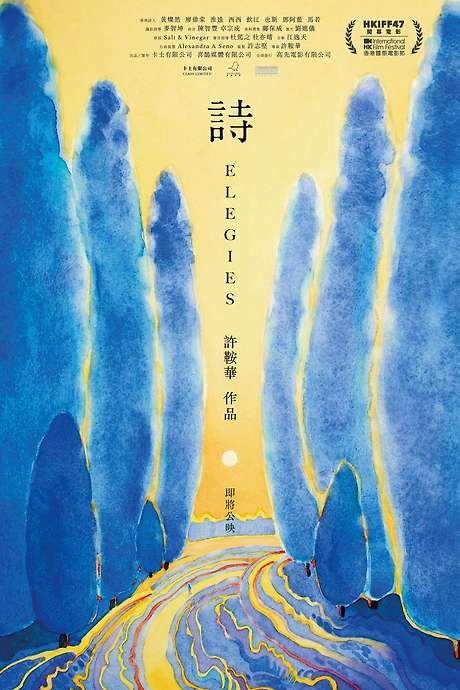
What Is Elegies About?
The premise of Elegies in 347 words, with nothing given away. The full story follows below.
In Elegies, filmmaker Ann Hui turns her attention from Hong Kong’s cinematic history to its poets, assembling an intimate, musically paced portrait of a literary world shaped by memory, migration, and social change. The documentary follows conversations with writers whose work draws on the textures of local life, from street-level observation and native-language rhythm to landscape, history, and the unease of a city in transition. Archival images and the measured cadence of the interviews create an elegiac mood: reflective rather than polemical, attentive to what words can preserve when places and eras are changing.
Two figures anchor the contrasting halves of the film. Huang Canran, living in seclusion in Shenzhen, presents poetry as a private, demanding vocation pursued for its integrity rather than public reward. Liu Wai-tong, based in Taiwan, brings a more outward-facing life, balancing writing, teaching, music, and public engagement while raising questions about how a poet inhabits both family and history. Their differing temperaments—one marked by inward concentration, the other by intellectual breadth and civic awareness—give the film quiet tension without forcing them into rivalry.
Around them, Hui gathers a wider circle of Hong Kong poets, including Wai Yuen, Yam Gong, Deng Ah-lam, and York Ma, alongside the resonant presence of Xi Xi and Leung Ping-kwan through archival material. Their reflections suggest that no single aesthetic can contain the city: poetry may arise from the mundane, preserve a vanishing landscape, test the limits of language, or turn private feeling into a form of public witness. Recurring images of old Hong Kong lend the conversations a sense of layered time, while discussions of belonging hint at larger questions about identity and displacement.
As Hui listens, asks, and reflects with them, the documentary becomes an exploration of poetry as both refuge and bridge. Her encounters with artists working under very different circumstances reveal a shared conviction that creative work can offer clarity without offering simple answers. The result is a compassionate group portrait of writers and a city, inviting viewers to hear the echoes between generations and the emotional geography hidden in ordinary Hong Kong life.
What Happens in Elegies?
The complete story of Elegies, from the first scene to the last, in 292 words (about 1 minute). Spoilers throughout. Names in the text link to 6 cast member pages.
Spoilers ahead
Elegies is a documentary structured into three distinct segments that explore the lives and philosophies of poets connected to Hong Kong. The first part features interviews with Wai-Yuen, Yam Gong, Deng Ah-Lam, and Ma York, while incorporating archival footage of the late poets Xi Xi and Leung Ping-kwan. In these discussions, Wai-Yuen argues that any subject can inspire poetry, emphasizing the tangible qualities of local Hong Kong works. Yam Gong suggests that the unpredictability of poetry mirrors the current social climate, while Xi Xi identifies local poetry through themes of nostalgia and everyday imagery, such as “lemon tea” and “Kai Tak Airport.” Meanwhile, Deng Ah-Lam discusses the intuition of using native Cantonese, and Ma York utilizes landscape imagery to express his deeper political ideals.
The second part focuses on Huang Canran, a poet and translator who relocated to Shenzhen to escape Hong Kong’s high cost of living. Describing himself as an “economic exile,” Huang Canran prioritizes artistic integrity and the creative process over commercial success. Despite battling depression in his youth, he finds freedom in a modest lifestyle, viewing poetry as a pursuit that transcends monetary value.
The final segment follows Liu Waitong, who moved to Taiwan in 2018. Unlike the seclusion of others, Liu Waitong balances a conventional family life with roles in music, social activism, and university teaching. The film examines his academic views on Paul Celan and Bertolt Brecht, as well as his history with the Queen’s Pier preservation campaign. He is joined by other exiled poets, including Huang Yun-ru, who discusses the function of poetry through the lens of writing to friends imprisoned during the 2019–2020 protests. The film closes with a monologue by Ann Hui, reflecting on how poetry serves as a source of solace and resonance.
Elegies Timeline: Every Key Event in Order
16 key events in the order they happen, from “Wai Yuen Defines the Essence of Poetry” to “Ann Hui's Closing Monologue”. 15 events name a place, across 4 locations.
- 1
Wai Yuen Defines the Essence of Poetry
The documentary's first part opens with an interview in which the poet Wai Yuen defines the very essence of poetry. He argues that any subject, even the most mundane, can inspire poetic expression. He also highlights the unique, tangible qualities of local Hong Kong poetry amid the dominance of modernism in Taiwan and mainland China.
Where:Hong Kong
- 2
Yam Gong on Poetry and Hong Kong's Social State
Poet Yam Gong suggests that the unpredictability of poetry reflects a poet's deeper thoughts about the current social state of Hong Kong. His interview roots poetic form in the mood and anxieties of the city. It frames verse as an unconscious response to a society in flux.
Where:Hong Kong
- 3
Xi Xi on Everyday Life and Nostalgia
Archival footage presents the late poet Xi Xi reflecting on local Hong Kong poetry. Although she was not born in Hong Kong, she identifies with its themes of everyday life and nostalgia. She cites recurring imageries such as 'Kai Tak Airport' and 'lemon tea' as examples that evoke these characteristics.
Where:Hong Kong
- 4
Leung Ping-kwan Connects East and West
In archival footage, the late poet Leung Ping-kwan discusses the connections between contemporary Western poetries and the literary scenes of Taiwan and mainland China. He also speaks about his interactions with the Misty Poets. His reflections situate Hong Kong within a broader international literary conversation.
Where:Hong Kong
- 5
Ann Hui Reminisces About the Late Poets
Director Ann Hui reminisces about the late Xi Xi and Leung Ping-kwan, two towering figures of Hong Kong poetry. Her memories add a personal, elegiac layer to their earlier words. The tribute quietly acknowledges the loss from which the film takes its title.
Where:Hong Kong
- 6
Deng Ah-lam Champions the Native Language
Poet Deng Ah-lam examines the difference between concrete and abstract words in Cantonese. He emphasises the importance of using one's native language in poetry, an approach that mirrors his intuitive method as a writer. His segment presents language itself as the soul of authentic Hong Kong verse.
Where:Hong Kong
- 7
York Ma's Topographical Poetic Ideals
York Ma, known for his topographical poetry, explains that he sees poems primarily as a means to express his ideals. He often employs landscape imagery to convey deeper themes, including his political views. His conversation ties the physical terrain of a place to personal conviction.
Where:Hong Kong
- 8
Huang Canran's Economic Exile in Shenzhen
The film's second part turns to poet and translator Huang Canran, who migrated to Dongbei Village in Shenzhen to write poetry in seclusion. He left Hong Kong to escape its high cost of living and describes himself as an 'economic exile'. The segment portrays his quiet, deliberate daily life away from the city.
Where:Dongbei Village, Shenzhen
- 9
The Essence of Being a Poet
In conversation with Ann Hui, Huang Canran discusses the essence of being a poet, emphasising the importance of poetry over commercial success and valuing the creative process itself. This conviction inspired him to adopt a modest lifestyle. He sees poetry as an essential pursuit that transcends monetary worth, as articulated in his works, including the poem 'In the Teahouse'.
Where:Dongbei Village, Shenzhen
- 10
Depression and Freedom Through Writing
Huang Canran reflects on the depression he faced in his early years. Despite the struggle, he found freedom in his writing and prioritised artistic integrity over publication. His testimony shows poetry not as a career but as a means of survival and liberation.
Where:Dongbei Village, Shenzhen
Show the other 6 events of Elegies Hide the last 6 events
- 11
Liu Wai-tong's New Life in Taiwan
The final part follows director Ann Hui as she visits poet and university lecturer Liu Wai-tong in Taiwan, where he migrated in 2018. In contrast to Huang Canran, he leads a multifaceted life, balancing literature, music, social activism, and university teaching. His stable family life represents a more conventional path among the migrating poets.
Where:Taiwan
- 12
Lectures on Celan and Brecht
The film features some of Liu Wai-tong's university lectures, in which he shares his views on the works of Paul Celan and Bertolt Brecht. These classroom scenes reveal his role as an educator in Taiwan. They also show how the Western poetic tradition shapes his teaching and thinking.
Where:Taiwan
- 13
Echoes of the Queen's Pier Campaign
The documentary presents records of Liu Wai-tong's past involvement in social movements, most notably the preservation campaign for Queen's Pier. These archives trace his years of activism in Hong Kong before his migration. They connect his political past to his present life across the strait.
Where:Queen's Pier, Hong Kong
- 14
Meeting Hong Kong Poets in Taiwan
The film traces Liu Wai-tong's meetings with other Hong Kong poets who have also moved to Taiwan, including Chan Wai and Huang Run-yu. These encounters reveal a small community of writers rebuilding their lives on the island. Together they sketch a portrait of a poetic diaspora in formation.
Where:Taiwan
- 15
Letters to Imprisoned Friends
Poet Huang Run-yu discusses the functions of poetry during the gatherings. She cites her experience of writing letters to friends imprisoned for the 2019–2020 Hong Kong protests as an example of poetry's power. Her words present verse as a lifeline of solidarity reaching across borders and prison walls.
Where:Taiwan
- 16
Ann Hui's Closing Monologue
Elegies concludes with director Ann Hui's monologue about her motivation for creating the documentary. She expresses how poetry provided her with solace and resonance through words. The closing reflection binds together the film's portraits of poets navigating identity, exile, and belonging.
Who Are the Main Characters in Elegies?
3 characters, among them Wai Yuen, Huang Canran and Liu Wai-tong: who each one is and the part they play in the story. Every profile links to the actor’s page.
- WY
Wai Yuen
Played by Wai-Yuen
Wai Yuen represents a key voice in the Hong Kong poetry scene, showcasing the essence of poetic expression and its connection to daily life. His discussions shed light on the unique qualities of local poetry and its themes of nostalgia and cultural identity. Through his insights, he highlights the importance of grounding poetry in the local experience.
- ✍️ Poet
- 🌟 Local Voice
- 🎤 Interviewee
- HC
Huang Canran
Played by Huang Canran
Huang Canran is depicted as an 'economic exile' who migrated to Shenzhen to pursue his artistic ambitions. His journey reflects the challenges faced by contemporary poets seeking to balance creative integrity with financial survival. Canran's introspective nature and commitment to his craft highlight the profound role of poetry in his life.
- 📜 Poet
- 🌏 Migrant
- 💭 Introspective
- LW
Liu Wai-tong
Played by Liu Waitong
Liu Wai-tong exemplifies a multifaceted artist, intertwining his roles in literature, music, and social activism. His balanced life in Taiwan and involvement in educational endeavors showcase a dedication to both family and creative expression. Liu's reflections on literary giants reveal his deep engagement with the poetic tradition, enriching the film's exploration of literary themes.
- 🎓 Lecturer
- 🎶 Musician
- 🌍 Activist
Where and When Is Elegies Set?
Elegies is set in Hong Kong, Shenzhen and Taiwan (Modern Day). Here is why the time and place matter to the story.
When
Modern Day
The narrative unfolds in contemporary times, highlighting the complexities of life for poets in Hong Kong and beyond. This period reflects the social and political tensions in Hong Kong, particularly during the 2019–2020 protests, which serve as a crucial context for the poets' experiences. The emphasis on artistic integrity amid commercial pressures is a significant theme of this era.
Where
Hong Kong, Shenzhen, Taiwan
The film traverses various locations, starting in Hong Kong, a vibrant city known for its rich cultural tapestry and poetic heritage. Shenzhen is depicted as a place of refuge and creativity for poets like Huang Canran, reflecting the challenges of urban living. Taiwan serves as a contrasting backdrop where Liu Wai-tong pursues his literary endeavors and family life, embodying the intersection of culture and identity.
- 🏙️ City
- 🌍 Migration
- 📚 Literature
What Are the Themes of Elegies?
3 ideas the story keeps returning to, among them Poetic Expression, Migration and Identity and Social Reflection.
-
01
Poetic Expression
The theme of poetic expression is central to 'Elegies,' emphasizing how everyday subjects can inspire profound art. The film showcases the diversity of poetic voices and styles, illustrating how local culture shapes creativity. It advocates for authenticity in poetry, celebrating individual artistic journeys and the power of words.
-
02
Migration and Identity
Migration emerges as a critical theme in the film, as poets seek new landscapes for inspiration and refuge. Their movements between Hong Kong, Shenzhen, and Taiwan reflect the complex interplay between personal identity and cultural belonging. The film explores how poetry serves as a means to navigate these transitions and articulate the nuances of their experiences.
-
03
Social Reflection
The film engages with social themes, particularly the poets' reflections on the current state of Hong Kong. Through their work, they confront societal issues, seek to evoke change, and find solace in writing. This thematic exploration highlights the role of poetry as a voice for the marginalized and a response to sociopolitical turmoil.
What Kind of Film Is Elegies?
Melancholic in tone, with slow pacing and a moderate story, going by the plot summary.
- Tone
- Melancholic
- Pacing
- Slow
- Story
- Moderate
- Intensity
- Medium
- Ending
- Happy
A contemplative documentary portrait of Hong Kong poets, weaving intimate interviews and archival reflections into a quietly melancholic meditation on exile, memory, and art’s sustaining power.
- reflective
- contemplative
- nostalgic
- intimate
- somber
- meditative
- poetry
- hong kong identity
- exile
- artistic integrity
Content notes: depression, political imprisonment, social unrest.
Quiz
How well do you remember Elegies? Test yourself on the story.

