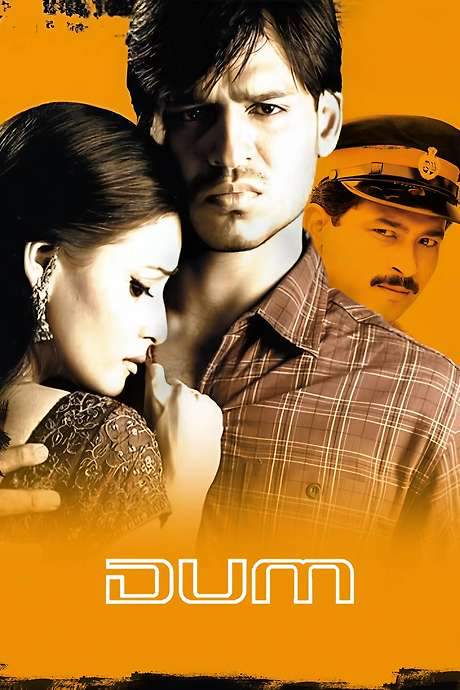
Dum 2003

Directed by

Eeshwar Nivas
Made by

Cineyugg Entertainment Pvt. Ltd.
Where to Watch Dum
See current US streaming, rental, and purchase options for Dum (2003) via JustWatch.






Streaming availability powered by 
Dum Plot Summary
Read the complete plot summary and ending explained for Dum (2003). From turning points to emotional moments, uncover what really happened and why it matters.
Sushant Singh as Mohan and Vivek Oberoi as Uday Shinde come from modest, lower-middle-class families and are stubbornly set on earning a police badge. They dream not just of status, but of proving themselves on merit, trusting that their capabilities will carry them farther than any recommendation. With no powerful connections and little leverage, luck finally smiles when they meet their training officer, Mukesh Rishi in the guise of Raj Dutt Sharma, a seasoned cop who believes in real talent over pedigrees. Under Sharma’s steady guidance, the two young men train hard, push through the grind, and slowly earn a reputation as no-nonsense, upright cops who embody a fresh, principled approach to law enforcement. The bond between mentor and trainees grows as they begin to carve out a place for themselves in a system that often rewards the well-connected more than the capable.
In the film’s broader world, a musically charged moment introduces a special appearance by Yana Gupta in the song Babuji Zara Dheere Chalo, a scene that hints at the film’s blend of grit with larger-than-life showmanship. The plot thickens when Uday’s girlfriend, Kaveri, played by Dia Mirza, witnesses Inspector Shankar—known in the force as Encounter Shankar, a hard-edged cop with a reputation for bending rules—urinating in a river. The witnessing of such a crude act unsettles Kaveri and exposes the darker facets of power within the department. Shankar tries to quiet the disturbance with aggression, attempting to slap Kaveri, but Uday intervenes and delivers a brutal beating, shattering any illusion that Shankar’s code of conduct is above reproach. The confrontation triggers a chilling vow from Shankar: revenge.
From Sharma’s perspective, Shankar’s behavior is not a rogue anomaly but a symptom of a corrupt ecosystem he helped to foster. Sharma explains that Shankar is egoistic, ruthless, and uses his authority to shield himself and others who push wrongdoing. The deeper corruption is traced to Minister Deshmukh, a political heavyweight whose orders set the stage for tragedy. Deshmukh, portrayed by Govind Namdeo, has backed Babu Kasai, a notorious goon, who killed a rival on the minister’s behalf. Babu Kasai is brought to life on screen by Yashpal Sharma. In the backstory, Sharma’s own wife Lakshmi, brought to life by Sheeba, becomes a key witness to the murder, and that testimony places the family in the crosshairs of a murderous power play. The violence doesn’t end there: Shankar himself barges into Sharma’s home and, in a horrific show of force, kills Sharma’s daughter in front of Lakshmi. After this brutal act, Shankar receives a promotion while Sharma is demoted and assigned to the grueling task of selecting new officers for training. These revelations help explain why Sharma took a chance on Mohan and Uday, seeing in them the potential to counterbalance the very system that punished him.
Mohan and Uday decide that they will not let this menace go unchallenged. But Shankar is not a man who accepts challenges silently. He escalates the conflict by killing Mohan, a blow that only hardens Uday’s resolve. In a fierce confrontation, Uday fights back and latches onto Shankar’s gun, using it to kill Babu Kasai. The scene sows confusion and fuels the belief that Shankar was the killer, turning the city’s fear toward the notion that the evil cop has prevailed. The murder, however, triggers Shankar’s most brazen counter-move: he kills Minister Deshmukh and frames Uday for the crime, flipping the public narrative and tightening the net around the two recruits.
As the investigation unfolds, the truth behind Babu Kasai’s fate begins to unravel: Babu Kasai’s death was staged, and he is alive, kept in captivity by Uday as part of a dangerous ruse designed to expose the corruption at the top. Unaware of this, Shankar launches a full-scale manhunt against Uday, determined to wipe out the threat he believes Uday poses. The chase intensifies as the trio—Uday, Kaveri, and the still-elusive Babu Kasai—are tracked across the city. A gunfight erupts, Babu Kasai is gravely wounded, and in a crucial moment, the dying criminal confesses his crimes to Kaveri on video, revealing the tangled web of deceit that had driven the events.
With the evidence mounting and the truth finally surfacing, the city’s commissioner arrives at the crime scene. The confession video, combined with the mounting evidence, compels a surrender from Shankar and Uday alike. Strapped with the legal jeopardy of the charges and the desire to see justice prevail, Uday tracks Shankar down in a final confrontation and kills him, bringing an end to Shankar’s reign of intimidation. After these climactic events, Uday surrenders himself and stands trial. The court’s verdict clears him of the charges, based on the broader evidence that the system had long concealed, and the film closes with a sense of vindication as the public cheers the renewed legitimacy of the police and the resilience of those who fought to restore it.
Dum Timeline
Follow the complete movie timeline of Dum (2003) with every major event in chronological order. Great for understanding complex plots and story progression.
Uday and Mohan join the police under Sharma
From lower middle-class backgrounds, Uday and Mohan dream of joining the police. They pursue the force on merit, without relying on recommendations. Their potential catches the eye of Raj Dutt Sharma, who becomes their training officer and mentor.
Duo earns a reputation as no-nonsense cops
After their training, the duo quickly earns a reputation for being upright and effective, admired for their commitment and discipline. They become symbols of merit-based success within the force. Sharma supports their growth and helps them rise through the ranks.
Kaveri confronts Shankar by the river; Uday intervenes
Kaveri, Uday's girlfriend, witnesses Shankar urinating in a river and objects to his conduct. Shankar slaps at her, but Uday intervenes and beats him, prompting Shankar to vow revenge. This personal vendetta seeds the ensuing conflict.
Sharma exposes Shankar's corruption
Shankar is described as egotistical and corrupt, working on Deshmukh's payroll. Sharma reveals the minister's influence and the danger Shankar poses to justice. The revelation foreshadows the clash between the two cops.
Shankar murders Sharma's daughter; Sharma is demoted
In a brutal act, Shankar barges into Sharma's home and kills Sharma's daughter in front of Lakshmi. Following the murder, Sharma is demoted and reassigned to the role of selecting officers for training, weakening his authority.
Uday vows to end Shankar's menace
Fuelled by the assault on Sharma and the murder of Mohan, Uday resolves that he will not rest until Shankar's menace ends. He commits to bringing the corrupt officer to justice and protecting the public.
Shankar kills Mohan
Shankar escalates his offensive by killing Mohan, Uday's partner. The personal loss deepens Uday's resolve and intensifies the conflict between them.
Uday steals Shankar's gun and kills Babu Kasai
During a tense confrontation, Uday corners Shankar and steals his gun. He uses it to kill Babu Kasai and makes it look like Shankar gunned the criminal, manipulating public perception against Shankar.
Shankar kills Deshmukh and frames Uday
In retaliation, Shankar murders Minister Deshmukh and frames Uday for the crime. This raises the stakes and triggers a massive manhunt for Uday.
Babu Kasai's death is faked; he is alive
It is revealed that Babu Kasai's death was staged and that he is actually alive and held in captivity by Uday. This revelation rewrites the investigation and intensifies the pursuit.
Final confrontation and Babu's deathbed confession
Shankar accelerates the manhunt as the trio is traced. In the aftermath, Babu Kasai is fatally wounded and, on his deathbed, confesses all his crimes to Kaveri, who records the confession on video.
Commissioner exposes the truth and orders surrender
The commissioner arrives and is shown the damning confession. With Shankar's true crimes exposed, he orders both Uday and Shankar to surrender. Shankar attempts to flee, but Uday corners and kills him.
Uday is exonerated and the people celebrate
Uday surrenders and stands trial, but the evidence leads to his exoneration. He is greeted by cheering people as justice is seen to prevail and order is restored.
Dum Characters
Explore all characters from Dum (2003). Get detailed profiles with their roles, arcs, and key relationships explained.
Mohan (Sushant Singh)
From a lower-middle-class background, Mohan pairs with Uday to chase a police career based on merit and grit. He is principled, capable, and hard-hitting, earning a reputation as a no-nonsense officer. His murder at the hands of Shankar becomes the emotional and strategic turning point that fuels Uday's fight for justice.
Uday Shinde (Vivek Oberoi)
Ambitious and fearless, Uday pushes to join the police on merit alone. He rises to challenge corruption while valuing his partner and Kaveri, and he refuses to back down when faced with a powerful adversary. His arc moves from idealistic recruit to a man hunted by a frame-up, ultimately choosing accountability and surrender.
Kaveri (Dia Mirza)
Uday's girlfriend who witnesses a key act of police brutality and becomes a crucial source of truth. She records the confession and presents evidence to the commissioner, driving the collapse of Shankar's facade. Her courage under pressure helps reveal the real stakes behind the killings.
Inspector Shankar (Encounter Shankar) (Atul Kulkarni)
A powerful, corrupt officer aligned with Deshmukh, Shankar uses his badge to commit violence and manipulation. His acts include killing Sharma's daughter and framing Uday, making him the principal villain who embodies abuse of power. His downfall comes through exposure and a final confrontation with Uday.
Raj Dutt Sharma (Mukesh Rishi)
The training officer whose belief in Uday and Mohan helps shape their careers. He provides a moral compass and reveals systemic corruption, offering a path to truth despite political pressures. He becomes part of the backstory that justifies the trainees' trust and actions.
Babu Kasai (Yashpal Sharma)
A goon working for the minister, orchestrating murders to maintain control. His death is staged and later revealed, and his confession becomes key proof in exposing the corrupt network. He embodies the criminal reach of political power.
Deshmukh (Govind Namdeo)
A minister who uses his influence to order violence through goons and police. His scheming and manipulation set the framework for the crime plot and the exploitation of officers for political gain. He is the systemic antagonist behind many of the film's conflicts.
Lakshmi Sharma (Sheeba)
Sharma's wife, who endures the trauma after her daughter's murder and becomes a witness to the truth. She is central to testimony that exposes Shankar's crimes and helps lead to a public presentation of the plot's real criminals. Her courage under pressure adds a human cost to the case.
Dum Settings
Learn where and when Dum (2003) takes place. Explore the film’s settings, era, and how they shape the narrative.
Time period
Early 2000s
Set in contemporary India of the early 2000s, the film depicts a police force grappling with corruption and political interference. The era's tone is one of modern urban crime fighting, with new tactics clashing with old-bossed systems. The story's timeline anchors a society wrestling with accountability and justice.
Location
India
The story unfolds in an urban Indian setting where crime, corruption, and law enforcement intersect. It centers on a police training environment and a city-wide struggle against a powerful political backdrop. The backdrop emphasizes the gritty realities of policing, where choices between duty and danger define the characters.
Dum Themes
Discover the main themes in Dum (2003). Analyze the deeper meanings, emotional layers, and social commentary behind the film.
⚖️
Justice
Justice in the film hinges on truth, evidence, and due process rather than personal vengeance. It shows how crooked power can derail outcomes, but integrity surfaces through testimony and a confession. The commissioner demands surrender, Shankar is exposed, and Uday is exonerated in court, underscoring that justice prevails through proper legal channels.
🗡️
Vigilantism
Uday's pursuit of Shankar sometimes crosses the line into personal justice, reflecting the tension between personal retaliation and the rule of law. The narrative probes whether stopping a corrupt officer justifies taking life, highlighting moral costs and the danger of letting anger guide action. Ultimately, the film leans toward due process, even as it exposes the limits of the system.
🤝
Loyalty
Loyalty threads through the bonds between Mohan and Uday, and between mentors and officers. Mohan's steadfastness in face of danger and his tragic death test Uday's resolve. The loyalty of allies becomes a catalyst for truth-telling, justice, and the decision to surrender to the legal system.

Coming soon on iOS and Android
The Plot Explained Mobile App
From blockbusters to hidden gems — dive into movie stories anytime, anywhere. Save your favorites, discover plots faster, and never miss a twist again.
Sign up to be the first to know when we launch. Your email stays private — always.
Explore the mobile appDum Spoiler-Free Summary
Discover the spoiler-free summary of Dum (2003). Get a concise overview without any spoilers.
In the bustling streets of a city where ambition collides with entrenched power, Uday dreams of pulling on a police badge not for prestige, but to serve his nation with integrity. Raised in a modest background, his determination is matched only by the raw grit of his environment, a world where the line between law and loophole is constantly tested. The film’s tone balances hard‑edged realism with moments of hopeful idealism, painting a portrait of a young man whose resolve is both his greatest weapon and his most vulnerable thread.
Guided by the seasoned trainer Raj Dutt Sharma, who values merit over connections, Uday and his steadfast companion Mohan immerse themselves in the relentless grind of police preparation. Their mentorship forms the heart of a brother‑in‑arms dynamic, underscoring the tension between disciplined duty and the chaotic forces that swirl beyond the academy’s walls. The atmosphere is tinged with a gritty, almost noir‑like edge, where personal convictions clash with the shadowy undercurrents of a corrupt system.
A chance encounter with Kaveri, a television employee whose own world is laced with its own pressures, throws Uday into an unforeseen swirl of personal and professional challenges. Their emerging relationship adds a layer of emotional stakes, hinting at how love and loyalty can both ground and destabilize a soul on the cusp of change. As Uday steps further into the labyrinthine world of law enforcement, the narrative teases a looming confrontation with entrenched corruption, promising a journey where ideals are tested, alliances are forged, and the true cost of justice begins to surface.
Movies with Similar Twists and Themes
Uncover films that echo the narrative beats, emotional arcs, or dramatic twists of the one you're exploring. These recommendations are handpicked based on story depth, thematic resonance, and spoiler-worthy moments — perfect for fans who crave more of the same intrigue.





Featured on this page

What's After the Movie?
Not sure whether to stay after the credits? Find out!
Check out our other apps:

SAT Sphere
Build confidence for the Digital SAT.

Mori Atlas
Discover wild places worth protecting.

Luntero
Search smarter for a home in Amsterdam.

Plot Explained
Unravel movie endings and hidden clues.

Pokechamp
Dive into Pokémon data and battle logic.

Driving Theory
Get ready for your European theory test.

Movie Dust
Plan your next cinema trip with ease.

Musemap
Find art and culture as you travel.

Selkobase
Compare credentials before committing.

Local Manual
Turn an unfamiliar country into practical next steps.

Lernavi
Compare school systems before your next move.

GymRoam
Find a workout stop wherever your plans take you.
Explore Our Movie Platform
New Movie Releases (2026)
Famous Movie Actors
Top Film Production Studios
Movie Plot Summaries & Endings
Major Movie Awards & Winners
Best Concert Films & Music Documentaries
Movie Collections and Curated Lists
© 2026 What's After the Movie. All rights reserved.
Privacy Policy