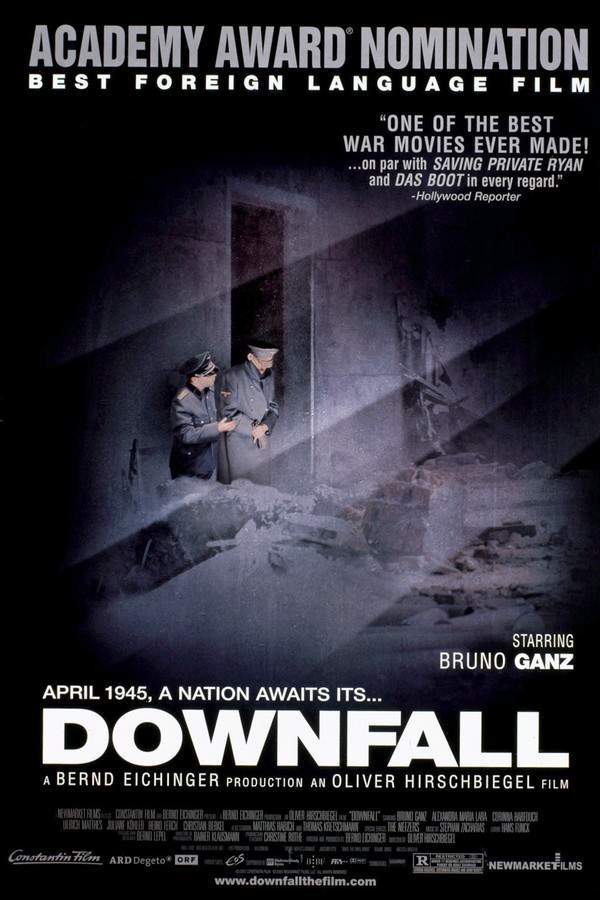
Downfall 2005


Directed by

Oliver Hirschbiegel
Made by

Newmarket Films
Where to Watch Downfall
See current US streaming, rental, and purchase options for Downfall (2005) via JustWatch.

Amazon Prime Video
HD
Amazon Prime Video with Ads
HD
Shout! Factory Amazon Channel
HD
Fawesome
HD
Hoopla
SD
Kanopy
HD
Amazon Prime Video Free with Ads
HD
Plex
HD
Plex Channel
HD
Pluto TV
SD
Shout! Factory TV
HD
Tubi TV
SD
YouTube Free
HD
Amazon Video
SD
Apple TV Store
HD
Fandango At Home
SD
Google Play Movies
SD
YouTube
SD Streaming availability powered by 
Downfall Plot Summary
Read the complete plot summary and ending explained for Downfall (2005). From turning points to emotional moments, uncover what really happened and why it matters.
In November 1942, Adolf Hitler interviews a group of young women for the position of personal secretary and ultimately selects Traudl Junge, Alexandra Maria Lara. The film then pivots from the early accession of a trusted aide to the grim, final days of a crumbling regime, tracing the echoing fear, the tangled loyalties, and the rigid routines that persist even as the war closes in on Berlin.
By 20 April 1945, Hitler’s birthday, the city is pounded by the Red Army as artillery shells streak through the sky, signaling the start of the Battle of Berlin. Inside the bunker, the power dynamics tighten: Reichsführer-SS Heinrich Himmler, unable to persuade Hitler to flee, slips away to secretly negotiate with the Allies. His counterpart, SS-Gruppenführer Hermann Fegelein, who is Eva Braun’s brother-in-law, also fails to move the dictator from the capital. In a parallel bid to safeguard civilians, SS doctor Ernst-Günther Schenck remains behind, stubbornly staying to tend to the people despite the collapsing situation. The tension inside the bunker sharpens as a father, whose son Peter Kranz fights on the front, pleads for desertion, but Peter’s resolve only hardens in the face of wartime indoctrination.
In a telling meeting inside the Führerbunker, Hitler forbids any retreat by the overwhelmed 9th Army and orders counter-attacks by units under Obergruppenführer Felix Steiner and Lieutenant General Walther Wenck’s 12th Army. The dictator himself steps outside the confines of the bunker to recognize a young tank destroyer, Peter, praising him as braver than his generals. The conversation then shifts to the arming of the nation’s dwindling resources; Hitler debates Albert Speer about a scorched-earth policy. Speer argues against destroying the country’s infrastructure, yet Hitler insists the German people have earned their fate and deserve death. Meanwhile, Eva Braun hosts a party in the Reich Chancellery, a scene interrupted by shelling, and she remains firm in her decision not to flee Berlin with Fegelein.
As the pressure mounts, General Weidling learns that a death sentence awaits him for allegedly relocating his command post, prompting him to present himself in the Führerbunker to clear his name. Hitler is visibly moved by Weidling’s sense of duty and promotes him to commander of Berlin’s defense. When Hitler discovers that Steiner’s weakened forces did not mount the anticipated counter-attack, a rare public rage erupts; he denounces his generals in a blistering tirade and, for the first time, acknowledges that the war is lost. He declares his intent to commit suicide rather than surrender or abandon Berlin.
Within the political maelstrom, Goebbels pleads for fewer inexperienced soldiers to be thrown into combat, but the propaganda minister dismisses the notion, asserting that the German people, having proven weaker than their enemies, deserve their fate. A tense communication arrives from Reichsmarschall Hermann Göring, who asks for a leadership role in Hitler’s stead; Hitler responds by ordering Göring’s arrest for treason. Speer returns to the bunker for a final visit and admits that he defied the scorched-earth order. Overcome by a sense of betrayal, Hitler dismisses Speer, choosing not to punish him but to sever ties.
News reaches the Führerbunker that Himmler has engaged in secret negotiations with the Allies, and Hitler orders the execution of Fegelein when the desertion plans become clear. The SS physician Grawitz refuses to leave Berlin and, fearing an Allied reprisal, takes his own life along with his family with hand grenades. Hitler learns of Fegelein’s attempted desertion and authorizes his execution despite Eva’s pleas.
As the city’s plight worsens, Hitler pinpoints a glimmer of hope in Wenck’s 12th Army, even as he knows the odds are slipping away. He dictates his last will and testament to Traudl Junge before a formal marriage to Eva Braun in the early hours of the morning. The moment is shadowed by the realization that the city cannot be saved, and Hitler tests poison on his dog Blondi as a grim prelude to what follows. After farewell exchanges with his inner circle and a resolute refusal to escape, he and Eva commit suicide, their bodies subsequently cremated in the Chancellery garden.
In the aftermath, General Hans Krebs fails to negotiate a ceasefire with Red Army Colonel General Vasily Chuikov, who remains steadfast on unconditional surrender. Magda Goebbels, wife of Goebbels, poisons their six children with cyanide, sealing a grim family tragedy. Krebs and Wilhelm Burgdorf take their own lives as the bunker braces for a surrender. Peter Kranz, the only surviving member of his unit, learns that his parents were executed, while the Goebbels family also perishes. The remaining occupants of the bunker attempt to break out, but only Traudl Junge and Peter manage to escape together. Walther Hewel, a diplomat aligned with the regime, commits suicide despite pleas from Schenk to live.
The film closes with documentary footage featuring an elderly Traudl Junge confessing that youthful ignorance should not have justified involvement in the Nazi regime. The final images linger on the cost of loyalty, the consequences of blind obedience, and the quiet, human toll of a history that, even in its darkest hour, demanded a reckoning.
Downfall Timeline
Follow the complete movie timeline of Downfall (2005) with every major event in chronological order. Great for understanding complex plots and story progression.
Hitler hires Traudl Junge as personal secretary
In November 1942, Adolf Hitler interviews several young women for the position of personal secretary and selects Traudl Junge. She enters the inner circle and begins handling his daily schedule and correspondence. The moment marks Junge’s rise to become a central voice in the film’s narration.
Battle of Berlin begins; Berlin comes under fire
On 20 April 1945, Red Army artillery opens the assault on Berlin as the city braces for its final stand. Himmler attempts to persuade Hitler to flee, while Fegelein also tries to influence him but fails. Ernst-Günther Schenck remains in Berlin to safeguard civilians, defying the chaos around him.
Hitler forbids retreat and orders a counter-attack
In the Führerbunker, Hitler refuses permission for a retreat by the 9th Army and presses for a counter-attack by Steiner’s units and Wenck’s 12th Army. He also publicly honors Peter Kranz for destroying enemy tanks, elevating him above his own generals. The moment underscores the surreal persistence of his stubborn resolve.
Speer argues against scorched-earth policy
Albert Speer visits the bunker to push a plan that would preserve Germany’s infrastructure. Hitler insists on a scorched-earth stance, arguing that the German people deserve death. The clash reveals the widening rift between pragmatic governance and total war ideology.
Eva Braun hosts a party interrupted by artillery
Eva Braun holds a party in the Reich Chancellery, oblivious to the collapsing situation around them. Artillery fire soon interrupts the gathering, interrupting any sense of celebration. She also refuses Fegelein’s pleas to flee Berlin with him.
Weidling is summoned and promoted
General Helmuth Weidling learns he’s been sentenced to death for moving his command post, but he reports to the Führerbunker to clear his name. Impressed by his action, Hitler promotes him to commander of Berlin’s defense. The move centralizes the city’s remaining defenses under a trusted hand.
Hitler denounces his generals and admits defeat
Hitler learns Steiner’s weakened forces did not counter-attack as ordered and erupts in a furious tirade against his generals. He openly acknowledges the war is lost and vows to commit suicide rather than surrender or abandon Berlin. The confession marks a turning point in the bunker’s already doomed atmosphere.
Goebbels argues cynically about the fate of the German people
Propaganda Minister Goebbels presses Mohnke to stop sending inexperienced troops into combat, but he signals there is little hope. He dismisses any notion of mercy and asserts that the German people, having proved weaker than their enemies, deserve their fate. The exchange showcases the collapse of morale at the top.
Göring’s bid for power is rejected; arrest ordered
Hitler receives a telegram from Reichsmarschall Göring requesting delegated state leadership in Hitler’s absence. In response, Hitler orders Göring’s arrest for treason. The moment demonstrates how far the inner circle had fractured.
Speer admits defying scorched-earth; dismissed
Albert Speer visits one last time and admits he defied the scorched-earth order. Hitler dismisses him, not for punishment but with a clear sense of personal betrayal. The moment underscores the isolation and paranoia inside the bunker.
Himmler’s secret negotiations with the Allies exposed
Hitler learns of Heinrich Himmler’s secret negotiations with the Allies and reacts with fury. He orders Himmler’s execution as a traitor, further deteriorating the diplomatic options for the regime. Berlin’s world is shrinking to the bunker’s claustrophobic walls.
Fegelein is executed for desertion
Fegelein’s plans to desert Berlin are discovered and he is executed on Hitler’s orders, despite Eva Braun’s pleas. The incident highlights the regime’s resolve to purge even intimate circles of dissent. The brutal act contrasts with the personal relationships still present in the bunker.
Hitler’s last will and marriage to Eva Braun
Hitler dictates his last will and testament to Traudl Junge, then marries Eva Braun in an early morning ceremony. The rituals underscore a yearning for normalcy even as the collapse accelerates. The duo’s actions crystallize the endgame of his rule.
Suicide, poison and cremation in the bunker
Hitler tests poison on his dog Blondi before taking his own life with Eva Braun. The couple’s bodies are carried out for cremation in the Chancellery garden, sealing the final, ritual acts of the regime. The scene marks the irreversible end of the Nazi leadership’s power.
Endgame deaths, fallout, and escapes
In the final hours, Krebs fails to negotiate a ceasefire and Burgdorf takes his own life. Magda Goebbels poisons her six children. Walther Hewel also commits suicide in the bunker. Amid the chaos, Traudl Junge escapes the bunker and is later joined by Peter Kranz.
Downfall Characters
Explore all characters from Downfall (2005). Get detailed profiles with their roles, arcs, and key relationships explained.
Adolf Hitler (Bruno Ganz)
In the final days, Hitler isolates himself in the Führerbunker, clinging to a doomed belief that the war can still be won. He demands absolute obedience and pushes a scorched-earth policy, harshly judging perceived treachery and dismissing rivals. He dictates his last will, marries Eva Braun, and ultimately dies by suicide with Eva as Berlin falls.
Traudl Junge (Alexandra Maria Lara)
Chosen as Hitler’s personal secretary in 1942, Junge becomes a quiet observer as the bunker tightens around the Führer. She witnesses the dictator’s tirades, records the last will, and bears witness to the regime’s collapse even as she eventually escapes the ruined city. Her perspective anchors the film’s late-night, documentary-style coda.
Joseph Goebbels (Ulrich Matthes)
As propaganda minister, Goebbels embodies the regime’s ruthless pragmatism. He urges no mercy toward inexperienced soldiers, defends the scorched-earth plan, and clashes with others over strategy. He remains in the bunker until the collapse, sharing in the regime’s ultimate suicide.
Eva Braun (Juliane Köhler)
Hitler’s companion inside the bunker, she hosts a party amid bombardment and ultimately refuses to flee Berlin. She marries Hitler in an early-morning ceremony and dies with him by suicide, refusing to separate from her partner as the regime ends.
Magda Goebbels (Corinna Harfouch)
Magda Goebbels is depicted as fiercely devoted to her husband and family, ultimately poisoning their six children with cyanide capsules to avoid capture. She and Goebbels then take their own lives as the bunker collapses, reinforcing the regime’s ruthless final act.
Downfall Settings
Learn where and when Downfall (2005) takes place. Explore the film’s settings, era, and how they shape the narrative.
Time period
1942-1945
The narrative begins in November 1942 with Hitler selecting Traudl Junge as his personal secretary, and progresses to the collapsing days in 1945. It depicts the late-war siege of Berlin, the bunker life, and the decision points that lead to surrender and suicide. The film closes with reflections on the era from Traudl Junge.
Location
Berlin, Führerbunker, Reich Chancellery
The primary setting is Berlin during the final days of World War II. Key locations include the Führerbunker beneath the Reich Chancellery, where Hitler and his inner circle retreat from the war. The city endures heavy bombardment as the Battle of Berlin closes in, and the film centers on the bunker as the regime unravels.
Downfall Themes
Discover the main themes in Downfall (2005). Analyze the deeper meanings, emotional layers, and social commentary behind the film.
🔥
Power Collapse
The film portrays the intoxicating hold of power on Hitler and his inner circle as defeat looms. It shows how hubris distorts decisions, from the insistence on a scorched-earth policy to the refusal to retreat. The collapse of the leadership exposes the fragility of a regime built on fear and obedience.
🕯️
Loyalty Betrayal
Characters wrestle with loyalty to a figure who governs through intimidation, while others weigh personal safety against duty. Goebbels' cold pragmatism contrasts with intimate loyalties and family bonds within the bunker. The decisions—like Speer’s defiance and Eva Braun’s choices—reveal how betrayal and complicity shape outcomes.
🌆
War's End
The narrative culminates in the fall of Berlin and the end of the Nazi regime. It depicts relentless bombardment, futile attempts to turn the tide, and the personal tragedies that accompany surrender. The film closes with a stark, documentary-like reflection on the consequences of collective violence.

Coming soon on iOS and Android
The Plot Explained Mobile App
From blockbusters to hidden gems — dive into movie stories anytime, anywhere. Save your favorites, discover plots faster, and never miss a twist again.
Sign up to be the first to know when we launch. Your email stays private — always.
Explore the mobile appDownfall Spoiler-Free Summary
Discover the spoiler-free summary of Downfall (2005). Get a concise overview without any spoilers.
In the waning days of a continent‑wide conflict, Berlin’s underground command center becomes a pressure cooker of cramped corridors, low‑lit rooms, and relentless anxiety. The oppressive atmosphere is amplified by the distant roar of artillery and the knowledge that the war outside is collapsing, while inside the bunker a rigid routine persists, giving the impression that time itself might stall. The film immerses viewers in this claustrophobic world, where every whispered conversation feels both intimate and fraught with the weight of history.
At the heart of this tense environment sits a young woman thrust into the epicenter of power. Traudl Junge, fresh from a selection process for a secretarial position, becomes the personal aide to the Führer, granting her an unprecedented, if uncomfortable, proximity to the man who shapes the fate of a nation. Through her eyes we witness the stark contrast between the formalities of official duties and the unsettling, increasingly erratic behavior of the leader, all while navigating the silent expectations of those surrounding him. Her relationship with Adolf Hitler is marked by a mix of deference, bewilderment, and an emerging awareness of the enormity of the situation, while interactions with Eva Braun reveal a more personal, almost domestic side of the inner circle.
The tone is unflinching and stark, painting a portrait of loyalty tested under extreme pressure. The lingering presence of high‑ranking officials creates a delicate dance of power, fear, and desperation, each trying to maintain control as the world outside inexorably closes in. The film’s style blends documentary‑like realism with intimate close‑ups, urging the audience to feel the suffocating tension and the quiet, human moments that emerge amid the looming collapse. This backdrop sets the stage for a compelling exploration of duty, conscience, and survival in a moment that history will never forget.
Featured on this page

What's After the Movie?
Not sure whether to stay after the credits? Find out!
Check out our other apps:

SAT Sphere
Build confidence for the Digital SAT.

Mori Atlas
Discover wild places worth protecting.

Luntero
Search smarter for a home in Amsterdam.

Plot Explained
Unravel movie endings and hidden clues.

Pokechamp
Dive into Pokémon data and battle logic.

Driving Theory
Get ready for your European theory test.

Movie Dust
Plan your next cinema trip with ease.

Musemap
Find art and culture as you travel.

Selkobase
Compare credentials before committing.

Local Manual
Turn an unfamiliar country into practical next steps.

Lernavi
Compare school systems before your next move.

GymRoam
Find a workout stop wherever your plans take you.
Explore Our Movie Platform
New Movie Releases (2026)
Famous Movie Actors
Top Film Production Studios
Movie Plot Summaries & Endings
Major Movie Awards & Winners
Best Concert Films & Music Documentaries
Movie Collections and Curated Lists
© 2026 What's After the Movie. All rights reserved.
Privacy Policy