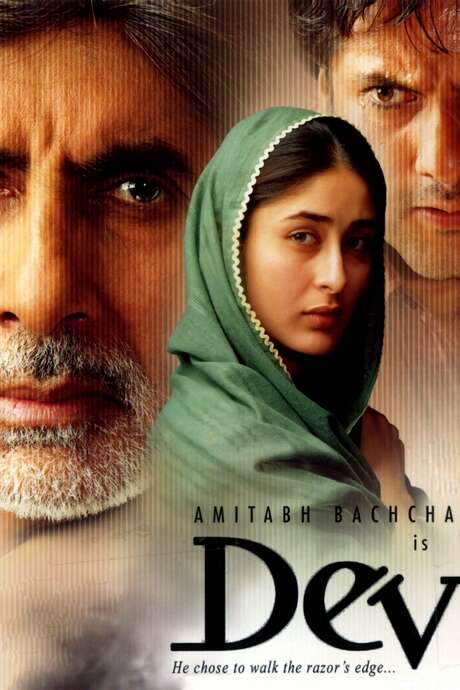



Where to Watch Dev
See current US streaming, rental, and purchase options for Dev (2004) via JustWatch.

Fawesome
HD
Plex
HD
Plex Channel
HD
Tubi TV
SD
Amazon Video
SD Streaming availability powered by 
Dev Plot Summary
Read the complete plot summary and ending explained for Dev (2004). From turning points to emotional moments, uncover what really happened and why it matters.
Two lifelong friends, Dev Pratap Singh, a duty-bound Joint Commissioner of Police, and Tejinder Khosla, the balancing force between political interests of Chief Minister Bhandarker and the rule of law, navigate a city where power and justice constantly clash. Each man holds firm to his own ideals: Dev champions strict adherence to the law, while Tejinder weighs political realities against public safety, trying to maintain order without sacrificing integrity. Their bond sits at the heart of a turbulent urban landscape where every decision ripples through communities, politics, and the streets.
Farhaan is a fresh law graduate raised on ideals of non-violence and patriotism. A peace demonstration turns brutal when his father dies, and Dev’s actions—even if unintended—leave Farhaan wounded in more ways than one. That single moment seeds a corrosive anger inside him, steering his future away from the quiet pursuit of justice and toward a path marked by rage and catastrophe. The city’s fragile peace tilts as Farhaan’s sense of purpose becomes hijacked by a harsher, more violent resolve.
Taking advantage of Farhaan’s vulnerabilities, Latif, a corrupt politician, steers him toward violence. He supplies training, guidance, and the means to wield a gun, transforming a hopeful young man into a dangerous instrument whose loyalty is to political power rather than the people he once sought to protect. This manipulation exposes how swiftly a principled upbringing can be bent by cynical ambition, and how easily fear can masquerade as righteous action when violence becomes a shortcut to “order.”
Aaliya enters Farhaan’s life as a beacon of light—beautiful, sincere, and brave enough to challenge the darkness around them. She embodies innocence and courage, standing up for truth even as she, too, is drawn into the extraordinary circumstances spiraling around Farhaan. Her presence offers a counterpoint to the violence, reminding him of a future that might still be saved by integrity and love.
On a train bound for Bombay from Surat, a police inspector interrogates Farhaan about his purpose in the city and any potential links to Pakistan. He explains he’s going to live with his father and has no such connections. As he probes deeper, he discovers that the Mumbai Police are targeting Muslims under the banner of counter-terrorism, resulting in killings that shock him into questioning the system. He learns that Dev Pratap Singh is involved in this ruthless campaign, a revelation that fuels his inner conflict and pushes him toward a pivotal choice about whom he will trust.
Farhaan’s sense of betrayal gives way to a grim realism as he joins Latif in the fight he’s been drafted into. He undergoes further indoctrination in weapon-handling and is prepared for operations that blur the line between justice and vengeance. Yet when the moment comes to act, he cannot bring himself to kill Dev—who escapes, rattled but alive—revealing the fragility of the line between heralded authority and failed governance.
Meanwhile, Chief Minister Bhandarker presses a ruthless campaign to root out perceived terrorists, stacking the deck in favor of swift, brutal measures and sidelining due process. The violence intensifies as Farhaan’s life intertwines with a riotous climate that destabilizes both Hindu and Muslim communities. In the chaos, Latif plots and coordinates a wave of attacks against Hindu targets, while his ally Mangal Rao—a right-wing figure who rises to organize the riots—stirs sectarian fury and fanatical crowds. The city becomes a tinderbox where every act of retaliation feeds another round of violence.
When a package Farhaan delivers explodes near a Hindu temple, the resulting carnage devastates neighborhoods and ignites widespread riots. Hundreds lose their lives as authorities are instructed to stand by rather than intervene, deepening the fracture between communities. Latif mobilizes his men to strike at Hindus and Hindu establishments, escalating fear and mistrust throughout the region. To end the bloodshed, Latif and Mangal Rao agree to a fragile truce on one condition: no Muslim male, female, or child may file an FIR in any police station. This chilling stipulation locks the community in silence and exposes the darkest side of political bargains.
In the fallout, Farhaan realizes he has been a pawn in Latif’s larger game. With his faith in the manipulators shattered, he makes a decisive pivot, choosing to place his trust in Dev Pratap Singh and to become an informer. The choice marks a turn toward accountability, even as the city’s wounds run deep and the futures of many—friends, lovers, and strangers alike—hang in a delicate balance between justice and vengeance.
Dev Timeline
Follow the complete movie timeline of Dev (2004) with every major event in chronological order. Great for understanding complex plots and story progression.
Train interrogation and awakening
On a train bound for Bombay from Surat, a police inspector questions Farhaan about his motive for going to Bombay and any ties with Pakistan. Farhaan insists he is traveling to live with his father and has no Pakistani connections. He also becomes aware that Bombay Police are targeting Muslims under the guise of fighting terrorism, which unsettles him early on.
Farhaan learns Dev is involved in witch hunts
Farhaan discovers that Joint Commissioner Dev Pratap Singh is overseeing the ruthless witch hunt against Muslims in the city. This revelation fuels his anger and leads him to think of killing Dev. He decides to align with Latif, the local Muslim political leader, to take action.
Farhaan joins Latif and gets trained
Latif trains Farhaan in handling firearms and prepares him for violent action against the regime. Farhaan becomes deeply involved in plans to use violence to protest the oppression he sees. The path labeled as revenge pushes him away from his peaceful ideals.
Failed assassination attempt
Farhaan confronts Dev but fails to kill him; Dev escapes unharmed though shaken. This close call reveals Dev’s readiness and capability to survive. The incident intensifies the political crackdown that follows.
Chief Minister orders crackdown
Following the attempted assassination, Chief Minister Bhandarkar orders the police to root out terrorist elements in the city. The crackdown is ruthless, affecting many innocent people and escalating tensions. The state takes a hard line on security, amplifying the violence.
Delivery of the explosive package
Farhaan is instructed to deliver a package to a man near a Hindu temple. He completes the delivery, unaware of the danger. The package explodes while he stops to buy snacks, killing several bystanders. The incident sparks communal riots.
Riots and police inaction
Riots erupt across the city as Hindus and Muslims clash. The police are instructed to observe and not intervene, allowing the violence to spiral out of control. Hundreds are killed in the chaos, further fracturing the community.
Latif and Mangal Rao's truce deal
In the aftermath, Latif manipulates the situation to reach a truce with Mangal Rao, the right-wing leader. The condition is that no Muslim male, female, or child will file an FIR in any police station. Latif imposes this warning on the Muslim community.
Public plea for peace
Hindus and Muslims publicly call for peace after the violent outbreak. The fragile truce underscores the fragile balance between political interests and public safety. It shows a moment of potential reconciliation even as distrust remains.
Farhaan realizes he’s been used
Farhaan learns that Latif has used him as a pawn in his larger political game. This realization shifts his perspective and leads him to re-evaluate his loyalties. He decides to trust Dev and use his position to fight the truth.
Farhaan becomes an informer for Dev
Farhaan resolves to become an informer for Dev, choosing to work from within Latif’s network. He believes this is the path to expose the truth and stop the violence from within. The transition marks a turning point in his personal journey.
Aaliya's influence
Aaliya, the light in Farhaan's life, remains caught in extraordinary circumstances but dares to stand up for truth. Her presence highlights the personal cost of the conflict and the possibility of moral courage. She becomes a catalyst for Farhaan to seek a better path.
Dev Characters
Explore all characters from Dev (2004). Get detailed profiles with their roles, arcs, and key relationships explained.
Farhaan Ali (Fardeen Khan)
A law graduate with initial ideals of non-violence and patriotism, Farhaan is pushed toward rage after his father's death at a peace demonstration. He becomes a pawn in Latif's political games and is trained to confront Dev Pratap Singh. Realizing he has been used, he decides to work with Dev as an informer to uncover the truth.
Dev Pratap Singh (Amitabh Bachchan)
Joint Commissioner of Police, Dev is a duty-bound, self-righteous officer whose commitment to the law clashes with political machinations. He navigates pressure from Tejinder Khosla and Chief Minister Bhandarker as he fights to keep order. He becomes a central figure as Latif's schemes unfold, staying true to his pursuit of justice.
Aaliya (Kareena Kapoor Khan)
Beautiful and innocent, Aaliya is the light in Farhaan's life and stands up for truth in the midst of turmoil. Her courage anchors Farhaan and challenges him to pursue what is right. She embodies resilience and compassion in a city torn by conflict.
Latif
Latif is a local Muslim political leader who uses the violence and unrest to advance his own agenda. He orchestrates actions to destabilize the city and manipulates communities through fear and rhetoric. His schemes reveal how political actors can profit from communal strife.
Mangal Rao
A right-wing faction leader who organizes riots near Hindu temples, escalating violence against Muslims. He embodies the retaliatory backlash that drives the city toward further chaos and hinders peace efforts.
Tejinder Khosla
Special Commissioner Tejinder Khosla acts as a balancing force between the Chief Minister's political aims and Dev's commitment to law and order. He negotiates conflicting orders as the city slides into unrest.
Chief Minister Bhandarker
A corrupt political figure who uses police and state machinery to shield his interests. His power plays drive much of the conflict, underscoring how political ambition can override justice.
Dev Settings
Learn where and when Dev (2004) takes place. Explore the film’s settings, era, and how they shape the narrative.
Time period
Early 2000s
Set in contemporary India, the story unfolds in the early 2000s amid political bargaining, police crackdowns, and communal unrest. It portrays a period when political interests often overshadow justice and civil liberties are strained by security concerns. The events reflect a modern urban crisis rather than a historical era.
Location
Mumbai, Surat
Mumbai (formerly Bombay) forms the core setting, a sprawling metropolis of crowded trains, markets, and conflicting communities. The narrative also touches the route from Surat to Mumbai, highlighting transit hubs and urban neighborhoods. The city's public spaces—temples, police stations, and riots—become theaters for political maneuvering and violence.
Dev Themes
Discover the main themes in Dev (2004). Analyze the deeper meanings, emotional layers, and social commentary behind the film.
⚖️
Power & Corruption
The film shows how politicians exploit fear and the police to advance their agenda. Dev, a rule-bound officer, confronts systemic corruption as Latif and Chief Minister manipulate him. Farhaan's radicalization illustrates how power structures recruit individuals to their violence. The theme examines moral compromise and the consequences of institutional corruption on ordinary people.
🕊️
Peace & Violence
Riots erupt and retaliation follows as law enforcement appears to look the other way, illustrating how civilian lives are sacrificed for political agendas. The narrative juxtaposes moments of fragile peace with bursts of brutal violence to underscore the fragile nature of communal harmony. The story suggests peace is achievable only when power structures prioritize justice over vengeance. It also examines the human cost of choosing violence as a political tool.
🧭
Identity & Loyalty
The narrative probes how identity and faith are exploited to fracture communities, testing where individuals place their loyalties. Farhaan's arc shows how personal ideals can be manipulated by political players, forcing a choice between loyalty to a cause or to truth. Aaliya's presence anchors Farhaan to a path of truth and non-violence amid surrounding chaos. The film challenges what loyalty means when survival and justice are at stake.

Coming soon on iOS and Android
The Plot Explained Mobile App
From blockbusters to hidden gems — dive into movie stories anytime, anywhere. Save your favorites, discover plots faster, and never miss a twist again.
Sign up to be the first to know when we launch. Your email stays private — always.
Explore the mobile appDev Spoiler-Free Summary
Discover the spoiler-free summary of Dev (2004). Get a concise overview without any spoilers.
In a restless metropolis where political ambitions constantly brush against the rule of law, Dev Pratap Singh serves as the Joint Commissioner of Police, embodying an uncompromising dedication to procedure. Beside him, Tejinder Khosla works as the Special Commissioner, constantly weighing the demands of the state against the pulse of the streets. Together they navigate the tightrope of governance under the watchful eye of Chief Minister Bhandarker, whose agenda adds a layer of strategic pressure to every decision. The city’s atmosphere hums with a gritty realism, where each directive can ripple through neighborhoods, igniting debates about justice, power, and survival.
Enter Farhaan, a freshly minted law graduate whose upbringing is steeped in non‑violence and patriotism. His idealistic outlook is challenged the moment he encounters the enforcement machinery that Dev represents, sparking an inner turmoil that hints at a darker transformation. At the same time, Latif lurks in the shadows of the political arena, a corrupt figure whose influence begins to shape the young graduate’s path, suggesting that the line between principle and pragmatism can be disturbingly thin. This tension sets the stage for a compelling exploration of how personal convictions can be tested by the harsh realities of a city teetering on the brink.
Against this backdrop, Aaliya arrives as a beacon of sincerity and courage, offering Farhaan a glimpse of hope and an anchor to his lingering humanity. Her presence introduces a softer counterpoint to the escalating unrest, hinting at the possibility of redemption amid chaos. The film’s tone blends brooding intensity with moments of fragile optimism, inviting viewers to sense the palpable undercurrents of conflict without revealing the outcome. As alliances form and loyalties are questioned, the story promises a charged atmosphere where every character must decide where they stand in a world where law, politics, and personal belief constantly collide.
Featured on this page

What's After the Movie?
Not sure whether to stay after the credits? Find out!
Check out our other apps:

SAT Sphere
Build confidence for the Digital SAT.

Mori Atlas
Discover wild places worth protecting.

Luntero
Search smarter for a home in Amsterdam.

Plot Explained
Unravel movie endings and hidden clues.

Pokechamp
Dive into Pokémon data and battle logic.

Driving Theory
Get ready for your European theory test.

Movie Dust
Plan your next cinema trip with ease.

Musemap
Find art and culture as you travel.

Selkobase
Compare credentials before committing.

Local Manual
Turn an unfamiliar country into practical next steps.

Lernavi
Compare school systems before your next move.

GymRoam
Find a workout stop wherever your plans take you.
Explore Our Movie Platform
New Movie Releases (2026)
Famous Movie Actors
Top Film Production Studios
Movie Plot Summaries & Endings
Major Movie Awards & Winners
Best Concert Films & Music Documentaries
Movie Collections and Curated Lists
© 2026 What's After the Movie. All rights reserved.
Privacy Policy