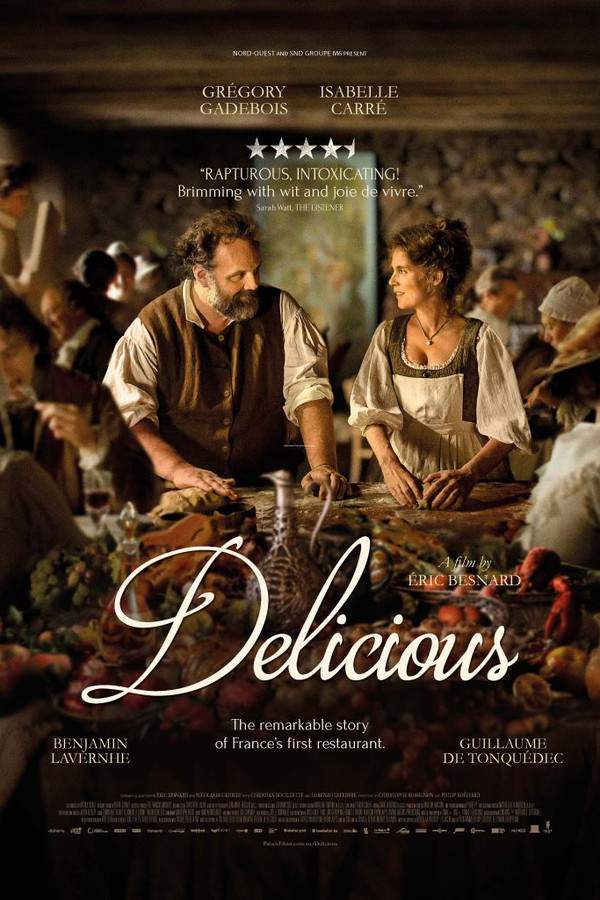
Delicious 2022


Directed by

Eric Besnard
Made by

Samuel Goldwyn Films
Where to Watch Delicious
See current US streaming, rental, and purchase options for Delicious (2022) via JustWatch.

Amazon Prime Video
HD
Amazon Prime Video with Ads
HD
Hoopla
SD
Kanopy
HD
Plex
HD
Plex Channel
HD
Pluto TV
SD
The Roku Channel
HD
Tubi TV
SD
YouTube Free
HD
Amazon Video
SD
Apple TV Store
HD
Fandango At Home
SD
Google Play Movies
SD
YouTube
SD Streaming availability powered by 
Delicious Plot Summary
Read the complete plot summary and ending explained for Delicious (2022). From turning points to emotional moments, uncover what really happened and why it matters.
Set in 1789, on the eve of the French Revolution, the story follows Pierre Manceron, a master cook who earns his living in the service of the stern and refined Le duc de Chamfort. He crafts a small, exquisite savory pastry—a tiny delicacy filled with mushroom and potato—that feels almost like a whispered rebellion against the rigid cuisine reserved for the aristocracy. Today is his chance to prove he belongs among Paris’s finest palates: if he can feed the duke’s circle of friends a meal that sparkles in their eyes, he will win a coveted invitation to cook for the city’s elite.
The banquet unfolds with a parade of classic dishes, yet [the delicious] pastry—as small as it is—becomes the center of attention. At first, the guests praise the cooking, but one sharp observer notices the inclusion of potatoes, a humble tuber unfamiliar and barely tolerated by the nobility of the time. The potatoes provoke laughter and scorn, and the moment exposes a fault line between refinement and practicality. The aristocrats’ mockery turns personal, and the masterful dinner collapses into humiliation. The duke’s merciless judgment lands squarely on [Pierre Manceron], and he is dismissed, his pride crushed, leaving him to retreat to his father’s home, which has already been looted by starving citizens in need of food. The weight of the failure is heavy, and Benjamin Manceron, Pierre’s son, along with Jacob, an old friend, join the family in their moment of defeat.
Into this bleak moment arrives Louise, a woman who asks to become Manceron’s apprentice. He resists, clinging to a belief that cooking is a man’s world, and even when she offers to pay, he refuses. Yet Louise refuses to be turned away; she endures the rain outside and refuses to leave until he changes his mind. Her stubborn resolve uncovers a natural talent in the kitchen, and a quiet, powerful bond forms between them through the shared craft of creating food. In time, Pierre Manceron recognizes her skill and reluctantly accepts her as part of the team. The partnership between the once-broken master and the determined apprentice begins to reshape their lives and their ambitions.
With Louise by his side, an opportunity to reclaim his status with the duke reappears. The family, including Benjamin Manceron, who brings a scholar’s curiosity and a revolutionary streak, and Jacob, prepare anew. The plan evolves beyond individual pride into something bolder: a venture that could redefine how meals are shared. They decide to run a public inn where food is accessible to all, offering generous portions and honest nourishment, a revolutionary idea in a society that keeps delicious cooking within the temple of aristocracy. The inn becomes a thriving hub of life, drawing soldiers and common folk alike to tables set with simple abundance. Louise uses her wiles to build a bustling place, and the workers—some of whom are young bread thieves turned waitresses—help transform the inn into a symbol of communal sustenance.
But Louise’s past still haunts them. She fears the duke will return and threaten to ruin them once more. Her plan to poison the duke resurfaces as a means to force recognition of their craft and to topple the old order. When a revised feast begins to take shape, the mood shifts from revenge to resilience, and Manceron, though wounded by Louise’s deception, discovers a new purpose in cooking for everyone who sits at his tables.
The turning point arrives when the duke himself is invited to the inn to sample the new recipes. Unlike the previous feast, there are no ostentatious decorations or guards, just a line of hungry patrons, a modest setup, and a sense that a real meal can belong to anyone. Manceron serves the duke on tin plates, insisting that the true flavor lies not in luxury, but in craft and heart. As the duke and his companion taste the first course—the long-simmered, rustic flavors that have become the soul of the inn—other guests begin to arrive. The duke is furious, insisting that the meal was supposed to be private, but Louise stands ready to reveal the truth. A flier is unveiled proclaiming, “Come to the Inn and eat a free meal with the Duke of Chamfort,” and the crowd erupts. The duke realizes the humiliation he faces is not a single rebuke but a mass awakening.
The scene expands into a chorus of voices: the aristocracy is challenged, the commoners reclaim their dignity, and the duke’s authority dissolves in a wave of collective action. A loyal servant to the duke shedding his wig and taking a seat at the tables signals a shift in allegiance as more people choose the inn over the old regime. The atmosphere crackles with a new sense of equality, and Pierre Manceron and Louise share a quiet, victorious kiss as the camera pulls back to reveal the sweeping French countryside. The film closes on a note of historical transformation, with the on-screen declaration: two days later, the Bastille fell.
In this intimate odyssey of food and memory, the art of cooking becomes an instrument of change. The partnership between Louise and Pierre Manceron evolves beyond professional respect into a shared dream of feeding all, regardless of class, while the steadfast courage of Benjamin Manceron and Jacob anchors the family’s new path. The narrative weaves together themes of resilience, social equity, and the power of humble meals to challenge a rigid social order, culminating in a moment of collective uprising that hints at a future where nourishment and opportunity are no longer the sole reserve of the few.
Delicious Timeline
Follow the complete movie timeline of Delicious (2022) with every major event in chronological order. Great for understanding complex plots and story progression.
The delicious pastry is unveiled
Pierre Manceron, the master cook for Duke Chamfort, unveils a tiny savory pastry filled with mushroom and potato, named the delicious. This dish is meant to prove his skill and earn a chance to cook for Paris's finest. The moment foreshadows the tension between aristocratic tastes and a cook's ambition.
The potato controversy at the banquet
Among the praise, a guest notices the potatoes in the pastry, which are seen as beneath the nobles. The remark humiliates Manceron and leads the Duke to fire him for not apologizing. The setback forces him to retreat from court life.
Return to the father’s house
Manceron goes back to his father's house, now looted by starving citizens seeking food. The master cook confronts ruin and uncertain prospects for his craft. His son Benjamin and his old friend Jacob join him for support.
Louise arrives seeking apprenticeship
Louise arrives at the doorstep offering to become Manceron's apprentice. Manceron initially refuses, claiming that cooking is a man's profession. She refuses to leave and sits in the rain all night until he relents, showing unwavering determination.
Louise proves her talent and bonds with Manceron
Manceron grudgingly takes her on and discovers she is a talented cook. They grow closer as they work side by side, forming a deep bond through their shared love of cooking. Their partnership begins to reshape their plans for the future.
A plan to reclaim status: the new feast
With Louise's skill, they set their sights on winning back the Duke's favor by staging a fresh feast. Benjamin, the bookish revolutionary, doubts the plan but joins the effort as a catalyst for change. They work to create a dignified yet popular meal in a humble setting.
The duke's carriage passes by again
The planned feast is prepared, but the Duke and his friends laugh and drive past the inn without stopping. The moment underscores the old aristocracy's contempt for the common people's table. The overlooked feast plants seeds for the coming reversal.
Louise's aristocratic past revealed and motive explained
During the confrontation, Louise reveals she is an aristocrat's widow with a painful past and a calculated desire for revenge. She explains that she intended to poison the Duke and describes how the Duke ruined her life. Manceron is stunned by the revelation and the complexity of Louise's motives.
Despair to resilience: Louise leaves; the inn grows
Manceron is devastated by rejection and Louise's betrayal; He drowns his sorrows in drink and suffers a fall from his horse, injuring himself. Louise nurses him back to health, and when he wakes, the inn has become a thriving business with soldiers flocking to eat. The new venture signals a rebirth of their partnership and purpose.
A plan to win Louise back: invitation and retreat
Manceron resolves to reunite and convinces the Duke to come to the inn to taste his new recipes, seeking a second chance. He also goes to the convent where Louise has found shelter to beg her return and reveal the plan. The two seek to restore their partnership and spread the idea that food is for everyone.
The inn becomes a stage for equality
The Duke and his lady arrive at the inn, greeted by a plain setting where people of all classes share tables. More guests arrive and the crowd swells, pressing against aristocratic privilege. The Duke sputters in humiliation as Louise declares the new order, and a servant from the Duke's side seeks refuge among the inn's growing staff.
Two days later the Bastille fell
The confrontation at the inn culminates in a broader social awakening, symbolically echoed by the restive crowd outside. The camera pulls back to reveal the countryside as the on-screen text announces that the Bastille fell two days later. The story closes by linking personal revolution to a national upheaval, suggesting a new era of equality through food.
Delicious Characters
Explore all characters from Delicious (2022). Get detailed profiles with their roles, arcs, and key relationships explained.
Pierre Manceron (Grégory Gadebois)
Pierre Manceron is a master cook who takes pride in his craft and seeks to prove himself to the Duke of Chamfort. He is capable and stubborn, but his confidence is shattered when the aristocracy humiliates him over a humble pastry. After losing his position, he retreats to his father’s looted home and must confront what truly matters: creating meals that nourish more than just the elite. His arc moves from pride to resilience as he rebuilds through partnership with others.
Louise (Isabelle Carré)
Louise is a talented cook and aristocrat's widow who seeks shelter and employment with Manceron. She arrives with a complex motive, initially motivated by revenge against the duke for past humiliations and personal ruin. Her culinary skill becomes central to the transformation of the inn into a thriving, inclusive space. Her actions drive the plot’s moral questions about loyalty, justice, and the cost of revenge.
Jacob (Christian Bouillette)
Jacob is a loyal old friend who joins Manceron after the fall from grace. He provides steady support and helps navigate the dangers of rebuilding a kitchen and a community. His practical outlook and friendship anchor the group as they pursue a more egalitarian dining model. He embodies steadfast solidarity amid upheaval.
Le duc de Chamfort (Benjamin Lavernhe)
The Duke of Chamfort represents aristocratic entitlement and vanity. He humiliates Manceron in front of Parisian friends and resists any challenge to the aristocratic order. His fear and aggression are exposed when the crowd asserts its power, and he ultimately flees as the social equilibrium begins to tilt toward equality.
Benjamin Manceron (Lorenzo Lefèbvre)
Benjamin is Manceron’s son, a bookish and perceptive presence who questions the old order. He foresees the dangers and opportunities in turning a kitchen into a community hub and pushes for a more inclusive business. His character embodies the revolutionary spirit of seeing potential where others see limits.
Delicious Settings
Learn where and when Delicious (2022) takes place. Explore the film’s settings, era, and how they shape the narrative.
Time period
1789
The film unfolds in 1789, a year just before the French Revolution, when a privileged class holds sway over politics, land, and dining. It situates a society where food marks status and scarcity fuels tension. The Bastille’s fall is foreshadowed as a turning point, signaling an imminent upheaval.
Location
Paris, French countryside
Set in late 18th-century France, the story moves between Parisian aristocratic salons and the countryside where Manceron's family home and the inn become focal points. The locations highlight the divide between lavish feasts and the hunger that drives people to improvise communal meals. The contrast between urban privilege and rural hardship underscores the social shifts central to the narrative.
Delicious Themes
Discover the main themes in Delicious (2022). Analyze the deeper meanings, emotional layers, and social commentary behind the film.
⚖️
Class Struggle
The story centers on the clash between aristocratic privilege and the rising demand for dignity and access to food. The rejection of the potato pastry by Parisian elites exposes entrenched snobbery and the precariousness of those reliant on noble favor. As the inn opens to all, the film reveals how hunger and social hierarchy shape choices and outcomes. The eventual push from the community against aristocratic excess frames the narrative around systemic inequality.
🍽️
Culinary Power
Cooking becomes a vehicle for empowerment and social change. The act of feeding becomes a democratic act, transforming a private craft into a shared public experience. The characters use food to challenge boundaries between classes and to redefine worth beyond noble birth. Through recipes and meals, the film explores how nourishment can unite disparate people.
🔥
Revolutionary Spark
The plot builds from personal betrayals and culinary ambition into a broader challenge to the old order. The arrival of crowds at the inn, the disappearance of luxury, and the villagers’ willingness to stand up against tyranny signal a social awakening. The narrative hints at a turning point in history as collective action gains momentum around food, work, and dignity.

Coming soon on iOS and Android
The Plot Explained Mobile App
From blockbusters to hidden gems — dive into movie stories anytime, anywhere. Save your favorites, discover plots faster, and never miss a twist again.
Sign up to be the first to know when we launch. Your email stays private — always.
Explore the mobile appDelicious Ending Explained
Unravel the ending of Delicious (2022) with our detailed explanation. Understand the final scenes, character fates, and unresolved questions.
The ending of Delicious reveals that Teodora and her friends are cannibals, embodying their manifesto of “eating the rich” in a literal sense. They target the wealthy but choose to spare Alba and Philipp, which raises intriguing questions about their motives. It’s not clear if Teodora genuinely cares for Alba or sees her as a symbol of potential change, perhaps believing that Alba, coming from wealth, could adopt their anti-capitalist ideals. Teodora’s manipulation of Alba, including gaining her trust and making her feel insecure, hints that her decision to leave Alba alive might be strategic—either as an act of mercy or as an attempt to “convert” her. The film leaves uncertain whether Alba is aware of the cannibalism, or if she’s complicit in their cause, which adds to the ambiguity of her role. Meanwhile, Philipp’s survival is more perplexing. Despite his overt creepiness and anti-establishment sentiments, he remains untouched, possibly because the cannibals view him as a future pawn or simply because he’s a child. Yet, the decision to spare Philipp seems inconsistent, especially given his problematic behavior, suggesting that the film is critiquing the way privilege and superficial rebellion are treated differently.
The ending emphasizes that the revolution’s morality is complicated—if the oppressed are compassionate enough to spare their oppressors, what does that say about their justice? It also satirizes the idea that violence against the rich might be justified, but the film complicates this by showing that those fighting for justice might still harbor selfish or naïve motives. Overall, the movie leaves us questioning whether the cannibal revolutionaries are truly righteous, or if their actions fall into the same moral gray area as those they oppose. It’s a provocative finale that challenges the viewer to rethink notions of fairness, mercy, and revolution.
Delicious Spoiler-Free Summary
Discover the spoiler-free summary of Delicious (2022). Get a concise overview without any spoilers.
In the turbulent summer of 1789, France teeters on the brink of revolution, and the world of haute cuisine mirrors the rigid hierarchy of the Ancien Régime. Marble kitchens glow beneath gilded chandeliers, while streets outside whisper of hunger and change. The film captures this clash of opulence and unrest with a lush, almost tactile atmosphere—rich scents of butter and herbs mingle with the distant clatter of a nation demanding a new order. The tone is both intimate and sweeping, inviting viewers to taste the tension that flavors every scene.
At the heart of this culinary landscape is Pierre Manceron, a celebrated chef whose exacting standards have earned him a coveted place in the duke’s household. When a daring creation—an unexpected twist on a classic pastry—provokes scorn rather than applause, his reputation crumbles, and he retreats to his family’s modest inn. There, the once‑imperial kitchens feel hollow, and his genius seems dimmed by disgrace. Yet the film lingers on his quiet resilience, hinting at a restless fire that refuses to be extinguished, even as he wrestles with a society that values tradition over innovation.
Into this fragile sanctuary arrives Louise, a determined and spirited woman who insists on becoming his apprentice despite the conventions that deem the kitchen a man’s domain. Her persistence, rain‑soaked arrival, and innate talent spark a transformative partnership that awakens both mentor and pupil. Together they begin to reimagine what food can mean—shifting from exclusive feasts for the elite to nourishing meals accessible to all. Their collaborative spark suggests a daring ambition to reshape the very notion of dining, planting the seeds for what might become France’s first public restaurant. The narrative swells with promise, leaving the audience eager to see how this unlikely duo will challenge entrenched customs and stir a culinary revolution.
Movies with Similar Twists and Themes
Uncover films that echo the narrative beats, emotional arcs, or dramatic twists of the one you're exploring. These recommendations are handpicked based on story depth, thematic resonance, and spoiler-worthy moments — perfect for fans who crave more of the same intrigue.




Featured on this page

What's After the Movie?
Not sure whether to stay after the credits? Find out!
Check out our other apps:

SAT Sphere
Build confidence for the Digital SAT.

Mori Atlas
Discover wild places worth protecting.

Luntero
Search smarter for a home in Amsterdam.

Plot Explained
Unravel movie endings and hidden clues.

Pokechamp
Dive into Pokémon data and battle logic.

Driving Theory
Get ready for your European theory test.

Movie Dust
Plan your next cinema trip with ease.

Musemap
Find art and culture as you travel.

Selkobase
Compare credentials before committing.

Local Manual
Turn an unfamiliar country into practical next steps.

Lernavi
Compare school systems before your next move.

GymRoam
Find a workout stop wherever your plans take you.
Explore Our Movie Platform
New Movie Releases (2026)
Famous Movie Actors
Top Film Production Studios
Movie Plot Summaries & Endings
Major Movie Awards & Winners
Best Concert Films & Music Documentaries
Movie Collections and Curated Lists
© 2026 What's After the Movie. All rights reserved.
Privacy Policy