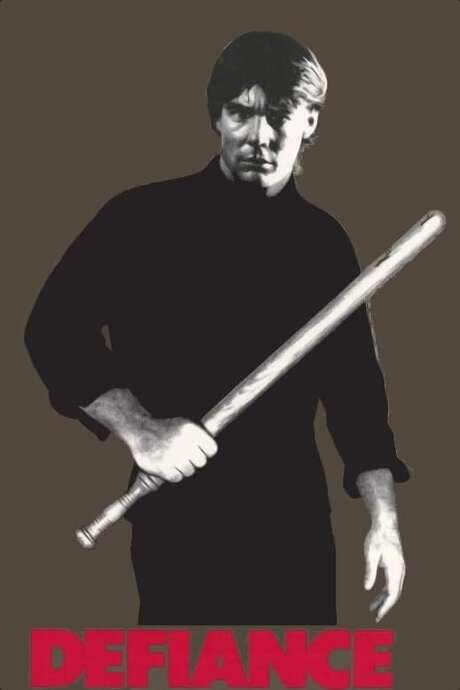
Defiance 1980


Directed by

John Flynn
Made by

Necta
Where to Watch Defiance
See current US streaming, rental, and purchase options for Defiance (1980) via JustWatch.

fuboTV
HD
MGM Plus
HD
MGM Plus Roku Premium Channel
HD
MGM+ Amazon Channel
HD
Philo
HD
Tubi TV
SD
Amazon Video
SD
Fandango At Home
HD
Google Play Movies
SD
YouTube
SD Streaming availability powered by 
Defiance Plot Summary
Read the complete plot summary and ending explained for Defiance (1980). From turning points to emotional moments, uncover what really happened and why it matters.
Tommy Campbell, Jan-Michael Vincent, a merchant seaman, finds himself grounded in New York City after a six-month suspension. With time on his hands, he rents a shabby apartment on the Lower East Side and keeps pestering his supervisor, Joseph Campanella as he hunts for any possible ship assignment. When he pretends to speak Spanish to land a job on a Panamanian freighter, the opportunity seems to surface briefly, yet the city’s rhythm quickly pulls him into a harsher reality. Back in his cramped flat, Tommy tunes his ears to Spanish-language records, and a curious neighbor’s child imitates his practice, foreshadowing how art and life will brush up against each other in this tight-knit, turbulent neighborhood. A neighborly moment with Marsha Bernstein, Theresa Saldana, unfolds as she waters her plants on the fire escape and sprinkles Tommy with an apology of sorts, chatting about his paintings and ship photographs; the exchange is light, but it’s also a window into a city where intimacy and danger share the same street.
At the corner grocery, the owner, Abe, Art Carney, agrees to field Tommy’s calls until a telephone is installed. But the rhythm of the block is disrupted by the Souls gang, who slide through the aisles and groceries with a brazen ease that unsettles everyone. A subway trip ends in violence when the gang robs Tommy of his watercolor paints after a brutal beating, and a nightclub scene pushes the tension higher as Angel Cruz, Rudy Ramos, funnels money to a local enforcer, El Bravo, and piles Tommy’s art into a violent display for the crowd. All the while, Marsha steps in as a steady presence, nursing Tommy back to health after another stumble.
Soon the pair’s bond deepens. Tommy invites Marsha out for a date, and their evening of bowling becomes a quiet, honest confession of their hunger for something more than mere survival. As they walk the pier and talk about the sea, Marsha reveals a past living situation on the Upper West Side, hinting at a broader map of the city’s human geography. They return to a shared warmth that crescendos in a moment of intimacy, and Tommy’s world widens beyond the waterfront’s edge. The next day, a younger neighbor—referred to as “the Kid,” Fernando López—and Whacko, Lenny Montana, a rough-and-tumble mentor figure, reveal the fragile bonds that keep the block together as the Souls taunt Whacko in an alley.
The apartment becomes a fortress as Tommy patches his defenses—he installs stronger locks after discovering walls smeared with graffiti and a claustrophobia that speaks to a life under constant threat. The neighborhood’s mood shifts after a violent incident at the local church bingo: Angel Cruz and his crew rob players, and the crowd watches in fear as the priest, Father Rivera, James Victor, warns of moral peril even as Angel rips the crucifix from the priest’s neck. The fear of retaliation silences many, but Abe gathers the courage to sign the police report, and the community’s frustration begins to solidify into resolve.
Carmine DeFranco, Danny Aiello, becomes a bridge between neighbors, inviting Tommy for a drink at the Sportsmen Bar and helping to unite a cautious, wary block. When Carmine’s effort to mobilize the residents heightens, Tommy’s reluctance to stir trouble clashes with the growing sense that the gang’s presence is a direct threat to everyone’s safety. The rooftop garden Carmine and others build for Marsha’s refuge becomes a symbol of resilience, a small act of beauty in a place where violence is all too common. But the Souls’ revenges are swift: they destroy the garden and brutalize the kid, forcing Tommy to respond with a blend of restraint and grit.
In a pivotal meeting with Karenski, Tommy learns he is due to report to the container ship American Trader at Pier 44 in a week, a horizon that promises both escape and exposure. Yet the violence intensifies: the Souls vandalize the roof and corner Tommy, Carmine, and their allies in a furious street encounter. The neighborhood’s defiance erupts as garbage rains from fire escapes and a distant explosion punctuates the clash. When Angel shoots Carmine, Tommy chases the gang leader through the city’s labyrinth of alleys and stairwells, delivering a raw, physical reckoning that echoes the film’s insistence on personal accountability.
Police arrive, and the fight shifts toward accountability and justice. Carmine’s persistence—paired with a growing willingness from neighbors to stand up—culminates in an arrest and a renewed sense of communal power. The moment of truth arrives as Marsha and the Kid help support a dazed Tommy: he tells the officers he wants to file a complaint, and one by one, the block signs on, choosing to believe that standing up to violence can rewrite their shared story.
What remains after the dust settles is a city that has learned to measure courage not by avoidance but by standing together. The film closes with the neighborhood’s fractured but hopeful sense of solidarity, the memory of Whacko’s death lingering as a somber reminder of what was at stake and what was saved. The tale remains anchored in Tommy’s journey—from displacement to determination, from fear to a stubborn, burning resolve to protect a corner of the city that has become his home.
Defiance Timeline
Follow the complete movie timeline of Defiance (1980) with every major event in chronological order. Great for understanding complex plots and story progression.
Stuck in New York after suspension
Merchant seaman Tommy Campbell is suspended for six months and winds up with nothing to do in New York. He rents a cheap Lower East Side apartment and pressures his supervisor Karenski to give him any ship assignment. He fills his time listening to Spanish language records, hoping to sound useful.
Karenski offers a Panamanian ship job
Tommy lies that he can speak Spanish, and Karenski offers him work on a Panamanian vessel. He eagerly accepts the chance and starts practicing again with Spanish records. The arrangement foreshadows the social tensions as he tries to blend in.
Marsha visits and Tommy's boredom
Back at his apartment, Marsha Bernstein stops by to apologize for the earlier noise and chats about his paintings and ship photos. Tommy appears bored and retreats to another room, hinting at his growing alienation. Their brief interaction plants the first seeds of a relationship.
Abe takes Tommy's calls; Souls gang lurks
At the corner grocery, Abe agrees to take Tommy's phone calls until his own line is installed. While they talk, two Souls gang members help themselves to groceries and leave, showing the neighborhood's peril. Abe grows angry but declines to confront them, signaling the gang's control of the block.
Subway beating and paint theft
One night Tommy uses a public subway restroom and the Souls gang beats him, stealing his watercolor paints. The assault underscores his vulnerability and foreshadows the looming conflict. He heads home bruised and angry.
Paints reach Angel Cruz via El Bravo
At a nightclub, gang leader Angel Cruz gives money to an older Latino, El Bravo, and presents Tommy's paintings to his companion. The loss of his art marks a personal hit and pushes Tommy deeper into the gang's orbit. The scene hints at the broader violence threatening the neighborhood.
Marsha nurses Tommy back to health
The next morning Marsha finds Tommy collapsed in the lobby and takes him into her apartment to nurse him. Their growing closeness deepens, even as the city outside remains perilous. The incident marks a turning point in their uneasy alliance.
Tommy meets Whacko and the kid by the waterfront
Tommy encounters his young neighbor Whacko and the kid collecting junk by the waterfront. He learns the boy ran away from foster homes and now lives with Whacko, expanding the circle of people Tommy wants to protect. They form a rough bond as they walk the docks.
Tommy and Marsha go on a date; romance grows
Tommy asks Marsha on a date and they go bowling. Afterward they walk to the pier, where Tommy talks about his love of the sea, and Marsha opens up about her past on the Upper West Side. They return home and share a quiet moment together.
Tensions rise as the Souls taunt Whacko
The Souls taunt Whacko near the waterfront and a confrontation seems inevitable. Tommy tries to intervene, but a patrol car arrives and the gang dissolves before trouble escalates. The incident shows the fragility of Tommy's attempts to stay peaceful.
Carmine befriends Tommy; church bingo robbery
Carmine DeFranco befriends Tommy and the two mingle with neighbors in a fragile sense of community. At a church bingo, Angel Cruz and his gang rob the players, and Father Rivera warns that the gang will be condemned to hell if they do not change. The victims fear signing police reports, leaving the investigation unsettled.
Karenski assigns Tommy to Pier 44 in one week
In a meeting with Karenski, Tommy is told to report to a container ship called American Trader at Pier 44 in one week. The assignment promises an escape from the gang's neighborhood, adding pressure to keep his head down. The threat of risk intensifies Tommy's thoughts about leaving.
Rooftop garden destroyed; kid beaten; Tommy escalates
Souls destroy the rooftop garden that neighbors built for Marsha, and they brutalize the kid. Enraged, Tommy uses a knife to cut off a gang member's ponytail near the basketball courts. Angel declares Tommy's death wish, and later breaks into Tommy's apartment while he's in the shower.
Tommy decides to stay and fight, not ship out
After the break-in, Tommy installs bars on his windows and tells Marsha that he is shipping out. He changes his mind on seeing the kid running in the street, and discovers Whacko's dead body. He decides to stay and destroy Angel's car, with Carmine and neighbors joining the assault.
Final showdown and aftershocks
The neighborhood braces for a final showdown: Tommy and Carmine confront Angel and the Souls as garbage rains from fire escapes and an explosion erupts. Angel shoots Carmine, but Tommy chases and defeats Angel. Police arrest the Souls, and neighbors sign the police report, solidifying a temporary peace.
Defiance Characters
Explore all characters from Defiance (1980). Get detailed profiles with their roles, arcs, and key relationships explained.
Tommy Campbell (Jan-Michael Vincent)
A suspended merchant seaman who alternates between restlessness and decisive action. He channels his artistic impulses into watercolor painting and sea imagery, which fuels his sense of purpose. As gang pressure closes in, Tommy shifts from passive observer to protective challenger, choosing to confront danger rather than endure it.
Marsha Bernstein (Theresa Saldana)
A compassionate neighbor who befriends Tommy, nurses him back to health, and shares memories of friendlier times. Her warmth anchors the film’s emotional core and she becomes a steady ally amid rising peril. Their budding relationship emphasizes empathy and mutual care within a fractured community.
Carmine (Danny Aiello)
A blunt, loyal neighbor who attempts to rally the block and stand up to the Souls gang. He bridges Tommy to the community and embodies a practical courage that helps shift the mood from fear toward collective action.
Abe
The corner grocery store owner who handles Tommy’s calls and becomes a steady, cautious voice within the neighborhood. His eventual decision to sign the police report signals a turning point in the community’s resolve to act.
Angel Cruz
Gang leader who terrorizes the neighborhood and exemplifies the brutality the residents must confront. His provocations drive the central conflict, testing the limits of courage and retaliation within the community.
Father Rivera
A priest who provides moral perspective and warnings about damnation for the violent actions around him. He acts as a voice of conscience amidst the chaos, underscoring themes of mercy and justice.
Karenski
A supervising police figure who directs Tommy toward the ship assignment and represents the bureaucratic side of the community’s response to crime. His stance reflects the complexities of law, order, and personal risk.
Whacko
A guardian-like neighbor connected to the younger kid, offering streetwise support. His life is cut short during the escalating conflict, highlighting the human cost of the neighborhood’s turmoil.
Paolo
A neighborhood resident listed in the cast; the summary does not detail Paolo’s specific actions, but he is part of the broader community fabric depicted in the film.
Defiance Settings
Learn where and when Defiance (1980) takes place. Explore the film’s settings, era, and how they shape the narrative.
Time period
Late 1960s to early 1970s
The events unfold during a period of urban upheaval in New York City, marked by economic strain and rising gang activity. Graffiti, makeshift safety measures, and a culture of street-based improvisation color daily life. The era’s volatility shapes how the community responds to threat and seizes moments to organize.
Location
Lower East Side, New York City
Defiance unfolds in the Lower East Side of New York City, a dense, working-class neighborhood of cramped tenement blocks and tight-knit communal life. Street-level commerce, bodegas, and fire escapes frame daily routines as residents face mounting tensions with local gangs. The waterfront and nearby Pier 44 provide a backdrop for key scenes, highlighting the neighborhood's grit and resilience.
Defiance Themes
Discover the main themes in Defiance (1980). Analyze the deeper meanings, emotional layers, and social commentary behind the film.
🤝
Community
The film centers on a close-knit block where neighbors look out for one another. Tommy’s bond with Marsha, Abe’s cautious support, and Carmine’s attempts to mobilize the tenants illustrate how collective action can arise from shared danger. Roof-garden projects, neighborhood gatherings, and police reports all underscore the power of solidarity in resisting intimidation.
💥
Violence
Defiance paints a vivid portrait of urban violence fueled by gang rivalry, fear, and intimidation. Attacks in subways, vandalism, and open confrontations escalate tensions and test each resident’s willingness to stand up. The story traces how violence begets more violence, pushing characters toward increasingly drastic responses.
🎨
Identity
Tommy's artistic inclination—his paintings and love of the sea—serves as a personal counterweight to the surrounding chaos. The movie uses art as a window into a longing for beauty and freedom, even as the neighborhood tries to push him toward survival through aggression. This tension between expression and threat highlights the characters' desires to preserve humanity amid decay.

Coming soon on iOS and Android
The Plot Explained Mobile App
From blockbusters to hidden gems — dive into movie stories anytime, anywhere. Save your favorites, discover plots faster, and never miss a twist again.
Sign up to be the first to know when we launch. Your email stays private — always.
Explore the mobile appDefiance Spoiler-Free Summary
Discover the spoiler-free summary of Defiance (1980). Get a concise overview without any spoilers.
In the cramped, graffiti‑streaked corridors of a Lower East Side apartment building, a storm of everyday life swirls around street‑market stalls, fire‑escape gardens, and the constant hum of the city’s restless rhythm. Tommy Campbell, a merchant seaman temporarily grounded by a suspension, drifts into this world looking for a quiet place to wait out his next assignment. He brings with him a habit of sketching ships and humming Spanish tunes, small habits that echo the multicultural pulse of his new neighborhood and hint at a yearning for something larger than the four walls he now occupies.
The building, however, has been quietly overtaken by a gang known as the Souls, whose presence turns ordinary hallways into uneasy passages. Their dominance creates a palpable tension that hangs over the tenants like a low‑frequency drone, making the simple act of stepping onto a fire‑escape feel like a negotiation. Tommy watches, listens, and feels the weight of a community forced to shrink into the shadows, yet something inside him refuses to stay silent.
A tentative bond forms with Marsha, a neighbor who waters her plants on the balcony and shares conversations about art and the sea. Through her, the apartment block begins to feel less like a set of isolated rooms and more like a fragile ecosystem of shared hopes and quiet courage. As the atmosphere tightens, Tommy finds himself at a crossroads, where the choice between passive endurance and quiet resistance promises to ripple through the building’s weary residents.
The film settles into a gritty, atmospheric tone that balances the harsh edge of urban survival with moments of unexpected tenderness. It explores how an ordinary man, thrust into a volatile environment, can spark a collective awakening, suggesting that defiance—when rooted in empathy—has the power to reshape a community that has learned to live in the shadow of fear.
Movies with Similar Twists and Themes
Uncover films that echo the narrative beats, emotional arcs, or dramatic twists of the one you're exploring. These recommendations are handpicked based on story depth, thematic resonance, and spoiler-worthy moments — perfect for fans who crave more of the same intrigue.


Featured on this page

What's After the Movie?
Not sure whether to stay after the credits? Find out!
Check out our other apps:

SAT Sphere
Build confidence for the Digital SAT.

Mori Atlas
Discover wild places worth protecting.

Luntero
Search smarter for a home in Amsterdam.

Plot Explained
Unravel movie endings and hidden clues.

Pokechamp
Dive into Pokémon data and battle logic.

Driving Theory
Get ready for your European theory test.

Movie Dust
Plan your next cinema trip with ease.

Musemap
Find art and culture as you travel.

Selkobase
Compare credentials before committing.

Local Manual
Turn an unfamiliar country into practical next steps.

Lernavi
Compare school systems before your next move.

GymRoam
Find a workout stop wherever your plans take you.
Explore Our Movie Platform
New Movie Releases (2026)
Famous Movie Actors
Top Film Production Studios
Movie Plot Summaries & Endings
Major Movie Awards & Winners
Best Concert Films & Music Documentaries
Movie Collections and Curated Lists
© 2026 What's After the Movie. All rights reserved.
Privacy Policy