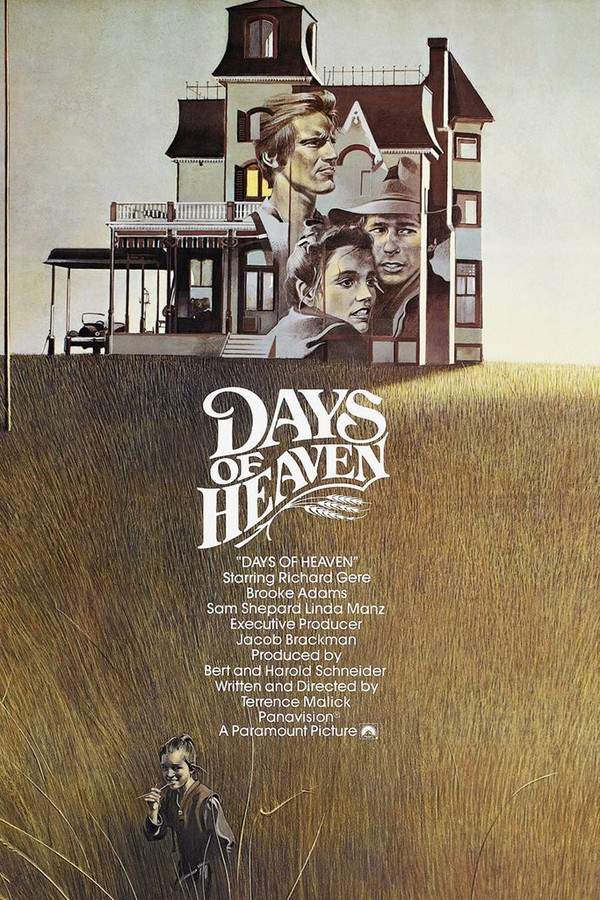
Days of Heaven 1978


Directed by

Terrence Malick
Made by

Paramount Pictures
Where to Watch Days of Heaven
See current US streaming, rental, and purchase options for Days of Heaven (1978) via JustWatch.

MGM Plus
HD
Hoopla
SD
Kanopy
HD
YouTube Free
HD
Amazon Video
HD
Apple TV Store
4K
Fandango At Home
4K
Google Play Movies
SD
JustWatch TV
HD
YouTube
SD Streaming availability powered by 
Days of Heaven Plot Summary
Read the complete plot summary and ending explained for Days of Heaven (1978). From turning points to emotional moments, uncover what really happened and why it matters.
In 1916, Chicago steelworker Bill [Richard Gere] accidentally kills his factory foreman during an argument. He flees to the Texas Panhandle with his girlfriend Abby [Brooke Adams] and his young sister Linda [Linda Manz]. As their train winds across the country, an older Linda mulls over these events in voiceover narration. She recalls that a religious man warned her of a vision of apocalyptic hellfire, and notes that at the Last Judgment, God will rescue the good and turn away the evil.
In Texas, a wealthy farmer [Sam Shepard] suffering from an unspecified malady hires as many seasonal shockers as he can find, including Bill and Abby, who pretend to be siblings to deter gossip. Bill overhears a doctor telling the farmer that he has one year left to live. The farmer’s accountant encourages him to sell his farm and enjoy his profits, but the farmer decides on staying.
The terminally ill farmer takes a liking to Abby, and asks her to stay with him after the harvest. Bill encourages Abby to marry the farmer so that they can inherit his money when he dies. Abby questions whether Bill still loves her. Bill confidently predicts that the farmer will die soon and they will be reunited. Abby marries the farmer and persuades him to let Bill and Linda stay at the farmhouse. The farmer’s foreman suspects that Abby and Bill are con artists, but the farmer dismisses the suggestion and distances himself from the foreman.
The farmer’s health remains stable, foiling Bill’s plans. Over time, the shy farmer wins over Abby with his genuine disposition. However, he grows suspicious of Abby’s excessively familiar relationship with her “brother.” Bill belatedly realizes that Abby has fallen in love with the farmer. He realizes that the only way to salvage the situation is to depart the farm, leaving his little sister with his ex-girlfriend. The farmer tries to be a good father figure to Linda.
Bill returns to the farm during the following year’s harvest. He admits to Abby that encouraging her to marry another man was a mistake. Before Abby can make a decision, a locust swarm arrives. To save the harvest, the farmer lights controlled fires to smoke out the locusts. However, when he sees Bill, he loses control of himself and chases after Bill with a gun. He accidentally knocks over one of his own lamps, triggering a blaze that destroys much of the harvest. Bill kills the farmer with a screwdriver the next day during a confrontation where the farmer points a revolver at him.
Once again, Bill, Abby, and Linda are on the run. With the foreman’s help, the police shoot Bill while he tries to escape. Seeking a new life, Abby leaves Linda at a boarding school and departs on a train with soldiers headed for World War I. Later, Linda runs away from the school with a friend from the farm.
Days of Heaven Timeline
Follow the complete movie timeline of Days of Heaven (1978) with every major event in chronological order. Great for understanding complex plots and story progression.
Killing and flight from Chicago
In 1916, Bill accidentally kills his factory foreman during an argument in Chicago. He flees with his girlfriend Abby and his younger sister Linda, heading toward the Texas Panhandle. Linda narrates these events in voiceover, recalling a vision of apocalyptic hellfire and a Last Judgment that will separate the good from the evil.
Arrival in the Texas Panhandle and a new ruse
Linda accompanies them as they join the farmer's seasonal labor pool in the Texas Panhandle. Bill and Abby pose as siblings to avoid gossip about their relationship. The group settles onto the farmer's land, beginning a precarious, improvised new life.
Prognosis and the farmer's decision
Bill overhears a doctor tell the farmer he has one year left to live. The farmer's accountant suggests selling the farm to enjoy profits, but the farmer resolves to stay and endure. The prognosis casts a shadow over their arrangements as they work on the land.
Abby's staying power and love doubt
After the prognosis, the farmer takes a liking to Abby and asks her to stay after harvest. Bill urges Abby to marry the farmer so they can inherit the money when he dies. Abby questions whether Bill truly loves her, torn between loyalty and longing.
Abby's marriage and household tension
Abby agrees to marry the farmer and persuades him to let Bill and Linda remain at the farmhouse. The farmer's foreman grows suspicious of Abby and Bill's sibling act, but the farmer dismisses the concerns. The marriage seems to create a fragile stability on the farm.
Stability, affection, and suspicion
The farmer's health remains stable, foiling Bill's plan to force a quick payout. Over time, the farmer's genuine disposition wins Abby, even as she remains wary of Bill's manipulation and the uneasy household dynamic. The bond between Abby and the farmer deepens while Linda watches.
Bill's realization and departure
Bill realizes Abby has fallen in love with the farmer. He determines the only way to salvage the situation is to depart the farm, leaving his sister Linda with Abby. He hopes this sacrifice will allow Abby to choose the farmer and find a kinder future.
Return and confession at the harvest
Bill returns during the following year's harvest and admits that encouraging Abby to marry another man was a mistake. He faces the consequences of his manipulation and the fragile balance on the farm. Abby's feelings remain conflicted as tension returns to the household.
Locusts, fires, and a deadly blaze
A locust swarm arrives just as the harvest faces ruin. The farmer lights controlled fires to smoke out the locusts, hoping to save the crops. When he spots Bill, he loses control and chases him with a gun, accidentally knocking over a lamp and starting a blaze that destroys much of the harvest.
Confrontation and the farmer's death
Confronted by Bill, the farmer draws a revolver. Bill kills the farmer with a screwdriver the next day during their deadly confrontation. The violent fallout deepens the trio's peril and pushes them toward flight.
Escape and police intervention
Bill, Abby, and Linda go on the run again. With the foreman's help, the police shoot Bill as they attempt to escape. The trio's flight ends in a grim confrontation with law enforcement.
Abby leaves Linda for a new path; Linda's defection
Abby sends Linda to a boarding school and departs on a train with soldiers headed for World War I. Later, Linda runs away from the school with a friend from the farm. The story closes on a new, uncertain future for Linda.
Days of Heaven Characters
Explore all characters from Days of Heaven (1978). Get detailed profiles with their roles, arcs, and key relationships explained.
Bill (Richard Gere)
A steelworker who kills his foreman and flees with Abby and Linda. He orchestrates a scheme to marry for money and secure a future, displaying confidence and unscrupulous cunning. His manipulation intensifies as genuine feelings complicate his plan, and his worldview collapses under pressure, leading to violent consequences.
Abby (Brooke Adams)
Bill’s partner who becomes entangled in deception while seeking safety for herself and Linda. She marries the farmer to secure his wealth, yet she gradually develops genuine care for him and questions her loyalty to Bill. Her choices reflect a struggle between survival, affection, and moral duty, ultimately leading to a difficult departure.
Linda (Linda Manz)
The narrator and younger sister who observes the adults’ actions with a stark, perceptive eye. Her voiceover frames events, and she carries a memory of prophetic warnings that contrast with the unfolding tragedy. She bears witness to love, deceit, and loss, ending the story in a boarding school far from the farm’s dangers.
The Farmer (Sam Shepard)
Terminally ill and generous, he offers Abby a chance at a quiet life and becomes a genuine paternal figure for Linda. His suspicion of Abby’s bond with her ‘brother’ grows, complicating the trio’s ruse. His eventual death arrives amid a volatile confrontation, underscoring the fragility of trust and the loss that follows.
The Farm Foreman (Robert J. Wilke)
A wary supervisor who senses possible deception from the new workers on the farm. His skepticism creates tension and foreshadows the consequences of the trio’s scheme. He represents the practical, watchful authority that tests the limits of trust and loyalty.
The Mill Foreman (Stuart Margolin)
An overseer of seasonal labor, embodying the rigid, industrial order of the era. He maintains discipline among workers and keeps the machinery of the mill and harvest turning. His presence signals the harsh economic backdrop against which the characters operate.
Mill Worker (Terrence Malick)
A quiet, weary participant in the milling work, representing the transient labor force that follows the harvest cycle. His presence underscores the repetitive, exhausting labor that defines the workers’ daily lives. He embodies the human cost of the industrial system.
Harvest Hand (Timothy Scott)
A seasonal laborer who participates in the farm’s harvest. He is part of the community of workers that the farmer depends on, highlighting the interconnectedness of people who rely on the land for livelihood. His role helps illustrate the social dynamics of the rural economy.
Accountant (Bob Wilson)
The farmer’s accountant who pushes the idea of selling the farm to cash in on profits. His stance introduces a blunt, financial viewpoint that clashes with the farmer’s more conservative instincts. He embodies practical calculations that influence life-or-death decisions.
Preacher (John Wilkinson)
A religious figure whose memories frame the narrative with a sense of moral judgment. The preacher’s presence and the vision of apocalyptic hellfire inform the characters’ reflections on guilt and redemption. The Last Judgment motif casts a long shadow over the choices made by Abby, Bill, and Linda.
Days of Heaven Settings
Learn where and when Days of Heaven (1978) takes place. Explore the film’s settings, era, and how they shape the narrative.
Time period
1916-1917
Events unfold in the early 20th century, starting in 1916 as Bill and Abby flee to Texas, with the following harvest season extending into 1917. The era’s economic and social conditions frame the characters’ schemes and loyalties. The looming World War I era adds a sense of instability and a push toward new beginnings or escapes. The timeline emphasizes transitions from flight to confrontation, followed by tragedy.
Location
Chicago, Texas Panhandle
The story moves from Chicago’s industrial backdrop to the wide, arid plains of the Texas Panhandle. Chicago situates the characters within a crowded urban-industrial setting, while the Texas farms reveal vast, open farmland and rural life shaped by harvests and seasonal labor. The contrast between city noise and rural stillness highlights the precariousness of ambition and survival. The farmhouse and nearby fields become the focal point where fortunes are tested.
Days of Heaven Themes
Discover the main themes in Days of Heaven (1978). Analyze the deeper meanings, emotional layers, and social commentary behind the film.
💔
Love and Betrayal
A web of affection and deceit drives the core relationships. Abby and Bill pretend to be siblings to avoid gossip, yet genuine feelings emerge that complicate their plans. Linda watches with a wary, almost moral perspective as trust fractures and loyalties shift. The emotional conflicts culminate in actions that harm others and alter the characters’ futures.
💰
Greed and Deception
Bill’s scheme to profit from the farmer’s fortune hinges on manipulation and privilege. The farmer’s desire for a simple life clashes with the con artists’ need for cash and security. The accountant’s pragmatic push to sell the farm exposes the tension between wealth and moral risk. The pursuit of money fuels the mounting danger and eventual catastrophe.
🌾
Nature and Fate
The harvest landscape becomes a relentless force—locusts, fire, and the pressures of survival shape every decision. The arid plains and controlled fires test endurance and resourcefulness. Nature’s disruptions magnify human vulnerabilities and accelerate the collapse of carefully laid plans. The environment appears as a distant, indifferent judge of the characters’ actions.
🕊️
Moral Pressure
Religious imagery and moral questions frame how characters assess right and wrong under strain. The Last Judgment motif surfaces as characters weigh loyalty, love, and survival. The film probes whether choices made to protect oneself or others can remain justifiable under dire circumstances. Ultimately, moral compromise culminates in tragedy and reflection.

Coming soon on iOS and Android
The Plot Explained Mobile App
From blockbusters to hidden gems — dive into movie stories anytime, anywhere. Save your favorites, discover plots faster, and never miss a twist again.
Sign up to be the first to know when we launch. Your email stays private — always.
Explore the mobile appDays of Heaven Spoiler-Free Summary
Discover the spoiler-free summary of Days of Heaven (1978). Get a concise overview without any spoilers.
Terrence Malick’s Days of Heaven stands as a landmark achievement in American cinema, offering a visual and auditory experience that feels less like a traditional narrative and more like a memory unfolding. Set in 1916, the story begins in the industrial grit of Chicago before shifting to the sprawling, golden wheat fields of the Texas Panhandle. The film is framed through the unique perspective of a young narrator, whose observations lend the events a lyrical, sometimes prophetic tone. This voice guides the audience through a world where the beauty of nature contrasts sharply with the complexities of human behavior.
At the heart of the story are Bill, his lover Abby, and his younger sister Linda. Fugitives seeking a fresh start, they travel together under a veil of secrecy, with Bill and Abby pretending to be siblings to avoid suspicion. They find work on the farm of a wealthy, shy man who hires a large crew of seasonal workers. The farm becomes a temporary paradise, a place of hard work and immense skies, but the arrival of autumn brings a shift in atmosphere. The farmer, a solitary figure, is drawn to Abby, creating a complicated triangle of affection and obligation.
As the trio settles into life on the farm, the boundaries between truth and deception begin to blur. The dynamic between Bill and the farmer grows tense, fueled by unspoken rivalries and the presence of Abby. Malick’s direction emphasizes the transient nature of their happiness, using the changing seasons and the vastness of the landscape to mirror the characters’ internal states. Without relying on explicit exposition, the film captures the inevitability of conflict, suggesting that in a world so governed by fate and timing, even the most idyllic days are numbered.
Featured on this page

What's After the Movie?
Not sure whether to stay after the credits? Find out!
Check out our other apps:

SAT Sphere
Build confidence for the Digital SAT.

Mori Atlas
Discover wild places worth protecting.

Luntero
Search smarter for a home in Amsterdam.

Plot Explained
Unravel movie endings and hidden clues.

Pokechamp
Dive into Pokémon data and battle logic.

Driving Theory
Get ready for your European theory test.

Movie Dust
Plan your next cinema trip with ease.

Musemap
Find art and culture as you travel.

Selkobase
Compare credentials before committing.

Local Manual
Turn an unfamiliar country into practical next steps.

Lernavi
Compare school systems before your next move.

GymRoam
Find a workout stop wherever your plans take you.
Explore Our Movie Platform
New Movie Releases (2026)
Famous Movie Actors
Top Film Production Studios
Movie Plot Summaries & Endings
Major Movie Awards & Winners
Best Concert Films & Music Documentaries
Movie Collections and Curated Lists
© 2026 What's After the Movie. All rights reserved.
Privacy Policy