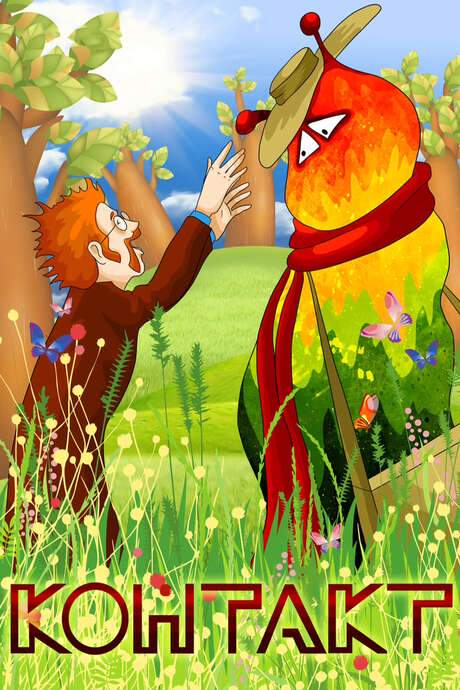
Contact 1978

Directed by

Vladimir Tarasov
Made by

Soyuzmultfilm
Where to Watch Contact
See current US streaming, rental, and purchase options for Contact (1978) via JustWatch.






Contact Plot Summary
Read the complete plot summary and ending explained for Contact (1978). From turning points to emotional moments, uncover what really happened and why it matters.
On a bright summer day, the painter Leonid Chizhik wanders the rolling countryside, taking in the world with a gentle curiosity. He pauses before a delicate butterfly, contemplating the cruelty of some people who might trap such a creature for a collection, but he chooses mercy instead, letting it drift on the warm breeze. A moment later, he watches a bird with the same quiet respect, refraining from pursuit and simply letting it fly free. As he climbs over a gentle hill, he discovers a pond so picturesque that he is overcome with joy and hurries toward the water to rest in its serene surroundings.
While he sits on the grass, softly humming a tune that will echo through the film’s silent language, a large spaceship lands nearby. An alien steps onto the scene, carefully observing the surroundings and trying to communicate by altering his appearance to resemble nearby animals and objects, and by making physical contact. The painter is frightened, and the fear intensifies as he loses his belongings one by one—boots, hat, scarf, smoking pipe, and paints—while he tries to flee. A fall from a cliff injures his leg, leaving him unable to move forward. The alien retrieves the scattered items as if to return them, yet the painter imagines the worst—that he might be caged or subjected to harm, much as some humans treat animals.
Unable to escape due to the injury, the painter shields his face, bracing for an ominous fate. The alien approaches and attempts to hum the same melody the painter sang earlier, though with several imperfect notes. Realizing that the visitor is not a threat, the painter bravely engages, and a tentative collaboration begins as he teaches the alien how to hum the tune. The two figures walk away together, hand in hand, their bond formed through shared touch, patience, and music.
This film unfolds without any spoken language; every exchange relies on music, gestures, and glances, while the alien also communicates through shapeshifting. Director Vladimir Tarasov uses this lack of dialogue to explore a theme of universal communication, presenting animation as “the Esperanto of all mankind.” The result is a quiet, contemplative journey that invites viewers to listen with more than their ears and to seek connection across differences. Through its serene pace and thoughtful imagery, the movie invites reflection on mercy, curiosity, and the ways we reach out to others beyond words.
Contact Timeline
Follow the complete movie timeline of Contact (1978) with every major event in chronological order. Great for understanding complex plots and story progression.
A serene countryside stroll
On a beautiful summer day, a painter wanders through the countryside, admiring nature. He spares a butterfly and then a bird, choosing kindness over capture. He climbs over a hill to a picturesque pond and settles down to rest, humming softly.
Alien arrival
A large spaceship lands near the painter, breaking the peaceful hush of the countryside. An alien steps out, photographs the environment, and scans the painter. The alien attempts to contact him by changing its appearance to resemble nearby animals and objects and by touching him.
The contact attempt continues
The alien keeps trying to communicate through shapeshifting and touches, hoping to bridge the gap between species. The painter is frightened by the alien's odd methods but is curious enough to watch. The two begin a silent exchange of intent across a language-less barrier.
Panic and retreat
Frightened, the painter bolts in a desperate attempt to escape. He loses his boots in the scramble, slipping toward the cliff's edge as he runs.
The hat is discarded
The painter's hat falls away as fear drives him forward. He trembles, still pursued by the unknown presence but keeps moving, trying to put distance between them.
The scarf and pipe
Another loss as the scarf slips from his neck and the smoking pipe lands somewhere behind him. Each lost item marks a step deeper into the unknown, heightening the sense of urgency.
The paints tumble
The painter's last belongings, his paints, tumble from his grasp and skid across the ground. The alien's acquisition of items suggests a strange care to return them later.
Falls and injury
The chase leads the painter to the cliff's edge, and he slips, injuring his leg. He is unable to move further, overwhelmed by pain and fear.
Alien gathers the items
The alien gently collects the fallen belongings, preparing to return them to the painter. The painter misreads the alien's intention, fearing that he will be locked in a cage or harmed.
The uneasy standstill
Unable to move, the painter covers his head with his hands, bracing for an unknown fate. The alien approaches but continues to communicate through gestures and a tentative humming attempt.
A shared melody
The alien attempts to hum the same tune the painter sang earlier, though the notes falter. The painter recognizes the friendly intent and offers guidance, teaching the alien how to hum in harmony.
New understanding
Through music, gesture, and gaze, the two beings reach a mutual understanding beyond language. The initial fear dissolves as trust grows.
Walking away together
With their differences bridged, they walk away hand in hand across the landscape. The film closes on a quiet image of shared companionship and a promise of universal communication.
Contact Characters
Explore all characters from Contact (1978). Get detailed profiles with their roles, arcs, and key relationships explained.
Painter
A gentle, nature-loving artist who finds joy in simple moments and shows compassion toward living creatures. He initially fears the alien's arrival but chooses curiosity over danger, teaching the visitor how to hum the tune he loves. His patience and openness become the bridge between two very different beings.
Alien
A friendly visitor who cannot rely on words, instead shapeshifting and humming to communicate. Initially mistaken for a threat, it gradually demonstrates curiosity and a desire to understand human culture. The alien's gentleness and willingness to copy and learn the painter's tune reveal a shared longing for connection.
Contact Settings
Learn where and when Contact (1978) takes place. Explore the film’s settings, era, and how they shape the narrative.
Location
Countryside, near a hill and a pond
A serene rural landscape on a sunny summer day frames the painter's stroll. He pauses by a hill and a picturesque pond, enjoying the quiet before the encounter. The peaceful setting highlights the sudden intrusion of the alien spaceship and the shift from solitude to unintended contact.
Contact Themes
Discover the main themes in Contact (1978). Analyze the deeper meanings, emotional layers, and social commentary behind the film.
🎶
Communication
The story relies on music, gestures, and gaze rather than spoken language to convey meaning. The painter and the alien learn to understand one another through humming, timing, and shared movement. This universal language underpins their budding friendship and echoes Tarasov's idea that animation can be the Esperanto of humankind.
🤝
Connection
Fear gives way to trust as beings from different worlds bridge their differences. They exchange care, recover lost belongings, and eventually walk hand in hand, illustrating how empathy can flourish without words. The bond grows through patience and mutual curiosity, culminating in a quiet companionship.
🌍
Universality
The encounter emphasizes common ground across distinct lives: a human painter and a shapeshifting alien sharing a moment of beauty and understanding. The environment and music carry meaning more than dialogue, suggesting that art and melody can connect disparate species. The film presents communication and friendship as universal possibilities.

Coming soon on iOS and Android
The Plot Explained Mobile App
From blockbusters to hidden gems — dive into movie stories anytime, anywhere. Save your favorites, discover plots faster, and never miss a twist again.
Sign up to be the first to know when we launch. Your email stays private — always.
Explore the mobile appContact Spoiler-Free Summary
Discover the spoiler-free summary of Contact (1978). Get a concise overview without any spoilers.
In a luminous summer landscape, a solitary painter named Leonid Chizhik drifts across rolling fields, his easel and curiosity guiding him through quiet meadows, shy butterflies and reflective ponds. The film opens with a contemplative pace that lets the viewer linger on the soft brushstrokes of light, the gentle rustle of grass, and the tender reverence the protagonist holds for the fragile world around him. There is no spoken dialogue; instead, a serene soundtrack and subtle visual cues become the language of the countryside, inviting an intimate, almost meditative immersion.
When an unexpected craft touches down nearby, an alien visitor emerges, its form fluid and capable of mimicking the surrounding flora and fauna. The extraterrestrial’s attempts at contact rely on shape‑shifting, careful gestures and an earnest, imperfect hum that echoes the melody Leonid once sang to himself. Though initially startled, the painter’s innate empathy and love for delicate life draw him toward this strange presence, setting the stage for a tentative exchange that hinges on music, touch and shared curiosity rather than words. The film’s visual style—bright, minimalist animation paired with expressive body language—highlights the fragile bridge forming between two wholly different beings.
Director Vladimir Tarasov treats this wordless encounter as a meditation on universal communication, framing the animated world as an “Esperanto of all mankind.” The tone remains quiet and contemplative, allowing each gesture and note to resonate with deeper meaning. Through its gentle pacing and rich, lyrical imagery, the story encourages viewers to listen beyond sound, to feel the unspoken connections that can arise when mercy and wonder meet the unknown. The resulting atmosphere is one of hopeful curiosity, a quiet invitation to consider how art, music and simple kindness might unite even the most distant of travelers.
Movies with Similar Twists and Themes
Uncover films that echo the narrative beats, emotional arcs, or dramatic twists of the one you're exploring. These recommendations are handpicked based on story depth, thematic resonance, and spoiler-worthy moments — perfect for fans who crave more of the same intrigue.


Featured on this page

What's After the Movie?
Not sure whether to stay after the credits? Find out!
Check out our other apps:

SAT Sphere
Build confidence for the Digital SAT.

Mori Atlas
Discover wild places worth protecting.

Luntero
Search smarter for a home in Amsterdam.

Plot Explained
Unravel movie endings and hidden clues.

Pokechamp
Dive into Pokémon data and battle logic.

Driving Theory
Get ready for your European theory test.

Movie Dust
Plan your next cinema trip with ease.

Musemap
Find art and culture as you travel.

Selkobase
Compare credentials before committing.

Local Manual
Turn an unfamiliar country into practical next steps.

Lernavi
Compare school systems before your next move.

GymRoam
Find a workout stop wherever your plans take you.
Explore Our Movie Platform
New Movie Releases (2026)
Famous Movie Actors
Top Film Production Studios
Movie Plot Summaries & Endings
Major Movie Awards & Winners
Best Concert Films & Music Documentaries
Movie Collections and Curated Lists
© 2026 What's After the Movie. All rights reserved.
Privacy Policy